How the Body Measurement Comparator Works
This tool compares each of your measurements against three reference points: the population average for adult men, the “impressive” threshold (roughly the top 10% of gym-goers), and the “elite” threshold (competitive natural bodybuilding territory). Your score for each body part is plotted on a 0–100 scale and color-coded from gray (below average) through green (above average), orange (impressive), and red (elite).
The overall Size Score is a weighted average of all individual measurements. Biceps, chest, and neck carry the most weight because they are the most visually prominent indicators of muscularity. The waist measurement is inverted — a smaller waist relative to your frame scores higher, since a narrow waist improves the V-taper that defines an athletic build.
What Is Considered “Big” for Each Body Part
The reference values below come from a combination of CDC anthropometric survey data, published exercise science research, and commonly cited standards in the natural bodybuilding community. All measurements are for adult men.
| Body Part | Average | Impressive | Elite (Natural) |
|---|---|---|---|
| Bicep (flexed) | 13.5" | 16" | 17.5"+ |
| Chest | 40" | 46" | 50"+ |
| Shoulders | 44" | 52" | 56"+ |
| Waist | 36" | 32" | 30" or less |
| Forearm | 11" | 13" | 14"+ |
| Neck | 15" | 17" | 18"+ |
Keep in mind that height matters. A 16-inch arm on a 5'7" frame looks significantly different than on a 6'3" frame. These benchmarks are general — taller individuals typically need larger absolute measurements to achieve the same visual impact.
How Body Proportions Affect the Perception of Size
Raw measurements only tell part of the story. Two people with identical 15.5-inch arms can look dramatically different depending on their overall proportions. Several factors affect how “big” you appear:
- Shoulder-to-waist ratio — the single biggest factor in looking muscular. A ratio above 1.6 creates a visible V-taper. Classic bodybuilding ideals target 1.618 (the golden ratio). You can have modest arm measurements and still look jacked if your shoulders are wide and your waist is tight.
- Muscle insertions and belly length — someone with a long bicep muscle belly will look bigger than someone with the same circumference but a short belly and high peak. This is purely genetic and cannot be changed through training.
- Body fat percentage — muscle definition matters as much as size. At 12% body fat, a 15-inch arm with visible separation looks bigger than a 16-inch arm buried under fat. Lean arms photograph larger and create more visual impact.
- Frame size — wrist and ankle circumference indicate skeletal frame size. A thick-framed individual has more surface area to fill out, meaning they need more muscle mass to look proportionally developed. Conversely, small-framed lifters can look impressive at lower absolute measurements.
- Height — taller people need proportionally larger measurements to fill their frame. A 48-inch chest on someone who is 5'8" looks massive. The same measurement on someone 6'4" looks athletic but not necessarily imposing.
Natural vs Enhanced Standards
It is important to calibrate your expectations based on whether you are comparing yourself to natural lifters or enhanced athletes. The standards are very different, and social media has blurred the line to the point where many lifters have unrealistic expectations.
What Is Achievable Naturally
For most men with average genetics and 5+ years of consistent, hard training:
- 16–17 inch arms (flexed, lean) — this is genuinely impressive and puts you in the top few percent of natural lifters
- 46–48 inch chest — a well-developed chest takes years to build
- 32–33 inch waist at a reasonable body fat percentage
- A shoulder-to-waist ratio around 1.55–1.65
Genetically gifted natural lifters can exceed these numbers, but they are the exception. If someone claims 18+ inch lean arms while being natural, they either have extraordinary genetics, are not as lean as they appear, or are not being truthful about their natural status.
Where Enhancement Changes the Ceiling
Performance-enhancing drugs primarily affect the rate and ceiling of muscle growth. Enhanced athletes commonly exceed natural limits by 20–40% in circumference measurements. This means the “elite” category in this tool — which is based on natural standards — would be merely “above average” in an enhanced competitive context. We use natural standards deliberately because they represent what the vast majority of lifters can realistically achieve.
How to Measure Accurately
Garbage in, garbage out. If your measurements are sloppy, the comparisons are meaningless. Here is how to get reliable numbers for each body part:
- General rules — use a flexible fabric tape measure. Measure at the same time of day (morning, before training). Keep the tape snug but not compressing the skin. Take each measurement twice and average the results.
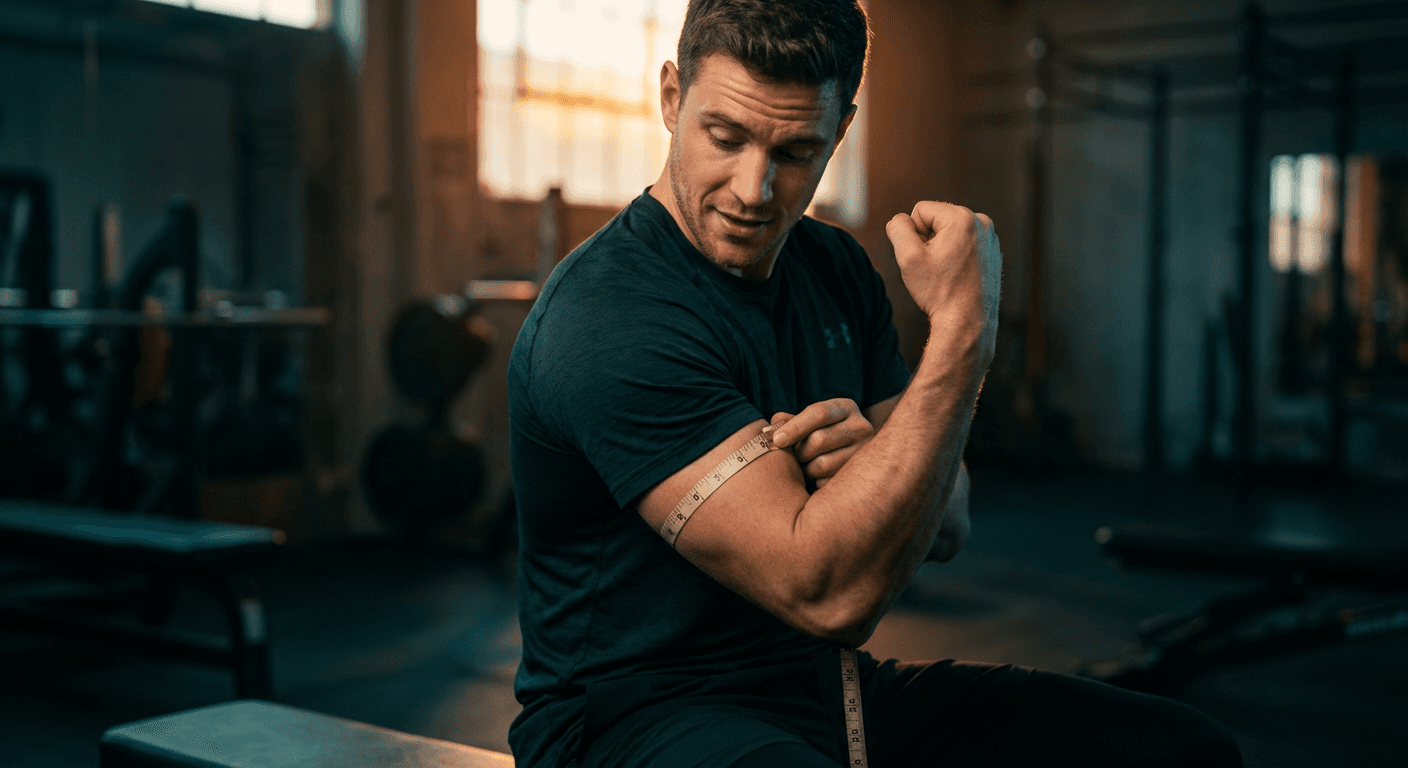
- Bicep — flex your arm at a 90-degree angle with a clenched fist. Wrap the tape around the thickest point of the upper arm, usually at the peak of the bicep. This is your flexed measurement, which is the standard for comparison.
- Chest — stand relaxed with arms at your sides. Wrap the tape around the fullest part of the chest, usually at nipple level. Keep the tape parallel to the floor. Do not puff out your chest or inhale deeply.
- Shoulders — stand relaxed. Have someone wrap the tape around the widest point of your shoulders, passing over the deltoid caps. This is difficult to self-measure accurately.
- Waist — measure at the navel (belly button) while standing relaxed. Do not suck in your stomach. This is different from your pants waist size, which is typically measured lower at the hips.
- Forearm — extend your arm straight out with your fist clenched. Measure the thickest part of the forearm, usually about an inch below the elbow.
- Neck — stand straight and look forward. Measure around the thickest part of the neck, just below the Adam's apple. Keep the tape level.