Cable Only Workout: A Full Body Gym Routine
Cables provide constant tension, are easy on the joints, and can train every muscle in your body. Here is a complete cable-only full body program.
 Jeff·Feb 10, 2026·10 min read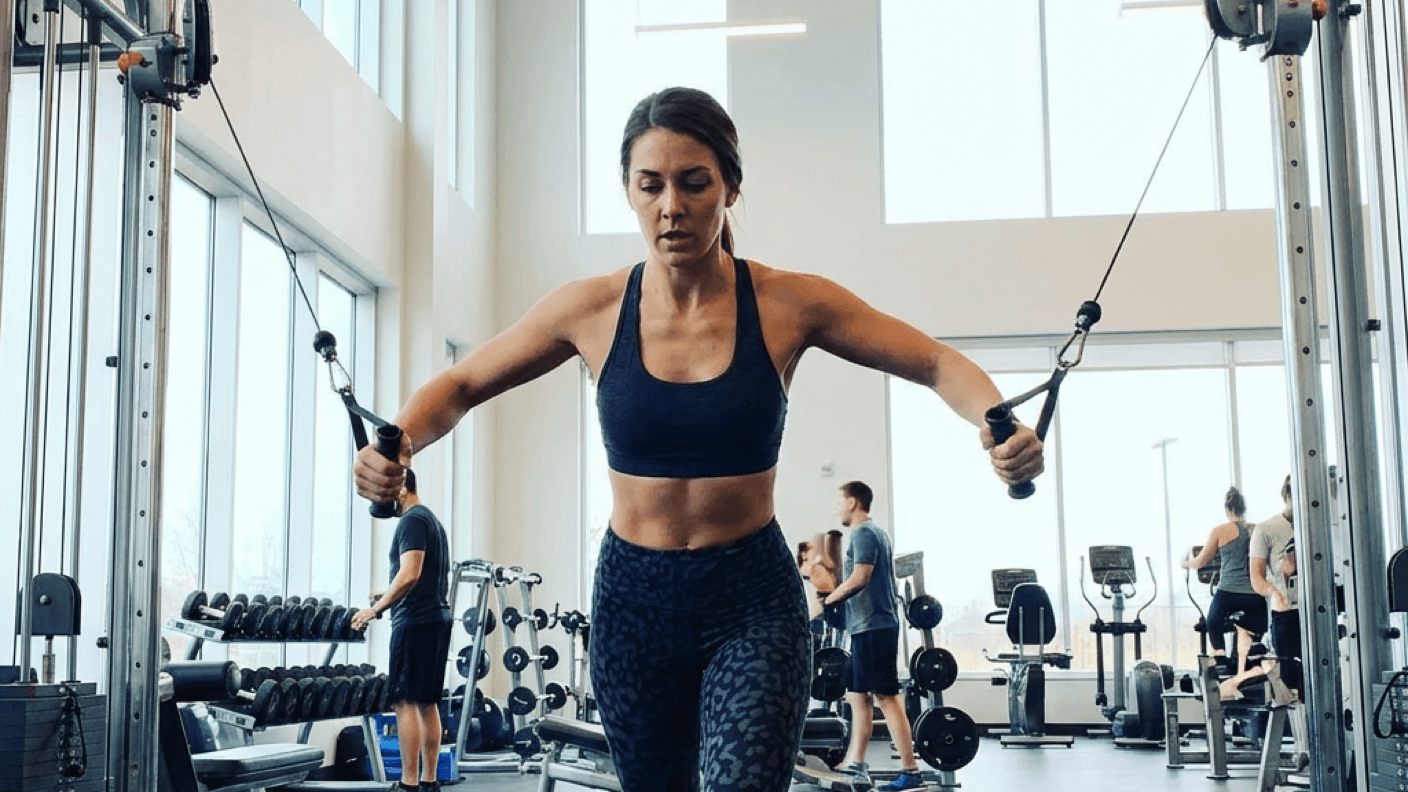
Key Takeaways
- Cables keep tension on your muscles through the entire range of motion, which means more time under tension and better muscle growth compared to free weights that lose tension at certain points.
- Your chest will actually look better after focusing on cables because they hit angles and provide resistance curves that barbells and dumbbells cannot replicate.
- Cable exercises are way easier on your joints than free weights since there's no heavy bar compressing your spine and the resistance curve is smooth.
- If you can't feel your target muscles working with free weights, cables will fix that problem because the constant tension makes it impossible not to feel the muscle engaged.
- You can build just as much muscle with a 60-lb cable press taken to failure as a 200-lb bench press taken to failure since hypertrophy cares more about tension than pure load.
Get This on WhatsApp
Get a quick summary and link sent straight to your WhatsApp.
Send Me This ArticleWhy cables deserve more respect
Walk into any commercial gym and you will see the cable machine sitting in the corner, mostly used for tricep pushdowns and the occasional face pull. Meanwhile, every bench and squat rack is occupied by guys who think free weights are the only legitimate training tool.
Here is the thing: cables are one of the most versatile and effective pieces of equipment in the gym. And they have some real advantages over free weights that most people do not appreciate.
I went through a period about three years ago where an elbow injury made barbell pressing painful. I switched to almost exclusively cable work for about ten weeks while it healed. Expected to lose size. Did not. My chest actually looked better at the end of those ten weeks because cables hit angles and provide resistance curves that dumbbells and barbells simply cannot replicate.
The constant tension advantage
This is the big one. With a dumbbell curl, there is essentially zero tension at the top of the movement (when your forearm is vertical, gravity is pulling straight down through your elbow, not against your bicep). With a cable curl, there is tension throughout the entire range of motion because the cable is pulling at an angle at every point.
This constant tension means more time under load per rep. More time under load means more metabolic stress, more muscle fiber recruitment, and (over time) more growth.
Burd et al. (2012) showed that time under tension is a significant driver of muscle protein synthesis. Cable exercises naturally maximize time under tension without you needing to consciously slow the tempo. You get the benefit automatically.
The flip side is that cables are harder to load as heavily as free weights. You cannot really cable press 300 lbs the way you can bench press 300 lbs. But for hypertrophy (muscle growth), the load matters less than the tension. You can build just as much muscle with a 60-lb cable press taken close to failure as you can with a 200-lb bench press taken close to failure, assuming the muscle is doing the work.
Who should do a cable-only workout
People with joint issues. Cables are significantly easier on the joints than free weights. The smooth resistance curve, the ability to adjust angles, and the lack of a heavy bar compressing your spine make them ideal for lifters with cranky shoulders, elbows, or knees.
People who struggle with the mind-muscle connection. If you have trouble feeling your chest work during bench press (a common problem), try a cable fly. The constant tension makes it almost impossible NOT to feel the target muscle working. Cables teach you what proper muscle engagement feels like.
Gym tourists. If you are traveling and the hotel gym only has a cable stack and some dumbbells, this program lets you get a full body workout in.
Anyone who wants variety. If you have been doing nothing but barbell and dumbbell work for years, a block of cable training is a great way to expose your muscles to a novel stimulus. Novel stimuli drive adaptation.
Full body cable workout: Day A (push emphasis)
This session hits chest, shoulders, and triceps as the primary movers, with some quad and core work mixed in.
| Exercise | Sets | Reps | RPE | Rest |
|---|---|---|---|---|
| Cable chest press (mid height) | 4 | 10-12 | 8-9 | 2 min |
| Cable fly (low to high) | 3 | 12-15 | 9 | 90 sec |
| Cable lateral raise | 4 | 12-15 | 9 | 60 sec |
| Cable overhead tricep extension | 3 | 10-12 | 9 | 90 sec |
| Cable front squat (Zercher hold) | 3 | 12-15 | 8 | 2 min |
| Cable pallof press | 3 | 12-15 each side | 8 | 60 sec |
Total sets: 20
Estimated time: 45-55 minutes
Full body cable workout: Day B (pull emphasis)
Back, biceps, and rear delts are the focus. Hamstrings get some attention through cable pull-throughs.
| Exercise | Sets | Reps | RPE | Rest |
|---|---|---|---|---|
| Cable lat pulldown (wide grip) | 4 | 8-10 | 8-9 | 2 min |
| Cable row (seated, close grip) | 4 | 10-12 | 8-9 | 2 min |
| Cable face pull | 3 | 15-20 | 8-9 | 60 sec |
| Cable rear delt fly | 3 | 12-15 | 9 | 60 sec |
| Cable curl (low pulley) | 3 | 10-12 | 9 | 90 sec |
| Cable pull-through | 3 | 12-15 | 8 | 90 sec |
Total sets: 20
Estimated time: 45-55 minutes
Full body cable workout: Day C (legs and arms)
A combination day that hits the lower body harder and finishes with arm supersets.
| Exercise | Sets | Reps | RPE | Rest |
|---|---|---|---|---|
| Cable Romanian deadlift | 3 | 10-12 | 8-9 | 2 min |
| Cable squat (goblet style) | 3 | 12-15 | 8 | 2 min |
| Cable kickback (glutes) | 3 | 12-15 each leg | 9 | 60 sec |
| Cable leg curl (ankle strap) | 3 | 12-15 each leg | 9 | 60 sec |
| Cable curl (rope) | 3 | 10-12 | 9 | superset |
| Cable pushdown (rope) | 3 | 10-12 | 9 | 90 sec |
| Cable overhead press | 2 | 10-12 | 8 | 90 sec |
Total sets: 20 (plus the supersetted arms)
Estimated time: 50-60 minutes
Exercise technique notes
Cable chest press: Set the pulleys at about chest height. Grab a handle in each hand, step forward into a split stance, and press the handles out in front of you until your arms are fully extended. Squeeze the pecs hard at the end range. This is different from a bench press because the resistance is pulling you backward, not downward. You will feel your chest working through the entire rep.
Cable fly (low to high): Set the pulleys at the lowest position. Grab a handle in each hand, step forward, and sweep the handles up and together in an arc until they meet in front of your upper chest. This is an incline fly without a bench. The angle targets the upper chest, and the cable keeps tension on the pecs even at the top where a dumbbell fly goes slack.
Cable lateral raise: Set the pulley to the lowest position. Stand sideways to the cable, grab the handle with your far hand (the cable crosses in front of your body), and raise your arm to the side until it is parallel with the floor. The cable provides peak tension at the top of the movement, which is where dumbbell lateral raises start to lose tension. This makes cable lateral raises arguably superior to dumbbell lateral raises for delt development.
Cable front squat (Zercher hold): This one takes some creativity. Set the cable low, loop a rope attachment or hold a bar attachment in the crook of your elbows (like a Zercher squat position), and squat. It is not as heavy as a barbell front squat, but the constant cable tension forces your core to work overtime. Great for conditioning and quad endurance.
Cable pull-through: Set the cable low between your legs. Face away from the machine, grab the rope between your legs, and hinge at the hips (like an RDL). Stand up tall by driving your hips forward, squeezing the glutes at the top. This is one of the best glute exercises you can do and nobody does it because it looks awkward. Get over it. Your glutes will thank you.
Cable Romanian deadlift: Set the cable at the lowest position. Face the machine, grab the handle with both hands, and perform an RDL by hinging at the hips. The cable is pulling you forward, which means your posterior chain has to fight harder to maintain position throughout the rep. The tension at the bottom (stretched position) is significantly higher than with a dumbbell RDL, where gravity provides less challenge at full hip flexion.
Programming and weekly schedule
Run the three workouts across the week with at least one rest day between sessions:
| Day | Session |
|---|---|
| Monday | Day A (push emphasis) |
| Wednesday | Day B (pull emphasis) |
| Friday | Day C (legs and arms) |
Every muscle gets hit at least once per week directly, and the bigger muscles (chest, back, legs) get indirect work from the other sessions. If you want to bump frequency to four days, repeat Day A on Saturday or alternate weeks where you run A-B-C-A then B-C-A-B.
Progression on cables
Cable machines have fixed weight increments, usually in 5 or 10-lb jumps depending on the machine. This makes micro-loading harder than with free weights.
Here is how to handle it:
Option 1: Rep progression first. Pick a weight where you can hit the bottom of the rep range. Each session, try to add 1-2 reps per set. When you can hit the top of the range on all sets, move the pin up one increment.
Option 2: Tempo manipulation. Before adding weight, slow the eccentric to 3-4 seconds. This increases time under tension at the same load. Once you can do 3-4 second eccentrics for all prescribed reps, speed the tempo back to normal and add weight.
Option 3: Add sets. If the jump between weight increments is too big (10 lb jumps are common), add a set at the current weight. Go from 3x12 to 4x12, then when you move up in weight, drop back to 3x10 and work up from there.
Cable progression is slower than barbell progression. Accept it. You are not chasing 1RM records on cables. You are chasing muscle growth through tension and volume. If your cable chest press goes from 40 lbs to 60 lbs over the course of three months, that is solid, meaningful progress.
Limitations and when to mix in free weights
I want to be honest about what cables cannot do:
Heavy compound loading. You cannot squat 300+ or deadlift 400+ on cables. If maximal strength is your goal, you need barbells. Cables are a hypertrophy tool, not a strength tool.
True squat and hip hinge patterns. Cable squats and cable RDLs are decent but they do not replicate the feel and loading pattern of a barbell squat or conventional deadlift. The resistance vector is different (horizontal vs. vertical) and the stability demands are lower.
Progressive overload with small increments. Most cable stacks jump in 5-10 lb increments. Barbells let you go up 2.5 lbs at a time.
If you are using this as your primary program for a training block (8-12 weeks), it will work great for building muscle, improving work capacity, and giving your joints a break from heavy free weights. After that block, I would suggest transitioning back to a program that includes barbell compounds for strength development, using cables as your primary accessory and isolation tool.
The ideal long-term approach is a combination: barbell compounds for the main lifts, cable work for accessories and isolation. But if you need or want a period of cable-only training, this program covers all your bases.
Frequently Asked Questions
- Can you build muscle with cables only?
- Yes. Cables provide constant tension through the entire range of motion, which free weights do not. You will not build maximal strength the same way as barbell training, but for hypertrophy, cables are genuinely excellent and underrated.
- Are cable machines good for beginners?
- They are actually great for beginners because the fixed path and constant tension make it easier to feel the target muscle working. There is less technique to learn compared to barbell lifts, and the injury risk is much lower. A solid option if free weights feel intimidating at first.
- What muscles can you train with cables?
- Every single one. Cable chest press, rows, pulldowns, curls, tricep pushdowns, lateral raises, face pulls, cable squats, Romanian deadlifts, and woodchops. A single cable stack is genuinely one of the most versatile pieces of equipment in any gym.
- Are cables better than free weights?
- Neither is universally better. Free weights are superior for building raw strength on compound lifts. Cables are better for isolation work, maintaining tension at peak contraction, and training at odd angles. The smartest lifters use both.