🏋️
1RM Calculator
Estimate your one-rep max from any weight and rep count using the Epley formula
Strength

kg
reps
What This Calculator Measures
The one-rep max (1RM) is the maximum amount of weight you can lift for a single repetition with proper form. It is the gold standard for measuring absolute strength and is used by coaches and athletes worldwide to program training loads.
How It Works
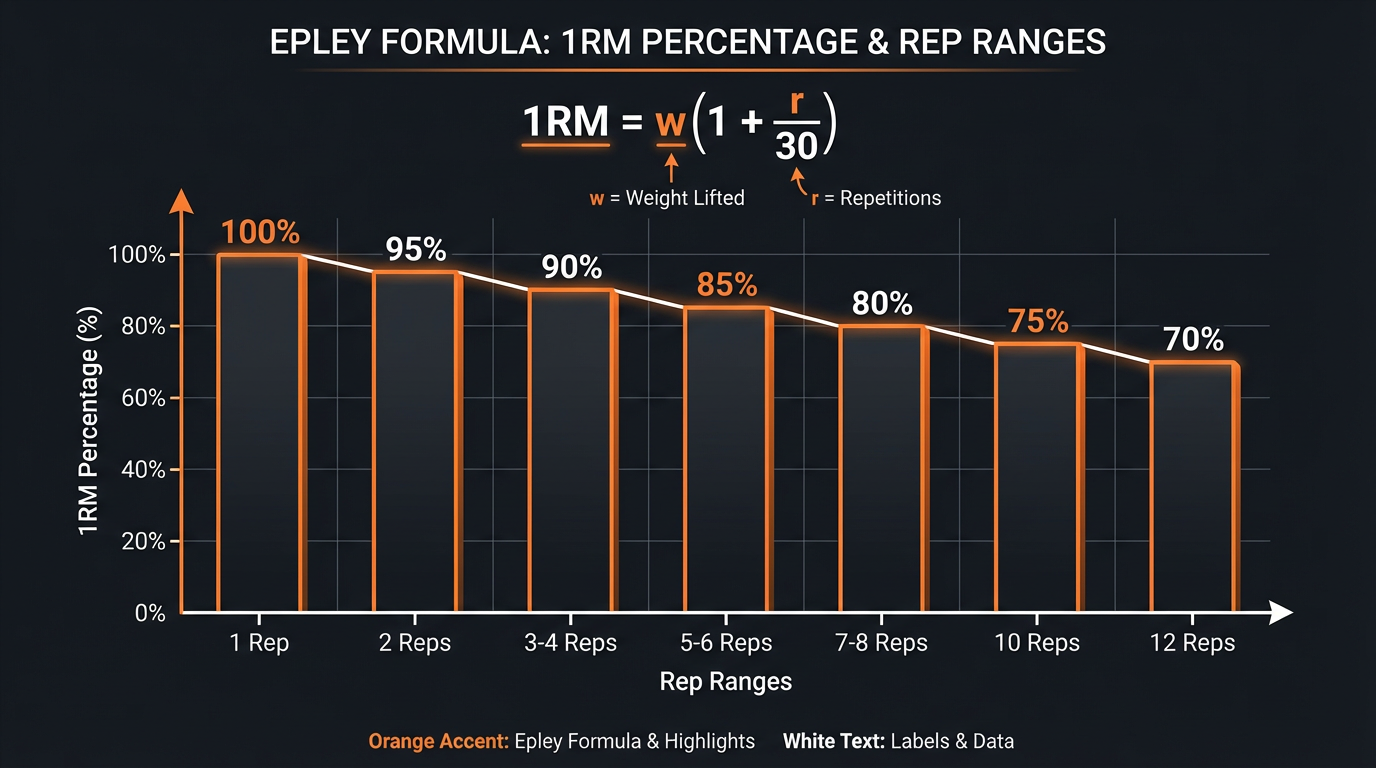
This calculator uses the **Epley formula**, one of the most widely validated 1RM prediction equations:
**1RM = Weight x (1 + Reps / 30)**
For example, if you bench press 100 kg for 5 reps, your estimated 1RM is 100 x (1 + 5/30) = **117 kg**.
The formula is most accurate when reps are between 1 and 10. Above 10 reps, predictions become less reliable because muscular endurance begins to influence the outcome more than raw strength.
| Percentage of 1RM | Typical Rep Range | Training Effect |
|---|---|---|
| 90-100% | 1-3 reps | Maximal strength |
| 75-85% | 4-8 reps | Strength and hypertrophy |
| 65-75% | 8-12 reps | Hypertrophy |
| 50-65% | 12-20 reps | Muscular endurance |
Limitations
•Accuracy decreases with higher rep counts (above 10 reps).
•The formula assumes reps are performed to or near failure. If you had 3 reps left in reserve, the result will underestimate your true 1RM.
•Different exercises may follow slightly different strength curves. The Epley formula works best for compound barbell movements like squat, bench press, and deadlift.
•Individual variation in muscle fiber composition means no formula is perfectly accurate for everyone. Use the estimate as a starting point and adjust based on experience.
Frequently Asked Questions
- How accurate is a 1RM calculator?
- Within about 5-10% for sets of 2-5 reps. The fewer reps you use to estimate, the more accurate it gets. A calculated 1RM from a 3-rep set is more reliable than one from a 10-rep set. For programming purposes, it's accurate enough.
- Should I actually test my one-rep max in the gym?
- Not unless you're a competitive powerlifter. Calculated estimates are safer and close enough for programming percentages. True 1RM testing has injury risk and requires a spotter, proper warm-up protocol, and peaking.
- What is the Epley formula?
- It's the most common 1RM estimation formula: Weight x (1 + Reps/30). You enter the weight you lifted and how many reps you got, and it predicts what you could lift for a single rep. It works best for rep ranges between 2-10.
- Why do I need to know my one-rep max?
- Most strength programs prescribe weights as percentages of your 1RM -- like "squat 75% of your 1RM for 5 sets of 5." Without knowing your 1RM, you can't follow percentage-based programs accurately.
- How often should I recalculate my 1RM?
- Every 4-6 weeks, or whenever you hit a new rep PR. If you benched 185 for 5 last month and now you got 185 for 7, your estimated 1RM went up. Recalculate and adjust your training weights accordingly.