Chest Workout at Home: No Bench Needed
You do not need a bench or a gym to build a solid chest. This bodyweight and minimal-equipment workout will prove it.
 Jeff·Feb 10, 2026·9 min read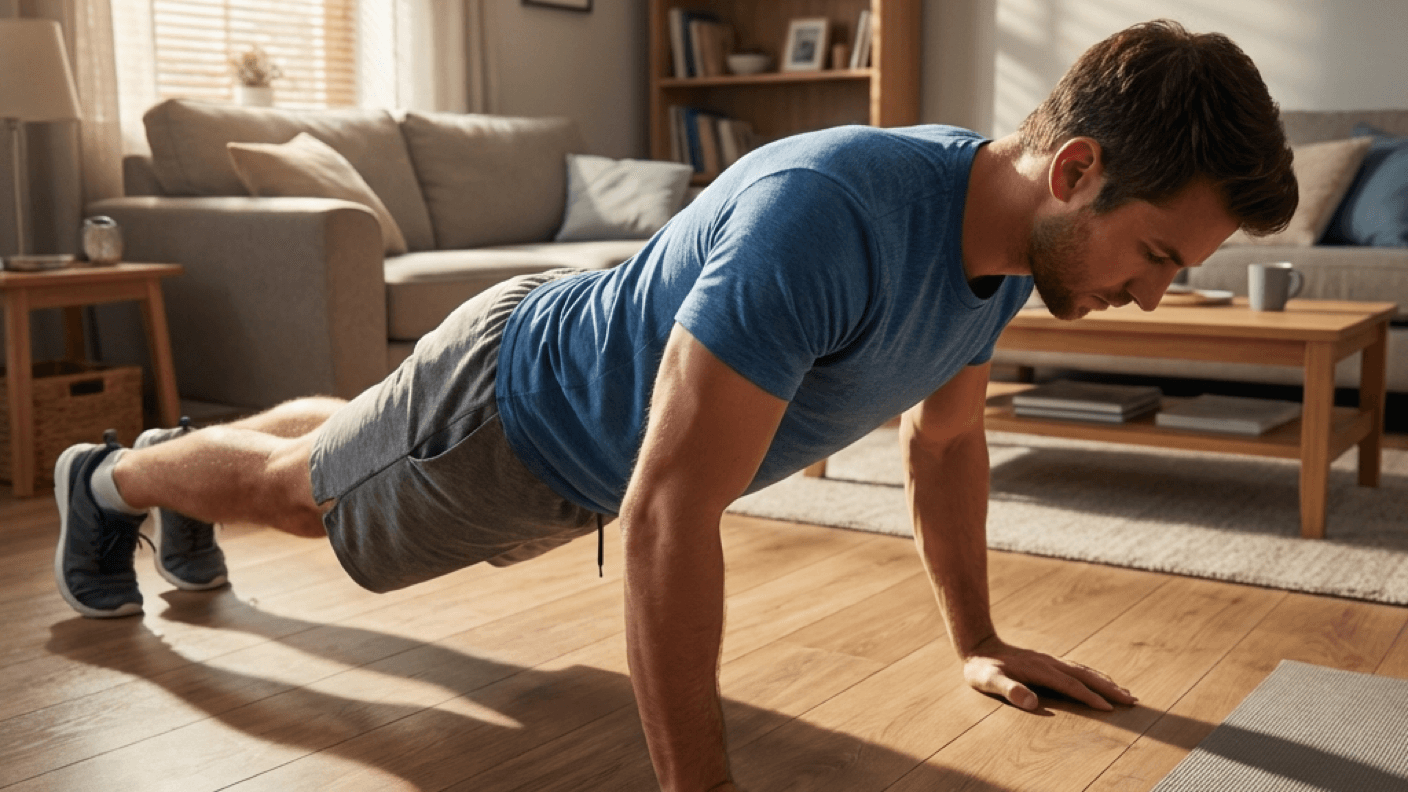
Key Takeaways
- You can absolutely build a solid chest at home with just push-ups and their variations if you focus on making them progressively harder instead of just doing more easy reps.
- A guy who can bang out 15 perfect deficit push-ups with a 40-pound backpack and slow tempo is legitimately stronger than most dudes benching at commercial gyms.
- Elevate your feet during push-ups to hit the upper chest harder, and add weight with a loaded backpack or resistance bands wrapped around your back.
- The key is treating push-ups like a serious lift by adding pause reps, deficit range of motion, and external load rather than cranking out high-rep sets with bodyweight only.
- If you can grab some adjustable dumbbells, you unlock floor presses and floor flies which fill the gaps that push-up variations leave behind.
Get This on WhatsApp
Get a quick summary and link sent straight to your WhatsApp.
Send Me This ArticleCan you actually build a chest at home?
Look, I am not going to pretend that home training is equal to a fully equipped gym. It is not. A gym gives you barbells, cables, dumbbells, and machines that provide resistance curves and loading options you simply cannot replicate at home with nothing but the floor.
But can you build a decent chest at home? Absolutely. Especially if you are a beginner or early intermediate. The push-up and its variations can take your chest further than most people realize, and if you add a pair of dumbbells or some resistance bands, you can go even further.
I trained exclusively at home during 2020 like everyone else. No bench, no barbell. Just a pair of adjustable dumbbells, some bands, and the floor. My chest did not shrink. It actually filled out a bit because I was forced to get creative with angles and rep ranges instead of defaulting to flat bench press three times a week.
The key is progressive overload. You need to make the exercises harder over time, not just do more reps of easy push-ups. I will show you how.
The push-up is not a beginner exercise
Somewhere along the way, the fitness industry decided that push-ups are for beginners and bench press is for serious lifters. That is backwards.
A properly executed push-up (full range of motion, controlled tempo, scapulae protracted at the top) is a legitimate chest builder. Calatayud et al. (2015) found that push-ups performed with similar load (using a resistance band to match the bench press weight) produced equivalent pec activation to the bench press. The issue with push-ups is not effectiveness. It is load management. Once you can do 30+ push-ups, your body weight is not challenging enough to drive growth, and you need to make the exercise harder.
Here is how:
- •Elevate your feet (puts more load on the upper chest)
- •Add a pause at the bottom (increases time under tension)
- •Wear a weighted vest or backpack
- •Use a band across your back
- •Slow the tempo (3-4 seconds down, 2 seconds up)
- •Reduce your base of support (deficit push-ups with hands on dumbbells or books)
A guy who can do 15 perfect deficit push-ups with a 40-lb backpack and a 3-second eccentric is strong. Genuinely strong. That is the equivalent of benching your bodyweight plus 40 lbs for reps, which is more than most commercial gym regulars can do.
Equipment that helps (but is not required)
Resistance bands (recommended): A set of loop bands costs about 20 bucks. Wrap one across your back and hold the ends in your hands during push-ups for added resistance. You can also use them for standing chest flyes by anchoring them to a door frame.
A pair of dumbbells (ideal): If you have even one pair of adjustable dumbbells, your options expand dramatically. Floor presses, floor flyes, and squeeze presses become available. These fill in the gaps that push-up variations leave.
A backpack: Seriously. Fill a backpack with books, canned goods, or water bottles. Wear it while doing push-ups. It is ugly but it works. A heavy backpack adds 20-40 lbs of resistance for free.
Push-up handles or parallettes: These increase the range of motion by letting your chest sink below your hand level. Deeper range of motion means more stretch on the pecs, which means more growth stimulus.
The no-bench chest workout
Tier 1: Heavy push-up variation (strength focus)
| Exercise | Sets | Reps | RPE | Rest |
|---|---|---|---|---|
| Weighted/banded push-up (feet elevated) | 4 | 8-12 | 8-9 | 2 min |
Tier 2: Mid-range work
| Exercise | Sets | Reps | RPE | Rest |
|---|---|---|---|---|
| Deficit push-up (hands on handles or books) | 3 | 10-15 | 8-9 | 90 sec |
| Dumbbell floor press (if you have dumbbells) | 3 | 10-12 | 8-9 | 90 sec |
Tier 3: Isolation and stretch
| Exercise | Sets | Reps | RPE | Rest |
|---|---|---|---|---|
| Dumbbell floor fly (or banded chest fly) | 3 | 12-15 | 9 | 60-90 sec |
| Svend press (plate or dumbbell squeeze press) | 2 | 15-20 | 9 | 60 sec |
Tier 4: Burnout
| Exercise | Sets | Reps | RPE | Rest |
|---|---|---|---|---|
| Standard push-up to failure | 2 | Max | 10 | 60 sec |
Total sets: 17
Estimated time: 35-45 minutes
If you do not have dumbbells, replace the floor press with another push-up variation (diamond push-ups target the inner chest and triceps) and replace the floor fly with banded chest flies or archer push-ups.
Exercise technique guide
Weighted push-up with feet elevated: Place your feet on a sturdy surface (couch, chair, step) about 12-18 inches high. Wear your loaded backpack or drape a band across your upper back. Hands slightly wider than shoulder width, fingers pointing forward. Lower your chest to the floor (full range of motion), pause for a beat, then press back up. Protract your shoulder blades at the top (push your upper back toward the ceiling). This engages the serratus anterior and maximizes pec contraction at the top.
The foot elevation shifts the angle to emphasize the upper chest, similar to an incline bench press. The higher the elevation, the more shoulder-dominant the movement becomes. Twelve to eighteen inches is the sweet spot for upper chest focus without turning it into a pike press.
Deficit push-up: Place your hands on push-up handles, dumbbells, or thick books. The elevation lets your chest sink lower than your hand level, increasing the stretch on the pecs at the bottom. Think of it like a deep bench press without the bench. Go as deep as your shoulder mobility allows without pain.
Dumbbell floor press: Lie on the floor with your knees bent and feet flat. Hold a dumbbell in each hand at chest level. Press straight up, squeeze the pecs at the top, then lower until your upper arms touch the floor. Pause for a full second on the floor (this eliminates the stretch reflex and makes every rep harder) then press back up.
The floor press has a shorter range of motion than a bench press because the floor stops your elbows. But that pause on the floor makes each rep honestly harder than a lot of bench pressing I see in commercial gyms where guys bounce the bar off their chest.
Dumbbell floor fly: Same starting position as the floor press. Arms extended above your chest with a slight bend at the elbows. Lower the dumbbells out to the sides in a wide arc until your upper arms touch the floor. Pause, then squeeze the dumbbells back up along the same arc. Light weight here. This is about the stretch and contraction, not the load.
Svend press: Hold a dumbbell (or a weight plate) between your palms at chest level. Press it straight out in front of you while actively squeezing your palms together the entire time. Squeeze hard at full extension, then bring it back to your chest. This constant inward force is an isometric adduction of the arms, which is exactly what the pecs do. It looks easy. It is not.
Push-up to failure: Standard push-ups, perfect form, until you cannot do another rep. These are your finisher. You are chasing total volume and a pump here. Do not worry about hitting a specific number. Just go until your chest says no.
Progressing beyond bodyweight
The biggest challenge with home chest training is progression. In a gym, you add 5 lbs to the bar. At home, you need to be more creative.
Week 1-4: Establish your baseline. Pick weights and variations that let you hit the middle of the rep ranges. Focus on form.
Week 5-8: Start adding load. More weight in the backpack (add 5 lbs per week), a thicker band, heavier dumbbells. If you hit the top of the rep range on all sets, the exercise is too easy.
Week 9-12: Add volume. Go from 3 to 4 sets on the main push-up variation. Add a set to the floor press or fly. Keep the total session under 50 minutes.
Beyond week 12: Cycle through different push-up variations to keep the stimulus fresh. Spend 4 weeks emphasizing deficit push-ups, then 4 weeks emphasizing weighted push-ups with feet flat, then 4 weeks with feet elevated. Each variation stresses the chest slightly differently and prevents staleness.
If you hit a point where you can do every push-up variation with a 50-lb backpack for sets of 15, honestly, you have outgrown home training. Time to join a gym. But that is a great problem to have, and it will take most people a year or more to get there.
Sample weekly schedule
Run this workout twice per week with at least 48 hours between sessions. Pair it with a pull workout (rows, curls) and a lower body workout for a complete home training program.
| Day | Workout |
|---|---|
| Monday | Chest (this workout) |
| Tuesday | Lower body |
| Wednesday | Rest |
| Thursday | Chest (this workout) |
| Friday | Pull (back and biceps) |
| Saturday | Lower body |
| Sunday | Rest |
On the second chest day, consider swapping some exercises for variety. If you did weighted elevated push-ups on Monday, do deficit push-ups as your main movement on Thursday. If you did floor presses on Monday, do squeeze presses on Thursday. Same muscles, different stimulus.
When to switch to the gym
Home chest training has a ceiling. For beginners and early intermediates, that ceiling is pretty high. You can build a genuinely solid chest with push-ups, floor presses, and bands for a year or more. But eventually you will want:
- •A bench for full range of motion pressing
- •Cable machines for chest flies with constant tension
- •Barbells for heavier progressive overload
- •Incline and decline angles
There is no specific strength level where you "must" switch. But if your chest development has stalled, you have maxed out your available loading at home, and you want to keep growing, the gym is the next step. Think of home training as building the foundation. The gym is where you refine and maximize. Both are valuable. Neither is wasted effort.
Frequently Asked Questions
- Can you build a big chest without a bench?
- You can build a solid, defined chest with push-up variations and dips, but there is a ceiling. Weighted dips and progressed push-ups will get you far, but eventually you need some form of progressive resistance. A pair of dumbbells and a floor press can close the gap significantly.
- What push-up variations build chest the best?
- Wide-grip push-ups, decline push-ups with feet elevated, and archer push-ups target the chest more than standard push-ups. The key is slowing down the tempo and focusing on a deep stretch at the bottom. If regular push-ups are easy, elevate your feet or add a backpack with weight.
- How many push-ups should I do to build chest muscle?
- Focus on sets and reps in the 8-15 range with a harder variation rather than doing 50 easy push-ups. Once you can do 15 clean reps of a variation, progress to a harder one. High-rep push-ups build endurance, not size.
- Are dips better than push-ups for chest?
- Dips load the chest with more resistance since you are moving your full body weight through a larger range of motion. If you can do dips with good form and no shoulder pain, they should be your primary chest builder at home. Push-ups are the backup, not the other way around.