How Push-Ups Transform Your Body: Before and After Results
What actually happens to your chest, arms, and shoulders after 30 days of push-ups? Here are the realistic results, backed by research.
 Jeff·Aug 20, 2024·12 min read
Key Takeaways
- Push-ups build your chest and triceps the most, with hand width changing which muscles get hit harder.
- Research shows push-ups can grow muscle as effectively as bench press when made challenging enough through added resistance or harder variations.
- You'll see real changes in chest firmness after 30 days and visible muscle development after 60-90 days of consistent training.
- Most push-up challenges fail because they ramp up volume too fast without rest days or movement variation.
- Train push-ups 4 days per week instead of daily, focus on perfect form over high reps, and add harder variations when standard ones get easy.
Get This on WhatsApp
Get a quick summary and link sent straight to your WhatsApp.
Send Me This ArticleI've been doing push-ups for about 15 years now. Not every single day, obviously. But they've been a staple in my training for long enough that I have a pretty clear picture of what they can and can't do for your body. And honestly, most of the "push-up before and after" content online is either wildly exaggerated or just made up.
So let me give you the real version. What actually changes when you commit to push-ups, what the research supports, and a plan that builds real strength without burning you out by day 12.
What push-ups actually do to your muscles
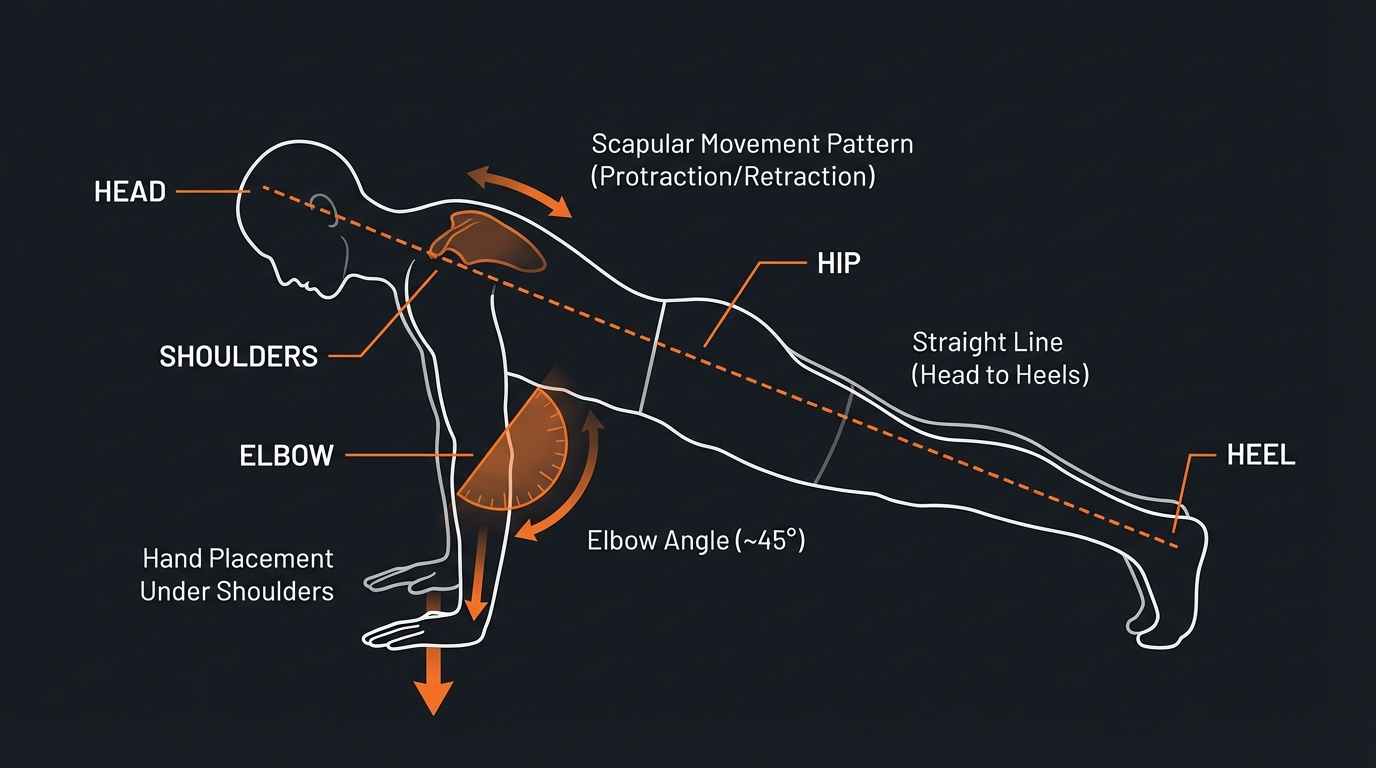
A push-up is a horizontal pressing movement. The primary movers are your pectoralis major (chest), anterior deltoids (front of your shoulders), and triceps. Your core works isometrically the entire time to keep your body rigid, which is why push-ups are genuinely useful for midsection stability even though they're not an "ab exercise."
The muscles that get the most growth stimulus from standard push-ups are your chest and triceps. Your shoulders contribute, but they're not the limiting factor for most people. If your shoulders burn out before your chest during push-ups, your hand placement is probably too wide or too far forward.
Here's something a lot of people miss: hand width changes muscle emphasis significantly. A narrower hand position (hands under your shoulders or closer) shifts more work to the triceps. A wider grip hits more chest. This isn't a minor difference. It matters for how you program your training, and I'll get into that in the 30-day plan below.
What the research says about push-up gains
There are two studies I reference constantly when talking about push-ups, because they actually measured the outcomes that matter.
Kikuchi & Nakazato (2017) published a study in the Journal of Strength and Conditioning Research that put participants through a push-up training program and measured muscle thickness changes via ultrasound. After just 4 weeks of training, subjects showed significant increases in pec and triceps thickness. Four weeks. That's not a long time. The takeaway here is that push-ups do cause real, measurable hypertrophy, even in people who aren't beginners.
Calatayud et al. (2015) compared push-ups to the bench press and found something that surprised a lot of gym bros: when the load is equated (meaning the push-up is made heavy enough to match the bench press intensity), muscle activation in the chest and triceps is essentially the same. They used elastic bands to add resistance to push-ups and matched it to 6RM bench press loads. The EMG readings were comparable.
What does that mean practically? It means push-ups aren't a "lesser" exercise. If you can make them hard enough, they build muscle as effectively as the bench press. The catch is that word "if." For a 200-pound guy, a standard push-up loads roughly 64% of body weight through the hands, so about 128 pounds. That's a decent stimulus for a while, but eventually you need to add difficulty. More on that later.
There's also a 2019 study by Kotarsky et al. in the Journal of Exercise Science & Fitness that showed push-up training programs over 6-8 weeks produced measurable strength gains in untrained and moderately trained individuals. Nothing shocking there, but it confirms that progressive push-up work does what you'd expect it to do.
Realistic before and after: what to expect at 30, 60, and 90 days
I want to be honest with you about timelines, because the "100 push-ups a day for 30 days" YouTube thumbnails have warped expectations pretty badly.
After 30 days of consistent, progressive push-up training (3-4 sessions per week), here's what's realistic:
- •Your max set goes up noticeably. If you started at 10-15 reps, you might be hitting 25-30.
- •Your chest and triceps feel firmer. Not visually dramatic, but you can feel the difference when you flex.
- •Soreness is basically gone. Your body has adapted to the movement pattern.
- •You're starting to feel bored with standard push-ups. This is actually a good sign.
After 60 days, assuming you've been adding volume and introducing harder variations:
- •Visible changes in your chest, especially the outer pec near the armpit. This is usually the first area where you can see a difference.
- •Triceps have more shape to them, particularly the lateral head.
- •Your shoulders look a bit more capped from the front.
- •Friends and family probably haven't noticed yet. Sorry.
After 90 days, if you've been training properly with progressive overload:
- •Noticeable chest development that's visible in a t-shirt for most guys.
- •Clear triceps definition, especially if your body fat isn't too high.
- •Improved posture from stronger chest and core musculature.
- •You can probably do 40-50+ consecutive push-ups with good form.
The reality is that push-ups alone won't give you a magazine-cover physique. They'll build a solid upper body foundation and genuine functional strength. That's worth a lot. But if your expectations are shaped by those before/after photos that conveniently don't mention the lighting changes, pump, and tanning, you'll be disappointed.
Why most push-up challenges fail
The typical "30-day push-up challenge" you find on Pinterest goes something like this: Day 1 do 10, Day 2 do 12, Day 3 do 14, all the way up to Day 30 where you're somehow doing 100. These programs have a few problems.
They increase volume too fast. Adding reps every single day doesn't give your connective tissue time to adapt. Your muscles recover faster than your tendons and ligaments. By week 2, a lot of people develop wrist pain or shoulder irritation.
They don't include any variation. Doing the exact same movement pattern 30 days straight is a recipe for overuse injuries. Your wrists, elbows, and shoulders need variety in angles and grips.
They treat every day like a training day. Rest days aren't weakness. Your muscles grow during recovery, not during the workout itself. A program that has you doing push-ups 7 days a week is ignoring basic exercise physiology.
They focus on total reps instead of quality. Grinding out 80 sloppy push-ups teaches your body to do push-ups with bad form. You end up sagging your hips, flaring your elbows at 90 degrees, and doing half reps. None of that builds the muscle you're after.
A 30-day push-up plan that actually works
This plan trains push-ups 4 days per week with 3 rest days. Each week has a specific focus, and the progression is built on adding sets, harder variations, and controlled tempo rather than just cramming in more reps of the same thing.
Before you start: Do a max set of push-ups with good form. Full range of motion, chest to the floor (or within an inch), elbows at about 45 degrees, no hip sag. Write that number down. We'll test again at the end.
Week 1: Building the pattern (4 sessions)
The goal this week is to accumulate volume with clean reps. Don't go to failure on any set.
- •Session 1: 4 sets of 60% of your max, 90 seconds rest. Standard push-ups.
- •Session 2: 4 sets of 60% of your max, 90 seconds rest. Hands slightly narrower than normal.
- •Session 3: 5 sets of 50% of your max, 60 seconds rest. Standard push-ups. Shorter rest, more sets.
- •Session 4: 3 sets to 2 reps shy of failure. Standard push-ups. This is your benchmark session.
If your max is 20, you're doing sets of 12 on sessions 1 and 2, sets of 10 on session 3, and sets to about 18 on session 4. Adjust accordingly.
Week 2: Adding volume (4 sessions)
- •Session 1: 5 sets of 65% of your max, 90 seconds rest. Standard push-ups.
- •Session 2: 5 sets of 8-10 reps, 90 seconds rest. Close-grip push-ups (hands directly under shoulders).
- •Session 3: 6 sets of 50% of your max, 60 seconds rest. Standard push-ups.
- •Session 4: 3 sets to 1 rep shy of failure. Standard push-ups. Compare to last week.
Week 3: Introducing harder variations (4 sessions)
- •Session 1: 4 sets of 70% of your max, 90 seconds rest. Standard push-ups.
- •Session 2: 4 sets of 6-10 reps. Feet-elevated push-ups (feet on a chair or bench, roughly 12-18 inches high). These shift more load to your upper chest and shoulders.
- •Session 3: 4 sets of 8-10 reps. Close-grip push-ups with a 3-second lowering phase. Slow eccentrics are brutal and very effective for growth.
- •Session 4: 2 sets to failure with standard push-ups, then 2 sets to failure with close-grip push-ups. Full send.
Week 4: Peak and test (4 sessions)
- •Session 1: 5 sets of 70% of your max, 75 seconds rest. Standard push-ups.
- •Session 2: 3 sets of feet-elevated push-ups, 3 sets of close-grip push-ups. 6-10 reps each, 90 seconds rest.
- •Session 3: Light session. 3 sets of 50% of your max. Easy effort. This is a deload before your test.
- •Session 4: Max set test. Same rules as day 1. Full range of motion, good form, count every rep.
Most people see a 30-50% increase in their max set following this program. If you started at 20, hitting 28-30 is realistic. If you started at 40, getting to 52-55 is reasonable.
Push-up variations worth your time
Not all push-up variations are created equal. Some are legitimate training tools. Others are Instagram tricks that don't build much of anything. Here are the ones I think are actually useful:
Close-grip push-ups: Hands directly under your shoulders or slightly narrower. Hammers the triceps. Probably the single best push-up variation for arm size.
Feet-elevated push-ups: Feet on a bench, step, or chair. Increases the percentage of bodyweight on your hands and shifts emphasis to the upper chest and front delts. The higher the surface, the harder the movement.
Deficit push-ups: Hands on raised surfaces (push-up handles, dumbbells, or even books) so your chest can drop below your hands. Increases range of motion, which increases the stretch on the pec. More range of motion generally means more muscle growth.
Tempo push-ups: Standard push-ups with a 3-4 second lowering phase. Increases time under tension without needing any equipment. Humbling even for experienced lifters.
Band-resisted push-ups: Loop a resistance band across your back and hold the ends under your hands. This is the closest you can get to replicating heavy bench press loading with a push-up, and it's what Calatayud et al. used in their 2015 study to match bench press muscle activation.
Variations I'd skip: clap push-ups (high injury risk for the wrists, minimal extra muscle stimulus), Superman push-ups (looks cool, builds nothing), and single-arm push-ups (requires so much core rotation that it stops being a good chest exercise for most people).
What push-ups won't do
I think it's important to be upfront about the limitations.
Push-ups won't build your back. They're a pressing movement. You need pulling movements (rows, pull-ups, band pull-aparts) for a balanced upper body. Doing only push-ups will eventually create a muscular imbalance that rounds your shoulders forward.
Push-ups alone won't get you lean. Fat loss comes from a caloric deficit. Push-ups burn maybe 7-10 calories per minute depending on your weight and intensity. That's not nothing, but it's not going to overcome a bad diet.
Push-ups won't build big legs. Obviously. But I mention it because some push-up challenge programs imply that push-ups are a "full body" exercise. They work your core, sure. Your legs? Barely. Your quads and glutes are just stabilizing.
Standard push-ups will eventually stop being enough. If you weigh 180 pounds, a standard push-up loads about 115 pounds through your hands. That's good for a while. But after a few months of training, you'll need added resistance or harder variations to keep progressing. This is just how progressive overload works.
FAQ
How many push-ups should I do per day?
There's no magic number. What matters is weekly volume and progressive overload. For most people, 60-120 total push-ups spread across 3-4 sessions per week is a solid range for building muscle. Doing 200 push-ups every day is mostly training your endurance, not your size.
Can I build a bigger chest with just push-ups?
Yes, up to a point. If you're going from zero training to consistent push-up work, you'll see real chest growth for the first 3-6 months. After that, you'll likely need to add resistance (bands, a weighted vest, or harder variations) to keep the stimulus high enough for continued hypertrophy.
Will doing push-ups every day hurt my shoulders?
It can. Your rotator cuff and shoulder joint need recovery time. Training push-ups 4 days per week with rest days in between is safer and honestly more effective than daily training. If you do insist on daily push-ups, keep the volume low and vary your hand position.
I can only do 5 push-ups. Where do I start?
Start with incline push-ups. Hands on a counter, desk, or bench. This reduces the load on your hands to well below 64% of bodyweight. Work up to 3 sets of 15 at a given height, then lower the surface. Kitchen counter to desk to bench to floor. This is a much better progression than knee push-ups because it keeps the same body position as a full push-up.
Do push-ups work your abs?
They work your abs isometrically, meaning your core is bracing to keep your body straight but it's not going through a range of motion. Push-ups are decent for core stability, but they're not a replacement for direct ab training if visible abs are your goal. Planks are doing roughly the same thing for your core that push-ups are.
How fast will I see visible results?
Honestly? Most people notice changes in how their muscles feel (firmer, more pumped after training) within 2-3 weeks. Visible changes that other people notice usually take 8-12 weeks of consistent training, and that timeline depends heavily on your body fat percentage. Muscle can be growing underneath but invisible if there's a layer of fat over it.
Frequently Asked Questions
- What results can you expect from doing push-ups every day for 30 days?
- Most people see noticeably more defined chest, shoulders, and triceps after 30 days. You'll likely double your max reps and develop better posture. Don't expect dramatic size gains though, push-ups alone won't build a massive chest without adding resistance over time.
- Do push-ups actually change your chest shape?
- Push-ups build the pectoralis major, which adds thickness and definition to your chest. They won't change your genetic chest shape or insertion points, but they'll fill out what you have. Incline and decline variations can emphasize the upper or lower chest for more balanced development.
- How many push-ups a day to see a visible difference?
- Aim for a total of 50-100 push-ups per day spread across 4-5 sets. Quality matters more than quantity, so don't sacrifice form to hit bigger numbers. Most visible changes happen around the 3-4 week mark if you're consistent.
- Will push-ups get rid of man boobs?
- Push-ups build chest muscle underneath the fat, which can improve the appearance, but they won't directly burn chest fat. You need a calorie deficit to lose fat. Combining push-ups with a proper diet is the real fix for man boobs.