How to Deload: When to Back Off and Why It Makes You Stronger
Deloading is not laziness. A planned recovery week every 4-6 weeks dissipates fatigue while preserving fitness, setting you up for bigger PRs when you return.
 Jeff·Feb 19, 2026·8 min read
Key Takeaways
- A deload is a planned week of reduced training stress, not a week off
- The fitness-fatigue model explains why you hit PRs after backing off
- Schedule deloads every 4-6 weeks or when multiple fatigue signs appear
- Cut volume OR intensity by 40-50%, but keep showing up and moving
- Don't replace lifting with extra cardio or cut calories during a deload
Get This on WhatsApp
Get a quick summary and link sent straight to your WhatsApp.
Send Me This ArticleWhat a Deload Actually Is (and Isn't)
A deload is a planned period of reduced training stress, typically lasting one week. You lower the weight, the volume, or both. You still train. You just stop pushing into that red zone.
It's not a week off. It's not "taking it easy because you feel tired." It's a deliberate programming tool that every serious strength coach uses for a simple reason: your body can't push hard indefinitely. It needs structured periods where accumulated fatigue can dissipate while your fitness level holds steady.
Think of it like sleep. You don't sleep because you're weak. You sleep because that's when your body actually consolidates the adaptations you forced during the day. A deload works the same way for your training.
The Fitness-Fatigue Model
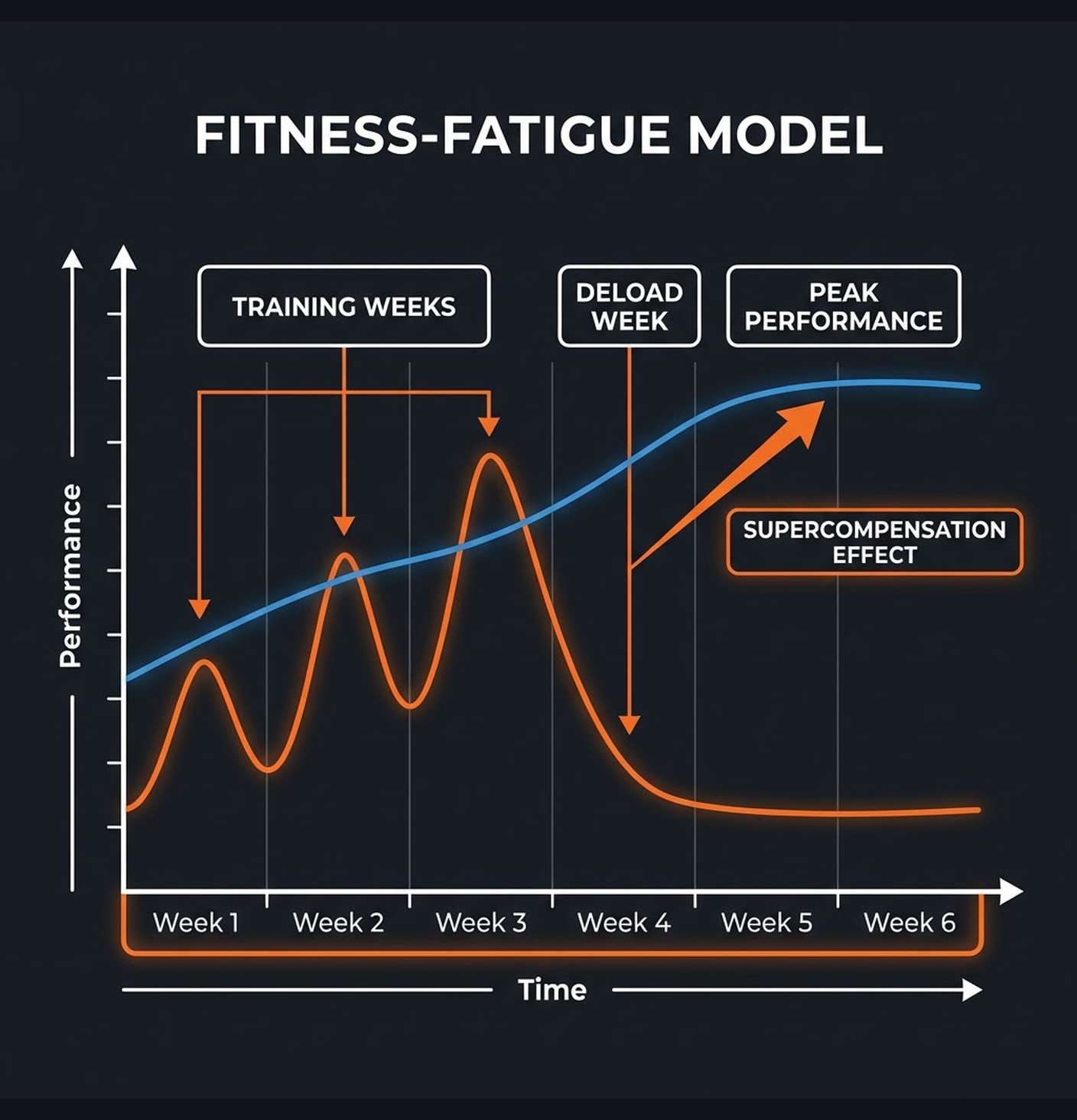
The theory behind deloading comes from the fitness-fatigue model, originally proposed by Banister et al. in the 1970s and still the foundation of modern periodization.
Here's the short version: every hard training session produces two things simultaneously.
- •Fitness -- the positive adaptation you're chasing (strength, muscle, endurance)
- •Fatigue -- the accumulated stress that masks your true fitness level
Fitness builds slowly and decays slowly. Fatigue builds fast and decays fast. During a normal training block, both are rising. Your performance stays flat or even dips slightly because fatigue is hiding your fitness gains.
When you deload, fatigue drops quickly (within 5-7 days) while fitness stays nearly the same (because it decays much slower). The result: your performance spikes. You feel strong, recovered, and ready to push harder than before.
This is why lifters often hit PRs the week after a deload. It's not random. It's what the model predicts.
When to Deload
Every 4-6 Weeks of Hard Training
The most common approach. Run 3-5 weeks of progressively harder training, then drop into a deload week. Most intermediate lifters do well on a 3:1 pattern (three hard weeks, one deload). Advanced lifters might push to 5:1 if recovery is well-managed.
This approach works because it's predictable. You plan your training blocks around it. You know exactly when to push and when to pull back.
When Your Body Tells You
Some coaches prefer autoregulated deloads. Instead of scheduling them, you watch for signs that fatigue has accumulated past your ability to recover:
- •Weights that normally feel moderate suddenly feel heavy
- •Your warm-up sets feel sluggish and slow
- •Persistent joint aches that don't clear up between sessions
- •Sleep quality tanks despite no lifestyle changes
- •Motivation to train drops off a cliff (not to be confused with regular laziness)
- •Bar speed noticeably slows on submaximal weights
- •You're irritable, hungry all the time, or getting sick more often
Two or three of these happening at once is a strong signal. One bad day doesn't mean you need a deload. A bad week does.
After a Competition or Testing Block
If you just hit a 1RM testing week, competed in a powerlifting meet, or finished a peaking block, you deload. No exceptions. Peak performance demands peak fatigue, and you need to let that dissipate before starting your next training cycle.
How to Structure a Deload Week
There are three main approaches. Pick whichever matches your temperament.
Option 1: Reduce Volume, Keep Intensity
Cut your sets by 40-50% but keep the weight the same (or close to it). If you normally do 5 sets of 5 at 315 on squats, do 2-3 sets of 3-4 at 315.
Best for: Lifters who hate feeling weak. You're still handling heavy weights so your nervous system stays primed, but the reduced volume lets your body recover.
| Normal Week | Deload Week |
|---|---|
| Squat: 5x5 at 315 | Squat: 3x3 at 315 |
| Bench: 4x6 at 225 | Bench: 2x4 at 225 |
| Deadlift: 4x4 at 365 | Deadlift: 2x3 at 365 |
| Accessories: 4 exercises, 3 sets each | Accessories: 2 exercises, 2 sets each |
Option 2: Reduce Intensity, Keep Volume
Keep your normal sets and reps but drop the weight by 40-50%. If you normally squat 315 for 5x5, do 5x5 at 185-205.
Best for: Lifters who need the routine. You still go through the motions, still get movement practice, but the load is light enough that your body isn't accumulating any real fatigue.
| Normal Week | Deload Week |
|---|---|
| Squat: 5x5 at 315 | Squat: 5x5 at 185 |
| Bench: 4x6 at 225 | Bench: 4x6 at 135 |
| Deadlift: 4x4 at 365 | Deadlift: 4x4 at 225 |
| All accessories | All accessories at 50% load |
Option 3: Reduce Both
Cut volume by 30-40% and intensity by 30-40%. This is the most conservative approach and produces the most recovery.
Best for: Lifters who are genuinely beat up. If you've been running high-volume hypertrophy work for 5-6 weeks and everything hurts, this is your play. Also good for older lifters or anyone with nagging joint issues.
| Normal Week | Deload Week |
|---|---|
| Squat: 5x5 at 315 | Squat: 3x5 at 205 |
| Bench: 4x6 at 225 | Bench: 2x6 at 155 |
| Deadlift: 4x4 at 365 | Deadlift: 2x4 at 245 |
| Accessories: 4 exercises | Accessories: 1-2 exercises, light |
What NOT to Do During a Deload
Don't Skip the Gym Entirely
A full week off is not a deload. It's a layoff. The distinction matters. When you take a full week off, you start to lose neuromuscular coordination after about 5-7 days. Your first session back feels clunky and uncoordinated.
A deload keeps you moving, keeps your technique sharp, and maintains the habit of showing up. The stimulus is just dialed way back.
Don't Replace Lifting with Extra Cardio
I see this constantly. Someone drops their lifting volume for a deload week, then adds three extra HIIT sessions or long runs to "stay active." You've now replaced one form of stress with another. Your body doesn't care whether fatigue comes from barbells or burpees. Stress is stress.
If you want to move during a deload, go for walks. Do some light stretching. Practice mobility work. Don't add a new training stimulus.
Don't Change Your Exercise Selection
Stick to your normal exercises, just lighter and/or for fewer sets. The deload isn't the time to try that new squat variation you saw online. Novelty creates soreness and neural demand, which defeats the purpose.
Don't Cut Calories
A deload is a recovery period. Your body is repairing tissue, consolidating strength gains, and resetting your hormonal milieu. This is not the time to slash calories or skip meals. Eat at maintenance. Get your protein. Sleep well.
Deloading by Training Style
For Powerlifters
Use Option 1 (reduce volume, keep intensity). Handle weights at 85-90% of your normal training loads for 2-3 singles or doubles. Skip backoff sets entirely. Cut accessories by half.
For Bodybuilders and Hypertrophy Training
Use Option 2 or 3. Your joints take a beating from high-volume work. Drop to 50-60% of your working weights and focus on slow, controlled reps with full range of motion. Think of it as a "technique week" where you refine your mind-muscle connection without taxing your recovery.
For CrossFit and HIIT Athletes
Scale the WODs. Cut the RX weights in half. Walk the runs instead of sprinting them. Do the movements, don't chase the clock. Your CNS and connective tissue need the break even if your cardio system doesn't feel tired.
For Beginners
Honestly, most beginners don't need to deload for their first 3-4 months. Your training loads aren't heavy enough to generate the kind of accumulated fatigue that demands a deload. If you're 8 weeks in and feel great, keep going.
Once you're squatting over bodyweight, benching over 0.75x bodyweight, and deadlifting over 1.25x bodyweight, start scheduling deloads every 4-6 weeks.
Common Mistakes
Deloading too often. If you're deloading every 2-3 weeks, your training isn't hard enough in the first place. You're using deloads to avoid discomfort rather than to manage genuine fatigue accumulation.
Never deloading at all. The other extreme. You push through every bad session, ignore the warning signs, and eventually stall completely or get injured. Planned deloads prevent unplanned time off.
Treating every bad session as a sign to deload. Bad days happen. Poor sleep, work stress, skipped meals -- these all affect performance. A single bad session is not accumulated fatigue. A pattern of declining performance over 1-2 weeks is.
Going too hard on the deload. You walk into the gym feeling fresh on day 2 of your deload and think "I feel great, maybe I'll just do a few heavy singles." Resist this. The entire point is to let fatigue dissipate. You'll feel even better next week if you stick to the plan.
The Week After: What to Expect
If you deloaded properly, the first session back should feel noticeably better than the last few sessions before the deload. Weights that felt heavy will feel moderate. Your bar speed will be up. Your joints won't ache.
This is where many lifters hit PRs. Not because they magically got stronger during a lighter week, but because they finally expressed the fitness they'd been building for the past 4-6 weeks. The fatigue that was masking it is gone.
Use this window. Push harder in weeks 1-2 of your next training block. Set new rep PRs. Add weight to the bar. Then start the cycle over: build, build, build, deload.
That's how long-term progress works. Not a straight line up, but a series of waves, each one cresting slightly higher than the last.
Frequently Asked Questions
- How often should you deload?
- Most intermediate lifters benefit from a deload every 4-6 weeks. A common pattern is 3 weeks of hard training followed by 1 deload week. Advanced lifters can sometimes push to 5-6 weeks, while older lifters or those training at very high volumes may need to deload every 3-4 weeks. Pay attention to performance trends rather than sticking rigidly to a schedule.
- What should you do during a deload week?
- Keep training but reduce the stress. Either cut your sets by 40-50% while keeping the weight similar, or keep your normal sets and reps but drop the weight by 40-50%. Still show up, still move through your normal exercises, but stop well short of failure on every set. Avoid adding new exercises or extra cardio.
- Can beginners skip deloads?
- Yes, for the first 3-4 months. Beginner training loads are not heavy enough to generate the kind of systemic fatigue that demands a deload. Once you are squatting over bodyweight and your lifts start plateauing on a week-to-week basis, start incorporating planned deloads every 4-6 weeks.
- Is a deload the same as a rest day?
- No. A deload is an entire week of reduced training intensity or volume. A rest day is a single day off. Deloads address accumulated fatigue that builds over weeks of hard training, while rest days handle day-to-day recovery between sessions. You still take your normal rest days during a deload week.
- Will I lose strength or muscle during a deload?
- No. Research shows that muscle mass and strength are maintained for at least 2-3 weeks of reduced training. A single deload week is far too short to cause any measurable loss. In fact, most lifters feel stronger after a deload because accumulated fatigue has dissipated, revealing the fitness they built during the hard training weeks.