How to Lose Fat Without Losing Muscle: The Complete Guide
Everything you need to set up a smart cut — from calories and protein to training adjustments and knowing when to stop. A practical, no-BS guide for lifters who want to get lean without getting weak.
 Jeff·Feb 23, 2026·12 min read
Key Takeaways
- Set a moderate calorie deficit of 300-500 below maintenance and eat 0.8-1g of protein per pound of bodyweight every day to protect muscle.
- Keep lifting heavy during a cut - the weight on the bar is the signal that tells your body to hold onto muscle tissue.
- Aim to lose 0.5-1% of bodyweight per week and track weekly averages, not daily weigh-ins, since water and glycogen cause daily fluctuations.
- Walking is the most underrated fat loss tool - it burns real calories without interfering with lifting recovery, unlike excessive HIIT.
- Most cuts should last 8-16 weeks with a diet break at maintenance if strength starts crashing or you have been in a deficit longer than 12 weeks.
Get This on WhatsApp
Get a quick summary and link sent straight to your WhatsApp.
Send Me This ArticleWhy Losing Fat Is Different When You Lift
Most weight loss advice is written for people who don't train. "Eat 1,200 calories and do 45 minutes on the elliptical" works fine if you don't care about muscle. But you do. You've spent months or years building strength, and you don't want to watch it disappear because some generic diet plan has you eating like a bird and doing cardio six days a week.
When you lift, your body has two competing demands during a fat loss phase: it needs fewer calories to shed fat, but it still needs enough fuel and stimulus to maintain (or even build) the muscle you've earned. That tension is what makes cutting different for lifters. The goal isn't just to see a smaller number on the scale. It's to lose fat, keep your strength, and actually look better with your shirt off at the end of it.
The good news: it's absolutely doable. The bad news: it requires more thought than "eat less, move more." This guide covers exactly how to set it up.
How Fat Loss Actually Works
Fat loss comes down to energy balance. If you consistently consume fewer calories than your body burns, you lose weight. That's not opinion — it's thermodynamics. Every diet that has ever worked, from keto to intermittent fasting to plain calorie counting, worked because it created a calorie deficit. The wrapper doesn't matter. The deficit does.
Your total daily energy expenditure (TDEE) is the number of calories you burn in a day from everything — your resting metabolism, digestion, daily movement, and exercise. If you eat less than your TDEE, your body pulls from stored energy (mostly body fat, but also some muscle) to make up the gap.
The simplest way to estimate your TDEE: multiply your bodyweight in pounds by 14–16. Use the lower end if you have a desk job and train 3 days a week. Use the higher end if you're on your feet all day or training 5+ days. This gives you a starting point, not a gospel number. You'll adjust based on what actually happens over the next few weeks.
The deficit sweet spot for lifters is 300–500 calories below maintenance. Aggressive enough to lose fat at a meaningful pace. Conservative enough to protect muscle and keep training quality high. Go much deeper than that and you start losing muscle, your training falls apart, and you feel terrible.
Set Your Macros for a Cut
Calories are the foundation. Macros are how you build on that foundation to make sure you're losing fat instead of muscle.
Protein: The Non-Negotiable
Eat 0.8–1 gram of protein per pound of bodyweight every day. This is the single most important nutritional decision you'll make during a cut. High protein intake does three things:
- •It preserves muscle tissue when you're in a deficit
- •It keeps you fuller for longer (protein is the most satiating macronutrient)
- •It has the highest thermic effect of food — your body burns more calories digesting protein than carbs or fat
If you weigh 185 pounds, that's 148–185 grams of protein per day. Hit this target no matter what. If you're going to be flexible on anything, be flexible on carbs or fat. Never protein.
Fat: Keep Your Hormones Happy
Set fat intake at 0.3–0.4 grams per pound of bodyweight. For a 185-pound guy, that's about 55–75 grams of fat per day. Fat is needed for hormone production (including testosterone), joint health, and absorbing certain vitamins. Going too low on fat during a cut is a fast track to feeling awful and tanking your hormones.
Carbs: Whatever Is Left
After you've set protein and fat, fill the remaining calories with carbs. Carbs are your training fuel. They keep your workouts from feeling like you're dragging a sled through mud.
Here's a worked example for a 185-pound lifter:
- •Estimated TDEE: 185 x 15 = 2,775 calories
- •Target intake (400 calorie deficit): 2,375 calories
- •Protein: 185g (740 calories)
- •Fat: 65g (585 calories)
- •Carbs: (2,375 - 740 - 585) / 4 = 263g (1,050 calories)
That's a solid starting point. You eat enough to train hard, enough protein to protect muscle, and you're in a deficit that should produce about 0.75 pounds of fat loss per week.
How to Adjust Your Training
This is where most lifters screw up their cuts. They hear "calorie deficit" and panic — switching to light weights with high reps, adding tons of cardio, and basically doing everything in their power to catabolize the muscle they spent years building.
Here's the rule: keep lifting heavy. Heavy weights are the signal that tells your body to keep muscle. If you were squatting 275 for sets of 5 before your cut, keep squatting 275 for sets of 5 during your cut. The weight on the bar is the stimulus. Without it, your body has no reason to hold onto metabolically expensive muscle tissue when calories are scarce.
What you can dial back is volume. Drop 1–2 sets per exercise across the board. If you were doing 4 sets of bench press, do 3. If you were doing 5 sets of rows, do 3–4. You're reducing the total work slightly to match your reduced recovery capacity, but keeping the intensity (the weight) the same.
Prioritize compound lifts: squat, bench press, deadlift, overhead press, barbell rows, pull-ups. These recruit the most muscle mass per movement and give you the biggest bang for your buck when training time and recovery are both limited.
Whatever you do, don't switch to "light weight, high reps" for fat loss. That's a bodybuilding myth from the 1980s that refuses to die. Light weights don't burn meaningfully more calories than heavy weights, and they remove the mechanical tension stimulus your muscles need to stay.
What to expect: strength might stall. That's normal. You might not add weight to the bar for several weeks. That's fine. What shouldn't happen is a nosedive. If your bench drops from 225 to 195 in three weeks, your deficit is too aggressive, your protein is too low, or your recovery is shot. Address those before you lose more ground.
The Role of Cardio
Cardio is a tool. It's not a requirement for fat loss, and it's not the enemy of gains. It's just another way to increase your calorie expenditure if you need to.
Walking is the most underrated fat loss tool. It burns a real number of calories (300–400 per hour depending on pace and bodyweight), it produces almost zero fatigue, it doesn't interfere with recovery from lifting, and you can do it every day. Aiming for 8,000–10,000 steps a day during a cut makes a meaningful difference without any downsides.
If you want to add structured cardio beyond walking, keep it to 2–3 sessions per week and keep it moderate. A 20–30 minute incline treadmill walk, a bike ride, or a rowing session. Something that elevates your heart rate without destroying you for tomorrow's training.
Don't use cardio to "earn" food. This is a trap. If you eat 500 extra calories and then run for an hour to "burn it off," you're just spinning your wheels. Set your diet to the right calorie target and use cardio as a supplement, not a correction.
LISS (low-intensity steady state) or HIIT (high-intensity interval training) — both work. LISS is easier to recover from and can be done more frequently. HIIT burns more calories per minute but is harder on your body and can interfere with lifting performance if overdone. Pick whichever you'll actually do consistently.
How Fast Should You Lose Weight?
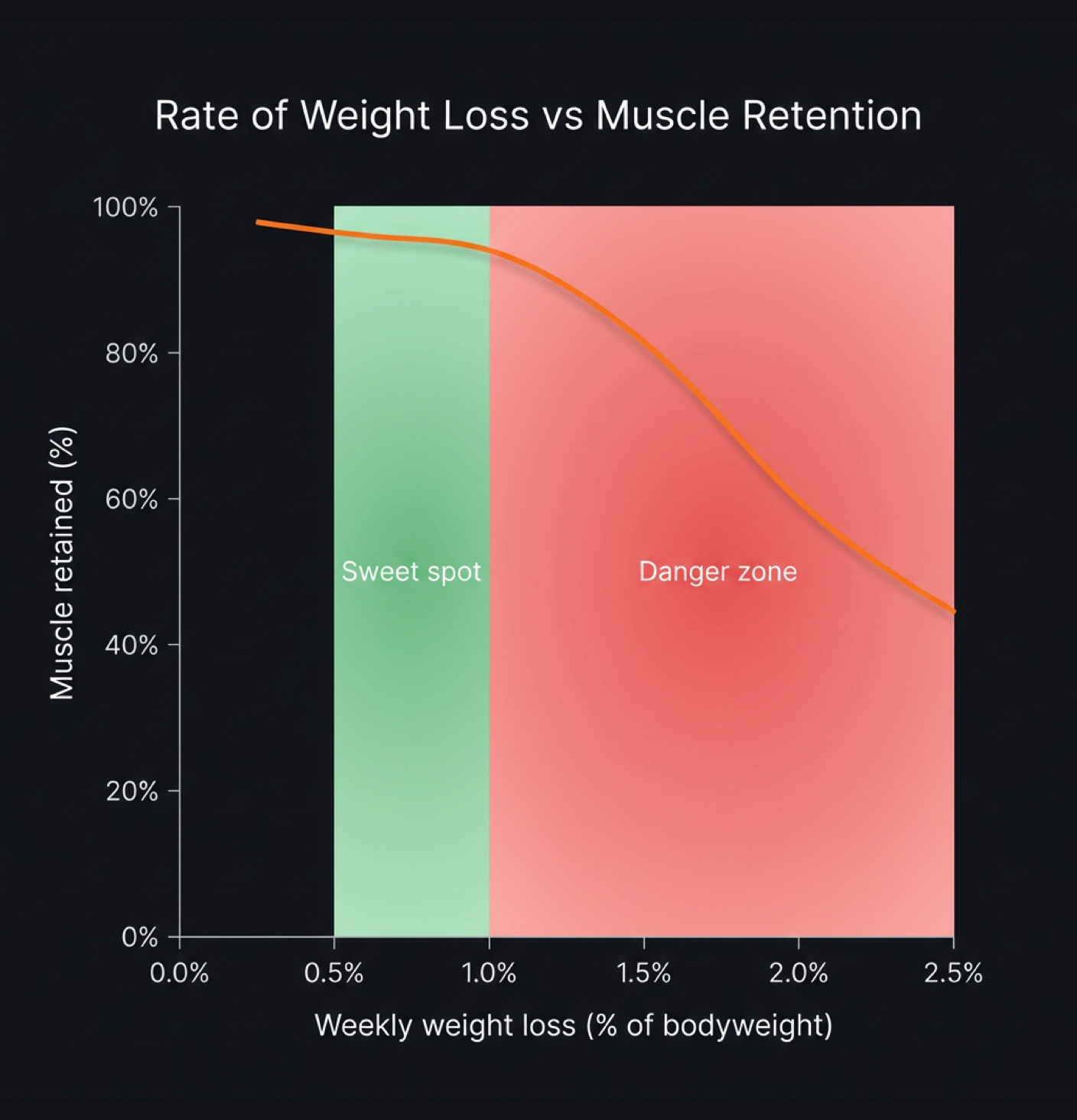
Aim to lose 0.5–1% of your bodyweight per week. For a 185-pound lifter, that's roughly 1–1.8 pounds per week. Stay in that range and you'll lose mostly fat while holding onto muscle.
Faster than that? You're probably losing muscle too. Research consistently shows that rates above 1% of bodyweight per week are associated with significantly more lean mass loss. The leaner you get, the more this matters — someone at 25% body fat can tolerate a faster rate than someone at 12%.
Track weekly averages, not daily weigh-ins. Your scale weight bounces around daily based on water retention, sodium, glycogen, stress, sleep, and what you ate last night. Weigh yourself every morning under the same conditions (after using the bathroom, before eating) and average those seven numbers at the end of the week. Compare weekly averages to spot the real trend.
Use multiple data points beyond the scale:
- •The mirror: Are you visually leaner? Can you see more definition?
- •Strength: Are your lifts holding steady or just slightly down?
- •Measurements: Waist circumference (at the navel) is the best single measurement for tracking fat loss
- •How your clothes fit: Pants looser in the waist? That's progress, regardless of scale weight
If the scale hasn't moved in two weeks but your waist is an inch smaller and your bench is still the same, you're doing great. Don't let the scale lie to you.
Common Mistakes That Cost You Muscle
Cutting calories too aggressively. A 1,000-calorie deficit sounds like it would work twice as fast. It doesn't. It works for about two weeks before your body rebels — energy crashes, muscle loss accelerates, strength plummets, and you end up binge eating because you're starving. A moderate deficit sustained for 12 weeks beats a crash diet every single time.
Dropping protein to save calories. When you need to cut calories, carbs and fats should take the hit. Protein stays the same or goes up. Some guys cut their protein because chicken breast and protein shakes "cost too many calories." This is backwards. Protein is the last thing you sacrifice.
Doing tons of cardio and no lifting. Running every day while skipping the weight room is the fastest way to become skinny-fat. Cardio doesn't preserve muscle. Lifting does. If you only have four hours per week to train, spend three of them lifting and one doing cardio.
Chasing the scale instead of the mirror. The guy who loses 15 pounds in a month but 5 of those pounds were muscle looks worse than the guy who lost 8 pounds of pure fat. Rate of loss matters less than what you're losing.
Not sleeping enough. Sleep is when your body repairs muscle tissue and regulates hunger hormones. Studies show that people who sleep 5.5 hours per night lose 60% more muscle and 55% less fat than people who sleep 8.5 hours — on the exact same diet. If you're cutting and not sleeping 7+ hours, you're sabotaging everything else you're doing right.
"Earning" food with exercise. This mindset turns food into a reward and exercise into a punishment. Set your calorie target based on your deficit goal and eat that amount regardless of whether you trained that day. Stop negotiating with yourself.
When to End Your Cut
Not every cut needs to go until you can see your abs. Here's when to call it:
You hit your target. Maybe that's a certain body fat percentage, a waist measurement, or just a visual look in the mirror. If you're there, you're done. Start transitioning back to maintenance.
Strength is tanking. A small dip in performance is expected. But if your lifts are dropping session after session for two or more weeks straight, your body is telling you it can't sustain this deficit any longer. Time to back off.
You've been cutting for 12–16 weeks. Even a perfectly set-up cut becomes harder to sustain past this point. Metabolic adaptation, psychological fatigue, and accumulated stress make it a good idea to take a diet break. Eat at maintenance for 2–4 weeks, then reassess whether you need another cutting phase.
Your life is falling apart. If you're obsessing over food, your sleep is wrecked, your training feels terrible, and you snap at everyone around you, the cut is doing more harm than good. Health comes first. Pull back.
How to reverse out of a cut: Don't jump straight back to your old calorie intake. Add 100–200 calories per week (mostly from carbs) until you're back at maintenance. This "reverse diet" approach helps your metabolism adjust without rapid fat regain. Most people reach maintenance in 4–6 weeks.
A Simple 4-Week Cut Template
Here's a practical starting framework for a 185-pound lifter. Adjust the numbers to your own bodyweight and TDEE.
| Week | Calories | Protein | Fat | Carbs | Training | Cardio |
|---|---|---|---|---|---|---|
| 1 | 2,375 | 185g | 65g | 263g | 4 days lifting | 3 walks (30 min) |
| 2 | 2,375 | 185g | 65g | 263g | 4 days lifting | 3 walks (30 min) |
| 3 | 2,250 | 185g | 60g | 244g | 4 days lifting | 4 walks (30 min) |
| 4 | 2,250 | 185g | 60g | 244g | 4 days lifting | 4 walks (30 min) |
Training structure: Upper/Lower split 4 days a week. Focus on compound movements. Keep the weight on the bar the same as pre-cut. Drop 1–2 sets per exercise compared to your building phase.
Weekly check-in (same day each week):
- •Morning weigh-in (fasted)
- •Waist measurement at the navel
- •Log your main lifts (squat, bench, deadlift)
- •Take a progress photo (same lighting, same pose)
Decision tree after each check-in:
- •Losing too fast (more than 1.5 lb/week for 2+ weeks): Add 150 calories from carbs
- •Losing on track (0.75–1.5 lb/week): Change nothing
- •Stalled (less than 0.5 lb/week for 2+ weeks): Drop 150 calories from carbs, or add one more 30-minute walk
- •Strength crashing: Add 150 calories from carbs and reduce cardio
After 4 weeks, reassess. If you're progressing well and feeling decent, run another 4-week block. Most cuts need 8–16 weeks total.
The Bottom Line
Fat loss for lifters is straightforward, but it takes discipline:
- •Set a moderate deficit (300–500 below maintenance)
- •Keep protein at 0.8–1g per pound of bodyweight
- •Keep lifting heavy — the weight on the bar protects your muscle
- •Use walking as your primary cardio tool
- •Track weekly averages, not daily fluctuations
- •Be patient — 0.5–1% of bodyweight per week is the sweet spot
A well-executed 12-week cut will get most guys where they want to be. You'll look better, feel better, and keep the strength you worked hard to build. That's worth a lot more than a 4-week crash diet that leaves you smaller, weaker, and ready to rebound.
Frequently Asked Questions
- Why Losing Fat Is Different When You Lift?
- Most weight loss advice is written for people who don't train. "Eat 1,200 calories and do 45 minutes on the elliptical" works fine if you don't care about muscle. But you do.
- How Fat Loss Actually Works?
- Fat loss comes down to energy balance. If you consistently consume fewer calories than your body burns, you lose weight. That's not opinion — it's thermodynamics. Every diet that has ever worked, from keto to intermittent fasting to plain calorie counting, worked because it created a calorie deficit.
- What should I know about set your macros for a cut?
- Calories are the foundation. Macros are how you build on that foundation to make sure you're losing fat instead of muscle.
- What should I know about protein: the non-negotiable?
- Eat 0.8–1 gram of protein per pound of bodyweight every day. This is the single most important nutritional decision you'll make during a cut. High protein intake does three things:
- What should I know about fat: keep your hormones happy?
- Set fat intake at 0.3–0.4 grams per pound of bodyweight. For a 185-pound guy, that's about 55–75 grams of fat per day. Fat is needed for hormone production (including testosterone), joint health, and absorbing certain vitamins.