Shoulder Impingement: Exercises to Fix and Prevent It
That pinching pain when you raise your arm overhead? Probably shoulder impingement. Here is what causes it and the exercises that actually fix it.
 Jeff·Feb 10, 2026·12 min read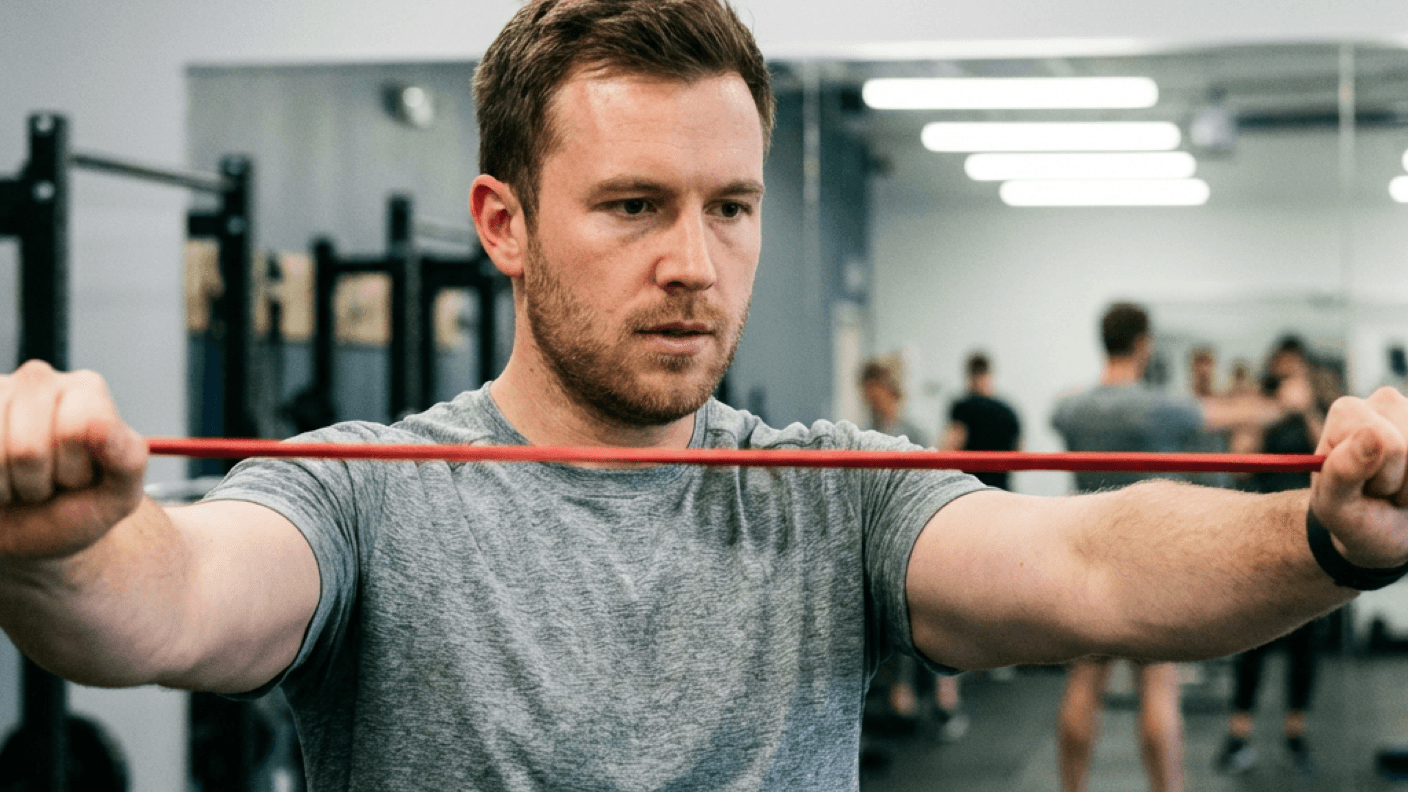
Key Takeaways
- Your tight pecs and lats from too much pressing are pulling your shoulders forward and creating the impingement problem.
- Start with external rotation exercises using super light weights to strengthen the back of your shoulders that got weak from all the pushing.
- Wall slides and band pull-aparts should become part of your daily routine to fix your shoulder blade movement.
- Skip lateral raises, upright rows, and behind-the-neck pressing until your shoulders are bulletproof again.
- For every pressing exercise you do, match it with two pulling exercises to prevent this mess from happening again.
Get This on WhatsApp
Get a quick summary and link sent straight to your WhatsApp.
Send Me This ArticleWhat shoulder impingement actually is
Shoulder impingement happens when the tendons of the rotator cuff (most commonly the supraspinatus) get compressed between the head of the humerus (your upper arm bone) and the acromion (the bony shelf on top of your shoulder blade). When you raise your arm, especially between about 60 and 120 degrees of elevation (the "painful arc"), these tendons get pinched in that narrow space.
It feels like a sharp or pinching pain in the front or top of your shoulder. It is usually worse when you raise your arm overhead, reach behind your back, or do pressing movements. Lateral raises are often the most painful exercise. Sleeping on the affected side is a nightmare.
If this sounds familiar, you are not alone. Shoulder impingement accounts for roughly 44-65% of all shoulder pain complaints (van der Windt et al., 1995). Among lifters, I would guess it is even higher because our sport specifically loads the shoulder in positions that aggravate it.
Why lifters get impingement
There are a few reasons this is so common in the lifting population:
Too much pressing, not enough pulling. The classic lifter imbalance. Bench press, overhead press, dips, push-ups. All of these train the anterior deltoid, pecs, and internal rotators of the shoulder. If your pulling volume does not match your pushing volume, the muscles on the front of your shoulder get tight and overpower the muscles on the back, pulling the humeral head forward in the socket. This narrows the subacromial space and sets the stage for impingement.
Tight pecs and lats. Both of these muscles internally rotate the humerus. Tight pecs pull the shoulder forward and down. Tight lats pull the humerus down and into internal rotation. If you bench press and do pull-ups religiously but never stretch either muscle, your shoulders are slowly closing down.
Weak rotator cuff. The rotator cuff's primary job is to center the humeral head in the glenoid (the shoulder socket) during movement. If the cuff is weak relative to the prime movers (deltoids, pecs, lats), the humeral head rides up too high during arm elevation, smashing the supraspinatus tendon into the acromion. A 2005 study by Ludewig and Cook demonstrated that altered scapular mechanics and rotator cuff weakness are consistently associated with impingement.
Poor scapular mechanics. Your shoulder blade needs to upwardly rotate and posteriorly tilt when you raise your arm overhead. If your serratus anterior and lower trapezius are weak (they almost always are in lifters), the scapula does not rotate enough, and the acromion stays in the way. This is called scapular dyskinesis and it is stupidly common.
Too much volume at problem angles. Lateral raises with internal rotation (thumbs down), upright rows with a narrow grip, and behind-the-neck pressing all place the shoulder in its most impingement-prone position. Do these frequently enough with enough volume and you are basically asking for it.
The internal rotation problem
Here is a quick self-test. Stand with your arms at your sides. Let them hang naturally. Now look at where your palms face. If your palms face behind you (instead of toward your thighs), your shoulders are internally rotated. Most lifters fail this test.
Internal rotation tightness is the single biggest contributor to shoulder impingement in the lifting population. The pecs, lats, subscapularis, and teres major all internally rotate the humerus. If these muscles are tight and your external rotators (infraspinatus, teres minor, posterior deltoid) are weak, the humerus sits in a chronically internally rotated position. Every time you raise your arm, the greater tuberosity of the humerus jams into the acromion earlier in the range of motion than it should.
Fixing this imbalance is the core of impingement rehab.
Phase 1: Calm it down
Before you start strengthening anything, you need to reduce the inflammation and pain. This usually takes 1-3 weeks.
Avoid painful movements. This does not mean stop training. It means stop doing the specific movements that cause pain. If lateral raises hurt, stop doing lateral raises. If overhead pressing hurts, stop overhead pressing. You can still train chest, back, arms, and legs while your shoulder calms down.
Ice after training. 15-20 minutes with an ice pack on the front/top of the shoulder. This is one of the few situations where icing is actually useful, because we are dealing with a compressed, inflamed tendon.
NSAIDs if needed. Ibuprofen or naproxen for 5-7 days can help reduce inflammation. Talk to your doctor about dosing. I am not a physician, I am a coach, so I will not prescribe anything. But NSAIDs are effective for tendon inflammation specifically.
Pendulum exercises. Lean forward with your good arm on a table. Let your affected arm hang straight down. Gently swing it in small circles (clockwise and counterclockwise) and forward/back. This provides gentle traction to the shoulder joint and increases blood flow without compression. Do this 2-3 times daily for 30-60 seconds.
Phase 2: Fix the imbalances
Once the acute pain has decreased (you can raise your arm without sharp pain, even if there is still some discomfort), start fixing the underlying problems.
External rotation strengthening
This is priority number one. You need to strengthen the infraspinatus and teres minor to counteract the internal rotation dominance.
Side-lying external rotation. Lie on your non-painful side. Hold a light dumbbell (3-5 pounds to start, seriously) in your top hand. Keep your elbow bent at 90 degrees and pinned to your side. Rotate your forearm up toward the ceiling, keeping the elbow fixed. Slow and controlled. 3 sets of 15-20 reps. This should be very easy with the weight you choose. If it is hard, the weight is too heavy.
Cable external rotation at 90 degrees. Stand with a cable at elbow height. Hold the handle with your elbow at 90 degrees, upper arm parallel to the floor. Rotate your forearm up while keeping your elbow in place. 3 sets of 12-15. Use light weight.
Band pull-aparts. Hold a resistance band in front of you at chest height, arms straight. Pull the band apart by squeezing your shoulder blades together and rotating your arms outward. 3 sets of 15-20. Use a light band. This is a fantastic exercise that you should honestly do every single training day as part of your warm-up.
Scapular stabilization
Wall slides. Stand with your back against a wall, arms in a "goal post" position (elbows at 90 degrees, backs of hands against the wall). Slowly slide your arms up the wall overhead while maintaining contact between your hands, forearms, elbows, and back against the wall. If you cannot keep contact, only go as high as you can while maintaining it. 3 sets of 10.
Serratus anterior punches. Lie on your back holding a light dumbbell straight up over your chest. Without bending your elbow, push the weight toward the ceiling by protracting your shoulder blade (punching upward). You should feel this on the side of your ribcage, which is your serratus anterior. 3 sets of 12-15.
Prone Y raises. Lie face down on an incline bench set to about 30-45 degrees. Hold very light dumbbells (2-5 pounds). Raise your arms at a Y angle (about 45 degrees from your head) with thumbs pointing up. Squeeze your lower traps at the top. 3 sets of 12-15. These are humbling. Everyone is weak at these.
Stretching the tight structures
Pec stretch (doorway). Stand in a doorway, forearm against the frame at shoulder height. Step through until you feel a stretch across your chest. Hold 30-45 seconds. Do this at two heights: elbow at shoulder level and elbow above shoulder level. This hits different portions of the pec major.
Lat stretch. Grab a squat rack or door frame at about hip height. Step back and hinge at the hips, letting your chest drop toward the floor. Push your hips away from your hands. Hold 30-45 seconds per side. You should feel a deep stretch along the entire side of your back.
Cross-body stretch (posterior capsule). Bring your affected arm across your chest. Use the other hand to gently pull it closer to your body. Hold 30 seconds. This stretches the posterior capsule and can help if your shoulder has become tight in internal rotation (which happens as a protective response to impingement).
Phase 3: Build bulletproof shoulders
Once you have been doing Phase 2 work for 3-4 weeks and your pain is significantly reduced, start building real strength in the shoulder stabilizers.
Face pulls. Set a cable at upper chest height with a rope attachment. Pull the rope toward your face, splitting your hands apart at the end so your fists are beside your ears. Squeeze your shoulder blades together hard. 3-4 sets of 15-20 reps. This is the single best exercise for long-term shoulder health in lifters. I do these every training day.
Bottoms-up kettlebell press. Hold a kettlebell upside down (bottom up) by the handle at shoulder height. Press it overhead while keeping the kettlebell balanced. The instability forces your rotator cuff to fire hard to stabilize the load. Start very light (15-20 lb kettlebell). 3 sets of 8-10 per arm.
Turkish get-ups. The full get-up is one of the best shoulder stability exercises ever invented. It loads the shoulder in multiple positions (overhead, 90 degrees, arm extended) while requiring stability throughout. Start with a shoe on your fist to learn the movement, then progress to a light kettlebell. 2-3 reps per side, slow and controlled.
YTWL raises. On an incline bench face down, perform raises in four patterns with very light dumbbells: Y (arms at 45-degree angle), T (arms straight out to sides), W (elbows bent at 90 degrees pulled back), and L (elbows at 90 degrees, rotate forearms up). Do 8-10 reps of each letter. This hits all the small shoulder stabilizers and scapular muscles in one circuit.
Exercises to modify or avoid during recovery
Lateral raises. Avoid entirely during Phase 1. In Phase 2, switch to scaption raises (raising in the plane of the scapula, about 30-45 degrees in front of the body rather than straight to the side). Keep your thumbs pointing up or slightly forward. Never do lateral raises with your thumbs pointing down.
Overhead pressing. Avoid barbell overhead press until Phase 3. Dumbbells are better because your arms can find a natural path. Press slightly in front of your body rather than straight up, and keep the dumbbells at a neutral or 45-degree angle rather than fully pronated.
Bench press. Usually tolerable but make these modifications: do not flare your elbows past 75 degrees (tuck them slightly), do not let the bar touch too high on your chest (mid-chest or slightly lower), and avoid extremely wide grips.
Dips. Avoid until fully recovered. Dips put the shoulder in the most impingement-prone position (internal rotation plus extension). Even after recovery, keep dips shallow (do not go super deep) if they bother you.
Upright rows. Avoid permanently, or at least use a wide grip (snatch grip). Narrow grip upright rows are basically a shoulder impingement test.
Smart substitutions for common exercises
| Painful exercise | Substitution |
|---|---|
| Barbell overhead press | Landmine press, neutral-grip DB press |
| Lateral raises | Cable Y-raise, scaption raises (thumbs up) |
| Dips | Close-grip bench press, diamond push-ups |
| Wide-grip bench | Close or moderate grip bench, floor press |
| Behind-the-neck press | Literally anything else |
| Upright rows | Wide-grip high pulls, face pulls |
A complete shoulder rehab routine
Do this 3-4 times per week, takes about 15-20 minutes:
Warm-up (2 minutes)
- •Pendulum swings: 30 seconds each direction
- •Band pull-aparts: 2x15
External rotation (4 minutes)
- •Side-lying external rotation: 3x15 (light)
- •Cable external rotation at 90 degrees: 3x12
Scapular stability (5 minutes)
- •Wall slides: 3x10
- •Serratus punches: 3x12
- •Prone Y-raises: 3x12
Stretching (4 minutes)
- •Doorway pec stretch: 2 positions, 30 seconds each
- •Lat stretch: 30 seconds each side
- •Cross-body stretch: 30 seconds each side
Strengthening (when pain-free, Phase 3)
- •Face pulls: 3x15-20
- •Bottoms-up KB press: 3x8-10 per arm
Long-term prevention
Once your impingement is resolved, here is how to keep it from coming back:
Match your pulling volume to your pushing volume. For every set of bench press or overhead press, do a set of rows or face pulls. Most lifters need a 2:1 or even 3:1 pull-to-push ratio until their shoulders are balanced.
Do band pull-aparts every training day. Takes 60 seconds. 2 sets of 15-20 reps. There is no simpler habit with a bigger payoff for shoulder health.
Stretch your pecs and lats after every session. 30 seconds each. That is 2 minutes of stretching. There is no excuse.
Do external rotation work 2-3 times per week. Light, high-rep, at the end of your training. It takes 5 minutes. Think of it as brushing your teeth for your shoulders.
Stop doing exercises that consistently hurt. Behind-the-neck press, narrow-grip upright rows, and thumbs-down lateral raises are not worth the risk when there are equally effective alternatives that do not compress the supraspinatus. Use the substitution table above.
I have dealt with shoulder impingement twice in my lifting career. Both times, the rehab protocol above got me back to full training within 6-8 weeks. Both times, the cause was the same: too much pressing, not enough pulling, tight pecs. Do not repeat my mistakes. Build shoulder health into your program from the start and you will probably never deal with impingement at all.
Frequently Asked Questions
- What does shoulder impingement feel like?
- A pinching or catching pain in the front or top of your shoulder, especially when you raise your arm overhead or reach behind your back. It often gets worse during overhead pressing, lateral raises, and bench press. It is not a sharp tear, more like a dull pinch that flares up with certain movements.
- Can I still lift with shoulder impingement?
- Yes, but you need to modify exercises that aggravate it. Switch to neutral grip pressing, avoid behind-the-neck movements, lower the angle on incline bench, and hammer face pulls and external rotations daily. Many lifters train through impingement successfully with smart adjustments.
- How long does it take to fix shoulder impingement?
- With consistent rehab exercises done daily (external rotations, face pulls, band pull-aparts), most people see significant improvement in 4-8 weeks. If it has been bothering you for months and rehab is not helping, get imaging done to rule out a rotator cuff tear.
- What exercises fix shoulder impingement?
- External rotations with a band, face pulls, prone Y-T-W raises, and scapular wall slides are the go-to rehab exercises. Do 2-3 sets of 15-20 reps daily. They strengthen the rotator cuff and improve how your shoulder blade moves, which takes pressure off the impinged tendon.