📈
Bulking Calorie Calculator
Calculate calorie targets for lean, standard, and aggressive bulks
Nutrition
kg
cm
years
What This Calculator Measures
The Bulking Calorie Calculator determines your calorie targets for gaining muscle mass at three different surplus levels. Choosing the right surplus size is the key to gaining muscle efficiently without excessive fat gain.
How It Works
The calculator first computes your TDEE using the Mifflin-St Jeor equation, then adds a caloric surplus:
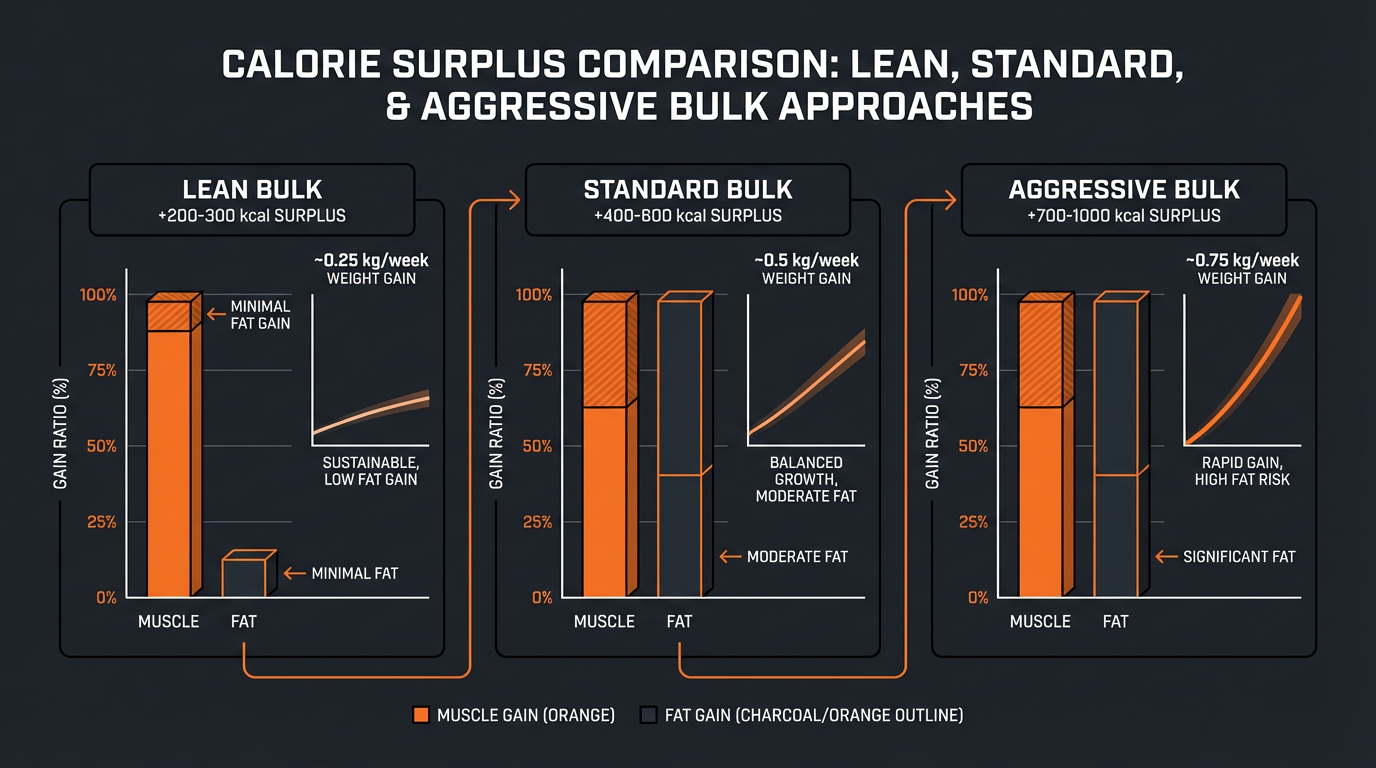
| Bulk Type | Surplus | Expected Weekly Gain | Best For |
|---|---|---|---|
| Lean bulk | +250 kcal | ~0.12 kg/week | Intermediate/advanced lifters, minimizing fat gain |
| Standard bulk | +500 kcal | ~0.25 kg/week | Most lifters, balanced approach |
| Aggressive bulk | +750 kcal | ~0.37 kg/week | Beginners, hardgainers, underweight individuals |
Choosing Your Surplus
•**Lean bulk (+250):** Best for experienced lifters who gain muscle slowly and want to minimize fat gain. Requires precise tracking.
•**Standard bulk (+500):** The most common recommendation. Provides enough surplus for muscle growth with manageable fat gain.
•**Aggressive bulk (+750):** Reserved for hardgainers, beginners (who have the highest potential for rapid muscle gain), or underweight individuals.
Monitoring Progress
Weigh yourself daily and track the weekly average. If you are gaining faster than expected, reduce calories by 100-200. If not gaining at all after 2-3 weeks, increase by the same amount.
Limitations
•Muscle gain rates are limited by biology (roughly 0.5-1 kg per month for intermediates). Excess calories beyond what supports muscle growth will be stored as fat.
•TDEE calculations are estimates. Adjust based on real-world scale trends.
•Genetic factors, training program quality, sleep, and stress all affect how effectively surplus calories are partitioned toward muscle growth.
Frequently Asked Questions
- How many extra calories do I need to bulk?
- A lean bulk adds 200-300 calories above your TDEE. A standard bulk is 300-500 extra. An aggressive bulk is 500+ over maintenance. The bigger the surplus, the faster you gain weight, but also the more fat you'll add alongside the muscle.
- What's the difference between a lean bulk and a dirty bulk?
- A lean bulk keeps the surplus small (200-300 cal) to minimize fat gain. A dirty bulk means eating everything in sight. Lean bulking is slower but you won't need a long cut afterward. Dirty bulking gets you bigger faster but with noticeably more fat.
- How much weight should I gain per week while bulking?
- 0.5-1 lb per week is ideal for a lean bulk. That translates to about 2-4 lbs per month. If you're gaining faster than that, you're adding unnecessary fat. If the scale isn't moving at all, eat more.
- Do I need to track calories while bulking?
- It helps, especially in the first few weeks until you get a feel for the right portions. Many skinny guys think they're eating a lot but they're actually 500+ calories short. Tracking for even 2 weeks shows you the gap between perception and reality.
- When should I stop bulking and start cutting?
- A good rule is to bulk until you hit roughly 18-20% body fat, then cut. This keeps you in a range where your body partitions nutrients efficiently. Bulking above 20% means more fat storage and a longer, more painful cut later.