DOTS Score Calculator
Modern alternative to Wilks for comparing powerlifting totals

What This Calculator Measures
The DOTS (Dynamic Objective Team Scoring) coefficient is a modern replacement for the Wilks Score, developed to provide a fairer comparison of powerlifting totals across body weight classes. It was adopted by many federations starting in 2019 as an improvement over the Wilks formula.
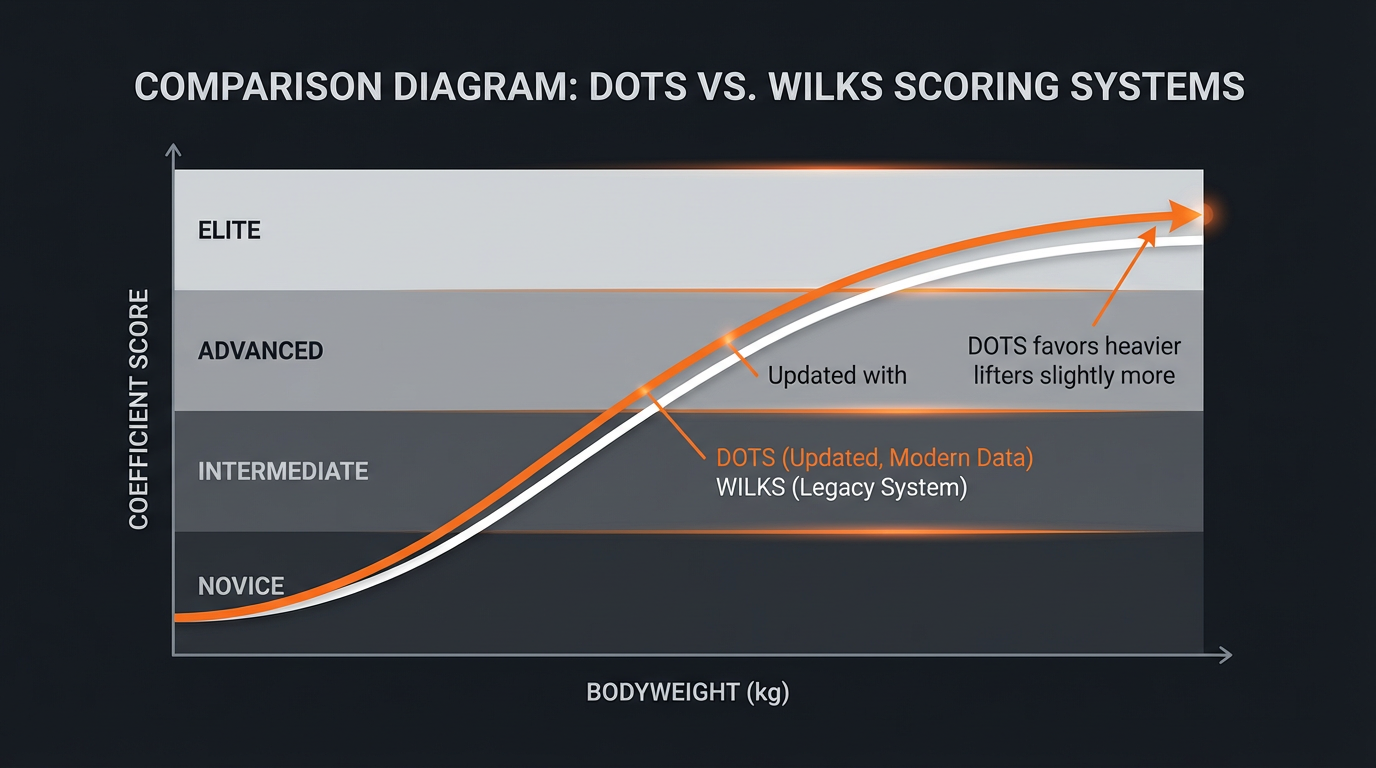
How It Works
DOTS uses a 4th-degree polynomial (vs Wilks' 5th-degree) to calculate a body weight coefficient:
**DOTS = Total x (500 / (a + bx + cx² + dx³ + ex⁴))**
Where x is body weight in kilograms. The simpler polynomial was designed to reduce the bias that the Wilks formula showed at extreme body weights, particularly favoring super heavyweight lifters.
| DOTS Score | Classification |
|---|---|
| Below 300 | Beginner |
| 300 - 399 | Intermediate |
| 400 - 499 | Advanced |
| 500+ | Elite |
DOTS vs Wilks
The primary advantage of DOTS over Wilks is improved accuracy at the extremes of the body weight spectrum. Lighter lifters (under 60 kg) and super heavyweights (over 120 kg) tend to get more equitable scores with DOTS. For lifters in the middle weight classes (70-100 kg), the two formulas produce very similar results.
Limitations
Frequently Asked Questions
- What is a DOTS score?
- DOTS (Dynamic Objective Team Scoring) is a modern formula for comparing powerlifting totals across different bodyweight classes. It was created as an improvement over Wilks, especially for lighter and heavier lifters where the old Wilks formula was less accurate.
- Should I use DOTS or Wilks?
- DOTS is generally considered more accurate and is being adopted by more federations. If you compete, check which formula your federation uses. For personal tracking, either works -- just pick one and be consistent.
- What's a good DOTS score for a recreational lifter?
- A DOTS score of 300-350 is solid for someone who's been training seriously for a couple years. Above 400 means you're quite strong for your weight class. Elite competitive lifters are typically 500+.
- How do I calculate my DOTS score?
- Enter your bodyweight and your best squat, bench, and deadlift. The calculator applies the DOTS coefficient to your total. You'll need actual or estimated maxes for all three lifts -- not rep maxes, but your one-rep max numbers.