Fat-Free Mass Index (FFMI)
Measure muscularity relative to height, adjusted for body fat

What This Calculator Measures
The Fat-Free Mass Index (FFMI) is a measure of muscularity normalized for height, similar to how BMI normalizes weight for height. Unlike BMI, FFMI only considers lean mass, making it a far superior metric for assessing how muscular someone is relative to their frame.
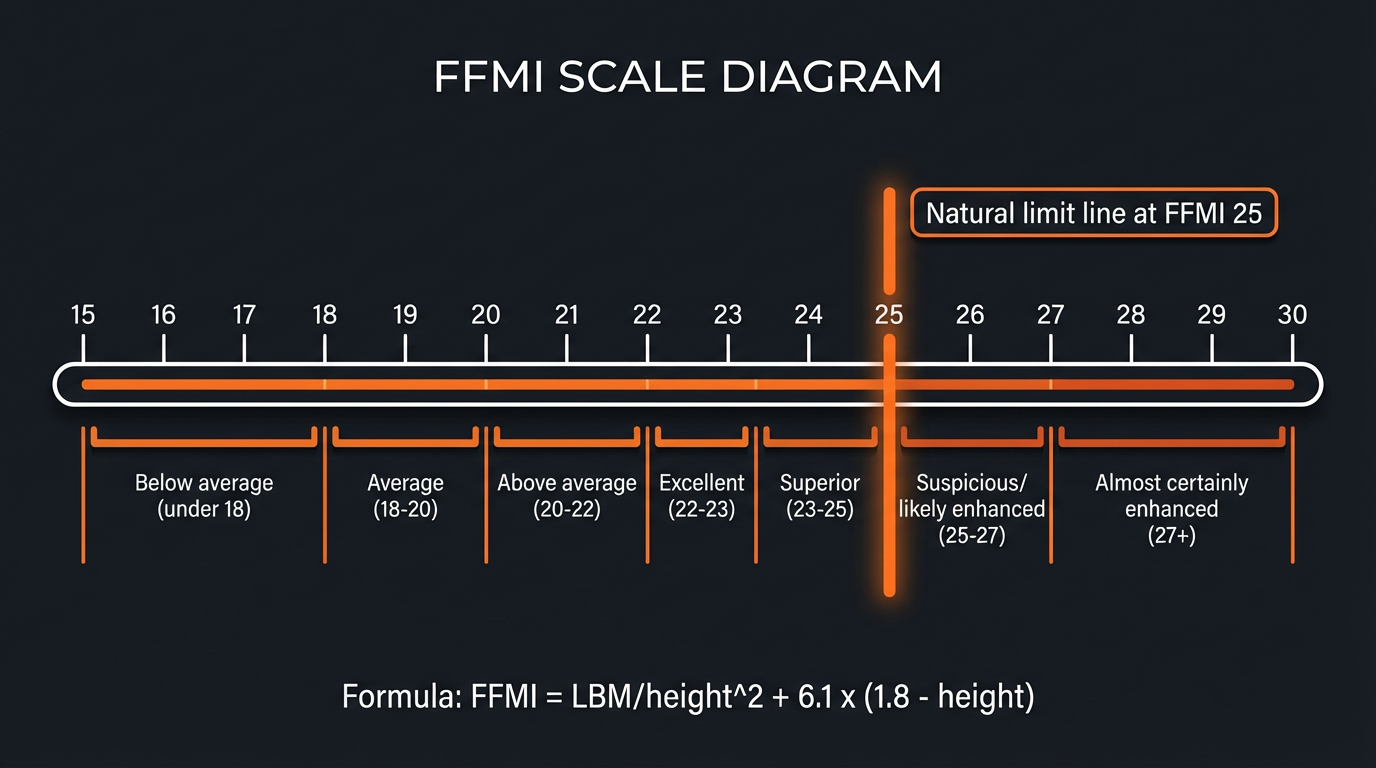
How It Works
**FFMI = Lean Mass / Height(m)²**
**Adjusted FFMI = FFMI + 6.1 x (1.8 - Height(m))**
The height adjustment normalizes the score so that taller and shorter individuals can be compared fairly.
| Adjusted FFMI | Classification |
|---|---|
| Below 18 | Below average muscularity |
| 18 - 20 | Average (typical male) |
| 20 - 22 | Above average (consistent training) |
| 22 - 25 | Excellent (years of serious training) |
| 25+ | Suspicious (likely exceeds natural limit) |
The Natural Limit
Research by Kouri et al. (1995) found that an FFMI of approximately 25 represents the upper limit of muscularity achievable without performance-enhancing drugs. Pre-steroid-era bodybuilders and modern drug-tested athletes rarely exceed this threshold.
Limitations
Frequently Asked Questions
- What is FFMI and why does it matter?
- Fat-Free Mass Index measures how muscular you are relative to your height. It's like BMI but only for lean tissue. An FFMI of 20 is average, 22-23 is well-built, and 25+ is near the natural limit. It tells you how close you are to your genetic muscular potential.
- What FFMI can a natural lifter reach?
- Most research suggests 25 is the approximate natural ceiling, with rare genetic outliers hitting 26-27. If someone has an FFMI of 28+, they're almost certainly not natural. For perspective, most guys who've trained hard for 5+ years land around 22-24.
- How do I calculate my FFMI?
- You need your height, weight, and body fat percentage. The formula is: (lean mass in kg) / (height in meters squared), then adjusted with a normalizing factor. Just plug your numbers into the calculator and it does the math.
- Is FFMI better than BMI for assessing physique?
- Way better. BMI calls muscular people overweight. FFMI actually measures muscularity. A bodybuilder and a couch potato might have the same BMI but vastly different FFMIs. If you lift, FFMI is the metric that actually tells you something useful.