Max Heart Rate Calculator
Compare multiple formulas for estimating your maximum heart rate

What This Calculator Measures
Maximum heart rate (MHR) is the highest number of beats per minute your heart can achieve during maximal physical exertion. It is the foundation for calculating heart rate training zones and is important for programming cardiovascular exercise intensity.
How It Works
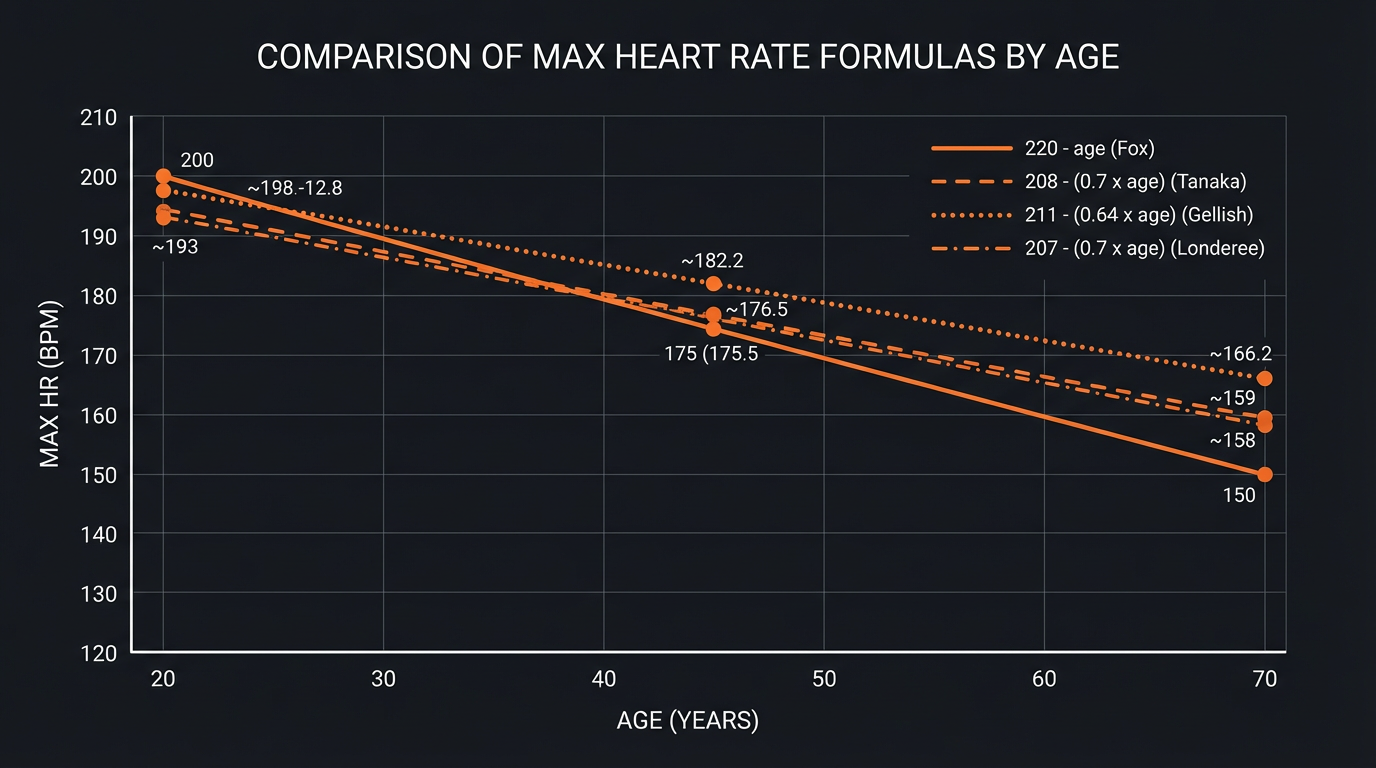
This calculator shows four well-known formulas:
| Formula | Equation | Best For |
|---|---|---|
| **Tanaka (2001)** | 208 - 0.7 x age | General population (recommended) |
| Traditional | 220 - age | Quick estimate, widely known |
| Gulati (2010) | 206 - 0.88 x age | Women specifically |
| HUNT (2012) | 211 - 0.64 x age | Physically active adults |
Example for age 30:
Why Tanaka?
The Tanaka formula (208 - 0.7 x age) is recommended as the primary result because a 2001 meta-analysis of 351 studies and 18,712 participants found it to be more accurate than the traditional 220-age formula, particularly for older adults where 220-age tends to overestimate max heart rate.
The Gold Standard
The only truly accurate way to determine your max heart rate is a graded exercise test (GXT) performed in a clinical or laboratory setting. All prediction formulas have a standard error of ±10-12 bpm, meaning your actual max could be meaningfully higher or lower.
Limitations
Frequently Asked Questions
- How do I estimate my max heart rate?
- The classic formula is 220 minus your age, but it's a rough estimate. The Gulati and Tanaka formulas are more accurate for different populations. For a 30-year-old, estimates range from 187-190 depending on the formula. Real max HR requires a lab test or an all-out effort.
- Why do different formulas give different max heart rates?
- Each formula was developed from different study populations. The 220-age formula is from the 1970s and oversimplifies things. Newer formulas like Tanaka (208 - 0.7 x age) account for age-related decline more accurately. No formula is perfect for every individual.
- Does fitness level affect my max heart rate?
- No. Max heart rate is mostly genetic and decreases with age regardless of fitness. What changes with fitness is your resting heart rate (lower is better) and how quickly you recover after intense effort. A fit person and an unfit person the same age can have the same max HR.
- Should I test my actual max heart rate?
- Only if you're healthy and have a baseline of fitness. A true max HR test involves running or cycling at increasing intensity until you physically can't continue. It's uncomfortable by design. For most people, formula estimates are close enough for setting training zones.