📊
Rep Max Percentage Table
View training loads at every percentage of your 1RM
Strength

kg
What This Calculator Measures
The Rep Max Percentage Table converts your one-rep max into working weights at various percentages. This is the foundation of percentage-based training programs, allowing you to prescribe precise training loads for different rep ranges and training goals.
How It Works
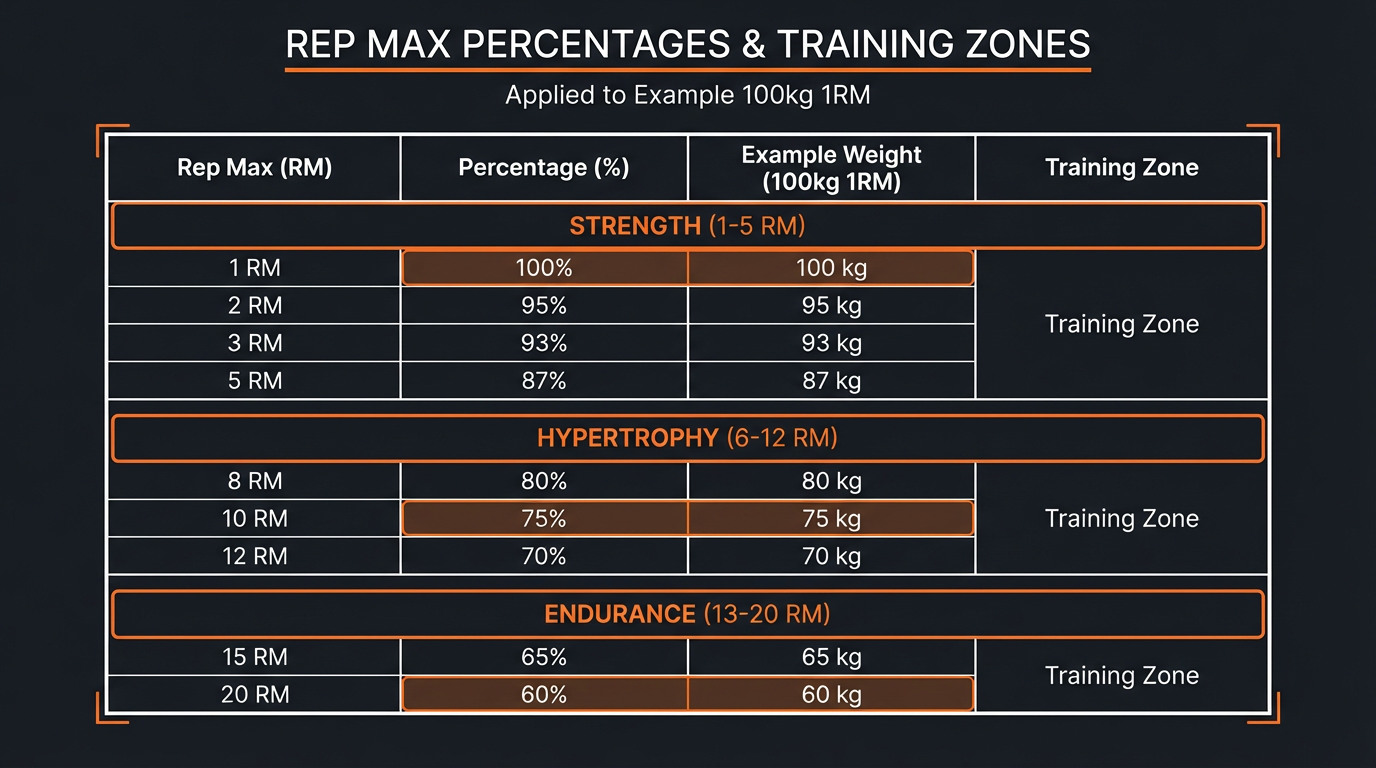
Each percentage of your 1RM corresponds to an approximate number of repetitions you can perform:
| % of 1RM | Estimated Reps | Primary Training Effect |
|---|---|---|
| 95% | ~2 reps | Maximal strength, neural adaptations |
| 90% | ~4 reps | Strength, low-rep power |
| 85% | ~6 reps | Strength-hypertrophy bridge |
| 80% | ~8 reps | Hypertrophy with strength |
| 75% | ~10 reps | Hypertrophy focus |
| 70% | ~12 reps | Hypertrophy, metabolic stress |
| 65% | ~15 reps | Muscular endurance, volume |
| 60% | ~20 reps | Endurance, recovery work |
How to Use This Table
Most strength programs prescribe loads as a percentage of 1RM. For example, a typical 5x5 program might call for 80-85% of your 1RM. With a 120 kg squat 1RM, that translates to 96-102 kg working weight.
Limitations
•Rep-percentage relationships are averages and vary by individual, exercise, and muscle group.
•Smaller muscle groups (biceps, lateral delts) tend to allow more reps at higher percentages than large compound movements.
•Fatigue accumulates across sets, so you may get fewer reps at the same percentage as sets progress.
Frequently Asked Questions
- What is a rep max percentage table?
- It shows the relationship between your 1RM and the weight you'd use for different rep ranges. For example, 85% of your 1RM is roughly your 5-rep max, and 70% is roughly your 12-rep max. It helps you pick the right weight for any prescribed rep range.
- How do I use a rep max table for my training?
- If your program says "4 sets of 8 at 75%," find 75% on the table and multiply by your 1RM. So if your squat 1RM is 300 lbs, you'd use 225 lbs for sets of 8. It takes the guesswork out of loading.
- Are the percentages the same for every exercise?
- Not exactly. The table is most accurate for big compound lifts like squat, bench, and deadlift. Isolation exercises and machine movements don't follow the same curves. Use the table for your main lifts and go by feel on accessories.
- Why does my actual rep max not match the table?
- Individual differences in muscle fiber type, training history, and fatigue tolerance cause variation. Some people are better at grinding out high reps, others are better at heavy singles. The table is an average -- use it as a starting point and adjust based on experience.