⏱️
Rest Period Calculator
Get evidence-based rest period recommendations for your training
Training

What This Calculator Measures
Rest periods between sets directly affect training outcomes. This calculator provides evidence-based rest period recommendations based on your rep range and training goal.
How It Works
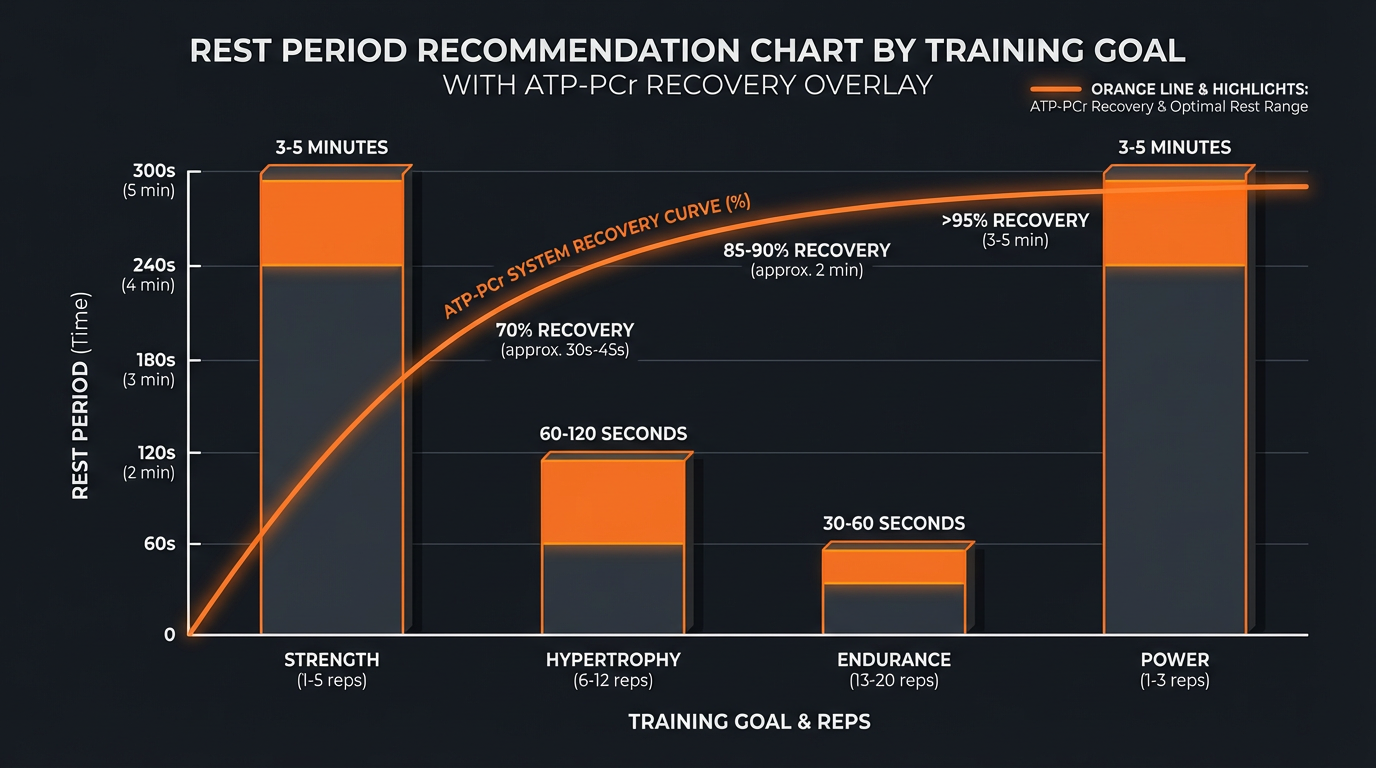
The calculator cross-references your rep range with your training goal to provide a recommended rest window. The general principle: heavier loads and strength-focused training require longer rest for neural recovery, while lighter loads and endurance work use shorter rest periods.
| Goal | Rep Range | Rest Period | Reasoning |
|---|---|---|---|
| Strength | 1-5 reps | 3-5 min | Full ATP-CP recovery for maximal force |
| Hypertrophy | 6-12 reps | 1.5-3 min | Balance recovery with metabolic stress |
| Endurance | 12+ reps | 30-90 sec | Maintain metabolic challenge |
The Science
•**ATP-CP system** (primary energy for heavy lifting) takes 3-5 minutes to fully recover. Cutting rest short during strength work means lifting less weight on subsequent sets.
•Recent research (Schoenfeld et al., 2016) found that **longer rest periods (3 min) produced greater hypertrophy** than shorter rest (1 min) when total volume was equated. This challenges the old advice that short rest is better for growth.
•For endurance goals, shorter rest periods are intentional: the incomplete recovery is part of the training stimulus.
Limitations
•These are general guidelines. Personal recovery rate, conditioning level, and exercise complexity all influence optimal rest.
•Compound exercises (squats, deadlifts) typically require more rest than isolation exercises (curls, laterals) at the same rep range.
•Supersets and circuits intentionally manipulate rest periods for time efficiency.
Frequently Asked Questions
- How long should I rest between sets?
- For strength (1-5 reps): 3-5 minutes. For hypertrophy (6-12 reps): 90 seconds to 2 minutes. For endurance (15+ reps): 30-60 seconds. The heavier the weight, the more rest you need to recover between sets.
- Does resting too long between sets hurt my gains?
- Not for strength or muscle growth. Research shows longer rest periods actually lead to better hypertrophy because you can lift more total weight. The old "60 seconds for the pump" advice is outdated. Rest enough to perform well on each set.
- Should I time my rest periods?
- Yes, especially if you tend to scroll your phone between sets and accidentally rest 5 minutes. Consistent rest periods make your training more productive and your workouts more time-efficient. Set a timer and be disciplined.
- Why do I feel weaker when I shorten my rest periods?
- Your phosphocreatine stores need 2-3 minutes to fully replenish. Short rest means you start the next set partially recovered, which means fewer reps and less weight. If strength is the goal, rest longer. Period.