📋
Strength Standards
See how your lifts compare to established strength benchmarks
Strength
kg
kg
What This Calculator Measures
Strength standards provide context for your lifts by comparing them to established benchmarks relative to your body weight. Rather than looking at absolute numbers, the body weight multiplier tells you how strong you are proportional to your size, which is a fairer measure across different weight classes.
How It Works
The calculator divides your lift weight by your body weight to produce a ratio. This ratio is then compared against widely-used strength standards for each lift.
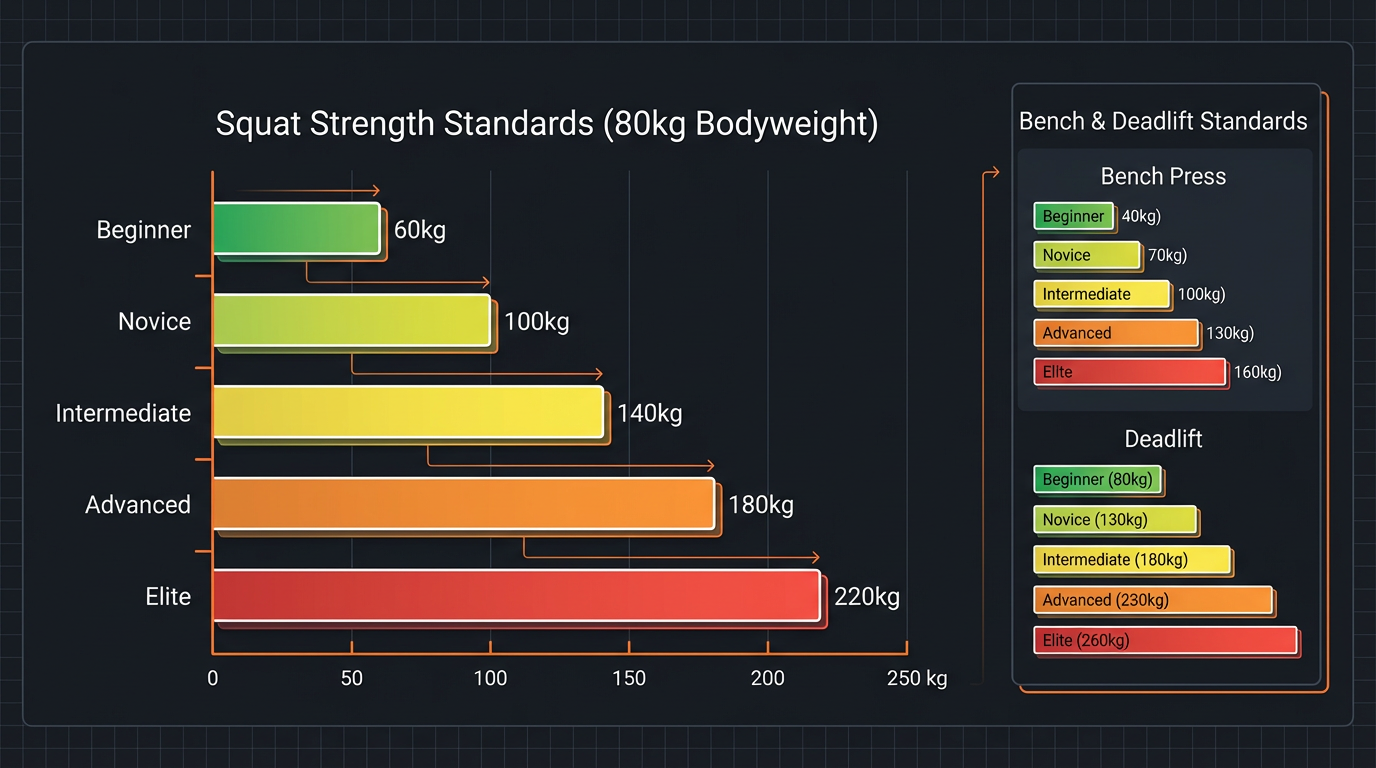
Male Standards (Body Weight Multiplier)
| Level | Squat | Bench Press | Deadlift |
|---|---|---|---|
| Beginner | < 0.75x | < 0.5x | < 1.0x |
| Novice | 0.75 - 1.25x | 0.5 - 1.0x | 1.0 - 1.5x |
| Intermediate | 1.25 - 1.75x | 1.0 - 1.5x | 1.5 - 2.0x |
| Advanced | 1.75 - 2.5x | 1.5 - 2.0x | 2.0 - 2.75x |
| Elite | 2.5x+ | 2.0x+ | 2.75x+ |
For example, an 80 kg lifter benching 100 kg has a ratio of 1.25x, placing them at the **Intermediate** level.
Limitations
•These standards are general guidelines. Actual competitive standards vary by federation and weight class.
•Strength ratios naturally decrease as body weight increases due to the square-cube law. A 60 kg lifter will typically have higher ratios than a 120 kg lifter at the same skill level.
•Age, training history, and individual leverages all affect where you fall.
Frequently Asked Questions
- What are strength standards and where do they come from?
- Strength standards rank your lifts from beginner to elite based on bodyweight and training experience. They're compiled from millions of user-submitted lifts across platforms like Symmetric Strength and ExRx. They give you a rough idea of where you stand.
- How accurate are online strength standards?
- Take them with a grain of salt. They're based on self-reported data, which skews high (people don't usually report bad lifts). They're useful as general guidelines but don't get depressed if your numbers seem low. Focus on your own progression.
- What's considered an intermediate bench press for my weight?
- Roughly 1x bodyweight for a bench press is a common intermediate milestone. At 180 lbs, benching 180 means you've moved past beginner territory. For squat it's about 1.5x bodyweight, and deadlift about 2x bodyweight.
- Should I compare my lifts to strength standards?
- Use them as a rough benchmark, not an ego measure. If your squat is at beginner level after a year of training, that's a sign to fix your programming or form. But don't chase arbitrary numbers -- consistent personal improvement is what matters.