Waist-to-Hip Ratio
Assess health risk based on fat distribution pattern

What This Calculator Measures
The Waist-to-Hip Ratio (WHR) is a measure of body fat distribution that indicates cardiovascular and metabolic health risk. Central (abdominal) fat is more strongly correlated with health risks than peripheral fat, making WHR a more useful health indicator than BMI for many people.
How It Works
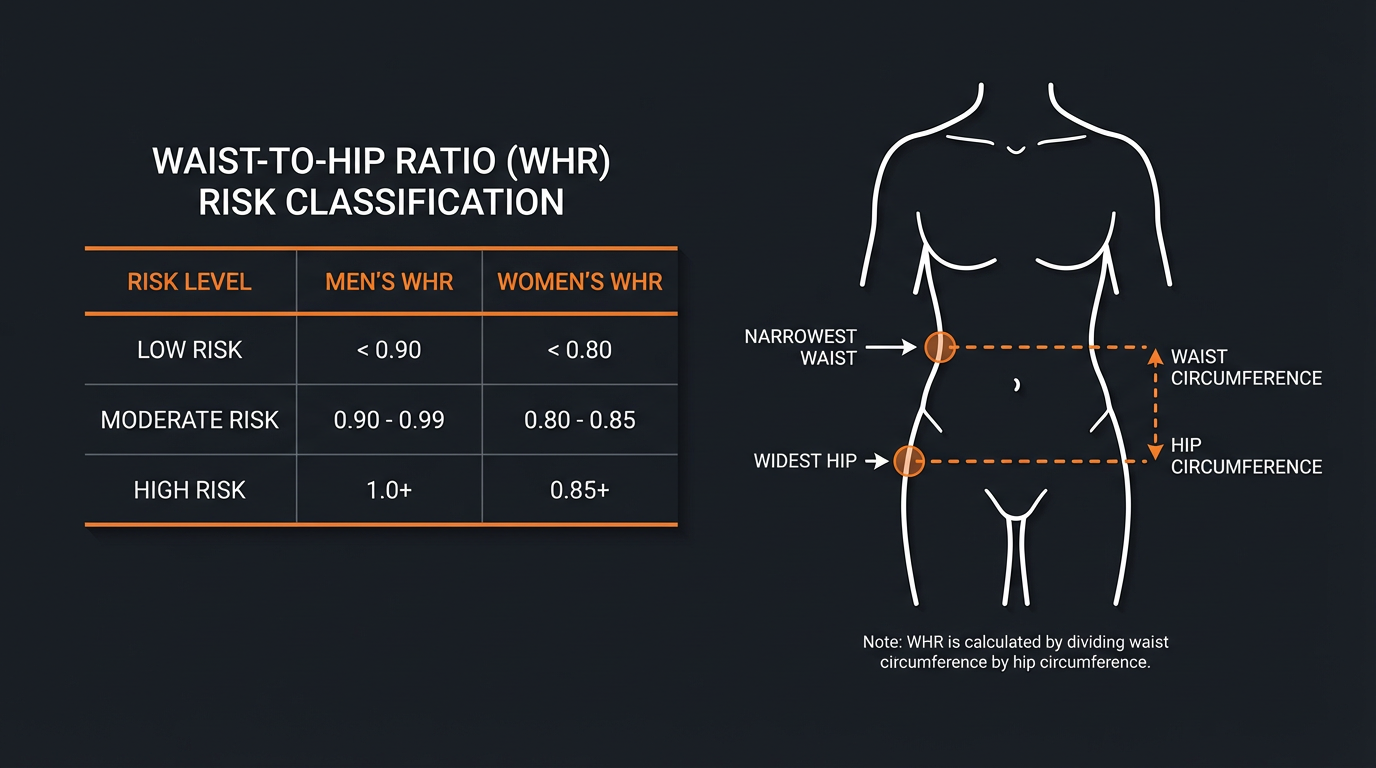
**WHR = Waist Circumference / Hip Circumference**
Measure your waist at the narrowest point (usually at the navel) and your hips at the widest point of the buttocks.
Male Risk Categories
| WHR | Risk Level |
|---|---|
| Below 0.90 | Low risk |
| 0.90 - 0.99 | Moderate risk |
| 1.00+ | High risk |
Female Risk Categories
| WHR | Risk Level |
|---|---|
| Below 0.80 | Low risk |
| 0.80 - 0.85 | Moderate risk |
| 0.85+ | High risk |
Why It Matters
A higher WHR indicates more visceral (abdominal) fat, which is associated with increased risk of cardiovascular disease, type 2 diabetes, and metabolic syndrome. Research consistently shows WHR is a better predictor of cardiovascular events than BMI alone.
Limitations
Frequently Asked Questions
- What is waist-to-hip ratio and why should I care?
- It compares your waist circumference to your hip circumference. A ratio above 0.90 for men indicates higher health risk because fat stored around your midsection is more dangerous than fat elsewhere. It's a simple way to assess visceral fat.
- What is a healthy waist-to-hip ratio for men?
- Below 0.90 is considered low risk, 0.90-0.99 is moderate risk, and 1.0+ is high risk. For an athletic look, aim for 0.80-0.85. Most fit guys who lift and keep body fat reasonable fall in this range.
- How do I measure my waist and hips correctly?
- Measure your waist at the narrowest point (usually at the navel, relaxed, not sucking in). Measure your hips at the widest point of your glutes. Stand straight, use a flexible tape measure, and keep it level around your body.
- Is waist-to-hip ratio better than BMI?
- For health risk assessment, yes. Waist-to-hip ratio specifically measures where your fat is stored, which matters more than how much you weigh. Two guys at the same BMI can have very different health risks based on their fat distribution.