🏆
Wilks Score Calculator
Compare powerlifting strength across weight classes
Strength

kg
kg
What This Calculator Measures
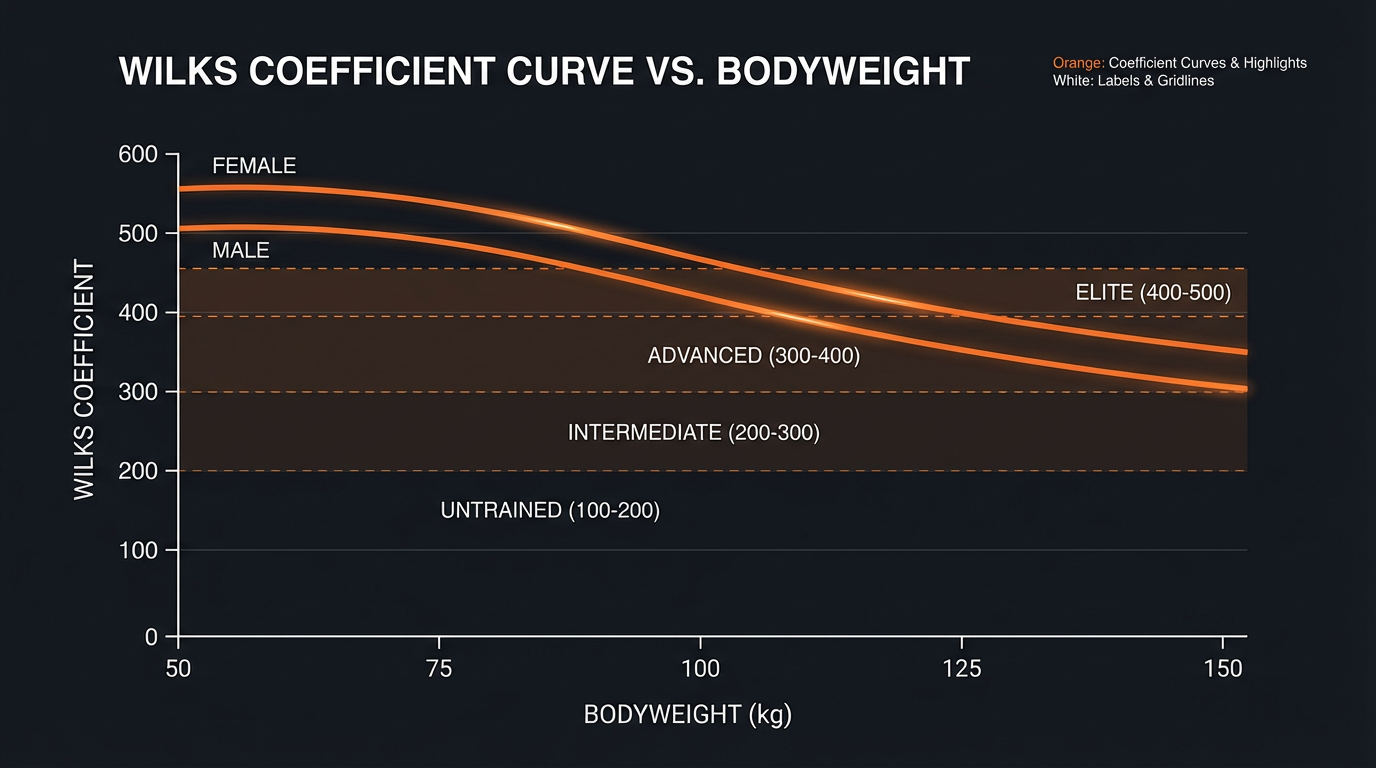
The Wilks Score is a coefficient used in powerlifting to compare the relative strength of lifters across different body weight classes. A higher Wilks Score indicates greater pound-for-pound strength. It has been the standard comparison metric in the International Powerlifting Federation (IPF) for decades.
How It Works
The Wilks formula applies a polynomial coefficient to your powerlifting total (squat + bench + deadlift):
**Wilks = Total x (500 / (a + bx + cx² + dx³ + ex⁴ + fx⁵))**
Where x is body weight in kilograms and a-f are sex-specific published coefficients. The formula normalizes totals so that a 60 kg lifter and a 120 kg lifter can be compared fairly.
| Wilks Score | Classification |
|---|---|
| Below 300 | Beginner |
| 300 - 399 | Intermediate |
| 400 - 499 | Advanced |
| 500+ | Elite |
Limitations
•The Wilks formula has been criticized for slightly favoring heavier lifters at extreme body weights.
•The DOTS and GL coefficients were developed as more modern alternatives that may provide fairer comparisons at the extremes of body weight.
•Wilks only applies to the powerlifting total (squat, bench, deadlift). It does not apply to individual lifts or other sports.
•The formula uses separate coefficients for male and female lifters. It is not designed for cross-sex comparisons.
Frequently Asked Questions
- What is a Wilks score and what does it measure?
- Wilks is a formula that adjusts your powerlifting total (squat + bench + deadlift) relative to your bodyweight. It lets a 150 lb lifter compare their strength to a 220 lb lifter on equal footing. Higher score means more impressive pound-for-pound strength.
- What is a good Wilks score?
- 300+ is solid for a recreational lifter. 400+ is competitive at the local level. 500+ puts you in elite territory. Most guys who train consistently for 2-3 years land somewhere in the 300-400 range.
- How is Wilks different from DOTS?
- Both compare strength across weight classes, but DOTS is newer and considered more accurate at extreme bodyweights (very light or very heavy lifters). For most people in the middle, the scores tell a similar story. DOTS is gradually replacing Wilks in competition.
- Do I need to be a competitive powerlifter to use this?
- No. Even casual lifters benefit from tracking their Wilks score over time. It tells you whether you're getting stronger relative to your bodyweight, which is more meaningful than just tracking raw numbers.