The Best Bicep Exercises Ranked by EMG Activation
We ranked the top bicep exercises by muscle activation data. Some of the results will change how you train arms.
 Jeff·Feb 8, 2026·8 min read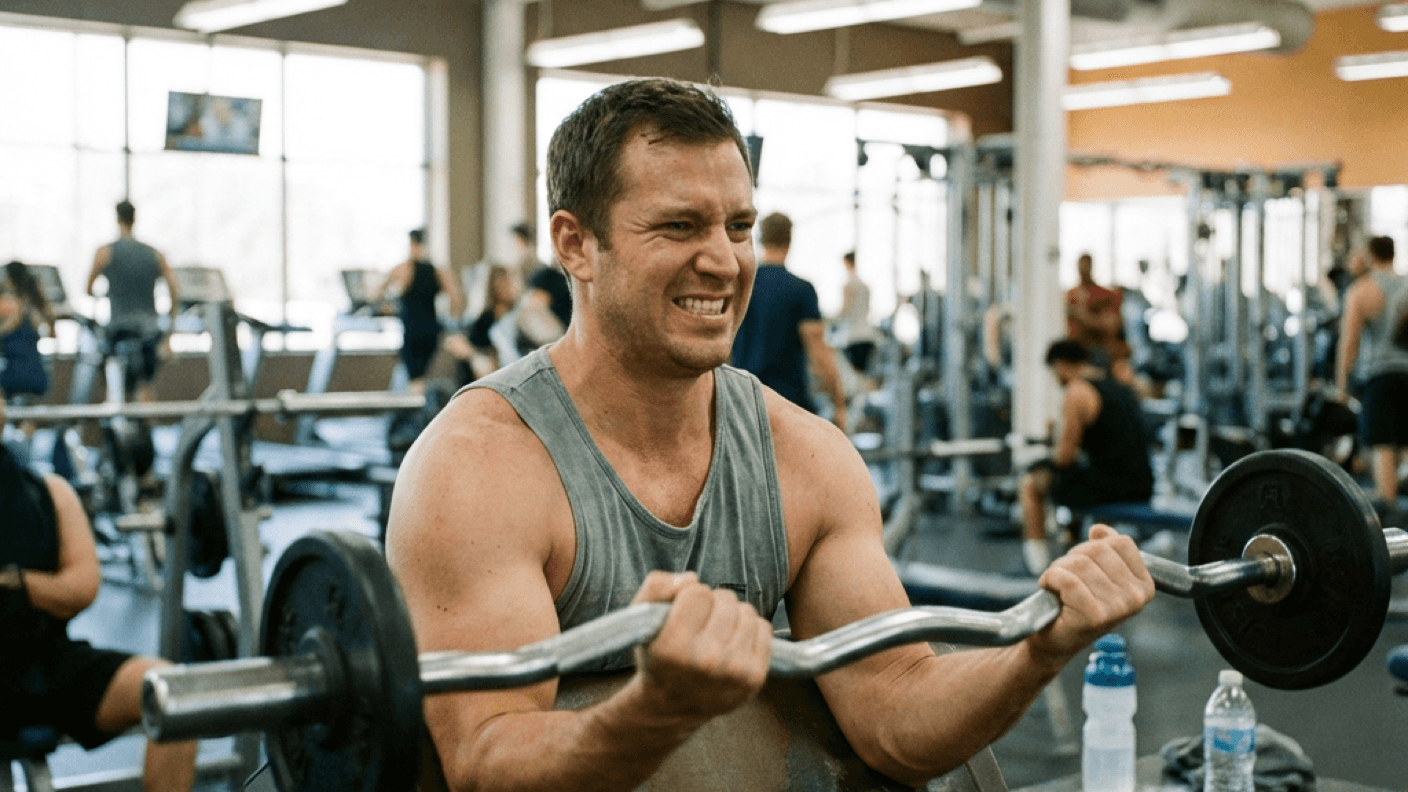
Key Takeaways
- Concentration curls top the EMG charts because they eliminate all cheating, but you'll never build serious mass with the light weight they force you to use.
- Barbell curls should be your main bicep exercise since you can load them heavy and progressively overload easier than any other curl variation.
- Hammer curls hit the brachialis muscle under your biceps, which pushes your biceps up and out when it grows, making your arms look bigger from the front.
- Incline dumbbell curls and behind-the-back cable curls target the long head better for building that bicep peak everyone wants.
- Skip machine preacher curls and cable concentration curls since they lock you into bad angles and offer no real advantages over the free weight versions.
Get This on WhatsApp
Get a quick summary and link sent straight to your WhatsApp.
Send Me This ArticleWhat EMG actually measures
Before we rank anything, you need to understand what electromyography (EMG) does and what it does not do. EMG measures the electrical activity in a muscle during contraction. Higher electrical activity generally means more motor units are being recruited, which usually means more muscle fibers are working.
Sounds perfect for ranking exercises, right? Not so fast.
EMG has real limitations. It measures surface-level electrical activity, so deeper muscles are harder to read accurately. It is affected by electrode placement, skin thickness, subcutaneous fat, and even sweat. A slight shift in the sensor pad between exercises can change the reading.
EMG also does not account for mechanical tension through a full range of motion. An exercise might show lower peak EMG but create more total tension across the entire rep. Stretch-mediated hypertrophy (muscle growth from loaded stretching) does not always show up as high EMG readings, but the research from Maeo et al. (2022) and others strongly suggests it drives significant growth.
So use these rankings as one data point, not gospel. The best exercise is still the one you can do with good form, progressive overload, and consistency. With that disclaimer out of the way, here are the results.
The rankings: peak bicep EMG activation
These rankings are compiled from multiple EMG studies, including Boeckh-Behrens and Buskies (2000), ACE-sponsored research (2014), and Oliveira et al. (2009). I have normalized the data to concentration curls at 100% since that is the benchmark most studies use.
| Rank | Exercise | Relative EMG (%) | Primary head targeted |
|---|---|---|---|
| 1 | Concentration curl | 100% | Short head |
| 2 | Cable curl (low pulley) | 94% | Both heads |
| 3 | Barbell curl | 90% | Both heads |
| 4 | Chin-up (supinated grip) | 89% | Both heads |
| 5 | EZ-bar curl | 86% | Both heads (slightly less supination) |
| 6 | Incline dumbbell curl | 85% | Long head |
| 7 | Preacher curl | 82% | Short head |
| 8 | Hammer curl | 71% | Brachialis + brachioradialis |
| 9 | Reverse curl | 63% | Brachioradialis + brachialis |
| 10 | Behind-the-back cable curl | 80% | Long head |
A few things jump out from this data.
Why concentration curls rank first (and why it does not matter as much as you think)
Concentration curls produce the highest peak EMG for the biceps because they completely eliminate momentum. Your upper arm is braced against your inner thigh, your body is stable, and the only thing moving the weight is your bicep. There is literally no way to cheat.
But here is the thing: peak EMG activation does not automatically mean "best exercise for growth." Concentration curls are limited by the load you can use. You are never going to concentration curl 80 pounds. And total mechanical tension (force x time x range of motion) is what drives hypertrophy, not just peak electrical activity in a snapshot of the movement.
Concentration curls are a great finishing exercise. They should probably not be your primary bicep movement. Use them for 2-3 sets at the end of your arm work to chase a pump and squeeze out some extra volume after your heavier movements.
The case for barbell curls as your primary movement
Barbell curls rank third in peak EMG but are arguably the best overall bicep builder for one reason: load. You can barbell curl significantly more weight than any other bicep isolation exercise. More weight means more mechanical tension. More mechanical tension means more growth stimulus.
Barbell curls also allow for natural progressive overload. You can add 2.5-5 pounds every few weeks in a way that is much harder with concentration curls or cable work. That steady progression over months and years is what actually builds big arms.
Strict form matters here. Stand with your back against a wall if you have to. No swinging, no hip thrust, no leaning back. If you cannot keep your elbows pinned to your sides and your torso still, the weight is too heavy.
Long head vs. short head: why it matters
Your bicep has two heads, and they respond differently to different exercises based on arm position:
Long head (outer bicep, creates the "peak"): Better targeted when your arm is behind your body or in a neutral/stretched position. Best exercises: incline dumbbell curls, behind-the-back cable curls, drag curls.
Short head (inner bicep, creates width): Better targeted when your arm is in front of your body or in a supinated position. Best exercises: concentration curls, preacher curls, spider curls.
If you only do barbell curls and nothing else, you are hitting both heads fairly equally, which is fine. But if you want to bring up a specific aspect of your bicep development, you can bias your exercise selection.
Want more peak? Add incline curls. Want more thickness? Add preacher curls.
The brachialis: the muscle you are probably ignoring
Look at the EMG chart again. Hammer curls rank relatively low for biceps activation at 71%. But they are not really a bicep exercise. They primarily target the brachialis, a muscle that sits underneath the biceps.
Why should you care about the brachialis? Because when it grows, it physically pushes the biceps upward, making your arm look taller and more peaked from the front. It also adds width to the upper arm when viewed from the front, filling in the gap between the bicep and tricep.
The brachialis responds best to neutral-grip and pronated-grip exercises:
- •Hammer curls (neutral grip): The best overall brachialis exercise
- •Cross-body hammer curls: Good for the brachialis with a slightly different angle
- •Reverse curls (pronated grip): Hit the brachialis and the brachioradialis (top of the forearm)
If your arms look flat from the front even though your bicep peak looks decent from the side, you probably need more brachialis work. Add 3-4 sets of hammer curls per week.
How to program these exercises
Here is where the EMG data becomes useful in practice. Instead of just picking your favorite exercises, you can build a program that hits every part of the bicep through its full range of motion.
A balanced bicep session (pick one from each category)
Heavy compound (high mechanical tension):
- •Barbell curl: 3-4 sets of 6-10 reps
- •Chin-up (weighted if possible): 3-4 sets of 6-10 reps
Long head emphasis (stretched position):
- •Incline dumbbell curl: 3 sets of 10-12 reps
- •Behind-the-back cable curl: 3 sets of 10-12 reps
Short head / peak contraction:
- •Preacher curl: 2-3 sets of 10-12 reps
- •Concentration curl: 2-3 sets of 12-15 reps
Brachialis:
- •Hammer curl: 3 sets of 10-12 reps
- •Reverse curl: 2-3 sets of 12-15 reps
You do not need to do all of these in one session. Spread them across 2-3 sessions per week. A sample split might look like:
Sample weekly bicep plan
Monday (with back training)
- •Barbell curl: 4x8 @ RPE 8
- •Incline dumbbell curl: 3x10-12 @ RPE 8-9
- •Hammer curl: 3x10-12 @ RPE 9
Thursday (arm day or with another body part)
- •Cable curl: 3x10-12 @ RPE 8
- •Preacher curl: 3x10-12 @ RPE 8-9
- •Concentration curl: 2x12-15 @ RPE 9-10
- •Reverse curl: 2x12-15 @ RPE 9
Weekly total: 18-20 sets across the biceps and brachialis
This is a higher-volume approach suited for someone specializing in arms. If your arms are not a weak point, cut it to 10-14 total sets per week and pick 2-3 exercises instead.
The exercises you can skip
Not everything is worth your time. A few exercises that rank poorly and have better alternatives:
Machine preacher curl: Most machines lock you into a fixed path that does not match natural bicep mechanics. Free weight preacher curls are better.
Cable concentration curl: Awkward setup, no advantage over dumbbell concentration curls, and the cable angle is wrong for peak contraction.
21s (7-7-7 curls): Fun for a pump, terrible for progressive overload. The partial reps at the bottom and top are too easy, and the full reps in the middle are too few. You are better off doing 3x10 with a weight that actually challenges you through the full range of motion.
The bottom line on EMG and exercise selection
EMG data gives you a starting point. It tells you which exercises create the most muscle activity, which is useful for making informed choices about your training. But it is not the whole picture.
The best bicep program combines:
- •A heavy movement you can progressively overload (barbell curls, chin-ups)
- •An exercise that loads the stretched position (incline curls)
- •An exercise with high peak contraction (concentration curls, preacher curls)
- •Something for the brachialis (hammer curls)
Hit those four categories across your training week, get stronger over time, and eat enough protein. That is the formula. The specific exercises matter less than people think. What matters is that you are covering all positions in the strength curve and pushing close to failure on most sets.
Frequently Asked Questions
- What bicep exercise has the highest muscle activation?
- Concentration curls consistently top EMG studies for peak bicep activation because your arm is braced and there is zero momentum. That said, EMG activation alone does not determine which exercise builds the most muscle. Heavy barbell curls and incline dumbbell curls are still staples for good reason.
- Are barbell curls or dumbbell curls better for bicep growth?
- Dumbbell curls generally produce slightly higher bicep activation because each arm works independently and you get a better supination at the top. But barbell curls let you go heavier. Use both. Barbell curls for strength, dumbbell curls for isolation.
- Do hammer curls work the biceps?
- Hammer curls hit the brachialis and brachioradialis more than the bicep heads. They are not a true bicep exercise, but they build the muscle underneath the bicep that pushes it up and makes your arm look thicker. Every arm routine should include them.
- How many sets of biceps per week for growth?
- Most people grow well on 10-20 direct sets per week, split across 2-3 sessions. Start at 10 and add a couple sets per week if you are recovering well. More than 20 sets per week for biceps is almost always junk volume.
- Should I go heavy or light on bicep curls?
- Both. Use heavier weight (6-8 reps) on barbell and standing curls early in your workout, then drop to lighter weight (10-15 reps) for concentration and cable curls. The biceps respond well to a mix of rep ranges.