How to Measure Your Arms Correctly (And Why You Are Probably Doing It Wrong)
Most people add an inch or more to their arm measurements without realizing it. Here is how to get an accurate number every time.
 Jeff·Feb 8, 2026·9 min read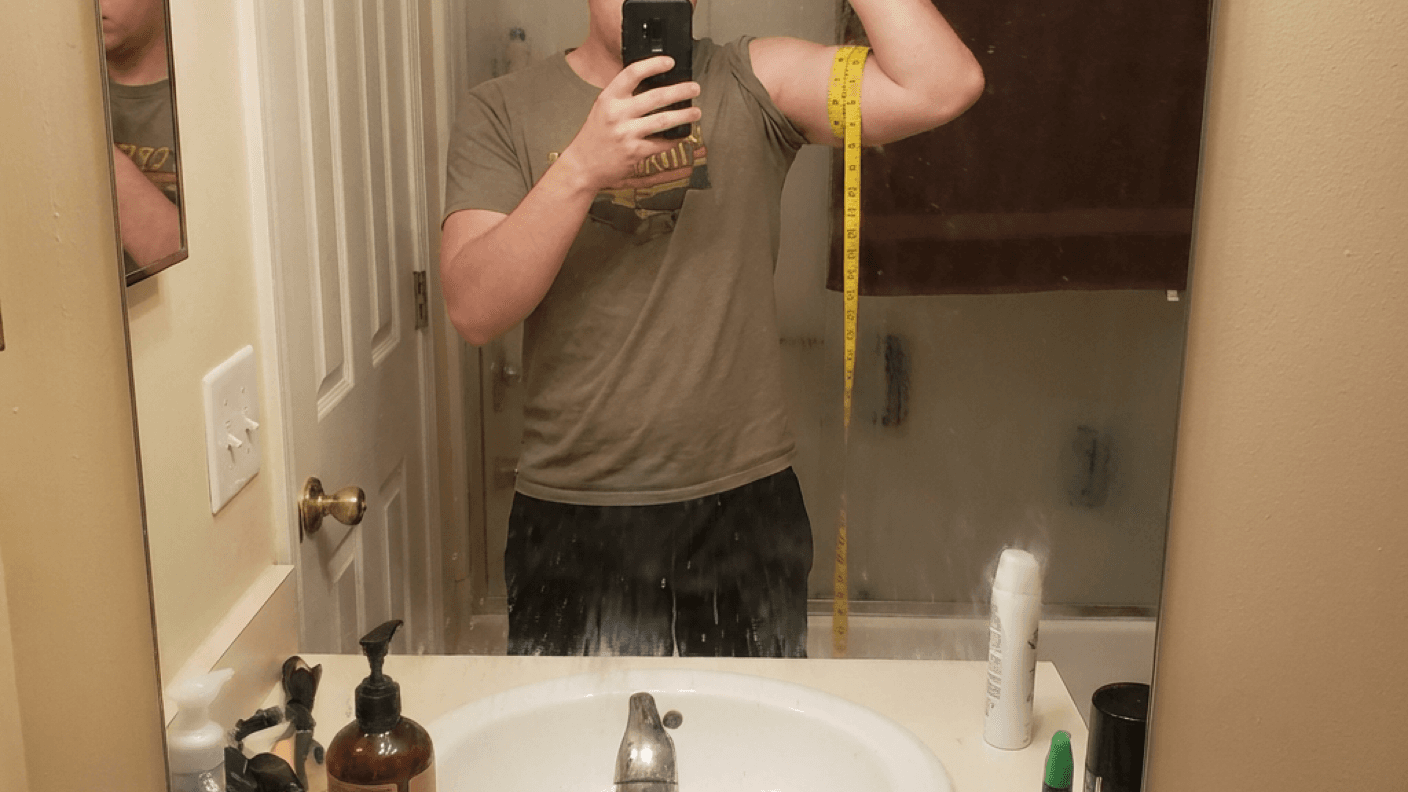
Key Takeaways
- Most people measure their arms post-workout with a pump and angle the tape to catch the highest point, inflating their measurements by half an inch or more.
- The fitness industry standard is flexed and cold (12-24 hours after your last upper body workout), not pumped from training.
- Measure at the midpoint between your shoulder and elbow with the tape perpendicular to your arm, not at the thickest part or angled diagonally.
- For balanced proportions, your flexed arms should equal your neck and calf measurements according to Steve Reeves' ideal ratios.
- Progress photos show muscle shape and definition changes that tape measurements can't capture, making them equally important for tracking development.
Get This on WhatsApp
Get a quick summary and link sent straight to your WhatsApp.
Send Me This ArticleYou are probably measuring wrong
I am going to guess something about you. You measure your arms right after a workout, flexed as hard as possible, with the tape angled slightly so it catches the peak of your bicep at the highest point. You might even pull the tape just a little snug. And then you tell people that number.
You are not alone. Almost everyone does this. And almost everyone's arm measurement is inflated by at least half an inch, sometimes a full inch or more.
Does it matter? If you are just tracking your own progress over time using the same method, honestly, not really. Consistency matters more than accuracy. But if you want a number that actually means something, a number you can compare to charts, to standards, to other lifters, then you need to measure correctly.
Flexed vs. unflexed: which one to use
The fitness industry standard for arm measurements is flexed, cold (no pump). This is what bodybuilders report, what most size charts reference, and what you should use for comparisons.
The NHANES/CDC measurements that show up in medical research are unflexed, relaxed. If you are comparing yourself to those charts, measure unflexed.
The difference between flexed and unflexed is typically 1-2 inches for a trained individual. So if your flexed measurement is 16 inches, your unflexed arm is probably around 14-14.5 inches. Keep track of which one you are using and be consistent.
Cold vs. pumped: why the pump lies
After a hard arm workout, blood rushes into the muscle and your arms can swell by 0.5 to 1.5 inches temporarily. This is the pump. It feels amazing. It looks amazing. It is also completely temporary and tells you nothing about your actual arm size.
Measure your arms cold, meaning at least 12-24 hours since your last upper body workout. First thing in the morning works well. Your muscles are at their true resting size, no inflation from training.
If you have been measuring post-workout and wondering why your arms "shrink" on rest days, now you know. They did not shrink. You were just measuring a temporary state.
Step-by-step: how to measure your upper arm
Here is the correct procedure. It is simple but the details matter.
- •Stand up straight with your arm at your side, relaxed
- •Find the midpoint of your upper arm, roughly halfway between the bony point of your shoulder (acromion) and the point of your elbow (olecranon). You can eyeball this or actually measure the distance and mark the middle with a pen
- •For a flexed measurement: Raise your arm to the side and bend your elbow to 90 degrees. Make a fist and flex your bicep as hard as you can. Wrap the tape around the thickest part of your upper arm at that midpoint. The tape should be perpendicular to the long axis of your arm
- •For an unflexed measurement: Keep your arm hanging at your side, relaxed. Wrap the tape at the same midpoint
- •Pull the tape snug but not tight. It should make contact with the skin all the way around without compressing the tissue. If the tape is digging into your arm, you are pulling too tight. If there is a gap between the tape and your skin, it is too loose
- •Read the number where the tape overlaps. Do not round up
Common mistakes
- •Measuring at the peak instead of the midpoint. If you slide the tape up toward your armpit to catch the thickest part of your bicep, you are cheating. The standard is midpoint
- •Angling the tape. The tape should be level, perpendicular to your arm. Angling it diagonally catches more surface area and inflates the number
- •Flexing your forearm too. When you flex your bicep, your forearm muscles also engage and can push the tape out. Try to isolate the bicep flex
- •Measuring over clothing. Seems obvious but I have seen it. Skin only
How to measure your forearms
Forearm measurements are less standardized, but the most common approach:
- •Extend your arm straight out in front of you with your palm facing up
- •Make a fist and flex your forearm (squeeze your fist hard)
- •Wrap the tape around the thickest part of your forearm, which is usually about 1-2 inches below the elbow crease
- •Same rules: snug not tight, tape level, no rounding up
Average forearm circumference for men is around 11-12 inches. A well-developed forearm on a trained male is 13-14 inches. Anything over 14 inches is genuinely large.
What measurements to track for progress
If you are serious about tracking your physique development, do not just measure your arms. Take a full set of measurements once a month. Here is the list I recommend:
- •Neck: At the narrowest point, below the Adam's apple
- •Shoulders: Around the widest point of both deltoids (you will need someone to help with this one)
- •Chest: At nipple level, relaxed, not puffed up
- •Upper arms: Flexed, cold, at midpoint (both sides)
- •Forearms: Flexed, at the thickest point (both sides)
- •Waist: At the navel, relaxed (do not suck in)
- •Hips: At the widest point of the glutes
- •Thighs: At the midpoint between hip crease and knee, flexed
- •Calves: At the thickest point, standing on tiptoe
Take these on the same day each month, at the same time of day, under the same conditions (morning, fasted, no pump). Write them down or put them in a spreadsheet. Photos from the same angles under the same lighting are also invaluable.
The goal is consistency. Your actual numbers matter less than the trend over time.
The Steve Reeves ideal proportions
Steve Reeves, the bodybuilder and actor from the 1950s, developed a set of "ideal" body proportions that are still referenced today. His measurements were taken during a time before widespread steroid use, so they represent what a truly elite natural physique can achieve.
Reeves believed that certain body parts should maintain specific ratios to each other:
| Measurement | Ratio |
|---|---|
| Flexed arm | Should equal neck circumference |
| Flexed arm | Should equal calf circumference |
| Waist | Should be 70% of chest |
| Thigh | Should be 25% larger than knee |
| Neck | Should be 2.5x wrist circumference |
The arm-to-neck-to-calf ratio is the one most people focus on. If your arms, neck, and calves all measure roughly the same, your upper body has balanced proportions. Most lifters have arms that outpace their calves and neck significantly, which is a sign that they are prioritizing show muscles over total development.
For reference, Reeves' own measurements were approximately:
- •Arms: 18.5" (flexed, cold, though some dispute this number)
- •Neck: 18.5"
- •Calves: 18.5"
- •Chest: 52"
- •Waist: 29"
He stood 6'1" and weighed about 215 pounds in contest shape. Whether you agree with his aesthetics or not, the proportionality concept is useful. It gives you targets beyond just "make my arms bigger."
Dealing with arm asymmetry
Almost everyone has one arm that is slightly larger than the other. For right-handed people, the right arm is usually a quarter to half inch bigger. This is normal. Do not freak out about it.
If the difference is more than half an inch, you might want to add a few extra sets of unilateral (single-arm) work for the smaller side. Do the weaker arm first, then match those reps and weight with the stronger arm. Over time, the gap should close.
If your arms have always been different sizes by a small margin, just accept it. Nobody is looking at your arms with a tape measure except you.
Progress photos: the measurement the tape cannot replace
Honestly, photos are more useful than tape measurements for tracking arm development. A tape can tell you your circumference went from 15.0 to 15.3 inches. A photo can show you that your bicep peak got taller, your brachialis started showing, and the separation between your bicep and tricep got sharper.
Here is how to take useful progress photos for your arms:
Front double bicep: Stand facing the camera, flex both arms with elbows at shoulder height. This shows peak, width, and overall arm shape. Keep the camera at chest level and stand the same distance away each time.
Side arm shot: Turn sideways to the camera and flex one arm. This shows the bicep peak from the side and gives a good view of the tricep from behind. Alternate which side faces the camera or take both.
Relaxed front: Stand facing the camera with arms at your sides, relaxed. This shows how your arms actually look in everyday life. It is less exciting than the flexed shots but more honest.
Take these under the same lighting conditions every time. Natural light from a window works well. Overhead gym lighting makes everyone look bigger and more defined than they are. Pick one and stick with it.
The tape measure you use matters
This sounds ridiculous but it is true. Fabric tape measures can stretch over time. If you have been using the same cloth tape for three years, it might be reading half an inch short because the material has stretched. Fiberglass or metal tape measures hold their calibration better.
Buy a Myotape body tape measure (about ten dollars) or a standard fiberglass sewing tape. Replace it once a year. Or, if you want to go really low-tech, use a piece of non-stretch string, mark where it overlaps, and measure the string against a rigid ruler.
How often to measure
Once a month is plenty. Measuring every day or every week is an exercise in frustration because natural fluctuations in hydration, sodium intake, and training status can swing your measurements by half an inch in either direction on any given day.
Pick a day. First Monday of the month, whatever. Measure that morning before you eat or train. Log the numbers. Forget about them until next month.
If your measurements are going up over a 3-6 month period and your waist is not growing at the same rate, you are building muscle. That is all you need to know. The tape does not lie over long time horizons, even if any single measurement is imperfect.
Frequently Asked Questions
- Should you measure arms flexed or unflexed?
- Both have value, but the standard for comparison is flexed with a cold muscle (no pump). Wrap the tape around the peak of your bicep at the thickest point while flexing hard. Unflexed measurements are useful for tracking progress over time since they are harder to cheat.
- Why is my arm measurement different every time?
- Pump, time of day, hydration, and how tight you pull the tape all affect the number. Always measure at the same time of day, before training, and use just enough tension to keep the tape flat against the skin without compressing the muscle.
- How much does a pump add to your arm measurement?
- A good pump can add half an inch to a full inch to your arm measurement. This is why you should never measure after training arms. That post-workout measurement is temporary and will deflate within an hour.
- Can I use a string instead of a tape measure for arms?
- In a pinch, yes. Wrap a non-stretchy string around your arm, mark where it meets, then measure the string flat against a ruler. Just make sure the string does not have any give to it or your measurement will be too small.