Coming Back to the Gym After Time Off: How to Regain Muscle and Strength
Took 3 months off? A year? Here is exactly how to get back without hurting yourself or losing motivation in week one.
 Jeff·Feb 17, 2026·8 min read
Key Takeaways
- Your muscle memory is real and those extra nuclei from your previous training stick around for months or years to help you rebuild faster.
- What took 6 months to build the first time will likely come back in 6-10 weeks, and your strength will return even faster than your size.
- Forget your old routine for the first two weeks and focus on light full-body sessions 3 times per week at RPE 5-6 just to get your body used to moving again.
- Eat at maintenance calories or a slight surplus with 1.6-2.2g protein per kg bodyweight and don't try to cut fat while rebuilding your training base.
- Compare yourself to last week not last year, and commit to 8 solid weeks before judging your progress or the program.
Get This on WhatsApp
Get a quick summary and link sent straight to your WhatsApp.
Send Me This ArticleYou Haven't Lost as Much as You Think
Here's the first thing you need to hear: muscle memory is real, and it's working in your favor.
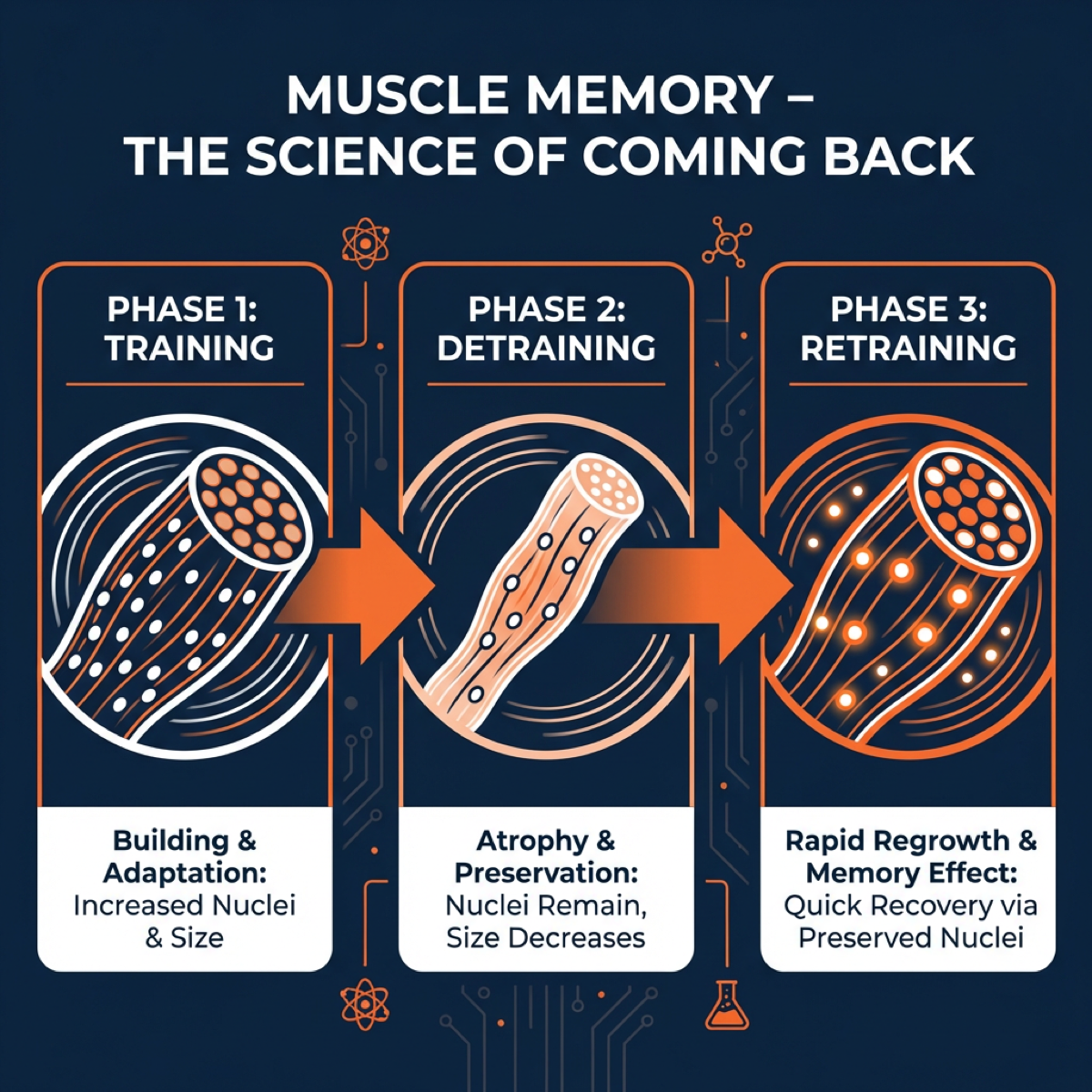
When you built muscle, your muscle fibers gained extra nuclei through a process called myonuclear addition. Those nuclei don't disappear when you stop training. They stick around for months, possibly years. So when you come back, your muscles don't have to start from scratch -- they've got the cellular machinery ready to rebuild.
Research from the University of Oslo showed that previously trained muscle fibers regain size significantly faster than untrained fibers. In practical terms, what took you 6 months to build the first time might take 6-10 weeks to get back.
Your strength will return even faster. Most of what you lost wasn't actual muscle tissue -- it was neural efficiency. Your nervous system forgot the motor patterns. That comes back within the first 2-3 weeks of consistent training. Don't be surprised if you're hitting 70-80% of your old numbers by week three.
Why You Took Time Off Matters
Not all comebacks are the same. Be honest about your situation:
Injury recovery: If you're coming back from surgery or a serious injury, get medical clearance first. No article replaces a physio's assessment. Start with whatever rehab movements they prescribed and build from there.
Life got busy: Job change, new baby, moving. You weren't hurt, just absent. Your connective tissue and joints are deconditioned but healthy. You have more room to push than the injury crowd, but not as much as you think.
Mental health break: Burnout, depression, loss of motivation. This is more common than people admit. The biggest risk here isn't physical -- it's diving back in too hard, burning out again in two weeks, and confirming the story that you "just can't stick with it."
Illness or medical treatment: Depending on what you went through, you might have lost significant muscle mass and cardiovascular fitness. Go slower than any other category. Your immune system is still recovering even after you feel fine.
The Two-Week Rule
Whatever your old routine was, forget it for the first two weeks.
Week one and two aren't about training. They're about reintroducing your body to the gym environment, rehearsing movement patterns, and establishing the habit of showing up. That's it.
Here's what this looks like:
- •3 sessions per week, full body each time
- •2-3 sets per exercise, not 4-5
- •RPE 5-6 -- you should finish each set feeling like you had 5+ reps left
- •8-12 reps on everything, no heavy singles or triples
- •Stick to machines and dumbbells for the first week if barbells feel shaky
- •Sessions under 45 minutes including warm-up
This will feel embarrassingly easy. That's the point. You're not here to impress anyone. You're here to not be sore for five days straight and quit again.
A Simple Comeback Template
Weeks 1-2: Reintroduction (3x per week)
Session A:
- •Goblet Squat: 3x10
- •Dumbbell Bench Press: 3x10
- •Cable Row: 3x12
- •Dumbbell Overhead Press: 2x10
- •Plank: 2x30s
Session B:
- •Leg Press: 3x12
- •Lat Pulldown: 3x10
- •Dumbbell Romanian Deadlift: 3x10
- •Incline Dumbbell Press: 2x10
- •Pallof Press: 2x10/side
Alternate A and B. Rest 60-90 seconds between sets. If you want to add 5-10 minutes of light cardio at the end, fine. Don't go crazy.
Weeks 3-4: Building Back (3-4x per week)
Now you can start adding weight and volume. Increase to 3-4 working sets. Push RPE to 7-8 -- a couple of reps in reserve, but you're actually working now.
Reintroduce barbell movements if they feel good. Start at 50-60% of your old working weights and add 5-10% each week.
You can move to a split here if you prefer. Upper/lower works well for 4 days.
Weeks 5-8: Progression
By now your body remembers. Your joints have adapted, your work capacity is back, and you're probably hitting 75-90% of your old strength.
Resume a normal program structure. Run a proven program like 5x5 StrongLifts or an upper lower split -- whatever you were doing before you stopped, or something new if you want a fresh start.
Soreness Management
You're going to be sore. Especially in week one. DOMS (delayed onset muscle soreness) hits harder when your body isn't adapted to training, and your eccentric strength is probably the most deconditioned component.
Tips that actually help:
- •Keep moving. Light walks on rest days. Don't sit on the couch all day.
- •Don't skip your next session because you're sore. Train through mild soreness. It usually feels better after the warm-up.
- •Sleep 7-9 hours. This is when repair happens. Not negotiable.
- •Hydrate. Basic but people forget.
- •Foam rolling. Doesn't speed recovery, but it reduces the perception of soreness.
What doesn't help: ice baths (research is mixed at best), ibuprofen (blunts muscle protein synthesis), and "active recovery" sessions that are actually just more training.
Nutrition for Your Comeback
You don't need a complicated diet plan. You need three things:
Protein: 1.6-2.2g per kg of bodyweight daily. Spread across 3-4 meals. This is the single most important nutritional factor for rebuilding muscle. If you weigh 80kg, aim for 130-175g per day.
Calories: Eat at maintenance or a slight surplus (200-300 calories above maintenance). Your body needs energy to rebuild. A caloric deficit while trying to regain muscle is working against yourself.
Carbs: Don't fear them. Glycogen-depleted muscles recover slower and perform worse. Eat carbs around your training sessions. Rice, oats, potatoes, fruit -- nothing exotic required.
If you gained weight during your time off, resist the urge to cut calories immediately. Spend 6-8 weeks rebuilding your training base first, then address body composition. Trying to lose fat and regain muscle simultaneously while deconditioned is a recipe for spinning your wheels.
The Mental Game
The hardest part of coming back isn't physical. It's accepting that you're not where you were.
You'll see weights on the rack that you used to warm up with and they'll feel heavy now. Someone will be squatting what you used to squat and it'll sting. Your reflection won't match the mental image you've been carrying.
None of that matters. What matters is that you showed up today. And you'll show up Wednesday. And Friday. That's all progress requires.
Some mental reframes that help:
- •You're not starting over. You're starting from experience. You know how to train, what works for your body, and what mistakes to avoid. A true beginner doesn't have any of that.
- •Compare yourself to last week, not last year. Your benchmark is your current self, not your peak self.
- •Commit to 8 weeks before evaluating. Don't judge the program, your progress, or your decision to come back until you've given it 8 honest weeks.
Common Mistakes
Going too heavy too soon. This is the number one reason people get hurt in their first week back. Your muscles might feel ready, but your tendons, ligaments, and joint capsules need more time. Connective tissue adapts slower than muscle.
Following your old program from day one. Your old program was designed for your old fitness level. You need to ramp back into it, not cannonball.
Skipping the warm-up. You need it more now than you did when you were training consistently. 5-10 minutes of light cardio plus dynamic stretching plus warm-up sets. Every time.
Training 6 days a week to "make up for lost time." You can't speed this up by doubling the volume. Three quality sessions beat six mediocre ones, especially in the first month.
Comparing yourself to others. Or worse, comparing yourself to your old training logs. Put the old logs away for a month. Start fresh.
A Realistic Timeline
Here's roughly what to expect:
- •Week 1-2: Everything feels hard. You're sore constantly. Weights feel embarrassingly light but that's by design.
- •Week 3-4: Strength starts coming back noticeably. Soreness becomes manageable. You start feeling like yourself in the gym again.
- •Week 5-8: You're operating at 70-85% of previous strength. Muscle fullness returns. You can handle real training volume.
- •Week 8-12: Most people are back to 90%+ of their previous strength. Physique is filling back in thanks to muscle memory.
- •Month 4-6: Fully back to baseline for most people who had 3-12 months off.
If you were out for a year or more, extend each phase. There's no shame in taking 6 months to rebuild properly. That's still faster than someone starting from zero.
When to Worry
See a doctor or physio if you experience:
- •Sharp joint pain (not muscle soreness) that doesn't resolve with rest
- •Pain that gets worse during training, not better after warm-up
- •Numbness or tingling in extremities
- •Chest pain or unusual shortness of breath during moderate effort
- •Any previous injury site flaring up
Pushing through actual pain signals is how a comeback turns into a setback. Be aggressive with your training plan but conservative with your body's warning signs.
The Bottom Line
Coming back is easier than starting for the first time. Your body remembers. Your technique is still in there. The only thing standing between you and your previous level of fitness is 8-12 weeks of consistent, smart training.
Start lighter than your ego wants. Progress slower than your motivation demands. Show up more consistently than your schedule thinks it can handle.
The gym didn't go anywhere. Neither did your potential. You just need to rebuild the habit, and the strength will follow.
Frequently Asked Questions
- How long does it take to regain muscle after time off?
- Most people get back to 90% of their previous strength within 8-12 weeks thanks to muscle memory. Your muscle fibers retained extra nuclei from previous training, so they rebuild much faster the second time. What took 6 months to build originally might take 6-10 weeks to regain.
- Is muscle memory real or just a myth?
- It is very real and backed by research. When you build muscle, your fibers gain extra nuclei that persist even during months of inactivity. Those nuclei let your muscles ramp up protein synthesis faster when you start training again, which is why previously trained people regain size quicker than true beginners.
- How much weight should I lift when returning to the gym?
- Start at roughly 50% of your old working weights for the first two weeks, even if it feels too light. Your muscles might feel ready for more, but your tendons, ligaments, and joints need time to readapt. Going too heavy too soon is the number one reason people get hurt during a comeback.
- Should I do my old workout routine when coming back?
- Not right away. Spend 2-3 weeks on a simplified full-body routine with lower volume and lighter weights. Your old program was designed for your old fitness level. Jump straight back in and you will be too sore to train consistently, which defeats the purpose.
- How do I stay motivated when I am weaker than before?
- Stop comparing yourself to your peak and start comparing to last week. You are not starting over, you are starting from experience. Commit to 8 weeks before evaluating your progress, and remember that your body already knows how to do this. The strength comes back faster than you expect.