What Nobody Tells You About Your First Year of Lifting
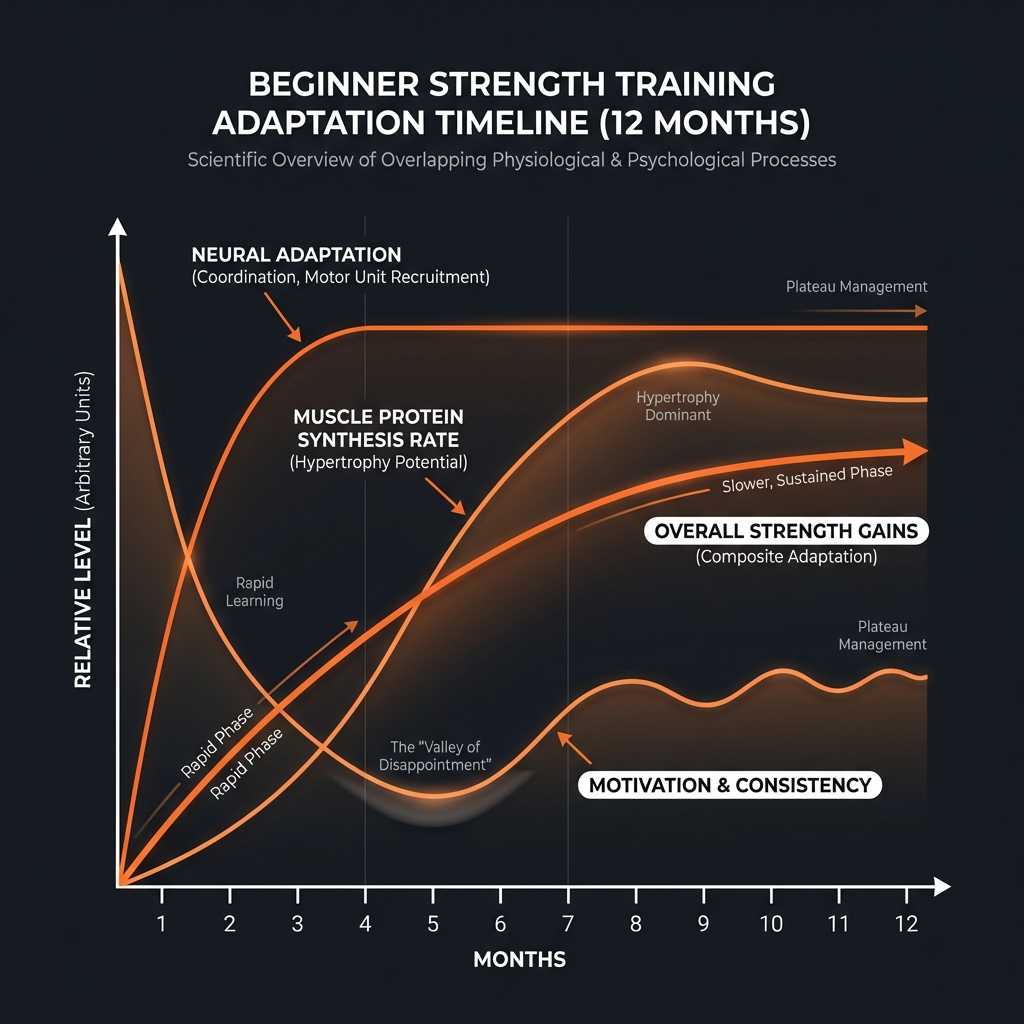
Most beginners experience rapid strength gains in weeks 1-8 due to neuromuscular adaptations, not actual muscle growth
 Jeff·Feb 12, 2026·12 min read
Key Takeaways
- Your strength jumps in the first month are just your nervous system getting better at the movements, not actual muscle growth.
- DOMS disappearing after 6 weeks doesn't mean you're not working hard enough, it means your body adapted to training.
- Months 4-6 is when most people quit because progress slows way down and the initial excitement wears off.
- When you hit your first plateau around month 7, take a deload week instead of panicking and switching programs.
- If you gain 8-12 pounds of actual muscle in your first year, you crushed it, even though it doesn't look like those crazy transformation photos.
Get This on WhatsApp
Get a quick summary and link sent straight to your WhatsApp.
Send Me This ArticleThe First 4 Weeks: Neural Adaptation and the Illusion of Instant Gains
Your bench press goes from 95 to 135 in three weeks. You're adding weight every session. Your arms look bigger in the mirror already. You think you've cracked the code.
You haven't. What you're experiencing is neuromuscular adaptation, not muscle growth.
Your nervous system is learning to recruit muscle fibers more efficiently. Your brain is getting better at the movement patterns. Your stabilizer muscles are firing in the right sequence. It feels like getting stronger, and technically you are, but you're not building appreciable muscle yet.
This matters because beginners make terrible decisions based on this initial rush. They think they've found the perfect program, the magic supplement stack, or their genetic gifts. Then week 8 hits and everything slows down. They panic and change everything.
The science-backed approach to building muscle explains why actual hypertrophy takes time. Your body needs weeks of consistent mechanical tension before protein synthesis rates elevate enough to create visible size increases. That happens around weeks 8-12, not weeks 2-4.
You probably won't see genuine muscle growth in your first month. Your gym pump will fade. That "bigger" look is mostly increased blood flow and glycogen storage. Accept it now and you won't crash later.
Months 2-3: The DOMS Valley and When Everything Hurts
Week 5 or 6, something shifts. You're not as sore anymore. This freaks beginners out.
"Am I working hard enough?" Yes.
"Should I add more volume?" No.
Research published in the *Journal of Strength and Conditioning Research* shows DOMS peaks in weeks 2-6, then decreases dramatically as your muscle tissue adapts to training stress. This isn't a bad thing. It's what's supposed to happen.
But here's what nobody tells you: the psychological impact of losing that soreness feedback is real. You spent weeks using pain as proof of a good workout. Now you need new markers of progress.
Strength gains start to slow during this window too. You're still adding weight, but not every session. Maybe every other week. Maybe you hit a wall on overhead press while your squat keeps moving. This is normal adaptation, not program failure.
The injury risk actually peaks right here in weeks 3-8, according to data from the American College of Sports Medicine. Your confidence now exceeds your technical competence. You're strong enough to load the bar heavy but haven't ingrained proper movement patterns yet. Your form breaks down under fatigue and you don't recognize it.
I see this constantly: someone adds 20 pounds to their deadlift in four weeks, then tweaks their lower back in week 7 because they never learned proper bracing. They confuse strength adaptation with mastery.
Months 4-6: The Motivation Crash Nobody Warns You About
This is where most beginners fall off. Not because they're lazy. Because nobody warned them this phase exists.
Your newbie gains start tapering. Progress slows from weekly to bi-weekly. You're not seeing the dramatic changes you expected based on those transformation posts. Your friends stopped commenting on your physique. The dopamine hit you got from those first months fades.
Meanwhile, the lifestyle demands pile up. Meal prep is tedious. Your gym schedule conflicts with social plans. You're tired more often than you expected. The shine wears off and you're left with the reality of consistent training, which is mostly boring.
Body dysmorphia often peaks here too. You're big enough to notice every flaw but not big enough to look how you imagined. You compare yourself to people months or years ahead and feel like you're failing. The gym mirrors become anxiety triggers instead of motivation.
The common mistakes that kill gains multiply during this phase. You start program-hopping, looking for the magic variable that will reignite progress. You either overtrain trying to force growth or undertrain because motivation is gone.
Here's the truth: months 4-6 are about building habits that survive mediocre motivation. You won't feel fired up. Go anyway. You won't see weekly changes. Track monthly instead. This is where lifters are made or broken.
Months 7-9: The Frustrating Plateau Phase and What It Means
Your squat hasn't moved in three weeks. Neither has your bench. You're doing everything "right" but the bar isn't moving. Welcome to your first real plateau.
This isn't failure. It's biology.
Your body needs periodic consolidation phases where strength gains stall while tissue adaptation catches up. Your nervous system integrated those early adaptations. Now your muscles, tendons, and connective tissue need time to remodel and strengthen.
The problem is you're probably not applying progressive overload correctly yet. Most beginners think progressive overload means adding weight every session. It doesn't. It means increasing the training stimulus over time through various methods: more reps, more sets, better form, shorter rest, slower tempo.
When the weight won't move, you have other tools. But beginners panic and either push into overtraining or give up entirely.
Sleep quality issues often resurface here too. You adapted to the initial training stress, but now you're pushing harder volumes and intensities. The National Strength and Conditioning Association identifies disrupted sleep patterns as an early overtraining sign that beginners miss. You're tired but wired. You fall asleep fine but wake up at 3 AM. Your resting heart rate creeps up.
This is your body telling you something. Usually that you need a deload week, which brings me to something almost no beginner does: intentionally backing off.
Taking a deload (reducing volume by 40-50% for one week) feels wrong when you're already not progressing. It works anyway. You come back stronger because you gave your body time to adapt to the accumulated stress.
Months 10-12: Consolidating Your First Year of Real Gains
If you made it here, you're ahead of 70% of people who start lifting. The ones who quit did it months ago.
Your progress now looks different than month 2. You're adding weight every 2-3 weeks instead of every session. You might chase rep PRs for a month before hitting a weight PR. Your working weights are 40-60% higher than where you started, but the graph isn't a straight line up and to the right.
The average beginner gains 15-25 pounds total in year one, according to ACSM progression guidelines. That's a mixture of muscle, water, glycogen, and yes, some fat. If you gained 8-12 pounds of actual muscle tissue, you did exceptionally well.
Most beginners expect more. They see 20-pound transformations online and assume that's all muscle. It's not. Those photos usually involve favorable lighting, a pump, and strategic posing. The difference between looking "bigger" and actually being measurably bigger is substantial.
What you should notice by month 12: your clothes fit differently, your lifts are significantly stronger, and you've developed a training intuition you didn't have. You can feel when form breaks down. You know the difference between productive discomfort and pain that signals problems. You've found a sustainable training frequency and volume.
This matters more than any specific physique change. You've built the foundation for years of consistent progress instead of burning out in the newbie gains window.
The Mental Game: Body Dysmorphia, Comparison Traps, and Gym Anxiety
Nobody talks about how lifting can temporarily make body image issues worse. You start noticing every asymmetry. Your left bicep looks smaller than your right. Your chest looks uneven. Your abs aren't developing evenly.
Some of this is real. Muscle imbalances exist and require correction. Most of it is perceptual distortion from staring at yourself daily. You don't see gradual progress because you're too close to it.
The comparison trap is worse now than ever. You're comparing your month 3 physique to someone's year 3 physique on Instagram. You're comparing your poverty bench press to the strong guy at your gym who's been training since high school. Every comparison you make is unfair and demotivating.
Gym anxiety shifts over the year too. Week 1 anxiety is about looking stupid and not knowing how equipment works. Month 6 anxiety is about feeling like you should look better by now. Month 10 anxiety is about whether you're wasting your time because progress is so slow.
The fix isn't motivation. It's taking comparison off the table entirely. Track your own numbers. Compete with your own PRs. Delete fitness social media if you need to. The mental game is harder than the physical one, especially in year one.
What Your Body Actually Does: Sleep, Appetite, and Recovery Changes
Your appetite in month 1 is unpredictable. Some beginners get ravenously hungry. Others lose appetite entirely as training stress elevates. Both normalize around month 3-4, but the adjustment period is rough.
The hunger that does arrive often surprises people. You're eating more than you ever have but still losing weight or not gaining as fast as expected. Or you're eating normally but gaining too quickly because your maintenance calories shifted and you didn't adjust.
Getting this right matters more than any training variable. The position stand from the International Society of Sports Nutrition makes it clear: protein intake and total calories drive muscle growth. No amount of optimal programming overcomes chronic undereating.
Sleep gets weird too. Months 2-4, you'll probably feel more tired despite sleeping the same hours. Your body is under higher stress loads and needs more recovery time. Sleep quality often dips as cortisol patterns shift. This improves around month 4-5 for most people, but you need to prioritize rest and recovery more than you think.
You'll also discover that training impacts your entire schedule. You're hungrier, so you're eating more frequently. You need 8+ hours of sleep instead of 6-7. Your social life shifts because you're tired on Friday nights and need to hit the gym Saturday morning. These lifestyle adjustments aren't optional.
Common Beginner Mistakes That Cost You 6 Months of Progress
The biggest mistake is program-hopping. You find a program, run it for 4-6 weeks, don't see dramatic results, switch to something else. You never give any protocol enough time to work.
Creating an effective routine matters less than following any decent routine consistently for 6+ months. The difference between good programs is maybe 10%. The difference between consistent and inconsistent execution is 90%.
Second mistake: chasing soreness. You keep adding volume, exercises, and intensity trying to recreate that week 2 soreness. You end up overtrained and under-recovered. Soreness isn't the goal. Progressive overload is.
Third mistake: bulking too aggressively in year one. You don't need to gain 30-40 pounds. Most of that will be fat, which you'll need to cut later, wasting months. A surplus of 200-300 calories above maintenance is plenty to maximize newbie gains without getting fat.
Fourth mistake: ignoring technical skill development. You add weight before you've mastered the movement pattern. Your deadlift goes up but your form is garbage, setting you up for injury. Strength is a skill. Master the skill before loading it heavily.
Fifth mistake: not taking deloads. You push hard every week until your body forces a break through injury or burnout. Planned deload weeks every 4-6 weeks keep you healthier and progressing longer.
These mistakes cost you months. Not because they eliminate gains entirely, but because they force you to backtrack, recover, or restart. Avoid them and you'll be substantially ahead by month 12.
The Social and Lifestyle Impacts Nobody Mentions
Your friends will notice your gym schedule before your physique. They'll comment on how you're always meal prepping, turning down drinks, or leaving parties early. Some will support it. Others will give you shit.
The financial aspect surprises most beginners. Gym membership is the small cost. Meal prep time and groceries add up. New clothes in different sizes cost money. If you hire a coach or buy a program, that's more. The annual cost of serious lifting is 2-5x what you initially budgeted.
Your relationship with food changes completely. You're tracking intake or at least thinking about protein at every meal. Eating out gets complicated. You turn down food at social gatherings because it doesn't fit your plan. This impacts how you socialize and who you spend time with.
Some relationships improve. You meet people at the gym who share your goals. You bond with others on the same journey. You find a community that understands the work.
Other relationships get strained. Your partner might not understand why you're spending 6-8 hours a week at the gym. Your friends might feel abandoned when you skip events for training. This is normal. It requires communication and boundary-setting.
Setting Realistic Expectations: The One-Year Transformation Reality Check
Here's what's realistic after 12 consistent months of intelligent training:
Strength gains:
- •Squat: +60-100 pounds
- •Bench: +40-70 pounds
- •Deadlift: +70-120 pounds
- •Overhead Press: +25-45 pounds
Body composition:
- •8-15 pounds of muscle tissue gained
- •15-25 pounds total weight gain (including water, glycogen, some fat)
- •1-2 inches on arms, chest, legs
- •Visible but not dramatic physique changes in clothes
What you won't have:
- •Magazine-cover abs at 170 pounds and 10% body fat
- •17-inch arms
- •A 315-pound bench press
- •The physique in your head based on enhanced athletes' timelines
The newbie gains window is real. You'll build muscle more easily this year than you ever will again. But it's still bounded by biology. Even with perfect training, nutrition, and recovery, your body can only synthesize so much muscle tissue per month.
The research from the American College of Sports Medicine shows that beginner strength gains follow predictable patterns. You're working within those patterns, not transcending them.
Accept the timeline now and you won't quit in month 6 when you realize you don't look like the doctored transformation photos. You'll keep showing up, keep progressing, and in year 2 and 3 you'll build the physique you actually want.
Your first year is about building the foundation: technique, consistency, work capacity, and mental resilience. The physique comes later if you don't quit early because your expectations were unrealistic.
Most people who make it through year one successfully didn't do anything special. They picked a simple program, followed it consistently, ate enough protein, slept reasonably well, and didn't quit when progress slowed. That's it. That's the secret nobody wants to hear.
Frequently Asked Questions
- How fast do beginners gain muscle in the first year?
- Most beginners can gain 15-25 pounds of muscle in their first year if training and nutrition are dialed in. The first 2-3 months feel incredible because your strength shoots up fast, but that is mostly your nervous system learning the movements, not actual muscle growth.
- Why did my strength gains slow down after 3 months?
- Your initial strength gains were mostly neuromuscular adaptations, meaning your brain got better at recruiting the muscle you already had. Real muscle growth is slower and kicks in around months 2-4. This is normal and does not mean your program stopped working.
- Should beginners worry about progressive overload?
- Yes, but not obsessively. As a beginner, just focus on adding a small amount of weight or one extra rep each week. You do not need a complicated periodization scheme yet. Showing up consistently and lifting a little more over time is the whole game for your first year.
- Is it normal to be sore every day as a beginner?
- Extreme soreness (DOMS) is normal for the first 2-3 weeks and gets much better as your body adapts. If you are still cripplingly sore after a month, you are probably doing too much volume. Dial it back and build up gradually.
- What are the biggest mistakes beginners make in the gym?
- Program hopping every two weeks, skipping legs, chasing a pump instead of progressive overload, and eating like garbage while expecting results. Pick one proven program, follow it for at least 12 weeks, eat enough protein, and get some sleep.