Dirty Bulk vs Clean Bulk: Which Actually Works Better?
The internet is split on this one. Some say eat everything in sight. Others say count every macro. Here is what actually happens with each approach and who should use which.
 Jeff·Feb 10, 2026·11 min read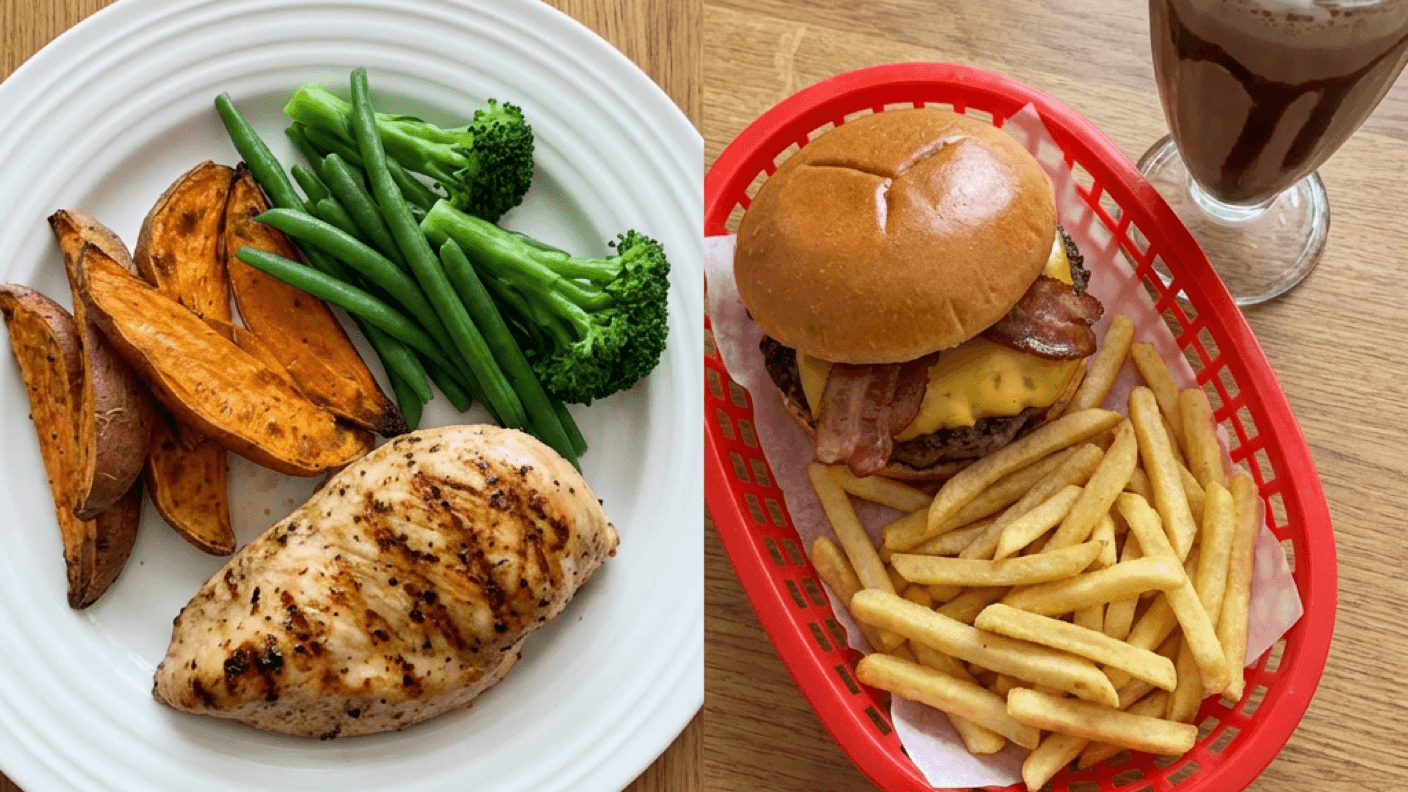
Key Takeaways
- You can only build muscle so fast regardless of how much you eat, so eating 1,000 calories over maintenance doesn't create more muscle than eating 300 over.
- Dirty bulking makes you gain way more fat that you'll have to spend months cutting later, which often leads to losing some of the muscle you built.
- Clean bulking with a 200-500 calorie surplus lets you build muscle while actually looking good during the process instead of wondering if you're getting jacked or just fat.
- The only people who should dirty bulk are stick-thin beginners who literally can't gain weight any other way, not regular lifters trying to add size.
- A controlled surplus of 300-400 calories over maintenance gives you all the muscle building benefits without turning you into a walking meatball.
Get This on WhatsApp
Get a quick summary and link sent straight to your WhatsApp.
Send Me This ArticleDefining the terms
Let me define these terms because people use them differently.
Dirty bulk: Eating in a large caloric surplus (500-1,000+ calories above maintenance) with little regard for food quality or macro ratios. The goal is to eat as much as possible to maximize muscle growth. Pizza, burgers, ice cream, protein shakes, whatever gets calories in. Think of the classic "see food" diet: you see food, you eat it.
Clean bulk: Eating in a moderate caloric surplus (200-500 calories above maintenance) with attention to food quality and macro ratios. Whole foods, adequate protein, controlled carbs and fats. Think chicken and rice, not chicken nuggets and fries.
Both approaches have the same underlying goal: provide enough energy and nutrients for your body to build new muscle tissue. They just go about it very differently.
The case for dirty bulking
I will be fair to the dirty bulk approach, because it does have some legitimate advantages.
It is easy. You do not have to track anything. You do not have to weigh food. You do not have to turn down the free donuts at work. When your only goal is "eat more," the mental burden is basically zero. For someone who has struggled to eat enough calories (hardgainers, ectomorphs, people with poor appetites), this simplicity is genuinely valuable.
You will get stronger. Being in a large caloric surplus means your body has plenty of fuel for training and recovery. Lifters on a dirty bulk typically see their strength numbers go up quickly. More food means more glycogen, better recovery, and more energy in the gym. Your bench will go up. Your squat will go up. That feels great.
You will gain weight. If the scale has been stuck and you have been frustrated, a dirty bulk will move it. Fast. You might gain 15-25 pounds in a few months. Some of that is muscle. Some of it is fat. Some of it is water and glycogen from eating more carbs. But the scale moves, and for some people, that psychological boost matters.
I knew a skinny kid in college, probably 140 pounds soaking wet at 5'11". He spent a summer eating everything in sight and training hard. Burgers, shakes, pasta, ice cream, whatever. By September he was 170. Did he gain some fat? Sure. But he also went from looking like he had never touched a weight to actually looking like he lifted. And his strength shot through the roof. That dirty bulk jumpstarted his training career.
The case for clean bulking
Here is where I am going to put my thumb on the scale (pun intended), because for most people in most situations, clean bulking is the better approach.
You build roughly the same amount of muscle. This is the key point. Your body can only synthesize so much new muscle tissue per day, regardless of how much you eat. Eating 1,000 calories above maintenance does not build more muscle than eating 300 calories above maintenance. The excess just gets stored as fat.
Less fat to cut later. Every pound of fat you gain during a bulk is a pound you have to lose during your next cut. And cutting sucks. It is hard, it takes time, and you risk losing muscle in the process. The less fat you gain during a bulk, the shorter and easier your cut will be.
You feel better. Eating clean during a bulk means your energy is stable, your digestion is good, you are not bloated all the time, and you do not feel like garbage. I have done both approaches, and the dirty bulk left me feeling sluggish, bloated, and generally gross despite the strength gains. The clean bulk felt like... just eating normally, but a bit more.
Better body composition throughout. You actually look good during a clean bulk. You are building muscle while staying relatively lean. With a dirty bulk, there is a period of several months where you look like you could go either way: lifter or someone who just really likes buffets.
What the research says
The science here is pretty clear, and it favors moderate surpluses.
A 2019 study by Iraki et al. in the Journal of the International Society of Sports Nutrition reviewed the evidence on caloric surplus and muscle building. They concluded that a surplus of 350-500 calories per day optimizes the rate of muscle gain while limiting fat gain. Going higher than that increases fat gain without meaningfully increasing muscle gain.
A 2013 study by Garthe et al. compared two groups of athletes: one eating in a ~600 calorie surplus and another eating in a ~300 calorie surplus. Over 8-12 weeks, both groups gained similar amounts of lean mass, but the higher surplus group gained significantly more fat.
The rate of muscle gain for natural lifters is roughly:
| Training level | Monthly muscle gain potential |
|---|---|
| Beginner (year 1) | 1.5-2.5 lbs/month |
| Intermediate (year 2-3) | 0.75-1.5 lbs/month |
| Advanced (year 3-5) | 0.5-0.75 lbs/month |
| Very advanced (5+ years) | 0.25-0.5 lbs/month |
These numbers come from various models (Lyle McDonald, Alan Aragon, Eric Helms). The exact rates vary by individual, but the trend is consistent: muscle gain slows down dramatically with training experience.
Here is why this matters for bulking strategy: if you are an intermediate lifter gaining roughly 1 pound of muscle per month, that requires a surplus of only about 200-300 extra calories per day (muscle tissue is roughly 1,500-2,000 calories per pound to synthesize, plus the energy cost of building it). Eating 1,000 extra calories per day gives you the same 1 pound of muscle, plus 3-4 extra pounds of fat per month. That math does not work out in your favor.
The fat gain problem
This is the part that dirty bulk advocates do not like to talk about. Let me walk through the numbers.
Say you dirty bulk for 6 months at 800 calories above maintenance. You gain 25 pounds. If you are an intermediate lifter, maybe 6-8 of those pounds are muscle and 17-19 are fat and water. Now you need to cut.
A reasonable cut is about 1 pound per week at a 500-calorie deficit. To lose 15 pounds of fat, that is 15 weeks of dieting. Almost four months. And during that cut, you might lose 1-2 pounds of muscle despite your best efforts (muscle loss during caloric restriction is well-documented, even with high protein intake, per a 2014 meta-analysis by Helms et al.).
So your net gain from a 6-month dirty bulk plus a 4-month cut is roughly 4-6 pounds of muscle over 10 months. You could have achieved the same result, or very close to it, with a clean bulk that took 10 months but did not require a cut at all. And you would have looked better the entire time.
This is the fundamental problem with dirty bulking for anyone past the beginner stage. The surplus that would actually be useful (a few hundred extra calories) is dwarfed by the surplus you are actually consuming (800-1,000+), and the excess becomes fat that you then have to spend months removing.
Who should dirty bulk
Despite everything I just said, there are specific situations where eating with abandon makes sense:
True hardgainers. If you are 6'1", 145 pounds, and you have tried eating more and it did not work, sometimes you just need to force-feed yourself for a while. Your body might be naturally resistant to weight gain, and a modest surplus is not enough to overcome that resistance. Eating big, even if it is messy, gets the scale moving and builds the habit of eating enough.
Beginners in their first 6-12 months. Newbie gains are real and they are fast. A beginner can build muscle at a rate that actually justifies a larger surplus. If you have never lifted before and you are underweight, eat a lot, train hard, and enjoy the ride. You can worry about optimization later.
Someone recovering from being significantly underweight. If you have been sick, have had an eating disorder, or have been severely undereating, the priority is getting weight on. Food quality matters less than food quantity in this context.
Who should clean bulk
Pretty much everyone else. Specifically:
Intermediate and advanced lifters. Your rate of muscle gain is slower, so the surplus needed is smaller. A dirty bulk at this stage just makes you fat.
Anyone who cares about aesthetics. If looking good year-round matters to you (and for most people, it does), a clean bulk keeps you in a range where you still like what you see in the mirror.
Anyone who hates cutting. And honestly, who doesn't? If you keep your bulk lean, you never need an aggressive cut. Maybe a mini-cut of 4-6 weeks to trim a few pounds, then back to building. That is way more enjoyable than alternating between "fluffy" and "miserable and dieting."
People over 30. Your metabolism, hormone profile, and recovery capacity are all declining gradually. Fat gain becomes easier and harder to lose. A controlled surplus makes more sense as you age.
My recommended approach: the controlled surplus
Here is what I recommend for most lifters who want to maximize muscle gain while minimizing fat gain:
Caloric surplus: 250-400 calories above maintenance. Start at the lower end and increase if the scale is not moving after 2-3 weeks.
Protein: 0.8-1g per pound of body weight. Non-negotiable.
Rate of weight gain: 0.5-1 pound per week for beginners, 0.5-0.75 pounds per week for intermediates, 0.25-0.5 pounds per week for advanced. If you are gaining faster than this, you are gaining too much fat.
Duration: Bulk for 4-6 months, then assess. If body fat is creeping above where you are comfortable (for most guys, that is around 18-20%), do a mini-cut of 4-6 weeks at a moderate deficit (500 calories below maintenance) to trim back down, then resume the bulk.
Food quality: 80% whole foods, 20% whatever you want. Hit your protein and calorie targets with mostly good food. But have the pizza on Friday night. Have the ice cream after a hard session. Life is too short to eat boiled chicken and broccoli seven days a week.
Sample bulking meal plans
Clean bulk: 3,000 calories (~180g protein, 380g carbs, 80g fat)
| Meal | Food | Calories | Protein |
|---|---|---|---|
| Breakfast | 4 eggs, 2 toast, banana, glass of milk | 620 | 32g |
| Snack | Greek yogurt with granola and honey | 350 | 22g |
| Lunch | 8 oz chicken breast, 2 cups rice, vegetables, teriyaki sauce | 750 | 50g |
| Snack | Apple with 2 tbsp peanut butter | 280 | 7g |
| Dinner | 8 oz salmon, large sweet potato, asparagus, olive oil | 700 | 42g |
| Evening | Bowl of cereal with milk, 1 cup cottage cheese | 400 | 30g |
| Total | ~3,100 | ~183g |
Dirty bulk: 4,000+ calories (who knows the macros honestly)
| Meal | Food | Calories | Protein |
|---|---|---|---|
| Breakfast | 4 eggs, 4 bacon, 3 toast with butter, large glass of whole milk | 950 | 42g |
| Snack | Mass gainer shake (milk, protein, banana, PB, oats) | 800 | 40g |
| Lunch | Double cheeseburger with fries | 1,100 | 45g |
| Snack | Trail mix, protein bar | 500 | 20g |
| Dinner | Pasta with meat sauce, garlic bread, Parmesan | 900 | 35g |
| Evening | Ice cream (generous bowl) | 400 | 5g |
| Total | ~4,650 | ~187g |
Notice that the protein totals are similar. But the dirty bulk has an extra 1,500 calories that are mostly fat and carbs from processed food. Those extra calories are not building more muscle. They are building love handles.
The clean bulk gives you everything your muscles need to grow. The dirty bulk gives you that same thing plus a lot of unnecessary excess. You are paying for that excess in the form of fat gain that you will eventually have to work off.
Choose the clean bulk. Your future self will thank you when it is time to take your shirt off at the beach.
Frequently Asked Questions
- What is the difference between a dirty bulk and a clean bulk?
- A dirty bulk means eating everything in sight with no regard for food quality, aiming for maximum caloric surplus. A clean bulk means eating in a controlled surplus of 300-500 calories with mostly whole foods. One gets you bigger fast but fat. The other is slower but you stay leaner.
- Is dirty bulking worth it?
- For most people, no. You will gain muscle faster in the short term, but you also gain significantly more fat, which then takes months to diet off. The exception is very skinny guys who genuinely struggle to eat enough. For them, eating anything that isn't nailed down can jumpstart growth.
- How many extra calories should I eat to bulk?
- A 300-500 calorie surplus is the sweet spot for building muscle without excessive fat gain. That translates to roughly 0.5-1 pound of weight gain per week. Any faster than that and the extra weight is mostly fat, which just creates more work for your cut later.
- Should skinny guys dirty bulk?
- If you are genuinely underweight and struggling to gain any weight, a more aggressive surplus of 500-1000 calories can make sense for the first few months. But even then, prioritize protein-rich foods over just pounding pizza and ice cream. Eating big does not mean eating garbage.