Pistol Squat Progression: From Zero to One-Leg Squat
The pistol squat looks impossible until you break it into steps. Here is a practical progression that takes you from struggling to standing on one leg all the way to a full pistol.
 Jess·Mar 28, 2026·6 min read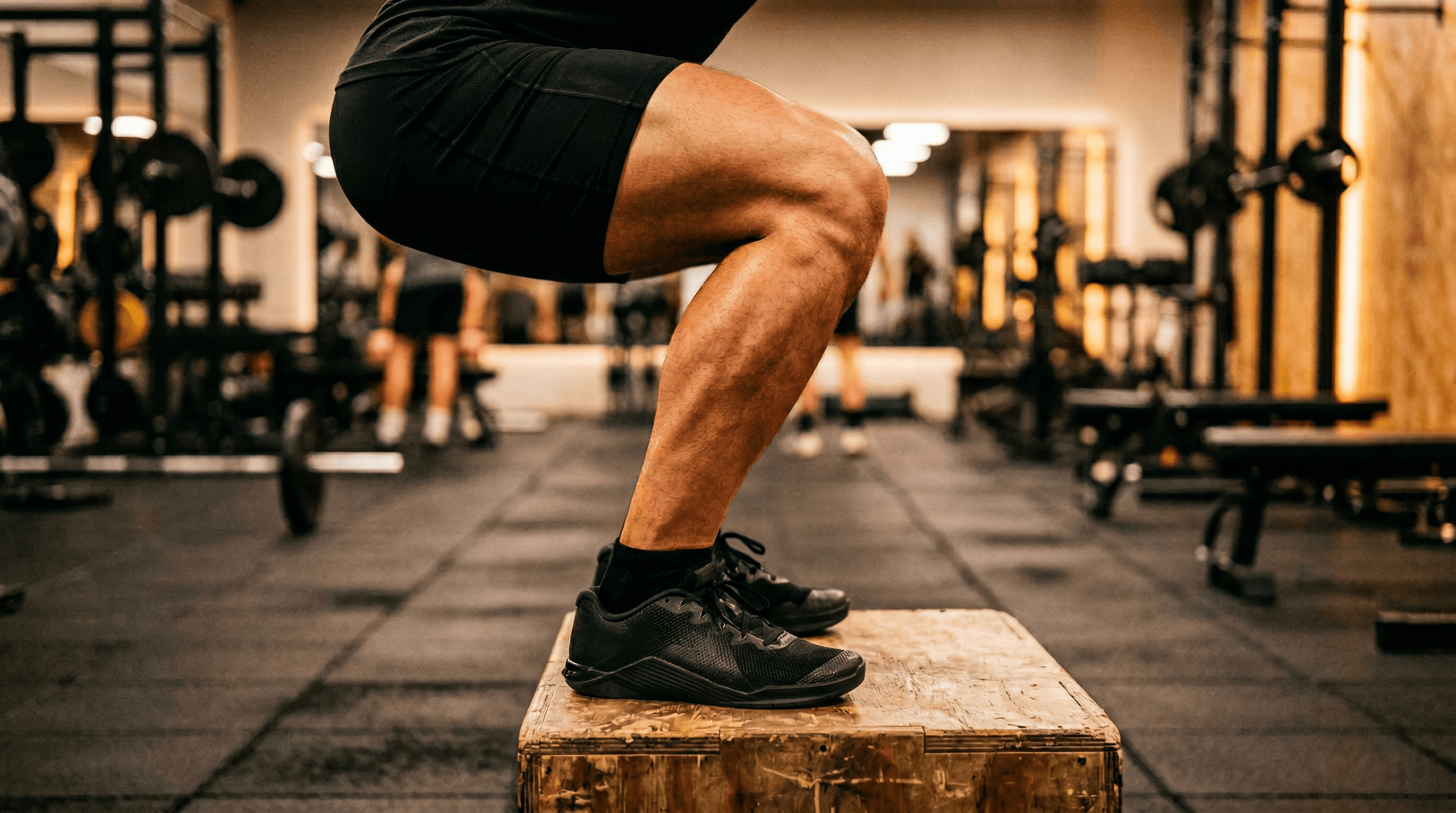
Key Takeaways
- Start with assisted pistol squats holding a door frame or TRX strap so you can learn the balance and bottom position without falling over.
- Box pistol squats to progressively lower surfaces are the fastest way to build the single-leg strength needed for a full pistol.
- Ankle mobility is usually the limiting factor -- if your heel lifts off the ground, spend 2-3 minutes daily stretching your calves and working ankle dorsiflexion.
- Counterbalance pistol squats with a light plate held in front of your chest make the balance much easier while you build strength.
- Train pistol squats 2-3 times per week with low reps (2-5 per side) and plenty of rest between sets since this is a strength and skill movement, not cardio.
Get This on WhatsApp
Get a quick summary and link sent straight to your WhatsApp.
Send Me This ArticleWhat Makes the Pistol Squat So Hard
The pistol squat is a full-depth single-leg squat with the other leg extended straight out in front of you. It looks like a party trick, but it is actually one of the best tests of lower body strength, mobility, and balance combined.
Most people who fail at pistol squats do not lack strength. They lack ankle mobility, hip flexor endurance (to hold the non-working leg up), and the balance to stay upright while descending on one foot. The good news: all of these can be trained systematically.
The Three Things You Need
1. Ankle Dorsiflexion
Your knee needs to travel well forward over your toes at the bottom of a pistol squat. If your ankles are stiff, your heel will come off the ground or you will fall backward. Test yourself: can you touch your knee to a wall with your foot 4-5 inches away? If not, your ankles need work.
Fix it: Spend 2 minutes per ankle doing wall ankle stretches before every lower body session. Stand facing a wall, one foot forward, and drive your knee over your toes repeatedly for 15-20 reps, then hold the stretched position for 30 seconds.
2. Hip Flexor Strength
Holding your non-working leg straight out in front of you is surprisingly hard. Your hip flexors have to contract hard at a shortened position, which most people never train.
Fix it: Sit on the floor with legs straight. Lift one leg off the ground with a straight knee and hold for 10 seconds. Do 5 holds per leg. Also add hanging leg raises or L-sits to your routine.
3. Single-Leg Balance
Standing on one foot is easy. Squatting down and standing back up on one foot while your center of gravity shifts is not. Balance is a skill and it improves with practice.
Fix it: Stand on one foot for 30-60 seconds per side, daily. Progress to doing it with your eyes closed. Then do it on an unstable surface.
The 8-Step Progression
Step 1: Deep Bodyweight Squat Hold (Week 1-2)
Before training pistol squats, you should be able to sit in a full-depth two-legged squat for 30+ seconds. Feet flat, chest up, hips below knees. If you cannot do this, work on your squat mobility first. The pistol squat demands everything a regular deep squat demands, but more.
Step 2: Assisted Single-Leg Squat (Weeks 1-4)
Hold onto a door frame, squat rack upright, or TRX strap with both hands. Extend one leg forward and squat down on the other leg as deep as you can. Use your arms to assist as needed. Focus on controlling the descent and keeping your heel down.
Target: 3 sets of 8 per leg with light assistance.
Step 3: Box Pistol Squat (Weeks 3-6)
Stand on one leg in front of a bench or box (knee height or slightly below). Extend your other leg forward and sit down onto the box slowly. Stand back up. The box catches you at the bottom and removes the hardest part of the movement. Lower the box height over time as you get stronger.
Target: 3 sets of 6 per leg to a box at knee height or below.
Step 4: Counterbalance Pistol Squat (Weeks 5-8)
Hold a 5-15 lb weight out in front of you at arm's length. The counterweight shifts your center of gravity forward, making it much easier to stay balanced during the descent. This is often the breakthrough step -- many people who cannot do a bodyweight pistol can do one immediately when holding a weight out front.
Target: 3 sets of 5 per leg with a 10 lb plate or dumbbell.
Step 5: Heel-Elevated Pistol Squat (Weeks 6-10)
Place your heel on a small plate (1-2 inches) or wedge. This reduces the ankle mobility demand and makes the bottom position more accessible. Do full pistol squats from this elevated position.
Target: 3 sets of 5 per leg.
Step 6: Negative Pistol Squat (Weeks 8-12)
Stand on one leg with no assistance. Lower yourself as slowly as possible into the bottom of a pistol squat (aim for 5 seconds down). At the bottom, put your other foot down and stand up on two legs. The eccentric phase builds the specific strength you need for the full movement.
Target: 3 sets of 4 per leg with a 5-second descent.
Step 7: Partial Range Pistol Squat (Weeks 10-14)
Do pistol squats but only go down to where your thigh is parallel to the floor, not full depth. This builds confidence and strength in the mid-range. Gradually increase depth over weeks.
Target: 3 sets of 3-5 per leg.
Step 8: Full Pistol Squat (Weeks 12-16+)
The full movement. One leg, full depth, no assistance, flat foot. Stand up without momentum. You made it.
Target: Start with singles and doubles. Build to 3 sets of 5 per leg over time.
Common Sticking Points
Falling backward at the bottom: Your ankle mobility is not there yet, or your counterbalance is off. Go back to counterbalance pistols (Step 4) or heel-elevated pistols (Step 5).
Knee caving inward: Your glute medius is weak. Add banded lateral walks, clamshells, and single-leg glute bridges to your warmup.
Cannot hold the non-working leg up: Your hip flexors are fatigued. Practice seated leg raises and flutter kicks. This improves faster than you would expect.
Pain at the bottom of the kneecap: This is often patellar tendon irritation from going too deep too fast. Reduce depth, increase the box height, and strengthen with slow tempo split squats before attempting full depth again.
Programming Pistol Squats
Pistol squats are a skill. Practice them frequently with low fatigue. The best approach:
- •3-4 days per week of pistol squat practice
- •Low reps per set (1-5 reps). This is a strength and skill movement, not a conditioning exercise.
- •Fresh, not fatigued. Do your pistol squat work at the beginning of your session, not after heavy squats and lunges.
- •Each leg independently. Your weaker leg sets the pace. If you can do 5 on your right and 2 on your left, program both legs at 2-3 reps and add extra sets for the weaker side.
Once you own the pistol squat with solid form, you can use it as a training tool. Adding a light dumbbell (10-25 lbs) held at your chest turns it into a goblet pistol squat and adds serious leg strength work. But master the bodyweight version first.
How Long Does It Take?
Realistic timelines based on your starting point:
| Starting Point | Time to Full Pistol |
|---|---|
| Can do 20+ bodyweight squats, good mobility | 6-10 weeks |
| Average gym-goer, moderate mobility | 10-16 weeks |
| Limited mobility, no single-leg training history | 16-24 weeks |
| Significant ankle or hip restrictions | 6+ months |
Do not rush this. A sloppy pistol squat where your heel comes up, your knee dives in, and you use momentum is not a real pistol squat. Build the foundation properly and the full movement will come.
Frequently Asked Questions
- What Makes the Pistol Squat So Hard?
- The pistol squat is a full-depth single-leg squat with the other leg extended straight out in front of you. It looks like a party trick, but it is actually one of the best tests of lower body strength, mobility, and balance combined.
- What should I know about 1. ankle dorsiflexion?
- Your knee needs to travel well forward over your toes at the bottom of a pistol squat. If your ankles are stiff, your heel will come off the ground or you will fall backward. Test yourself: can you touch your knee to a wall with your foot 4-5 inches away? If not, your ankles need work.
- What should I know about 2. hip flexor strength?
- Holding your non-working leg straight out in front of you is surprisingly hard. Your hip flexors have to contract hard at a shortened position, which most people never train.
- What should I know about 3. single-leg balance?
- Standing on one foot is easy. Squatting down and standing back up on one foot while your center of gravity shifts is not. Balance is a skill and it improves with practice.
- What should I know about step 1: deep bodyweight squat hold (week 1-2)?
- Before training pistol squats, you should be able to sit in a full-depth two-legged squat for 30+ seconds. Feet flat, chest up, hips below knees. If you cannot do this, work on your squat mobility first. The pistol squat demands everything a regular deep squat demands, but more.