Training Journal: How to Track Your Workouts Effectively
If you are not tracking your workouts, you are guessing. Here is exactly what to record, how to use the data, and why most people overcomplicate this.
 Jeff·Feb 10, 2026·10 min read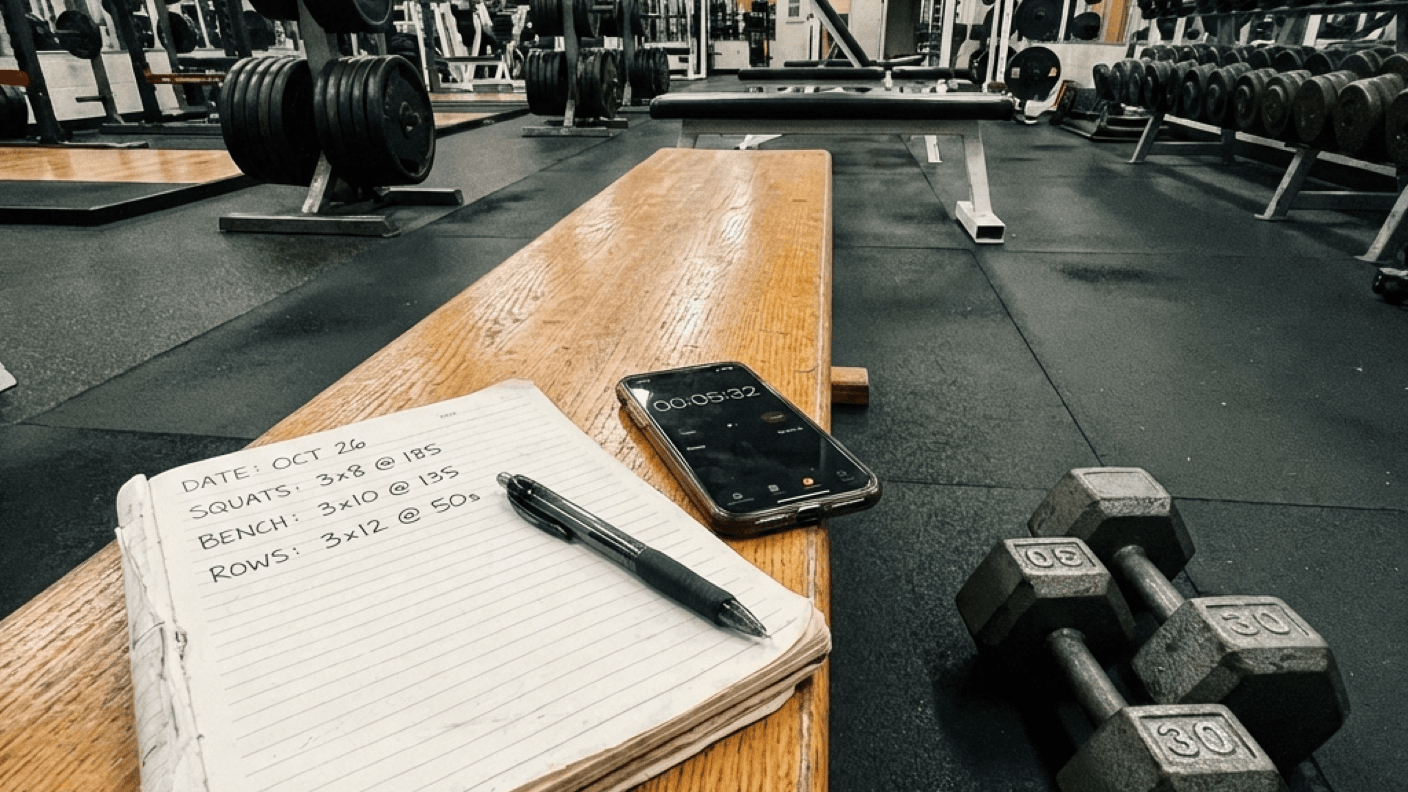
Key Takeaways
- Writing down your workouts prevents you from training blind and actually shows whether you're progressing or just spinning your wheels with the same weights for months.
- Track only five things per exercise: exact exercise name, weight used, actual reps completed, number of working sets, and a quick note about how hard it felt.
- Most people either track way too much data and burn out in three weeks or track nothing at all and rely on terrible human memory for numbers.
- Use your log data to make smart decisions: add weight when you hit all target reps easily, stay at the same weight if you missed reps on some sets, and drop weight if your numbers decline for weeks despite good recovery.
- Phone apps work best for most people because of convenience and automatic progress charts, but paper works great if you want to avoid screen distractions during workouts.
Get This on WhatsApp
Get a quick summary and link sent straight to your WhatsApp.
Send Me This ArticleThe case for writing things down
Here is a question: what did you bench press three Tuesdays ago? How many reps did you get? Were those reps easy or did you grind them out?
If you cannot answer that, you are training blind. And training blind means you have no idea whether you are actually progressing or just going through the motions.
Progressive overload is the single most important principle in resistance training. You need to do more over time: more weight, more reps, or more sets. Without a record of what you did last time, you have no baseline to improve on. You are just guessing. And guessing leads to stagnation.
I trained for almost two years before I started logging my workouts. When I finally did, I discovered something depressing: I had been using the same weights on most exercises for months. I thought I was progressing because the workouts felt hard. But "hard" does not mean "progressive." I was working hard while going nowhere.
What most people get wrong about tracking
The biggest mistake is trying to track everything. I have seen people with spreadsheets that look like NASA mission control: tempo recorded in four digits, grip width measured in centimeters, rest periods timed to the second, RPE for every set, subjective fatigue ratings, sleep quality from their watch, macros from the day before.
That is not a training log. That is a research project. And nobody maintains a research project for more than three weeks before they burn out and stop logging entirely.
The second mistake is tracking nothing at all and relying on memory. Human memory for numbers is terrible. You might remember the weight you squatted, but you will not remember whether you got 7 reps or 8 reps. That one rep difference is the data point that tells you whether to add weight next session.
The sweet spot is tracking enough to make informed decisions, and nothing more.
The five things you actually need to record
For each exercise, every session, log these five things:
1. The exercise name. Obvious, but be specific. "Bench press" could mean flat barbell, incline barbell, flat dumbbell, incline dumbbell, or machine. Write down exactly what you did so there is no confusion when you look back at it.
2. The weight used. In pounds or kilos, just be consistent. If you use the cable machine, note the pin setting. Some cable machines have a 2:1 ratio, so 50 on the stack is 25 at the handle. Note whatever number you can reliably replicate.
3. Reps completed per set. Not your target reps. Your actual reps. If the plan called for 10 but you got 8, write 8. If you got 12, write 12. Honest logging is the only useful logging.
4. Number of sets. Include working sets only. Warm-up sets do not count unless you are tracking those separately for a specific reason.
5. A brief note about difficulty. This does not need to be a formal RPE rating, though it can be. Even something like "easy," "hard," or "last rep was a grinder" is enough. This context helps you decide whether to add weight next time.
That is it. Five things. Takes about 15 seconds per exercise to jot down.
Paper journal vs app vs spreadsheet
Every medium has trade-offs. Here is my honest take on each.
Paper journal
Pros: No phone distraction, tactile satisfaction of writing, easy to flip back through, does not run out of battery. There is something about the physical act of writing that makes the data stick in your brain better. A 2014 study by Mueller and Oppenheimer found that handwriting notes led to better conceptual understanding than typing, though this was in academic settings.
Cons: Not searchable, easy to lose, harder to spot trends across months of data, your handwriting after a heavy set of deadlifts is probably illegible.
Best for: People who want to minimize screen time at the gym and enjoy the ritual of writing.
Phone app
Popular options include Strong, Hevy, JEFIT, and FitNotes.
Pros: Always with you (your phone is already in your pocket), built-in timers, exercise libraries with form cues, automatic charts and progress tracking, easy to see trends.
Cons: Phone distractions (you open the app, see a notification, and suddenly you are texting for three minutes between sets), some apps require subscriptions, data is locked in their ecosystem.
Best for: Most people. The convenience factor is hard to beat and the automatic progress charts are genuinely useful.
Spreadsheet
Google Sheets or Excel, custom-built to your liking.
Pros: Completely customizable, powerful data analysis if you know formulas, accessible from any device, free, you own your data.
Cons: Takes time to set up well, data entry is clunky on a phone, no built-in exercise library or timers, easy to over-engineer.
Best for: Data nerds who enjoy building systems and want complete control over their tracking.
I have used all three at different points. Right now I use a phone app (Strong) for daily logging and review my data in a spreadsheet at the end of each training block. That combination gives me ease-of-use during workouts and analytical power for planning.
How to use your training log to make decisions
Having data is useless if you do not act on it. Here is how your log should inform your training decisions:
When to add weight
If you hit the top of your target rep range on all sets with good form and moderate difficulty, add weight next session. Example: your plan calls for 3 sets of 8-10 reps on bench press. You got 10, 10, 10 and the last rep of the last set was hard but not a grinder. Time to add 5 pounds.
When to stay at the same weight
If you hit your target reps on some sets but not all, or the difficulty was very high, keep the weight the same and try to get more reps next time. Example: you got 10, 9, 8 on bench. Stay at that weight until you can get 10, 10, 10.
When to drop weight
If your reps are declining week over week despite good sleep and nutrition, you might be accumulating too much fatigue. Drop the weight by 10% and build back up. This is not failure. This is smart programming.
When to change exercises
If you have been stuck at the same weight and reps on an exercise for 4-6 weeks despite trying different rep ranges and intensities, it might be time to rotate that exercise for a similar one. Swap barbell bench for dumbbell bench, or back squat for front squat. Small variations can unstick plateaus.
Your log makes all of these decisions objective instead of emotional. You are not guessing whether you should add weight. You are looking at data and making a rational choice.
Tracking beyond sets and reps
While I warned against over-tracking earlier, there are a few additional data points that become useful as you get more advanced:
Body weight. Weigh yourself at the same time daily (first thing in the morning, after using the bathroom, before eating) and look at the weekly average. Daily weight fluctuates wildly based on water, sodium, and food volume. The weekly average shows the real trend.
Sleep quality. You do not need a fitness tracker for this. Just rate it 1-5 in your log. Over time, you will see clear correlations between poor sleep and poor performance. A 2011 study by Reilly and Edwards found that even partial sleep deprivation significantly reduced exercise performance across multiple measures.
General fatigue level. Rate it 1-5 before your session. If you notice your fatigue creeping up over several weeks while your performance drops, you are probably due for a deload week.
Bodyweight on key lifts over time. Tracking your bench, squat, deadlift, and overhead press over months and years is the single best measure of whether your training is working. Plot these on a graph quarterly. If the line is going up (even slowly), you are doing something right.
When to review your logs
Daily reviews are unnecessary and will make you neurotic. Here is a better schedule:
Before each session: Glance at what you did last time for the exercises you are about to do. This takes 30 seconds and tells you exactly what weight and reps to target.
Weekly: Quick scan of the week. Did you hit all your planned sessions? Any exercises where you missed reps consistently? Any standout performances?
Every 4-6 weeks (end of a training block): This is the big review. Look at all your key lifts across the block. Did they go up? Did any stall? How did your body weight change? How was your energy and recovery? Use this review to plan your next training block.
Every 6-12 months: Zoom way out. Compare where you are now to where you were six months or a year ago. This is where the log becomes deeply motivating. Even if progress felt slow month to month, the yearly view almost always shows meaningful improvement.
The training log that changed my approach
About five years into training, I went through a period where I felt stuck. Everything was stagnating. I was frustrated, considering a program change, and generally pissed off about my lack of progress.
Then I actually sat down and reviewed my logs from the previous year. What I found was eye-opening.
My bench had gone from 225 for 5 to 245 for 5. My squat had gone from 315 for 3 to 335 for 5. My overhead press had gone from 145 for 6 to 155 for 8. Those are significant strength gains. But because they happened gradually, a rep here, five pounds there, I never felt them happening in real time. Each individual workout felt like a grind. The long view told a completely different story.
That experience changed how I think about training. Progress is almost invisible in real time. You will almost never feel like you are making gains while you are making them. You feel it weeks and months later, looking back at the data. Without the log, I might have blown up my program chasing something new. The data saved me from my own impatience.
A simple template you can start using today
If you want to start tracking and you do not know where to begin, here is a dead-simple template. Copy this into a notebook or create it in a spreadsheet:
Date: ___
Session type: (Upper / Lower / Push / Pull / Full Body)
How I felt going in (1-5): ___
| Exercise | Set 1 | Set 2 | Set 3 | Set 4 | Notes |
|---|---|---|---|---|---|
| lbs x reps | lbs x reps | lbs x reps | lbs x reps | ||
| lbs x reps | lbs x reps | lbs x reps | lbs x reps | ||
| lbs x reps | lbs x reps | lbs x reps | lbs x reps | ||
| lbs x reps | lbs x reps | lbs x reps | lbs x reps | ||
| lbs x reps | lbs x reps | lbs x reps | lbs x reps |
Anything notable: ___
Fill it in as you go. Review it before your next session. That is all there is to it.
The people who make the most progress in the gym are not the ones with the best genetics or the most supplements. They are the ones who know exactly what they did last time and came in with a plan to do a little more. A training log makes that possible. Start today.
Frequently Asked Questions
- What should I write in a training journal?
- At minimum, track the exercise, weight, sets, and reps. If you want bonus points, note how the set felt — RPE or just "felt heavy" or "easy" works fine. Don't overthink it.
- Is there a benefit to tracking workouts on paper vs an app?
- Paper is faster between sets and has zero notifications to distract you. Apps are better for long-term trends and graphs. Pick whichever one you'll actually use consistently.
- How do I know if I'm making progress in the gym?
- Look at your training log. If the weights, reps, or both are going up over weeks and months, you're progressing. Without a log, you're literally just guessing.
- What's the best workout tracking app?
- Strong and JEFIT are solid free options. But honestly, a simple notes app or a $2 notebook works just as well. The best tracking tool is the one you'll actually open every session.