Zero to 10 Pull-Ups in 30 Days: Beginner's Guide and Workout Plan
A 4-week pull-up program with specific exercises, sets, reps, and progression for going from zero pull-ups to your first 10. Includes dead hangs, negatives, band-assisted work, and inverted rows.
 Jeff·Aug 20, 2024·16 min read
Key Takeaways
- Most people can't do a single pull-up because it demands serious work from your lats, rhomboids, traps, biceps, and forearms all at once.
- You can realistically go from zero to 5-10 pull-ups in 30 days if you follow a structured program and stay consistent.
- The five key exercises are dead hangs for grip strength, scapular pull-ups to learn back engagement, negative pull-ups for strength building, band-assisted pull-ups for full movement practice, and inverted rows for extra volume.
- Scapular pull-ups are the most overlooked exercise but teach you how to start the pull with your back instead of just yanking with your arms.
- Your bodyweight matters a lot since pull-ups are relative strength - if you're 250 pounds, expect it to take longer than 30 days.
Get This on WhatsApp
Get a quick summary and link sent straight to your WhatsApp.
Send Me This ArticleMost people can't do a single pull-up. That's not a dig — it's just the reality. EMG data shows the pull-up demands more from your lats, rhomboids, lower traps, biceps, and forearms than almost any other upper body exercise. It's hard. And if you've never trained for one specifically, there's no reason you'd be able to do it.
The good news: pull-ups are extremely trainable. The movement pattern responds well to progressive overload, and most people who follow a structured plan can go from zero to somewhere between 5 and 10 reps in about 30 days. Some will hit 10. Some will hit 6 or 7. That depends on your starting bodyweight, training history, and how consistently you show up. But you will get pull-ups if you do the work.
This is the program I've used with dozens of people who started at zero. It's 4 weeks, 3 sessions per week, and every exercise has a specific purpose.
Why Pull-Ups Are Worth the Effort
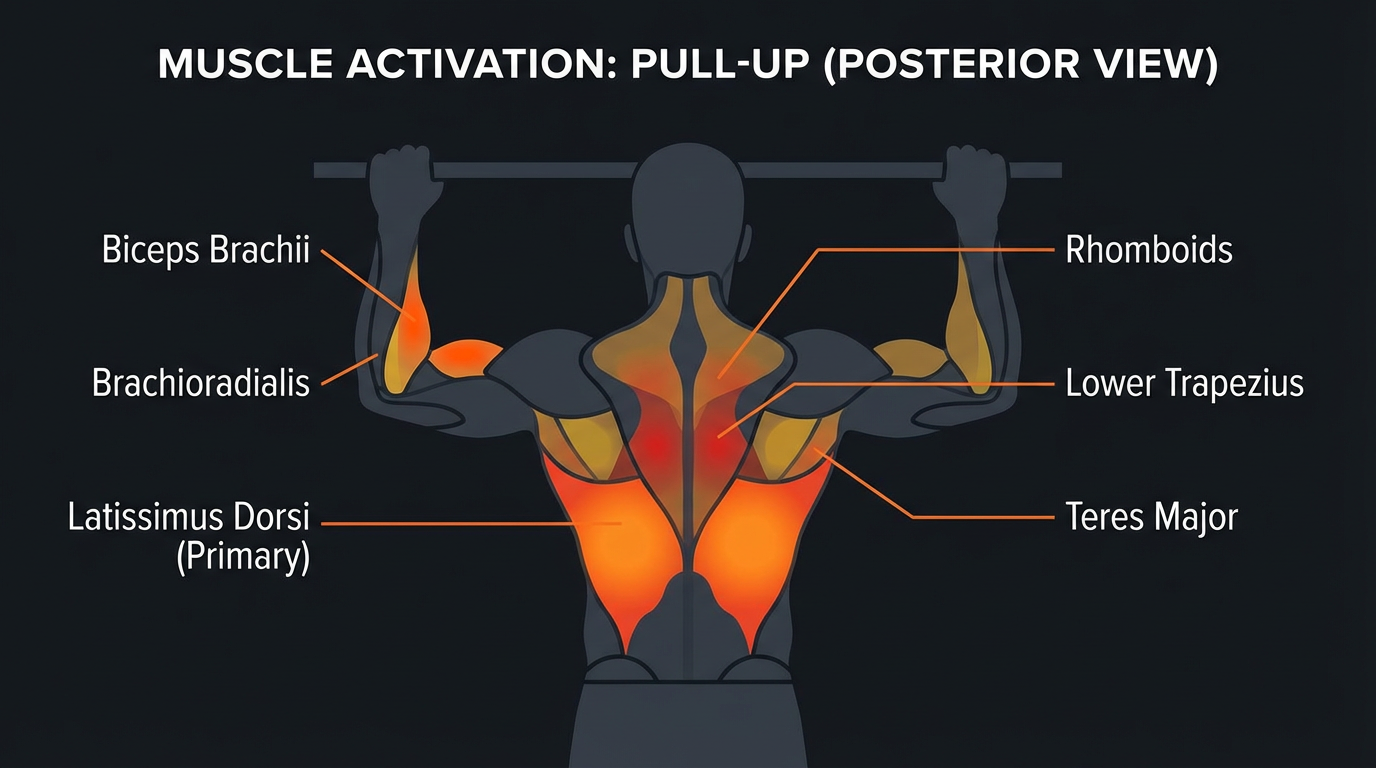
Pull-ups aren't just a party trick. They train your entire posterior chain from the mid-back up, and they do it through a full range of motion under load (your bodyweight). Here's what's actually working during a pull-up:
- •Latissimus dorsi — the primary mover, responsible for pulling your elbows down toward your hips
- •Biceps brachii and brachialis — elbow flexion (bending your arms)
- •Lower and middle trapezius — scapular depression and retraction (pulling your shoulder blades down and together)
- •Rhomboids — assist with scapular retraction
- •Forearm flexors — grip strength to hold onto the bar
- •Core musculature — stabilizing your torso so you don't swing
A 2010 study by Youdas et al. measured EMG activation during pull-ups and chin-ups and found both variations produced high activation across the lat, biceps, and infraspinatus. The pull-up (overhand grip) had slightly higher lat activation, while the chin-up (underhand) had slightly higher biceps activation. For this program, we're using overhand grip pull-ups, but if supinated grip feels better on your elbows, go for it. The lat recruitment difference is small.
There's also a practical carryover. Once you can do 10 pull-ups, you've built a base of relative strength that transfers to rows, deadlifts, and any sport where you need to pull something (climbing, grappling, swimming). It's one of the best bang-for-your-buck exercises you can learn.
What You Need Before Starting
Equipment:
- •A pull-up bar (doorframe, squat rack, or at a gym — doesn't matter)
- •1-2 resistance bands (one heavy, one medium — loop-style bands work best)
- •Access to a barbell or Smith machine at roughly hip height for inverted rows (a sturdy table works in a pinch)
Baseline requirement: You should be able to hang from a bar for at least 10 seconds. If you can't do that yet, spend a week just doing dead hangs for 3 sets, working up to 15-second holds, before starting the program.
Bodyweight note: Pull-ups are a relative strength exercise. If you weigh 250 lbs, the path to 10 pull-ups is going to be harder and probably longer than 30 days. That's just physics. The program still works, but be realistic with your timeline.
The 5 Key Exercises (and How to Actually Do Them)
1. Dead Hangs
Dead hangs aren't glamorous, but they're the foundation. You're training grip endurance, shoulder stability, and getting your body used to bearing load through the hands and arms.
How to do it: Grab the bar with an overhand grip, hands roughly shoulder-width apart. Let your body hang with straight arms. Keep your shoulders "packed" — think about pulling your shoulder blades slightly down, away from your ears. Don't just dangle like a wet noodle.
Common mistakes:
- •Shrugging your shoulders up to your ears (this loads your upper traps instead of building the hang pattern you want)
- •Gripping too wide — shoulder width is fine, going much wider makes it harder on your shoulders for no real benefit at this stage
- •Holding your breath — breathe normally
Target: Build up to 30-45 second holds. Once you can hit 45 seconds, your grip won't be the limiting factor in pull-up training.
2. Scapular Pull-Ups
This is the exercise most pull-up programs leave out, and it's arguably the most important one for beginners. A scapular pull-up teaches you how to initiate the pull-up with your back — not your arms.
How to do it: Hang from the bar with straight arms (dead hang position). Without bending your elbows, pull your shoulder blades down and together. Your body will rise maybe 1-2 inches. That's it. Then let yourself back down to the full dead hang. Each rep is small.
Common mistakes:
- •Bending the elbows — this turns it into a partial pull-up. Keep the arms straight.
- •Rushing through reps — hold the top (retracted) position for a full second
- •Not feeling it in your back — if you only feel it in your arms, you're pulling with your biceps. Think about tucking your shoulder blades into your back pockets.
Why it matters: The bottom of a pull-up is where most beginners fail. They can't initiate the pull because they don't know how to engage their lats from a dead hang. Scapular pull-ups teach that motor pattern directly.
3. Negative (Eccentric) Pull-Ups
Negatives are the single best exercise for building pull-up strength when you can't do a full rep yet. Your muscles can handle roughly 20-40% more load during the eccentric (lowering) phase than the concentric (lifting) phase. So even though you can't pull yourself up, you can absolutely control yourself on the way down — and that builds serious strength.
How to do it: Use a box, bench, or jump to get your chin above the bar. From the top position, lower yourself as slowly as you can until your arms are fully extended. Aim for a 4-5 second descent. Jump or step back up and repeat.
Common mistakes:
- •Dropping too fast — if your negatives are under 3 seconds, the load isn't doing much. Slow down. If you can't hold a 3-second negative, use a band for assistance.
- •Not going to full arm extension at the bottom — you need the full range of motion. Stopping with bent arms shortchanges the hardest part (the bottom).
- •Doing too many — negatives create a lot of muscle damage. More is not better here. Stick to the prescribed sets and reps.
4. Band-Assisted Pull-Ups
Bands let you practice the full pull-up movement pattern while removing some of your bodyweight. The thicker the band, the more assistance.
How to do it: Loop a resistance band over the bar. Place one foot (or knee) in the band. Perform a pull-up with the band taking some of your weight. Start with a heavier band and progress to lighter bands as you get stronger.
Common mistakes:
- •Using a band that's too light — if you're struggling to get 5 reps, use a thicker band. Ego has no place here. You need quality reps.
- •Relying on the band bounce — the band gives the most help at the bottom, which can teach you to explode out of the bottom and lose tension. Focus on a controlled pull, not a bounce.
- •Staying on the same band too long — if you can do 3 sets of 8 with a band, it's time to go to a thinner one.
Band progression: Heavy (green/dark) -> Medium (red/orange) -> Light (purple/thin) -> No band. Most people will drop one band thickness every 1-2 weeks during this program.
5. Inverted Rows
Inverted rows train the same muscles as pull-ups but at a less demanding angle. They're excellent for building volume when you can't do many (or any) pull-ups yet.
How to do it: Set a barbell in a rack at about hip height. Lie underneath it, grab the bar with an overhand grip slightly wider than shoulder width, and pull your chest to the bar. Your body should stay in a straight line from head to heels, like a reverse plank.
Common mistakes:
- •Sagging hips — keep your glutes and core tight. If your hips drop, you're making it easier and not getting the full benefit.
- •Pulling with your arms instead of your back — squeeze your shoulder blades together at the top of each rep. Think about driving your elbows toward the ground.
- •Not adjusting difficulty — the more horizontal your body, the harder it is. If you can't get 8 reps, raise the bar height or bend your knees.
The 4-Week Program
Train 3 days per week with at least one rest day between sessions (Monday/Wednesday/Friday works well). Each session takes about 25-35 minutes.
Week 1 — Building the Base
The goal this week is grip strength, scapular control, and getting comfortable hanging from the bar. Don't rush this.
Day A (repeat 3x this week):
| Exercise | Sets x Reps | Rest | Notes |
|---|---|---|---|
| Dead Hangs | 3 x 15-20 sec | 60 sec | Focus on packed shoulders |
| Scapular Pull-Ups | 3 x 6-8 | 60 sec | 1 sec hold at top |
| Negative Pull-Ups | 3 x 3 | 90 sec | 4-5 sec lowering phase |
| Band-Assisted Pull-Ups (heavy band) | 3 x 5-6 | 90 sec | Full range of motion |
| Inverted Rows | 3 x 8-10 | 60 sec | Feet flat, knees bent if needed |
Week 2 — Adding Volume
You should feel more comfortable on the bar by now. This week we increase reps and start pushing the negatives harder.
Day A (repeat 3x this week):
| Exercise | Sets x Reps | Rest | Notes |
|---|---|---|---|
| Dead Hangs | 3 x 25-30 sec | 60 sec | Packed shoulders, normal breathing |
| Scapular Pull-Ups | 3 x 8-10 | 60 sec | 1 sec hold at top |
| Negative Pull-Ups | 4 x 4 | 90 sec | 5 sec lowering — no faster |
| Band-Assisted Pull-Ups (heavy or medium band) | 4 x 6-8 | 90 sec | Switch to medium band if 8 reps feel manageable |
| Inverted Rows | 4 x 10-12 | 60 sec | Straighten legs to make it harder |
Week 3 — Transition Phase
This is where it starts to click. You're introducing attempts at real pull-ups (even singles count) and dropping band assistance.
Day A (repeat 3x this week):
| Exercise | Sets x Reps | Rest | Notes |
|---|---|---|---|
| Pull-Up Test | 1 x max reps | 2 min | Try unassisted. Even 1 rep counts. Record the number. |
| Negative Pull-Ups | 3 x 4-5 | 90 sec | 5-6 sec lowering |
| Band-Assisted Pull-Ups (medium or light band) | 4 x 6-8 | 90 sec | Move to light band when ready |
| Scapular Pull-Ups | 3 x 10 | 60 sec | These should feel easier now |
| Inverted Rows | 4 x 12-15 | 60 sec | Elevate feet on a bench for more challenge |
Week 4 — Testing and Maxing
The final week. You're doing real pull-ups now (with band assistance filling in the remaining volume) and pushing for your best numbers.
Day A (Monday and Wednesday):
| Exercise | Sets x Reps | Rest | Notes |
|---|---|---|---|
| Pull-Ups (unassisted) | 5 x max reps | 2 min | Even if max is 1-2 reps, do all 5 sets |
| Band-Assisted Pull-Ups (light band) | 3 x 6-8 | 90 sec | Top-up volume after the real sets |
| Negative Pull-Ups | 3 x 3 | 90 sec | 6 sec lowering |
| Inverted Rows | 3 x 12-15 | 60 sec | Feet elevated |
Day B (Friday — Test Day):
| Exercise | Sets x Reps | Rest | Notes |
|---|---|---|---|
| Warm-up: Dead Hangs | 2 x 15 sec | 60 sec | Just warming up, not going to fatigue |
| Warm-up: Band-Assisted Pull-Ups | 2 x 3 | 60 sec | Light, easy reps |
| MAX PULL-UP TEST | 1 x max reps | — | Full range of motion, chin clearly over bar, no kipping. This is your number. |
Common Sticking Points and How to Fix Them
"My grip gives out before my back does"
This is extremely common in the first two weeks. Your forearm flexors are smaller muscles and fatigue faster than your lats. Solutions:
- •Do dead hangs separately — add 2-3 sets of dead hangs on your off days, just for grip work
- •Use chalk or liquid grip — sweaty hands on a smooth bar will gas your forearms way faster than necessary
- •Try mixed grip on heavy sets — one hand overhand, one underhand. Alternate which hand is which each set. This isn't ideal long-term but can help bridge the grip gap while your forearms catch up.
Grip strength improves fast. Most people stop having this problem by week 2 or 3.
"I'm kipping/swinging and I can't stop"
Kipping means you're generating momentum with your hips to compensate for a lack of pulling strength. It's not necessarily bad in a CrossFit context, but for building strict pull-up strength, it defeats the purpose.
Fixes:
- •Cross your ankles and bend your knees slightly — this makes it physically harder to kip
- •Slow everything down — if you're swinging, you're going too fast. Think "controlled" on both the way up and the way down
- •Engage your core before you pull — brace your abs like someone's about to poke you in the stomach. A tight core reduces swinging.
- •Do more scapular pull-ups — kipping is often a compensation for not knowing how to initiate the pull with your lats. Scapular pull-ups teach that initiation.
"I can't get my chin over the bar"
You pull hard, you get up to about eye level or nose level, and then you stall. This is the most frustrating sticking point and the most common.
What's happening: the top portion of the pull-up requires more from your biceps, brachialis, and lower traps. If those are weak relative to your lats, you'll stall in the upper half.
Fixes:
- •Isometric holds at the top — use a band or jump to get your chin above the bar and hold for 5-10 seconds. Do 3-5 sets. This builds strength specifically in the position where you're failing.
- •More inverted rows with a pause — hold the top of the row (chest to bar) for 2-3 seconds per rep. This trains the retraction strength you need at the top of a pull-up.
- •Chin-ups as an accessory — the supinated grip puts your biceps in a stronger position. If you can get your chin over the bar with a chin-up but not a pull-up, use chin-ups temporarily to build top-end strength, then transfer back to pull-ups.
"I got a few pull-ups in week 2 but my numbers aren't going up"
Short-term plateaus in a 4-week program are usually about fatigue, not a real plateau. If you trained hard in weeks 1-2, your muscles might be accumulating fatigue by week 3. This is normal. The test day in week 4 includes reduced volume beforehand specifically to let you peak.
Other possibilities:
- •You're not sleeping enough. Strength adaptations happen during recovery, not during training. 7+ hours makes a real difference.
- •You're training pull-ups too frequently outside the program. Stick to the 3x/week schedule. Adding extra sessions doesn't speed up progress — it just adds fatigue.
Programming Notes
Rest days matter. The adaptations you're chasing — motor unit recruitment, tendon strength, muscle hypertrophy — happen during recovery. Training the same muscles 4+ days per week on this type of program will slow your progress, not speed it up.
Warm up before each session. 5 minutes of arm circles, band pull-aparts, and a set of easy inverted rows is enough. Don't start your first set of negatives with cold shoulders.
Track everything. Write down your reps, band thickness, and hold times each session. The numbers should trend upward week over week. If they're stagnating, you're probably under-recovering or you need to adjust band resistance.
After the 30 days: If you hit 10 pull-ups, congratulations — you can start working on weighted pull-ups (add 5-10 lbs with a dip belt) or higher rep sets. If you hit 5-7, repeat weeks 3 and 4 for another two weeks. Most people who hit 5 at day 30 can get to 10 by day 45-50.
FAQ
Can I do this program if I'm overweight?
Yes. Bodyweight makes pull-ups harder, but the progression is the same. You might spend more time on bands and negatives, and 10 reps in 30 days might be optimistic. That's fine. Progress is progress. I've seen people over 220 lbs go from zero to 5-6 pull-ups in a month, which is a huge accomplishment.
Chin-ups or pull-ups — does it matter?
For this program, either works. Chin-ups (palms facing you) are slightly easier for most people because the biceps are in a mechanically stronger position. Pull-ups (palms facing away) put a bit more emphasis on the lats. If regular pull-ups feel impossible at first, start with chin-ups and transition to pull-ups in week 3-4.
I can do 1-2 pull-ups already. Should I start from week 1?
Start from week 1 but use a lighter band for the assisted work. The scapular pull-ups and dead hangs in week 1 are still valuable for you. Think of it as building a more solid base before pushing your numbers.
How do I know if I should move to a thinner band?
If you can complete all prescribed sets and reps with 1-2 reps left in the tank on your last set, it's time to move down. If your last rep is a grinder every set, stay on the current band for another session or two.
What about lat pulldowns? Should I add those?
They're a fine accessory but not a substitute for the exercises in this program. Lat pulldowns don't train the stabilization demands or grip strength that pull-ups require. If you want to add them, do 3 sets of 10-12 after the main work. Don't replace anything in the program with them.
My elbows hurt when I do pull-ups. What's wrong?
Usually one of two things: your grip is too narrow (try moving your hands out to shoulder width), or you're extending your elbows under load too aggressively at the bottom (control the lowering phase instead of just dropping to a dead hang). If pain persists beyond mild soreness, see a physiotherapist — elbow tendinopathy is common in pulling movements and is very treatable, but it won't fix itself.
Can I do this every day instead of 3x per week?
No. You'll accumulate fatigue, your numbers will stall by week 2, and your elbows will probably start complaining. Three times per week gives you enough stimulus for adaptation and enough recovery to actually make gains. More is not better here.
Frequently Asked Questions
- How do I go from zero to one pull-up?
- Start with dead hangs (hold the bar for 20-30 seconds), then progress to slow negatives (jump up and lower yourself as slowly as possible over 5 seconds). Do 3 sets of 3-5 negatives three times per week. Most people get their first pull-up within 2-4 weeks.
- Are resistance band pull-ups effective?
- They're helpful as one step in the progression, but don't rely on them exclusively. Bands assist most at the bottom (where you're weakest) and least at the top, so they don't train the hardest part of the movement well. Mix them with negatives and dead hangs.
- Is it realistic to go from 0 to 10 pull-ups in 30 days?
- It's possible if you're relatively lean (under 20% body fat), have some base of upper body strength, and train 4-5 days per week. If you're starting from truly zero training experience or carrying extra weight, 60-90 days is more realistic.
- What's the fastest way to increase pull-up reps?
- Grease the groove: do 40-50% of your max reps multiple times throughout the day, every day. If your max is 4 pull-ups, do sets of 2 spread across the day, totaling 10-15 sets. Your nervous system adapts fast to frequent submaximal effort.
- Should I use an assisted pull-up machine?
- It's better than nothing, but negatives and band-assisted pull-ups transfer better to real pull-ups. The assisted machine stabilizes you, so you don't develop the core and shoulder stability needed for unassisted reps. Use it sparingly.