Chalk, Straps, and Wraps: A No-BS Guide to Lifting Accessories
Chalk, straps, wraps, sleeves, belts. Some of this stuff is genuinely useful and some is marketing nonsense. Here is what actually helps, when to use it, and when you are better off without it.
 Jeff·Feb 20, 2026·10 min read
Key Takeaways
- Chalk improves grip by absorbing sweat and is the simplest accessory to add -- liquid chalk works in gyms that ban powder and lasts longer per application.
- Lifting straps let you hold more weight than your grip can handle, making them essential for heavy rows, shrugs, and deadlift volume work above 80% of your max.
- Wrist wraps provide joint support during heavy pressing movements and should be snug but not so tight they cut off circulation.
- Use straps and wraps as tools to push your training harder, not as crutches -- train your raw grip and wrist stability on lighter sets.
- A good leather or lever belt is the single most impactful accessory for squats and deadlifts because it gives your core something to brace against.
Get This on WhatsApp
Get a quick summary and link sent straight to your WhatsApp.
Send Me This ArticleNot All Gear Is Created Equal
Walk into any serious gym and you will see lifters wearing an assortment of gear: chalk-covered hands, wrist wraps, knee sleeves, belts, straps. Walk into a commercial gym and you will see a different assortment: lifting gloves, padded bar wraps, ab-stimulation belts, waist trainers.
One group is using tools that serve a specific mechanical purpose. The other group is mostly spending money on comfort items and gimmicks.
This guide breaks down every common lifting accessory -- what it actually does, when you should use it, when you should not, and what is a waste of money. No brand endorsements, no affiliate links. Just practical information.
Lifting Chalk
What It Does
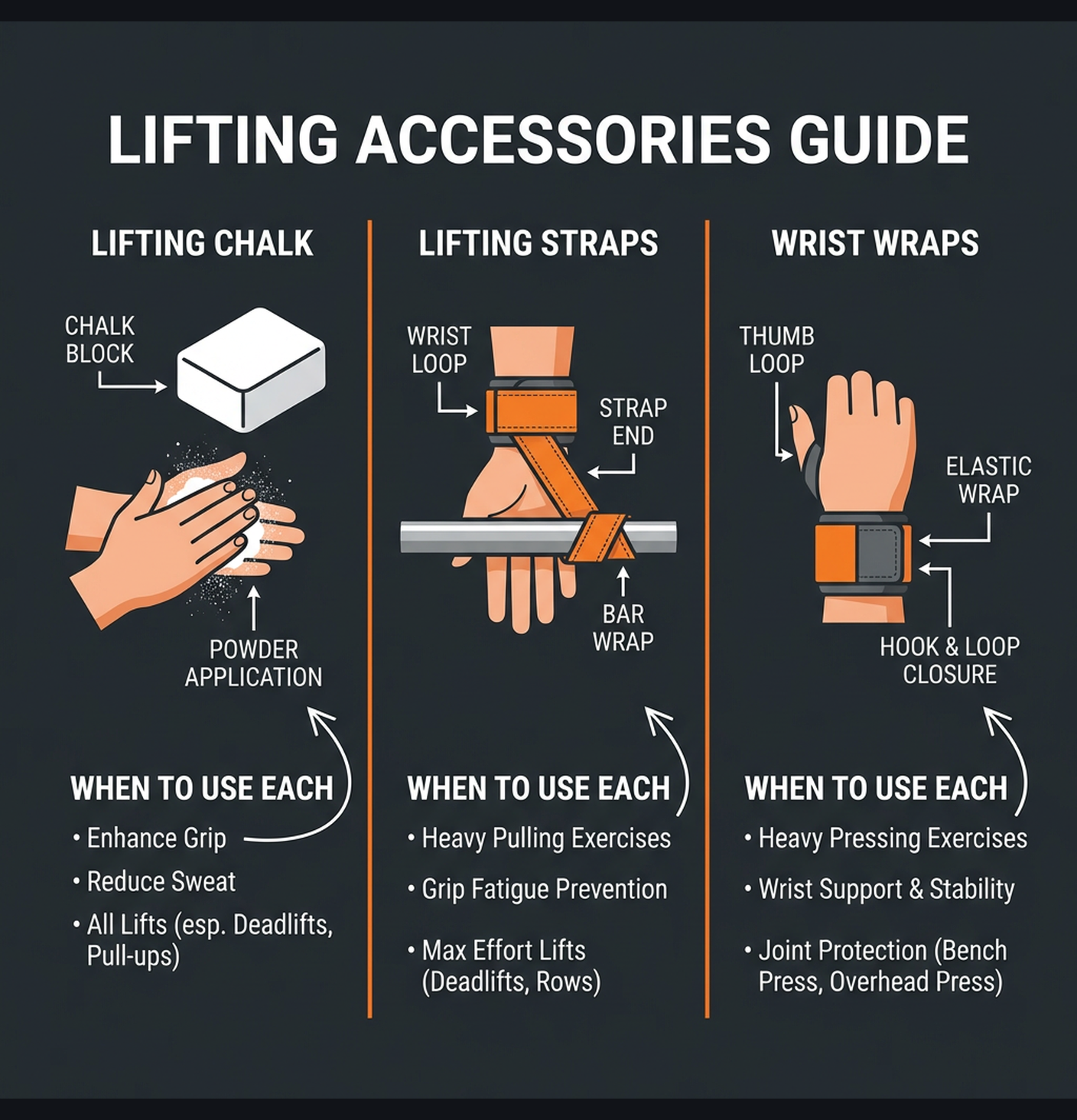
Chalk (magnesium carbonate) absorbs moisture from your hands to improve your grip on the bar. That is it. It does not make you stronger. It does not protect your hands from calluses. It absorbs sweat so the bar does not slip.
Why It Matters
A sweaty bar is a slippery bar. On deadlifts, rows, pull-ups, and any other pulling movement, your grip is the link between you and the weight. If the bar slips even slightly, your nervous system detects instability and reduces force output as a protective mechanism. You literally cannot pull as hard when your grip is insecure.
Chalk fixes this. It is the simplest, cheapest, and most effective training accessory you can buy.
Block vs Liquid
Block chalk (the traditional white bricks) works best. You crush it in your hands, rub it on, and it provides excellent coverage. The downside: it is messy. It gets on equipment, the floor, your clothes, and your gym might not allow it.
Liquid chalk is a suspension of magnesium carbonate in alcohol. You squeeze some on your hands, rub it in, the alcohol evaporates, and you are left with a thin layer of chalk. It is less effective than block chalk for heavy pulls but far less messy. Most gyms that ban block chalk will allow liquid chalk.
When to Use It
- •Any pulling movement where grip is a factor: deadlifts, rows, pull-ups, shrugs, carries
- •Pressing movements where a sweaty bar makes you nervous about control (bench press, overhead press)
- •Basically anytime your hands are sweaty and you are holding a bar
When You Do Not Need It
- •Machine exercises with handles that do not slip
- •Very light weights where grip is not an issue
- •Your warm-up sets
A block of chalk costs $3-5 and lasts months. Liquid chalk runs $8-15 for a bottle that lasts weeks to months depending on usage. Either way, this is the best cost-per-benefit training accessory available.
Lifting Straps
What They Are
Lifting straps are fabric or leather loops that wrap around your wrist and the barbell, creating a mechanical connection between you and the bar that does not depend on your grip strength. They essentially take your grip out of the equation.
Types
Cotton/nylon straps: The most common and cheapest option ($5-15). They wrap around the bar in a loop. Simple, effective, and they work for everything.
Figure-8 straps: These form a closed loop around your wrist and the bar. Faster to set up, more secure, popular with strongman competitors. They do not allow you to drop the bar easily, which can be a safety concern on deadlifts.
Lasso straps: A loop-and-tail design that wraps multiple times around the bar. More secure than basic cotton straps, slightly slower to set up.
For most lifters, basic cotton straps are all you need. Do not overthink this.
When to Use Them
- •Heavy deadlift top sets where your grip would fail before your back and legs
- •High-rep deadlifts (sets of 8+) where grip fatigue limits your training volume
- •Shrugs, rows, and pull work where you want to focus on back development without grip being the limiting factor
- •Romanian deadlifts and rack pulls where you are holding heavy weight for extended time
- •Farmer's walks and loaded carries at heavy weights
When NOT to Use Them
- •Every set of every pulling exercise. If you strap up for warm-up sets and light rows, your grip will never develop. Your grip needs to be trained, and the only way to train it is to grip things.
- •Competition deadlifts (if you compete in powerlifting). Straps are not allowed in competition. If your grip is your weak link, you need to train it, not avoid it.
The Grip Development Concern
This is the most common objection to straps, and it is valid. If you always use straps, your grip will not get stronger. Here is the practical solution:
Do all warm-up sets and sets below 80% of your max without straps. Let your grip work. When the weight gets heavy enough that your grip is the limiting factor (not your back, not your legs), strap up. This gives you the best of both worlds: grip training at moderate loads, and full posterior chain training at heavy loads.
Wrist Wraps
What They Are
Wrist wraps are stiff fabric wraps that go around your wrist joint to provide support during pressing movements. They limit wrist extension (bending back) and create a more rigid, stable wrist position under the bar.
When to Use Them
- •Heavy bench press (above 80% of your max) where the bar tends to push your wrists into extension
- •Heavy overhead press where wrist stability matters
- •Any pressing movement where you feel wrist discomfort under heavy loads
How Tight Is Right
Wrist wraps should be tight enough that your wrist feels supported but not so tight that your hands go numb. You should be able to move your fingers freely. If the wraps are cutting off circulation, they are too tight.
Wrap them so the wrap covers the wrist joint itself -- not just the forearm below the wrist. The whole point is to support the joint.
When You Do Not Need Them
- •Sets below 70-75% of your max (your wrists should be able to handle moderate loads without support)
- •Pulling movements (your wrists are not in a loaded extension position during pulls)
- •Curls, lateral raises, and other light isolation work
Good wrist wraps cost $15-30. Cheap ones stretch out after a few months. Buy a mid-range pair and they will last years.
Knee Sleeves
What They Are
Knee sleeves are neoprene tubes that slide over your knee joint. They come in different thicknesses, typically 5mm or 7mm.
What They Actually Do
Two things, and both are simple:
- •Warmth. Neoprene retains heat around the knee joint, keeping the joint warm and the synovial fluid (your natural joint lubricant) flowing better. A warm joint moves more smoothly and comfortably than a cold one.
- •Proprioception. The compression gives your nervous system additional feedback about where your knee is in space. This can improve your sense of stability and confidence during squats.
What They Do NOT Do
Knee sleeves are not knee braces. They do not provide significant mechanical support. They will not prevent ACL tears, meniscus injuries, or patellar tendon issues. If you have a structural knee injury, you need a brace prescribed by a medical professional, not a sleeve from Amazon.
The slight "rebound" from very tight competition-grade 7mm sleeves (like SBD or Stoic) can add a few pounds to your squat. We are talking maybe 5-15 lbs on a 300+ lb squat. It is minimal but nonzero.
When to Use Them
- •During squatting, especially if your gym is cold or your knees take a while to feel good during warm-ups
- •During high-volume leg training where joint comfort matters
- •Anytime your knees feel stiff or achy during leg work (if the ache persists, see a professional)
When You Do Not Need Them
- •Upper body days
- •Light warm-up squats (put them on when the weight gets working)
- •If your knees feel great without them, you do not need them
A good pair of 7mm knee sleeves runs $40-80. They last 2-5 years depending on usage and how well you wash them (yes, wash them -- neoprene absorbs sweat and will eventually smell horrifying).
Lifting Belt
This one gets its own article for a full deep dive, but here is the brief version:
A lifting belt does not support your back the way a back brace does. It gives your core something to brace against. When you take a deep breath and push your abs out into the belt, you create more intra-abdominal pressure, which stabilizes your spine and allows you to transmit force more efficiently.
Use it for heavy squats and deadlifts (above 80% of your max). Do not use it as a substitute for core strength -- if you cannot brace without a belt, fix that first.
A 10mm leather belt with a single-prong buckle or a lever is the standard. $60-100 for one that lasts a lifetime.
Elbow Sleeves
Same concept as knee sleeves: neoprene, warmth, proprioception. Useful if you get elbow discomfort during pressing or pulling. Not a fix for actual elbow injuries. A pair runs $25-50.
Use them if your elbows bother you during bench press, tricep extensions, or heavy curls. Skip them if your elbows feel fine.
What You Do NOT Need
Here is the gear that is either useless, counterproductive, or solving a problem that does not exist:
Lifting Gloves
Gloves create a thicker, less stable surface between your hand and the bar. This actually makes your grip worse, not better. They also prevent you from developing calluses, which are your body's natural adaptation to gripping a bar. If the bar hurts your hands, chalk and proper grip technique will fix it. Gloves are a crutch that creates a worse problem.
Padded Bar Wraps (Squat Bar Pads)
Those foam tubes that wrap around the bar for squats? They shift the bar's position on your back, change the center of gravity, and make it harder to create a tight, stable shelf for the bar. If the bar hurts on your back, you need to build your upper back musculature and learn proper bar positioning, not add padding.
Ab Stimulation Belts
Electronic belts that "stimulate" your abs with electrical impulses do not build meaningful core strength, do not burn fat, and do not give you a six-pack. Your money is better spent on a gym membership.
Waist Trainers
These have zero training benefit. They restrict breathing, limit bracing, and any "results" disappear the moment you take them off because they are just compressing your soft tissue. Do not wear one while lifting.
The Practical Guide
| Accessory | Cost | Use Case | Recommendation |
|---|---|---|---|
| Chalk (block or liquid) | $3-15 | Grip improvement on all pulling | Must-have for every lifter |
| Lifting straps | $5-15 | Heavy/high-rep pulling when grip limits training | Worth owning, use selectively |
| Wrist wraps | $15-30 | Heavy pressing support | Worth owning if you press heavy |
| Knee sleeves (7mm) | $40-80 | Warmth and comfort during squats | Worth owning, especially over 30 |
| Lifting belt (leather, 10mm) | $60-100 | Heavy squats and deadlifts | Worth owning once you squat/pull 1.5x bodyweight+ |
| Elbow sleeves | $25-50 | Elbow comfort during pressing | Optional, only if needed |
| Lifting gloves | $15-25 | None | Skip entirely |
| Bar pad | $10-20 | None | Skip entirely |
| Ab belt / waist trainer | $20-50 | None | Skip entirely |
The Bottom Line
Good lifting accessories solve a specific mechanical problem. Chalk improves grip. Straps let you train your back without grip being the bottleneck. Wraps support your wrists under heavy loads. Sleeves keep your joints warm. A belt amplifies your brace.
Bad lifting accessories solve problems that do not exist or create new ones. Gloves make your grip worse. Bar pads change your squat mechanics. Electronic gadgets do nothing.
Buy chalk first. It costs pocket change and helps immediately. Add straps, wraps, and sleeves as you get stronger and your training demands increase. Get a belt when you are squatting and deadlifting serious weight. And leave the gloves in the retail store where they belong.
Frequently Asked Questions
- Should I use lifting straps or train my grip raw?
- Both. Train your main deadlift sets without straps to build grip strength, and use straps on back-off sets, rows, and any pull where grip limits the target muscle. If your grip gives out before your back or hamstrings, straps let you keep training the muscles that actually matter for that exercise.
- When should I start using a lifting belt?
- Once you have a solid brace and can squat or deadlift with good form at moderate weights. A belt amplifies your bracing, it does not replace it. Most lifters benefit from a belt once they are handling weights above roughly 80 percent of their max on squats and deadlifts.
- What is the difference between wrist wraps and wrist straps?
- Wrist wraps go around your wrists to add joint support during pressing movements. Wrist straps wrap around the bar and your wrists to help you hold onto heavy weight during pulls. They serve completely different purposes, so do not mix them up when shopping.
- Is chalk worth using in a commercial gym?
- Chalk makes a massive difference for grip on deadlifts, pull-ups, and rows. Liquid chalk is the best option for commercial gyms because it does not leave a mess and most gyms allow it even if they ban regular chalk. A small bottle lasts months and costs under ten dollars.
- Do knee sleeves actually help or are they just for show?
- Knee sleeves provide warmth and mild compression, which can reduce discomfort during squats and make your knees feel more stable. They add a small amount of rebound out of the hole. They are not magic, but most lifters who squat regularly find them worth the investment for joint comfort during high-volume training.