Sumo vs Conventional Deadlift: Which One Is Right for You?
The sumo vs conventional debate has been raging for decades. The truth is it depends on your body proportions, hip structure, and goals. Here is how to figure out which one is yours.
 Jeff·Dec 10, 2025·8 min read
Key Takeaways
- Sumo deadlifts favor lifters with longer torsos and shorter arms because the wide stance keeps the torso more upright and shifts work to the hips and quads.
- Conventional deadlifts hit the posterior chain harder -- especially the spinal erectors, hamstrings, and glutes -- making them a better raw strength builder for most people.
- Your hip anatomy determines which stance feels natural; if your knees track forward easily and your hips open wide without pain, sumo is worth trying.
- There is no cheating debate -- both lifts are competition legal, and the best one for you is whichever lets you move the most weight safely.
- Try both for at least 4-6 weeks each before deciding; early discomfort with a new stance is usually a mobility or technique issue, not a sign it is wrong for you.
Get This on WhatsApp
Get a quick summary and link sent straight to your WhatsApp.
Send Me This ArticleTwo Stances, One Bar
The deadlift is simple. Pick up heavy weight from the floor. Stand up with it. Done. But the way you position your feet changes the entire lift -- what muscles work hardest, how your spine loads, where you get stuck, and ultimately how much weight you can pull.
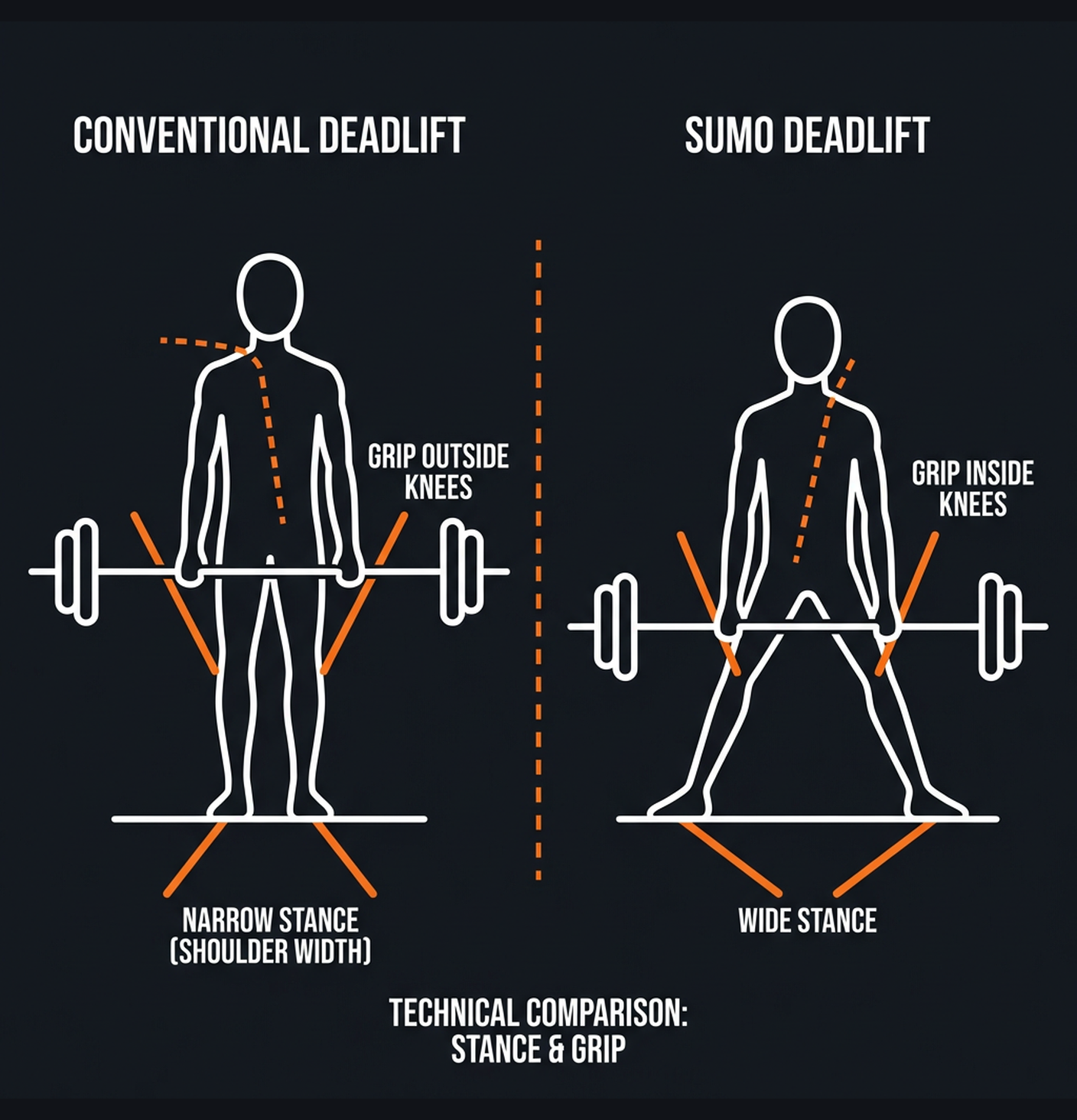
Conventional deadlift: feet roughly hip-width, hands outside the knees. Sumo deadlift: feet wide, toes pointed out, hands inside the knees. Same bar, same gravity, completely different movement patterns.
The internet treats this like a religious war. Conventional purists say sumo is "cheating" because of the shorter range of motion. Sumo lifters point out that plenty of world records have been set with a wide stance. The real answer is boring but useful: the best stance is the one that matches your body.
The Anatomy That Decides Everything
Your skeleton is not the same as everyone else's. Two factors matter more than anything when choosing a deadlift stance:
Hip socket depth and angle. Your femur (thigh bone) sits in your hip socket at an angle that is genetically determined. Some people have shallow sockets that face more forward -- these folks tend to feel comfortable in a wide stance with externally rotated hips. Others have deeper sockets that face more to the side -- they often feel pinched and restricted in a wide sumo stance.
Torso-to-femur ratio. If you have a long torso relative to your femurs, conventional deadlifts tend to work well. Your torso stays more upright even in a conventional stance, and your back has good leverage. If you have a short torso and long femurs, conventional deadlifts force you into a very bent-over position that puts enormous demand on your lower back. A wider stance shortens the effective femur length and lets you stay more upright.
There is a simple test: stand with your feet at sumo width (well outside shoulder width) and squat down as low as you can with your toes turned out about 30-45 degrees. If you feel comfortable, open, and strong in the bottom position, sumo might suit you. If you feel jammed, pinched in the front of your hips, or unstable, conventional is probably your stance.
Muscles Worked: What Each Stance Emphasizes
Both stances work your entire posterior chain, but the emphasis shifts significantly.
| Muscle Group | Conventional | Sumo |
|---|---|---|
| Lower back / erectors | Primary mover, heavy demand | Moderate demand, more upright torso |
| Glutes | Strong involvement, especially at lockout | Primary mover throughout the pull |
| Hamstrings | Primary mover off the floor | Moderate involvement |
| Quadriceps | Moderate involvement | High involvement, significant leg drive |
| Adductors (inner thigh) | Minimal | Primary stabilizer, heavy demand |
| Upper back / traps | High demand to maintain position | High demand to maintain position |
| Grip | Same | Same |
Conventional is essentially a hip hinge with a strong back component. Your back and hamstrings do the heavy lifting off the floor, and your glutes and back finish the lockout. It is a pull-dominant movement.
Sumo is more of a wide-stance squat with a pull component. Your quads and adductors drive the initial break from the floor, your glutes power the hip extension, and your back has to hold position but is under less shear stress because your torso is more vertical.
Who Should Pull Conventional
Conventional deadlifts tend to work best for lifters who have:
- •A longer torso relative to their legs
- •Narrower hips
- •Strong lower backs and hamstrings
- •Hip sockets that do not allow comfortable deep external rotation
- •A preference for more "back-dominant" pulling
If you come from a manual labor background, played sports that built back strength, or just feel natural bending over and picking things up, conventional is probably your home. Most people start with conventional, and many never need to leave it.
Common conventional cues:
- •Feet hip-width, toes slightly out
- •Grip just outside the knees
- •Hips start higher than a squat -- you should feel tension in your hamstrings at setup
- •Push the floor away with your legs while driving your chest up
- •Keep the bar tight to your body (it should scrape your shins)
- •Squeeze your glutes hard at lockout -- do not hyperextend your back
Who Should Pull Sumo
Sumo deadlifts tend to work best for lifters who have:
- •Shorter torsos relative to their legs
- •Wider hip structures
- •Good hip external rotation mobility
- •Strong quads and adductors
- •History of lower back issues that make heavy conventional pulls uncomfortable
If you squat well with a wide stance, have good hip mobility, and feel more powerful driving out of a wide position, sumo is worth trying seriously.
Common sumo cues:
- •Feet wide (shin angle roughly 45 degrees to the floor at the bottom)
- •Toes turned out 30-45 degrees to match your hip angle
- •Grip inside the knees, arms hanging straight down
- •Spread the floor apart with your feet -- this engages the adductors and glutes
- •Push your knees out over your toes as you break the bar from the floor
- •Stay patient off the floor -- sumo is slow to break and fast to lock out
- •Lock out by squeezing the glutes and driving the hips through
Common Mistakes by Stance
Conventional Mistakes
- •Rounding the lower back. The most common and most dangerous. If your lower back rounds significantly under load, you either need to improve your hip hinge pattern, strengthen your back, or reduce the weight.
- •Hips shooting up first. If your hips rise faster than your chest off the floor, the lift turns into a stiff-leg deadlift. Your back takes the entire load. Fix this by cueing "chest up" and strengthening your quads.
- •Bar drifting away from the body. The farther the bar gets from your center of mass, the harder your back has to work. Keep it close. Long sleeves and tall socks exist for a reason.
Sumo Mistakes
- •Treating it like a wide-stance conventional. Sumo is not just spreading your feet. If your torso angle looks the same as conventional but your feet are wide, you are doing a wide-stance conventional pull with bad leverage. In a proper sumo, your torso should be significantly more upright.
- •Knees caving in. If your knees collapse inward as you break the floor, your adductors are weak relative to the load. Drop the weight and strengthen them, or you will hurt your knees.
- •Hips too far from the bar. In sumo, you want your hips as close to the bar as possible at the start. If your hips are too far back, you lose the mechanical advantage that makes sumo work.
- •Rushing the break. Sumo deadlifts are slower off the floor than conventional pulls. This is normal. Do not jerk the bar. Apply steady force and let the bar break from the ground gradually.
Programming Both Stances
Even if you have a clear primary stance, there is value in training both. Using your non-primary stance as an accessory builds strength in positions you do not normally train and addresses muscle imbalances.
Here is a simple approach:
- •Primary stance: 3-5 sets of 1-5 reps at heavy loads (your main working sets)
- •Secondary stance: 2-3 sets of 6-8 reps at moderate loads (as an accessory on a different day)
If you compete in powerlifting, pick one stance for the platform and stick with it. In training, you have more freedom to rotate.
For general strength training without competition goals, you can alternate stances every training block (4-6 weeks of each) or use different stances on different training days.
Competition Considerations
In powerlifting, both stances are legal in every federation. The bar starts on the floor, you pick it up, you lock out. How you position your feet is your business.
The "sumo is cheating" crowd points out that sumo has a shorter range of motion. This is true. A sumo deadlift typically moves the bar 20-25% less distance than a conventional pull. But range of motion is not the only factor in difficulty. The hip mobility demands of sumo are higher, the patience required off the floor is greater, and the adductor strength needed is significant.
Some of the biggest deadlifts in history have been pulled conventional (Benedikt Magnusson, Eddie Hall). Others have been sumo (Yury Belkin, numerous 83 kg and 93 kg class records). The strongest stance is the one that lets you move the most weight with your body.
Side-by-Side Comparison
| Factor | Conventional | Sumo |
|---|---|---|
| Range of motion | Longer | Shorter (20-25% less) |
| Primary muscles | Back, hamstrings | Quads, glutes, adductors |
| Torso angle | More horizontal | More vertical |
| Spine loading (shear) | Higher | Lower |
| Speed off the floor | Faster | Slower |
| Lockout difficulty | Moderate | Generally easier |
| Mobility demands | Hamstring flexibility | Hip external rotation |
| Best for body type | Long torso, narrow hips | Short torso, wide hips |
How to Decide
If you have never tried both stances, spend 4-6 weeks with each and compare. Use submaximal weights (70-80% of your best conventional pull) and see which one feels more natural, stronger, and more repeatable.
Do not pick a stance because your favorite lifter uses it. Do not pick a stance because someone on the internet told you sumo is "easier." Pick the stance that matches your body, feels strong, and allows you to train hard without beating yourself up.
And remember -- this is not a permanent decision. Plenty of lifters switch stances at different points in their careers as their bodies change, their mobility improves, or their goals shift. Try both, pick one, and pull heavy.
Frequently Asked Questions
- Is sumo deadlift easier than conventional?
- Not easier, just different. Sumo shortens the range of motion and shifts more work to your hips and quads, while conventional demands more from your back and hamstrings. Plenty of elite lifters pull less sumo than conventional because it does not suit their proportions.
- How do I know if my body is built for sumo or conventional?
- Lifters with longer torsos and shorter arms often do better with sumo because it lets them stay more upright. If you have long arms and a shorter torso, conventional usually feels more natural. Try both for a few weeks and see which one lets you maintain better positions under load.
- Does sumo work your back less than conventional?
- Your lower back works less in sumo because your torso stays more vertical, but your upper back still has to keep the bar from drifting forward. If you are looking to reduce lower back stress, sumo can help, but it is not a free pass to ignore back strength.
- Can I train both sumo and conventional in the same program?
- Yes, and many lifters benefit from it. Use your stronger stance as your main lift and the other as an accessory. Pulling conventional for sets of 5 as a secondary movement after sumo, or vice versa, covers your weaknesses without overcomplicating your program.
- Why does my sumo deadlift feel weak off the floor?
- Sumo is hardest at the start because your hips are in a mechanically disadvantaged position at the bottom. Deficit sumo pulls and tempo pulls that slow down the first few inches build the hip strength and positioning you need to break the bar off the ground.