High Bar vs Low Bar Squat: Which Should You Do?
Bar position changes everything about the squat. High bar hits your quads and keeps you upright. Low bar loads your posterior chain and lets you move more weight. Which one is better depends on what you are training for.
 Sam·Dec 18, 2025·9 min read
Key Takeaways
- High bar sits on your traps and keeps your torso upright, which targets the quads more and is the default position for most recreational lifters.
- Low bar sits across the rear delts and lets you lean forward more, shifting stress to the glutes and hamstrings and usually allowing heavier loads.
- If you compete in powerlifting, low bar typically lets you squat 5-10% more weight; if you do Olympic lifting or front squat often, high bar has better carryover.
- Shoulder and wrist mobility issues can make low bar painful -- wider grip, thumbless grip, or stretching your pecs and lats usually fixes it.
- Most people benefit from using one as their primary squat and rotating the other in for 4-6 week blocks to shore up weak points.
Get This on WhatsApp
Get a quick summary and link sent straight to your WhatsApp.
Send Me This ArticleA Few Inches Changes Everything
The difference between a high bar squat and a low bar squat is about 2-3 inches of bar placement on your back. That is it. But those few inches completely change the mechanics of the squat -- your torso angle, which muscles do the most work, how deep you can go, and how much weight you can move.
Most recreational lifters never think about it. They step under the bar, put it wherever feels natural, and squat. That works fine for a while. But once you are moving real weight, understanding bar position helps you train smarter, fix sticking points, and choose the right variation for your goals.
Where the Bar Sits
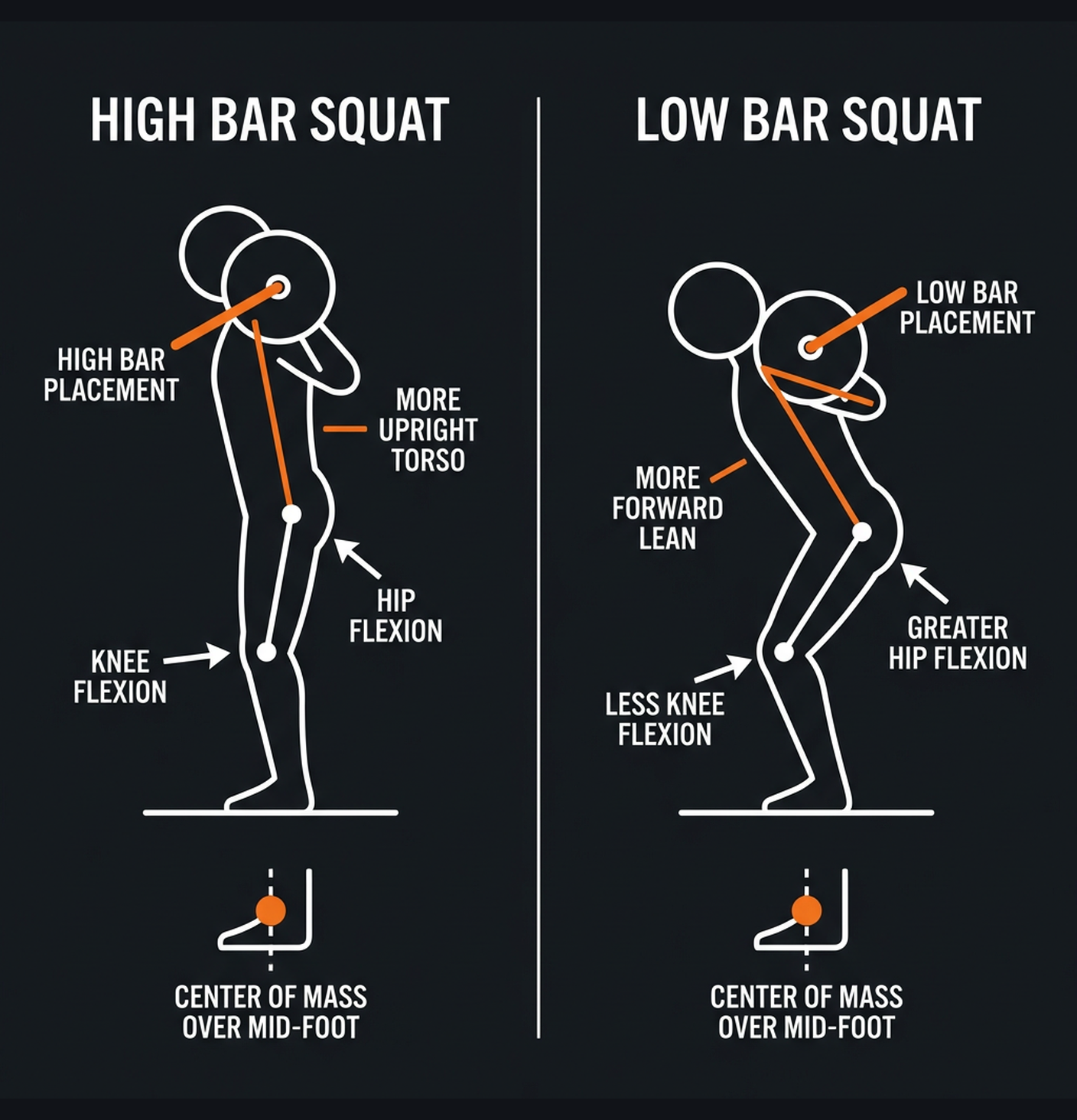
High bar sits on top of your traps, right at the base of your neck. If you shrug your traps up and flex them, the bar rests on the muscle shelf that creates. This is the position most people default to because it feels natural and stable.
Low bar sits across your rear deltoids and the spine of your scapula, about 2-3 inches lower than high bar. You need to squeeze your shoulder blades together hard to create a shelf for the bar. It feels awkward at first -- the bar seems like it is going to slide down your back. But once you get the shoulder blade squeeze right, it locks in.
The low bar position requires more shoulder mobility. If you cannot get your hands narrow enough on the bar to pin your shoulder blades together, you will struggle with low bar. Wrist pain from low bar squats is almost always a shoulder mobility problem, not a wrist problem. The wrists are bending to compensate for tight shoulders.
How Bar Position Changes the Squat
When the bar sits higher on your back, your torso stays more upright throughout the squat. Your knees travel further forward, and the movement looks more like a straight up-and-down piston. The quads do most of the heavy lifting because the knee angle is more acute at the bottom.
When the bar sits lower, physics demands that you lean forward more to keep the bar over your midfoot (which is where it needs to stay for balance). This forward lean means your hips push back further, your shins stay more vertical, and the squat becomes more hip-dominant. Your glutes, hamstrings, and lower back take on a bigger share of the work.
Here is the comparison:
| Factor | High Bar | Low Bar |
|---|---|---|
| Bar position | On upper traps | On rear delts / scapular spine |
| Torso angle | More upright (65-85 degrees) | More forward lean (45-65 degrees) |
| Knee travel | Significant forward travel | Less forward travel |
| Primary movers | Quads, glutes | Glutes, hamstrings, lower back |
| Depth potential | Generally deeper | Harder to reach full depth |
| Weight potential | Typically 5-10% less | Typically 5-10% more |
| Ankle mobility demand | Higher | Lower |
| Shoulder mobility demand | Lower | Higher |
Muscle Emphasis
High Bar: Quad Dominant
The upright torso and deep knee bend of a high bar squat put maximum stretch and tension on the quadriceps. This is why Olympic weightlifters almost exclusively use high bar -- they need strong quads to catch cleans and snatches in a deep front squat position, and the carryover from high bar back squats is direct.
If your goal is quad development, high bar is the better choice. The deeper knee flexion at the bottom of the lift puts the quads through a larger range of motion, which is a primary driver of muscle growth.
Low Bar: Posterior Chain Dominant
The forward lean and hip-hinge component of a low bar squat shifts the workload to the glutes, hamstrings, and spinal erectors. Powerlifters favor low bar because it allows them to move the most weight by recruiting more total muscle mass -- the posterior chain is bigger and stronger than the quads alone.
If your goal is maximum weight on the bar for competition, or if you want to train your posterior chain hard with a squat variation, low bar is probably your move.
Mobility Requirements
High bar squats demand good ankle dorsiflexion. If your ankles are stiff (common in people who wear rigid shoes, sit a lot, or have never done mobility work), your knees cannot travel forward enough and your torso pitches forward to compensate. This turns a high bar squat into a weird hybrid that loads your back without the posterior chain leverage of a true low bar squat.
Fix it with: squat shoes (with a raised heel), consistent ankle mobility work, or both. A solid pair of squat shoes adds 0.75-1 inch of effective heel elevation, which immediately improves high bar squat depth and position.
Low bar squats demand good shoulder external rotation and thoracic extension. If your shoulders are tight, you cannot create the shelf for the bar and your wrists absorb the load. This leads to wrist pain, elbow pain, and an unstable bar position.
Fix it with: band dislocates, doorway pec stretches, and gradually narrowing your grip over time. Do not force a narrow grip if your shoulders are not ready.
Who Uses Which
Olympic weightlifters use high bar almost exclusively. Their sport demands deep squats with an upright torso, and high bar develops exactly that pattern.
Powerlifters mostly use low bar. The goal is to squat the most weight possible to competition depth (roughly parallel), and low bar allows more muscle mass to contribute to the lift. But not all powerlifters go low bar -- some with good quad strength and longer torsos squat more high bar.
Bodybuilders tend to prefer high bar for quad development, though they use both depending on what they are targeting in a given training block.
General strength trainees can use either one. If you are not competing, the best bar position is the one that feels strongest, lets you hit good depth, and does not aggravate your joints.
Depth Comparison
High bar squats are generally easier to take deeper. The upright torso and forward knee position allow the hips to drop well below parallel without the lower back rounding (the dreaded "butt wink").
Low bar squats are harder to take to full depth. The forward lean and hip-dominant pattern mean that at a certain depth, your lower back will start to round as your hamstrings reach their flexibility limit. Most low bar squatters squat to just below parallel -- which is deep enough for powerlifting -- but rarely go "ass to grass."
If full-depth squatting matters to you (Olympic lifting, mobility, personal preference), high bar is usually the easier path. If you just need to hit parallel for competition or general strength, low bar works fine.
Switching Between Them
If you have only ever squatted one way, switching to the other will feel strange for 2-4 weeks. The motor pattern is different enough that you will feel weaker and less coordinated at first. This is normal.
When switching to low bar from high bar:
- •Start with about 70% of your high bar working weight
- •Focus on the shoulder blade squeeze and creating a solid shelf
- •Let your hips sit back more -- think "hip hinge into a squat"
- •Expect your depth to be slightly less at first
- •Your low back and glutes will be much more sore than you are used to
When switching to high bar from low bar:
- •Start with about 80-85% of your low bar working weight
- •Keep the bar high on the traps, not sliding down
- •Let your knees travel forward -- fight the urge to sit back
- •Your quads will be the limiting factor and will get very sore
- •Squat shoes help enormously if you do not already wear them
Programming Both Variations
You do not have to pick one forever. Many strong lifters use both in their programming:
- •Primary/secondary approach: Use your preferred bar position for heavy work (3-5 reps) and the other for lighter, higher-rep work (6-10 reps) as an accessory.
- •Block rotation: Spend 4-6 weeks with one bar position, then switch for the next block. This prevents overuse patterns and builds well-rounded leg strength.
- •Day split: Squat twice per week? Use low bar on your heavy day and high bar on your lighter, volume day.
The benefit of training both is that you develop strength through different ranges of motion and movement patterns. Low bar builds your posterior chain and teaches you to use your hips. High bar builds your quads and teaches you to stay upright. Both make you a better squatter overall.
Common Issues With Each
High Bar Problems
- •Forward lean at the bottom: Usually an ankle mobility issue. Get squat shoes or work on ankle flexibility.
- •Bar rolling up the neck: You are not squatting the bar -- it is drifting forward. Keep your upper back tight and chest up.
- •Knee pain: High bar puts more stress on the knees due to the acute knee angle. If this bothers you, check that your knees are tracking over your toes (not caving in) and consider low bar.
Low Bar Problems
- •Wrist/elbow pain: Shoulder mobility is the fix. Widen your grip temporarily and work on shoulder flexibility.
- •Lower back rounding at depth: You are going too deep for the movement pattern. Squat to just below parallel or work on hamstring flexibility.
- •Bar sliding down: Squeeze your shoulder blades harder and make sure you are not wearing a slick shirt. Chalk on your back helps.
- •Good-morning squat: If your hips rise and your chest drops out of the hole, your quads are the weak link. Add front squats or leg press as accessories.
The Bottom Line
High bar and low bar are both legitimate squat variations that build strength, muscle, and athleticism. High bar keeps you upright, hits your quads harder, and goes deeper. Low bar lets you lean forward, loads your posterior chain, and typically allows more weight.
Pick the one that matches your goals, feels strongest for your body, and lets you train consistently without joint pain. If you are unsure, spend a month with each and compare. The best squat is the one you will actually do, with good form, for years.
Frequently Asked Questions
- Where exactly does the bar sit for high bar vs low bar?
- High bar sits on your upper traps, right at the base of your neck. Low bar sits across your rear delts and the spine of your scapula, roughly 2-3 inches lower. Low bar requires more shoulder mobility to hold in place, which is why some lifters struggle with it initially.
- Which squat style is better for building quads?
- High bar hits your quads harder because the more upright torso lets your knees travel further forward over your toes. If quad development is your priority, high bar or front squats are your best options. Low bar shifts more of the work to your posterior chain.
- Why do powerlifters mostly use low bar?
- Low bar lets you lift more weight because the forward lean shortens the moment arm at the hip, and your glutes and hamstrings can contribute more force. In a sport where the only thing that matters is how much you squat, that mechanical advantage adds up to real pounds on the bar.
- Does low bar hurt your shoulders?
- It can if you lack shoulder external rotation mobility or grip the bar too narrow. Wrist pain and shoulder impingement are common complaints. Widening your grip, doing daily shoulder stretches, and using a thumbless grip usually fix the problem within a few weeks.
- Can I switch between high bar and low bar across training blocks?
- Absolutely. Many lifters use high bar during hypertrophy phases to hit their quads and keep things comfortable for higher reps, then switch to low bar when peaking for strength. Just give yourself a couple of weeks to readjust your groove when you switch.