How to Pick the Right Weight for Every Exercise
Too light and you are wasting time. Too heavy and your form breaks down. Here is a simple system for choosing the right weight on any exercise, whether you have been lifting for two weeks or two years.
 Jeff·Mar 8, 2026·7 min read
Key Takeaways
- Use the two-rep buffer rule: pick a weight where you could do 2 more reps than prescribed, but not 4 more.
- Find your working weight by warming up from an empty bar and adding small jumps until the target rep count feels challenging.
- Add 5 lbs per week for upper body barbell exercises and 10 lbs for lower body -- only when all sets are clean.
- On compound lifts, err lighter to protect form. On isolation exercises, you can push closer to failure.
- If weights feel 20% harder than normal on a bad day, drop 10-15% and get quality reps in rather than grinding with ugly form.
Get This on WhatsApp
Get a quick summary and link sent straight to your WhatsApp.
Send Me This ArticleThe Two-Rep Buffer Rule
Here is the simplest weight selection rule that works for almost every situation: pick a weight where you could do two more reps than the program asks for, but not four more.
If the program says 3 sets of 10, the weight should feel hard at rep 10 but you could have squeezed out reps 11 and 12 if someone put a gun to your head. If you could easily bang out 14 or 15, it is too light. If you are grinding to a halt at rep 8, it is too heavy.
This two-rep buffer keeps you in the productive zone: heavy enough to stimulate growth and strength, light enough that your form stays solid and you are not accumulating excessive fatigue.
The only exception is when a program specifically calls for failure (AMRAP sets) or a specific intensity like a percentage of your one-rep max. In those cases, follow the program. But for the vast majority of your training, the two-rep buffer is your best friend.
The Warm-Up Method
If you have never done an exercise before, or you are returning after a long break, here is how to find your working weight:
Step 1: Start With Just the Bar (or Very Light Dumbbells)
Do 10-12 reps with an empty barbell (45 lbs) or the lightest dumbbells available (usually 5-10 lbs). Focus entirely on form. How does the movement feel? Where do you feel it working?
Step 2: Add a Small Jump
Put on a little weight. For barbell exercises, add 10-20 lbs per side. For dumbbells, go up 5-10 lbs. Do 8 reps.
Ask yourself: was that easy, moderate, or hard?
- •Easy (could do 6+ more reps): Jump up again.
- •Moderate (could do 3-4 more reps): You are getting close. One more small jump.
- •Hard (could do 1-2 more reps): You went slightly past your working weight. Back off 5-10%.
Step 3: Lock It In
Once you find a weight that fits the two-rep buffer for your target rep range, write it down. This is your starting working weight. You will build from here over the coming weeks.
The whole process takes 3-4 sets. Yes, you are "wasting" a few sets to find the right weight. It is not wasted. You are warming up, learning the movement, and establishing a baseline. This saves you weeks of guessing.
Weight Selection by Rep Range
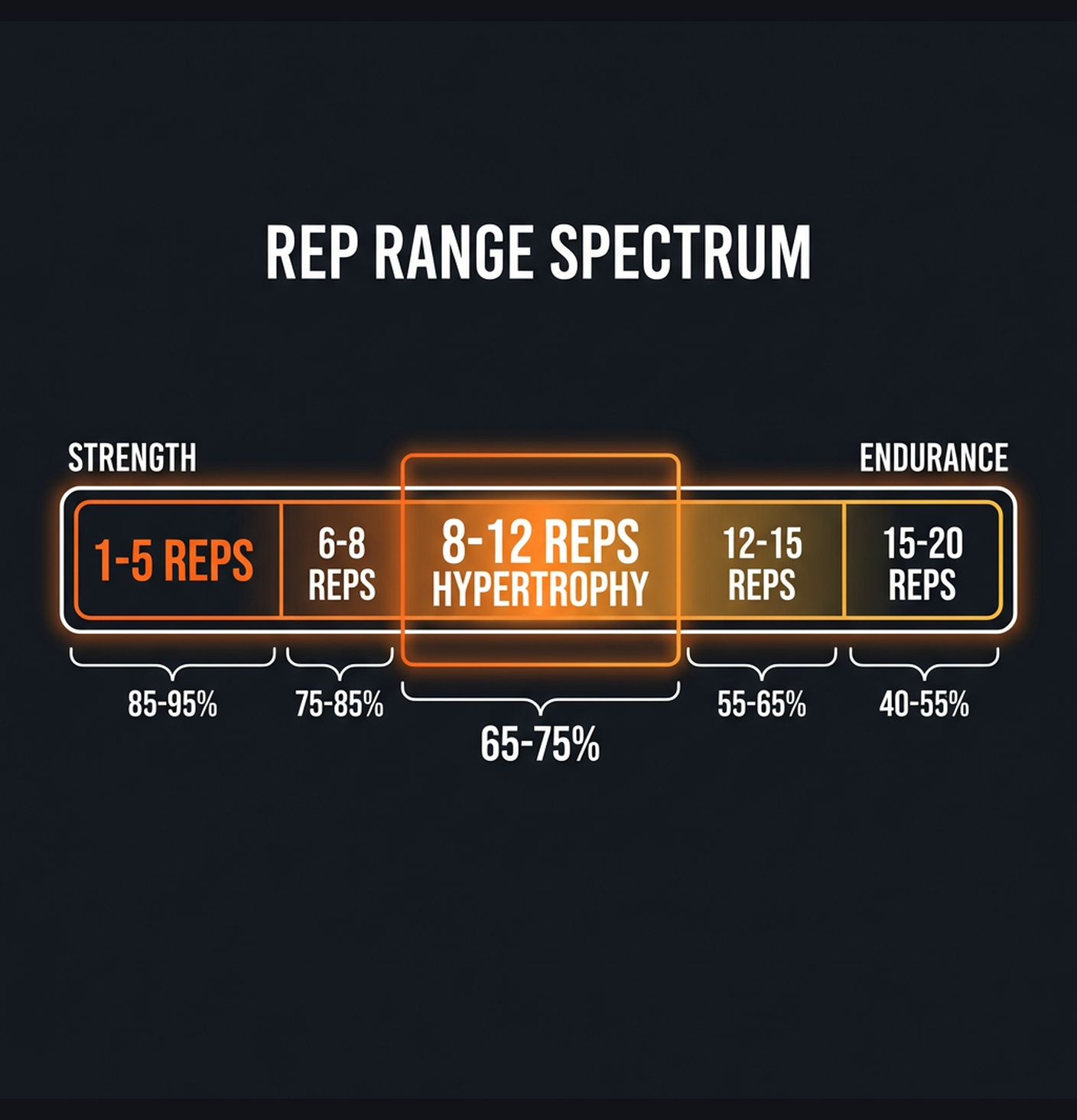
Different rep ranges serve different purposes, and the weight you use changes accordingly.
| Rep Range | Goal | How It Should Feel | % of 1RM (approx) |
|---|---|---|---|
| 1-5 reps | Maximal strength | Heavy, deliberate, every rep is an event | 85-95% |
| 6-8 reps | Strength + size | Hard, bar speed slows noticeably by rep 6 | 75-85% |
| 8-12 reps | Hypertrophy (muscle growth) | Challenging, burning by rep 10 | 65-75% |
| 12-15 reps | Muscular endurance | Burning, pumped, but technique holds | 55-65% |
| 15-20 reps | Endurance, rehab, warm-up | Light, metabolic burn | 40-55% |
These are guidelines, not laws. A strong intermediate lifter might squat 80% of their max for 8 reps while a beginner squats 80% for 3. Individual variation is real. Use the feel-based cues (the middle column) more than the percentage numbers until you have at least 6-12 months of consistent training under your belt.
Compound vs Isolation: Different Rules
Compound Lifts (Squat, Bench, Deadlift, Rows, Overhead Press)
Err on the side of slightly too light rather than slightly too heavy. Form matters enormously on these movements. A sloppy squat with too much weight doesn't build your quads -- it stresses your knees and lower back.
Start conservative and add 5 lbs per session (2.5 lbs per side) for barbell exercises. This is called linear progression and it works beautifully for beginners. You will be amazed how fast the weight climbs when you add a little each week.
Isolation Exercises (Curls, Lateral Raises, Flyes, Extensions)
You can push closer to failure on these because the injury risk is lower. If the program says 3 sets of 12 on bicep curls, pick a weight where rep 12 is genuinely hard and rep 13 would be ugly. The two-rep buffer can shrink to a one-rep buffer on isolation work.
The exception is anything overhead (lateral raises, overhead tricep extensions). Keep a little more buffer here because shoulder joints are finicky and do not appreciate being pushed to absolute failure with compromised form.
Signs You Picked the Wrong Weight
Too Heavy
- •Your form changes significantly in the last 2-3 reps (rounding your back, using momentum, shortening range of motion)
- •You cannot control the weight on the way down (the eccentric)
- •You need to rest more than 30 seconds mid-set to finish
- •You feel the exercise in your joints more than your muscles
- •Your rep speed slows to a near-stop on multiple reps
Too Light
- •You finish the set feeling like you could do it all over again immediately
- •You never feel the target muscle actually working
- •Your heart rate barely changes
- •The weight feels like your warm-up
- •You could have a conversation during the set without pausing
The Progressive Overload Ladder
Once you have your starting weight, progression is straightforward. When you can hit the top of your rep range for all prescribed sets with the two-rep buffer intact, it is time to move up.
For Barbell Exercises
Add 5 lbs total (2.5 lbs per side) for upper body. Add 10 lbs total (5 lbs per side) for lower body. If you do not have microplates and 5 lbs per side is the smallest jump available, that is fine for lower body but may be too aggressive for upper body pressing. Consider buying a set of 1.25 lb fractional plates.
For Dumbbells
Go up one increment (usually 5 lbs per dumbbell). If the jump from 30s to 35s feels too big, do an extra rep or two at the current weight until the jump feels manageable. Or try the heavier weight for just your first set and use the lighter weight for the remaining sets.
For Cables and Machines
The weight stacks usually jump in 10-15 lb increments, which can be too big. Many gyms have magnetic add-on weights (2.5 lbs or 5 lbs) that clip onto the stack. Ask at the front desk.
When to Drop the Weight
Not every session is a PR session. Some days you walk in and the weights feel heavier than normal. Bad sleep, work stress, poor nutrition, or accumulated training fatigue can all affect performance.
If your working weight feels 20% harder than it did last week and your form is suffering, drop 10-15% and get your reps in with good technique. This is not regression. This is smart training. You are still getting a stimulus, you are still building the movement pattern, and you will be back to normal next session.
The lifters who get hurt are the ones who refuse to adjust. The lifters who get strong are the ones who train consistently within the right intensity range, even when that means going lighter on a bad day.
A Note on Ego
The weight on the bar does not define you as a lifter. Nobody in the gym cares how much you are lifting. They are too busy worrying about their own sets.
The fastest way to build strength is to start lighter than you think you need to, nail the technique, and add weight systematically. The slowest way is to ego-lift heavy, get hurt, take time off, and start over.
Pick the right weight. Progress it gradually. Get strong for real.
Frequently Asked Questions
- How do I know if the weight is too heavy?
- If your form changes significantly in the last 2-3 reps, you cannot control the weight on the way down, or you feel it more in your joints than your muscles, the weight is too heavy. Drop 10-15% and focus on clean technique.
- How do I know if the weight is too light?
- If you finish every set feeling like you could immediately do it again, you never feel the target muscle working, or you could hold a conversation during the set without pausing, it is too light. You should finish each set feeling like you had about 2 reps left in the tank.
- How much weight should a beginner start with?
- Start with just the empty barbell (45 lbs) or the lightest dumbbells available. Do 10-12 reps focusing on form, then add small amounts of weight until you find a load where the target rep count feels challenging but doable with good technique. This usually takes 3-4 warm-up sets.
- How much weight should I add each week?
- For barbell exercises, add 5 lbs total for upper body and 10 lbs total for lower body each week. For dumbbells, go up one increment (usually 5 lbs per dumbbell). Only increase when you can hit all prescribed sets and reps with good form and a two-rep buffer.
- Should I use the same weight for all sets?
- For most people, yes. Straight sets (same weight across all sets) are the simplest and most effective approach. Your last set will be harder than your first because of accumulated fatigue, and that is fine. Only drop weight mid-workout if your form breaks down significantly.