How to Program Accessory Work Around Your Main Lifts
Your main lifts build the foundation. Your accessories fill in the gaps. Here is how to choose, organize, and progress accessory work so it actually supports your big lifts instead of just adding fatigue.
 Olivia·Jan 25, 2026·8 min read
Key Takeaways
- Accessory exercises exist to strengthen weak points in your main lifts -- pick them based on where you fail, not just what you enjoy doing.
- Place compound accessories right after your main lift while you are still fresh, and save isolation work like curls and lateral raises for the end of the session.
- Two to three accessory movements per session at 3 sets of 8-15 reps is enough for most people; more than that usually just adds fatigue without extra growth.
- Rotate accessories every 4-6 weeks to prevent staleness, but keep your main lifts consistent so you can track progress on the movements that matter.
- If a main lift is stalling, look at the accessory work first -- adding one targeted exercise for the weak muscle group is often more effective than adding more sets of the main lift.
Get This on WhatsApp
Get a quick summary and link sent straight to your WhatsApp.
Send Me This ArticleAccessories Are Not Random
Most lifters finish their main work -- squats, bench, deadlifts, overhead press -- and then wander around the gym doing whatever catches their eye. Some curls here, some lateral raises there, maybe a machine they saw someone else using. It feels productive, but it is basically random.
Accessory work should not be random. When chosen and programmed correctly, accessories strengthen your weak points, prevent injuries, build the muscles your main lifts miss, and directly improve your performance on the lifts that matter most.
When chosen poorly, they add fatigue without purpose, eat into your recovery, and give you the illusion of productive training while your main lifts stagnate.
The difference comes down to selection, organization, and knowing when to change.
The Three Tiers of Accessory Work
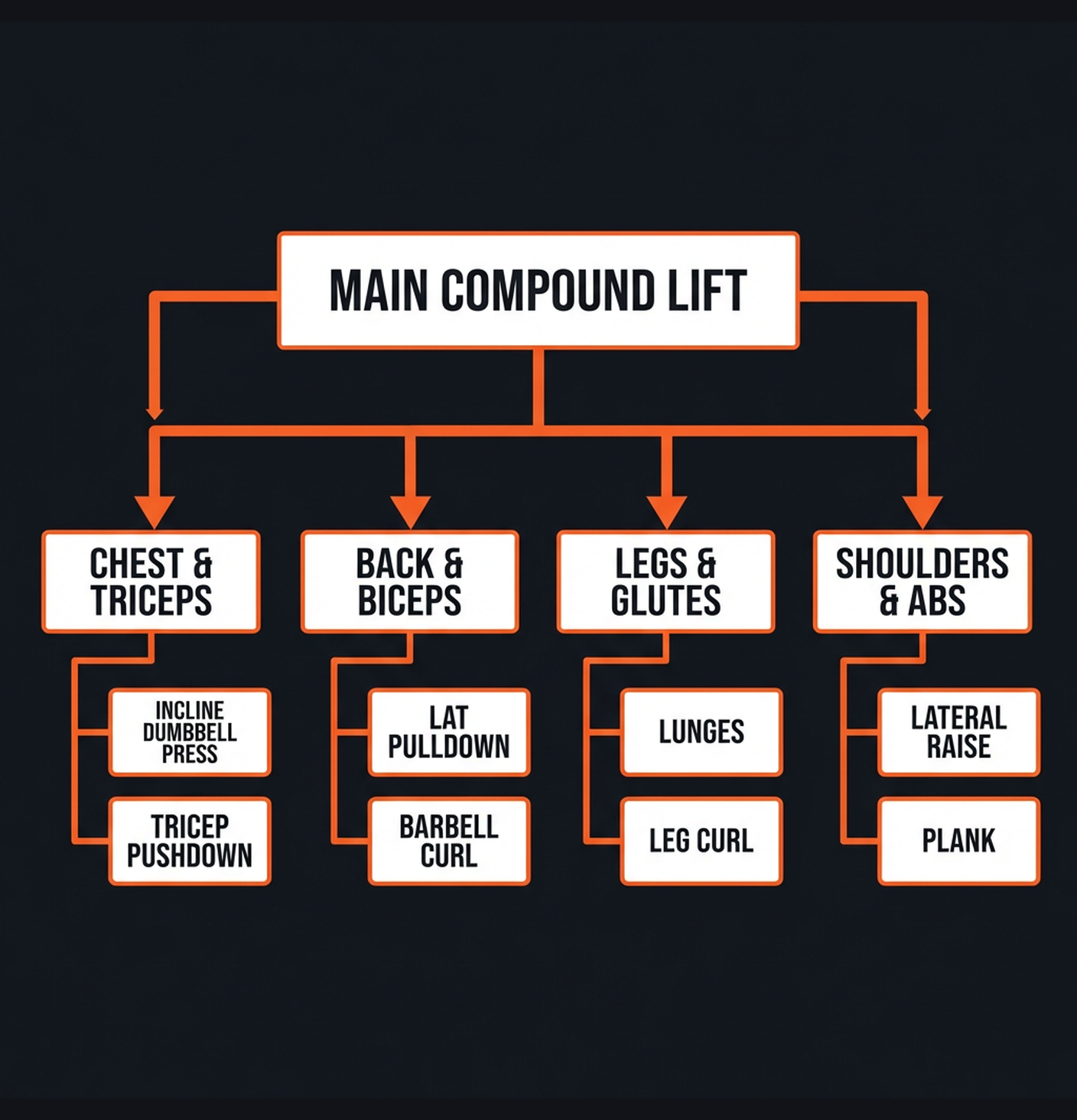
Not all accessories serve the same purpose. Think about them in three categories:
Tier 1: Supplemental Movements (Close Variations)
These are variations of your main lifts that train the same movement pattern with a slightly different stimulus. They are your heaviest and most important accessories.
Examples:
- •For squat: Front squat, pause squat, tempo squat, pin squat, safety bar squat
- •For bench: Close-grip bench, floor press, incline bench, Spoto press (pause 1 inch off chest)
- •For deadlift: Deficit deadlift, block pull, pause deadlift, Romanian deadlift
- •For overhead press: Push press, Z-press, dumbbell overhead press
Supplemental movements are typically done for 3-4 sets of 4-8 reps at moderate-to-heavy loads. They directly improve your main lifts by addressing specific weaknesses. If you are weak off the chest on bench, close-grip bench or Spoto press builds strength in that position. If you struggle at lockout on deadlifts, block pulls train exactly that.
Tier 2: Assistance Movements (Muscle Builders)
These target the individual muscles that contribute to your main lifts. They build muscle mass and address imbalances between muscle groups.
Examples:
- •For squat support: Leg press, Bulgarian split squats, leg curls, leg extensions, hip thrusts
- •For bench support: Dumbbell pressing variations, dips, chest flyes, tricep work (pushdowns, overhead extensions)
- •For deadlift support: Barbell rows, lat pulldowns, good mornings, back extensions, hamstring curls
- •For press support: Lateral raises, face pulls, rear delt flyes, close-grip bench
Assistance movements are done for 3 sets of 8-15 reps at moderate loads. The focus here is muscle development and volume accumulation. These do not need to be heavy -- the point is controlled reps with a solid mind-muscle connection.
Tier 3: Rehab/Prehab (Injury Prevention)
These are low-intensity exercises that keep your joints healthy and prevent the common overuse injuries that plague strength athletes.
Examples:
- •Face pulls (shoulder health)
- •Band pull-aparts (rear delts and rotator cuff)
- •External rotations (rotator cuff)
- •Reverse hypers or back extensions (lower back health)
- •Hip circles and clamshells (hip stability)
- •Wrist curls and extensions (forearm balance)
Prehab work is done for 2-3 sets of 15-25 reps with very light loads. It should never be fatiguing. Think of it as oil for your joints. It does not make you stronger today, but it keeps you training pain-free for years.
How to Identify What You Need
The most common mistake in accessory selection is choosing exercises you like instead of exercises you need. That lifter who always does cable flyes but never rows? Their bench would probably go up faster if they switched those sets to lat pulldowns.
Here is how to figure out what accessories will actually help:
Analyze Your Sticking Points
Where do your main lifts fail? This tells you exactly what is weak.
| Sticking Point | Likely Weak Muscle(s) | Accessory Suggestions |
|---|---|---|
| Squat: folding forward out of the hole | Quads, upper back | Front squats, leg press, upper back rows |
| Squat: hips shooting up | Quads | Tempo squats, leg extensions, pause squats |
| Squat: knees caving | Glutes, adductors | Hip thrusts, banded squats, adductor work |
| Bench: weak off the chest | Pecs, front delts | Dumbbell bench, Spoto press, dips |
| Bench: lockout failure | Triceps | Close-grip bench, floor press, tricep extensions |
| Bench: bar drifts forward | Lats, upper back | Rows, lat pulldowns, face pulls |
| Deadlift: slow off the floor | Quads, positional strength | Deficit deadlift, front squat, pause deadlift |
| Deadlift: lockout failure | Glutes, upper back | Block pulls, hip thrusts, rows |
| Deadlift: back rounds | Lower back, core | Good mornings, back extensions, planks |
If you do not have a clear sticking point yet, default to a balanced approach: some quad work, some hamstring work, some upper back work, some pressing assistance, and some prehab.
Look at Your Physique
Muscle imbalances often correlate with strength weaknesses. If your rear delts are underdeveloped compared to your front delts, your shoulder stability on pressing movements is compromised. If your hamstrings are weak relative to your quads, your deadlift lockout will suffer. Use the mirror (or honest photos) as a diagnostic tool.
Volume Guidelines
More is not always better with accessories. Every set you do accumulates fatigue that affects your recovery for the next session. Here is a practical framework:
Per session:
- •1-2 Tier 1 (supplemental) exercises: 3-4 sets each
- •1-2 Tier 2 (assistance) exercises: 3 sets each
- •1-2 Tier 3 (prehab) exercises: 2-3 sets each
Total accessory sets per session: 10-18 sets
That translates to roughly 30-45 minutes of accessory work after your main lifts. If your accessories are taking longer than your main work, you are doing too many.
Per week (across all sessions):
| Muscle Group | Weekly Sets (Including Main Lifts) |
|---|---|
| Quads | 10-20 |
| Hamstrings | 6-12 |
| Glutes | 6-12 |
| Chest | 10-16 |
| Back (rows/pulldowns) | 12-20 |
| Shoulders (lateral/rear) | 8-14 |
| Biceps | 4-8 |
| Triceps | 6-10 |
These ranges include the volume from your main lifts. A heavy squat day contributes to your quad, glute, and hamstring volume. A bench day contributes to chest and tricep volume. Your accessories fill in the remaining volume you need to reach these targets.
Progression on Accessories: The Double Progression Method
Main lifts use precise loading: add 5 lbs this week, 5 lbs next week. That approach does not work well for accessories because small incremental loads are harder to manage on machines and dumbbells, and accessory exercises benefit more from rep quality than raw load.
Instead, use double progression:
- •Pick a rep range (example: 8-12 reps)
- •Start at the bottom of the range with a weight that is challenging but allows good form (3 x 8)
- •Each session, try to add reps while keeping the weight the same (3 x 9, then 3 x 10, then 3 x 11, then 3 x 12)
- •Once you hit the top of the range for all sets (3 x 12), increase the weight and drop back to the bottom of the range (3 x 8 at a heavier weight)
This approach works perfectly for accessories because it guarantees progress without requiring fractional plates or precise loading. It also keeps the focus on rep quality -- you are not just slapping on more weight, you are earning the right to go heavier by hitting more reps first.
When to Change Your Accessories
Accessory exercises do not need to change every week or every session. But they also should not stay the same forever. Here is a practical timeline:
Keep the same accessories for 4-8 weeks. This gives you enough time to learn the movement, progress on it using double progression, and see whether it is actually helping your main lifts.
Change when:
- •You have stalled on the accessory for 2-3 consecutive sessions
- •Your main lift sticking point has shifted (you fixed the lockout, now the chest is the weak point)
- •You have been doing the same movement for 8+ weeks and want a new stimulus
- •An exercise is causing joint discomfort
Do not change just because you are bored. Boredom is not a programming principle. If an accessory is working, keep doing it until it stops working.
Sample Accessory Templates
Squat Day Accessories
- •Pause squat: 3 x 5 (Tier 1)
- •Bulgarian split squat: 3 x 10 per leg (Tier 2)
- •Leg curl: 3 x 12 (Tier 2)
- •Hip circle band walks: 2 x 15 per side (Tier 3)
Bench Day Accessories
- •Close-grip bench press: 3 x 6 (Tier 1)
- •Dumbbell incline press: 3 x 10 (Tier 2)
- •Tricep pushdown: 3 x 12 (Tier 2)
- •Face pulls: 3 x 15 (Tier 3)
Deadlift Day Accessories
- •Deficit deadlift or RDL: 3 x 6 (Tier 1)
- •Barbell row: 3 x 8 (Tier 2)
- •Back extension: 3 x 12 (Tier 2)
- •Band pull-aparts: 3 x 20 (Tier 3)
Overhead Press Day Accessories
- •Dumbbell overhead press: 3 x 8 (Tier 1)
- •Lateral raises: 3 x 12 (Tier 2)
- •Barbell curl: 3 x 10 (Tier 2)
- •External rotations: 2 x 15 (Tier 3)
The Bottom Line
Accessory work is not the flashy part of training. Nobody posts their band pull-apart PR on social media. But smart accessory selection is the difference between a lifter whose numbers plateau after a year and a lifter who keeps making progress for a decade.
Choose accessories based on your weak points, not your preferences. Organize them into the three tiers. Keep volume in check -- 10-18 sets of accessories per session is plenty. Progress with double progression. Change them when they stop working, not when you get bored.
Your main lifts are the foundation. Your accessories are the rebar that holds the whole structure together. Treat them with the same intention you give your squats and bench, and your big numbers will keep climbing.
Frequently Asked Questions
- How many accessory exercises should I do per session?
- Three to five accessory exercises per session is a practical range for most people. More than that usually means each exercise gets half-hearted effort. Pick movements that directly support your main lift or target a lagging muscle group, and actually push those sets hard.
- How do I choose the right accessories for my main lifts?
- Look at where you are weakest in your main lift and pick accessories that strengthen that position. Stalling at lockout on bench? Triceps work. Folding forward on squats? Upper back and core. If you cannot identify a weakness, general muscle-building work for the muscles involved in the lift is a safe bet.
- Should accessory work be heavy or light?
- Most accessories work best in the 8-15 rep range with moderate weight. The point is to build muscle and strengthen weak points, not to set PRs on leg curls. Save the low-rep heavy work for your main compounds and use accessories to accumulate volume without beating up your joints.
- How do I progress on accessory exercises?
- Double progression works well: pick a rep range like 10-15, start at the low end, and add reps each week until you hit the top. Then increase the weight and start back at 10 reps. It is simple, easy to track, and keeps you making progress without needing complicated periodization.
- When should I change my accessory exercises?
- Swap accessories every 4-8 weeks or when your main lift sticking point changes. There is no need to change them every session. Sticking with an exercise long enough to actually improve at it is more productive than constantly rotating for the sake of variety.