How to Read a Workout Program: Sets, Reps, and Notation Decoded
4x8 at 75%? A1/A2 supersets? AMRAP? RPE 8? If workout programs look like a foreign language, this guide translates every piece of notation you will encounter.
 Sam·Jan 29, 2026·7 min read
Key Takeaways
- The standard format is sets x reps x weight, so 3x8x135 means 3 sets of 8 reps at 135 pounds.
- RPE (Rate of Perceived Exertion) is a 1-10 scale where RPE 8 means you could have done 2 more reps -- it replaces fixed weight prescriptions.
- RIR stands for Reps in Reserve and is the inverse of RPE, so RIR 2 and RPE 8 mean the same thing.
- Letters like A1/A2 or B1/B2 indicate supersets -- do those exercises back to back before resting.
- Tempo notation like 3-1-2-0 describes seconds for the eccentric, pause, concentric, and lockout phases of each rep.
Get This on WhatsApp
Get a quick summary and link sent straight to your WhatsApp.
Send Me This ArticleSets x Reps: The Foundation
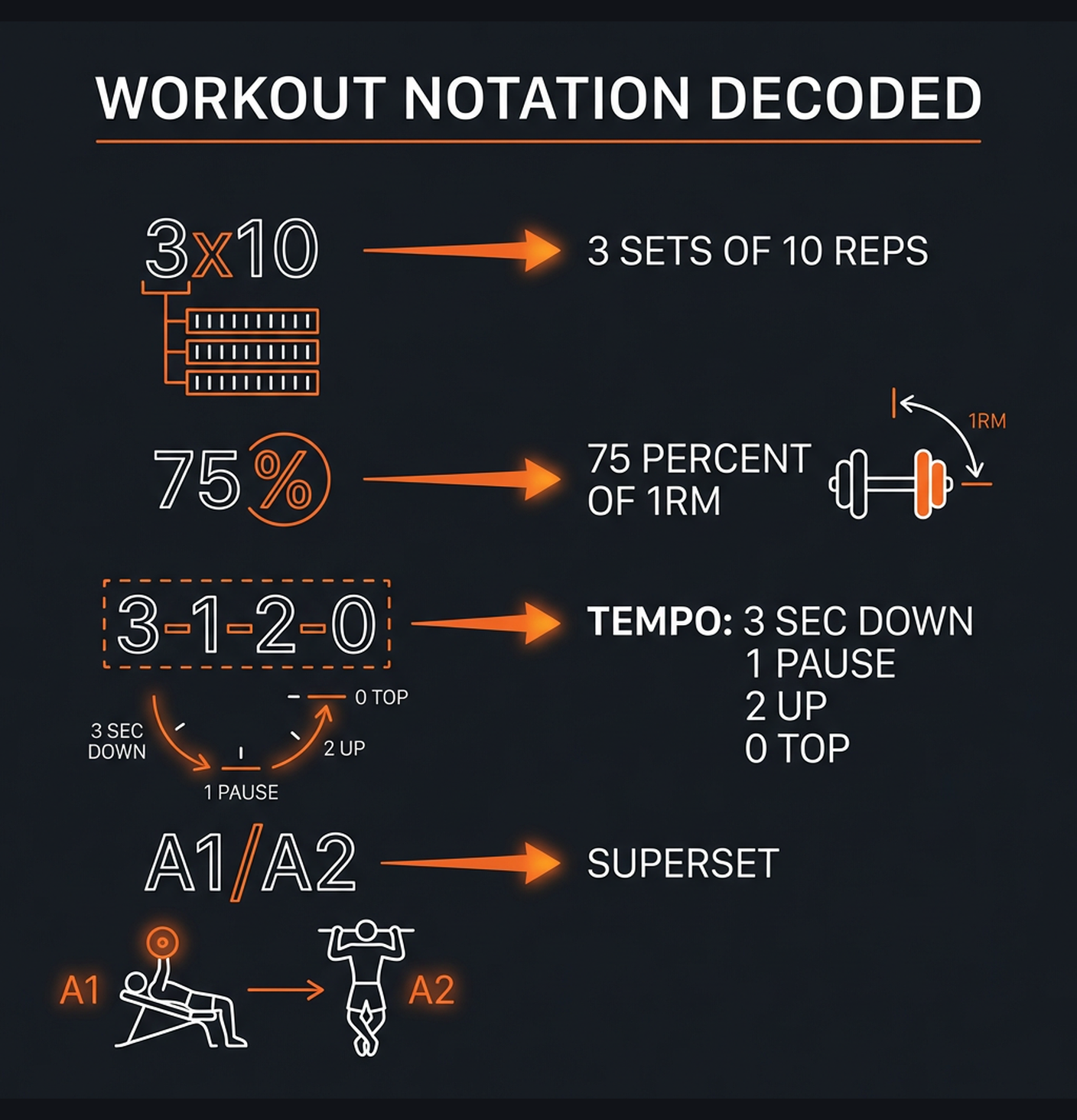
The most common format you will see in any workout program is the Sets x Reps notation. It looks like this:
Bench Press: 3x10
That means 3 sets of 10 reps. You do 10 reps, rest, do 10 more reps, rest, do 10 more reps. Done.
Sometimes it is written as 3 x 10 (with spaces) or 3X10. Same thing. The first number is always the number of sets. The second number is always the number of reps per set.
Some programs flip it and write reps first (10x3 meaning 10 reps for 3 sets), but this is less common and usually clarified in the program instructions. When in doubt, the convention is sets x reps.
Variations You Will See
- •4x8-10: 4 sets of 8 to 10 reps. Hit at least 8 reps. If you can do 10, do 10. When you hit 10 on all 4 sets, increase the weight next session.
- •5x5: 5 sets of 5 reps. Classic strength rep scheme.
- •3x12, 10, 8: 3 sets, but the reps change each set. First set is 12 reps, second is 10, third is 8. Weight usually increases as reps decrease.
- •1x5+: 1 set of at least 5 reps. The + means do as many as you can beyond 5 (AMRAP -- more on that below).
Percentage-Based Notation
When a program prescribes weight as a percentage, it is always a percentage of your one-rep max (1RM) -- the most weight you can lift for a single rep with good form.
Squat: 4x5 @ 80%
This means 4 sets of 5 reps at 80% of your squat 1RM. If your squat max is 300 lbs, you would use 240 lbs.
Some programs use estimated 1RMs (e1RM), which you calculate from a heavier set you have done recently rather than actually maxing out. The Epley formula (Weight x (1 + Reps/30)) is the most common estimation method.
Percentage-based programs are popular for powerlifting and structured barbell training. They remove guesswork and provide a clear progression path. But they require you to know (or estimate) your max, so they are less common in beginner programs.
Tempo Notation
Tempo notation tells you how fast to perform each phase of a rep. It is usually written as four numbers:
Squat: 3x8 @ 3-1-2-0
Those four numbers represent, in order:
- •Eccentric (lowering phase): 3 seconds going down
- •Pause at bottom: 1 second pause
- •Concentric (lifting phase): 2 seconds going up
- •Pause at top: 0 seconds, go right into the next rep
So a squat with 3-1-2-0 tempo means: take 3 seconds to descend, pause 1 second at the bottom, take 2 seconds to stand up, and immediately start the next rep.
Common tempo notations:
- •3-0-1-0: Controlled 3-second lowering, no pause, explosive up, no pause at top. Great for hypertrophy.
- •2-1-X-0: 2-second lowering, 1-second pause, explosive (as fast as possible) up, no pause. The X means "as fast as possible."
- •4-2-1-0: Slow eccentric with a pause. Used for technique work and time under tension.
Not every program uses tempo notation. If there is no tempo prescribed, just use a controlled lowering (about 2 seconds) and lift with intent (1-2 seconds up).
Superset Notation (A1/A2, B1/B2)
Supersets pair two exercises that you perform back-to-back with minimal rest between them. Programs use letter-number combinations to group them:
A1. Bench Press: 3x8
A2. Barbell Row: 3x8
This means: do a set of bench press, rest briefly (or not at all), do a set of barbell rows, rest, then repeat. Complete all 3 rounds of the A pair before moving to the B exercises.
B1. Dumbbell Lateral Raise: 3x12
B2. Face Pulls: 3x15
Same idea. Do lateral raises, then face pulls, rest, repeat.
Trisets and Giant Sets
- •A1/A2/A3: Three exercises done back-to-back. This is a triset.
- •A1/A2/A3/A4: Four exercises. This is a giant set. Common in high-volume bodybuilding programs and usually reserved for smaller muscle groups or circuits.
Why Supersets?
Two reasons: time efficiency and training opposing muscle groups. Pairing bench press with rows works opposing muscles (push/pull), so one muscle recovers while the other works. You get the same amount of work done in roughly half the time.
Common Abbreviations Decoded
Here is the table you will want to bookmark:
| Abbreviation | Meaning | Example |
|---|---|---|
| AMRAP | As Many Reps As Possible | 1x AMRAP at 70% (do max reps with 70% of 1RM) |
| EMOM | Every Minute On the Minute | EMOM 10: 3 deadlifts (do 3 deadlifts at the start of each minute for 10 minutes) |
| RPE | Rate of Perceived Exertion (scale of 1-10) | 3x5 @ RPE 8 (stop each set at a difficulty of 8/10) |
| RIR | Reps In Reserve | 3x8 @ 2 RIR (stop with 2 reps left in the tank) |
| SS | Superset | A1/A2 SS |
| DS | Drop set | 3x10 + DS (after last set, reduce weight and continue) |
| BB | Barbell | BB Squat |
| DB | Dumbbell | DB Bench Press |
| KB | Kettlebell | KB Swing |
| BW | Bodyweight | BW Lunges |
| 1RM | One-Rep Max | Work up to a 1RM |
| e1RM | Estimated One-Rep Max | Calculate e1RM from your last heavy set |
| TUT | Time Under Tension | Increase TUT with slower eccentrics |
| ME | Max Effort | ME Upper (max effort upper body day) |
| DE | Dynamic Effort | DE Lower (speed work on lower body) |
| SL | Single Leg | SL RDL (single-leg Romanian deadlift) |
| SA | Single Arm | SA DB Row (single-arm dumbbell row) |
RPE and RIR: Autoregulating Intensity
RPE (Rate of Perceived Exertion) and RIR (Reps in Reserve) are two sides of the same coin. They tell you how hard a set should feel rather than prescribing a specific weight.
RPE Scale for Lifting:
| RPE | Meaning | RIR Equivalent |
|---|---|---|
| 10 | Maximum effort, could not do another rep | 0 RIR |
| 9 | Could maybe do 1 more rep | 1 RIR |
| 8 | Could do 2 more reps | 2 RIR |
| 7 | Could do 3 more reps, speed is still good | 3 RIR |
| 6 | Warm-up weight, 4+ reps left | 4+ RIR |
So when a program says "3x5 @ RPE 8," it means: do 3 sets of 5 reps with a weight where you could have done 2 more reps on each set.
RPE-based programming is popular because it accounts for daily variation. If you slept poorly and your RPE 8 is 10 lbs lighter than last week, that is fine -- you are still training at the right effort level. Percentage-based programs do not adjust for bad days.
Rest Notation
Some programs specify rest between sets:
- •3x10 (60s rest): 60 seconds between each set
- •3x10 r90: 90 seconds rest
- •A1/A2 (rest 30s between exercises, 90s after A2): Rest intervals within and after supersets
If no rest is prescribed, use general guidelines: 2-3 minutes for heavy compounds, 60-90 seconds for moderate work, 30-60 seconds for isolation.
Example Program Decoded
Here is a typical upper body day from an intermediate program, decoded line by line:
A. Bench Press: 4x5 @ 80% (3 min rest)
Four sets of five reps at 80% of your bench 1RM. Rest 3 minutes between sets. This is your main strength work.
B1. Dumbbell Row: 3x8-10 @ RPE 8 (no rest, go to B2)
Three sets of 8-10 reps on dumbbell rows. Pick a weight where you have about 2 reps left in the tank. After your set, go straight to B2.
B2. DB Incline Press: 3x10-12 @ RPE 7 (90s rest, back to B1)
Three sets of 10-12 on incline dumbbell press. Slightly easier effort level (3 reps in reserve). Rest 90 seconds, then go back to B1. Repeat until all 3 rounds are done.
C1. Cable Lateral Raise: 3x15 (no rest)
C2. Face Pulls: 3x15 (60s rest)
Superset of lateral raises and face pulls. 15 reps each, minimal rest between, 60 seconds after face pulls before repeating.
D. Tricep Pushdown: 2x12 + DS
Two sets of 12 reps on tricep pushdowns. After the second set, reduce the weight by 20-30% and immediately do as many reps as you can. That is the drop set.
Once you understand the notation, reading a program becomes as straightforward as reading a recipe. Each symbol and abbreviation is just shorthand for something simple. You do not need to memorize everything at once. Bookmark the abbreviation table above and reference it until the notation becomes second nature.
Frequently Asked Questions
- What does 3x10 mean in a workout program?
- 3x10 means 3 sets of 10 reps. The first number is always sets and the second is reps. So you perform the exercise for 10 repetitions, rest, and repeat that two more times for a total of 3 sets.
- What does tempo 3-1-2-0 mean?
- Tempo numbers represent seconds for each phase of a rep: eccentric (lowering), pause at the bottom, concentric (lifting), pause at the top. So 3-1-2-0 means lower for 3 seconds, pause 1 second at the bottom, lift for 2 seconds, and no pause at the top before starting the next rep.
- What does a superset mean in a program?
- A superset means performing two exercises back to back with no rest between them. You rest only after completing both exercises. Programs usually mark supersets with matching letters like A1 and A2, or connect them with a bracket or the word superset.
- What does RPE or RIR mean?
- RPE stands for Rate of Perceived Exertion on a 1-10 scale, where 10 is absolute failure. RIR means Reps in Reserve, or how many more reps you could have done. RPE 8 and RIR 2 mean the same thing: you stopped with about 2 reps left in the tank.
- What does AMRAP mean?
- AMRAP stands for As Many Reps As Possible. When a program says AMRAP for the last set, it means push that set close to failure while maintaining good form. It is usually used on the final set to gauge your true capacity at that weight.