How to Warm Up for Squats, Bench Press, and Deadlifts
A proper warm-up is not five minutes on the bike. Here are specific warm-up sequences for the three big lifts that prepare your joints, muscles, and nervous system for heavy work.
 Sam·Mar 1, 2026·9 min read
Key Takeaways
- A good warm-up takes 10-15 minutes and includes general movement, targeted muscle activation, and progressively heavier barbell sets.
- For squats, focus on hip and ankle mobility with goblet squats and leg swings before working up in weight with the barbell.
- Bench press warm-ups should include band pull-aparts and light shoulder rotations to protect the rotator cuff before loading the bar.
- Deadlift warm-ups need hip hinges and glute activation -- try kettlebell swings or light RDLs before your working sets.
- Work up to your training weight in 3-4 progressively heavier sets, keeping reps low (3-5) on the heavier warm-up sets to avoid fatigue.
Get This on WhatsApp
Get a quick summary and link sent straight to your WhatsApp.
Send Me This ArticleWhy Lift-Specific Warm-Ups Matter
Hopping on the stationary bike for 5 minutes before squatting is not a warm-up. It is barely a wake-up. A real warm-up prepares your specific joints, muscles, and movement patterns for the exact demands of the lift you are about to perform.
A proper warm-up does three things:
- •Raises tissue temperature. Warmer muscles are more elastic, more responsive, and less injury-prone. Synovial fluid in your joints becomes less viscous and more lubricating. Nerve conduction speeds up.
- •Activates the right muscles. Your body needs to "turn on" the stabilizers and prime movers for a specific lift. The muscles that stabilize your squat are different from the ones that stabilize your bench press.
- •Grooves the movement pattern. Your first rep with 315 should not be the first time your body has rehearsed the squat pattern that day. Working through progressively heavier warm-up sets builds coordination and confidence before the weight gets serious.
Skipping the warm-up or doing a generic one costs you in three ways: higher injury risk, worse performance on your working sets, and slower progress over time.
The General Warm-Up (3-5 Minutes)
Before any lift-specific work, spend 3-5 minutes raising your heart rate and body temperature. This does not need to be complicated:
- •3-5 minutes on a rower, assault bike, or elliptical at moderate intensity
- •Or: 2-3 minutes of jumping jacks, light jump rope, or bodyweight squats
- •Or: a brisk walk to the gym if you walked there
The goal is to break a light sweat and feel your body wake up. You should not be winded. You should not be tired. Just warm.
If the gym is cold, lean toward 5 minutes. If you are already warm from daily activity, 2-3 minutes is fine.
Squat Warm-Up Sequence
Mobility (3-4 Minutes)
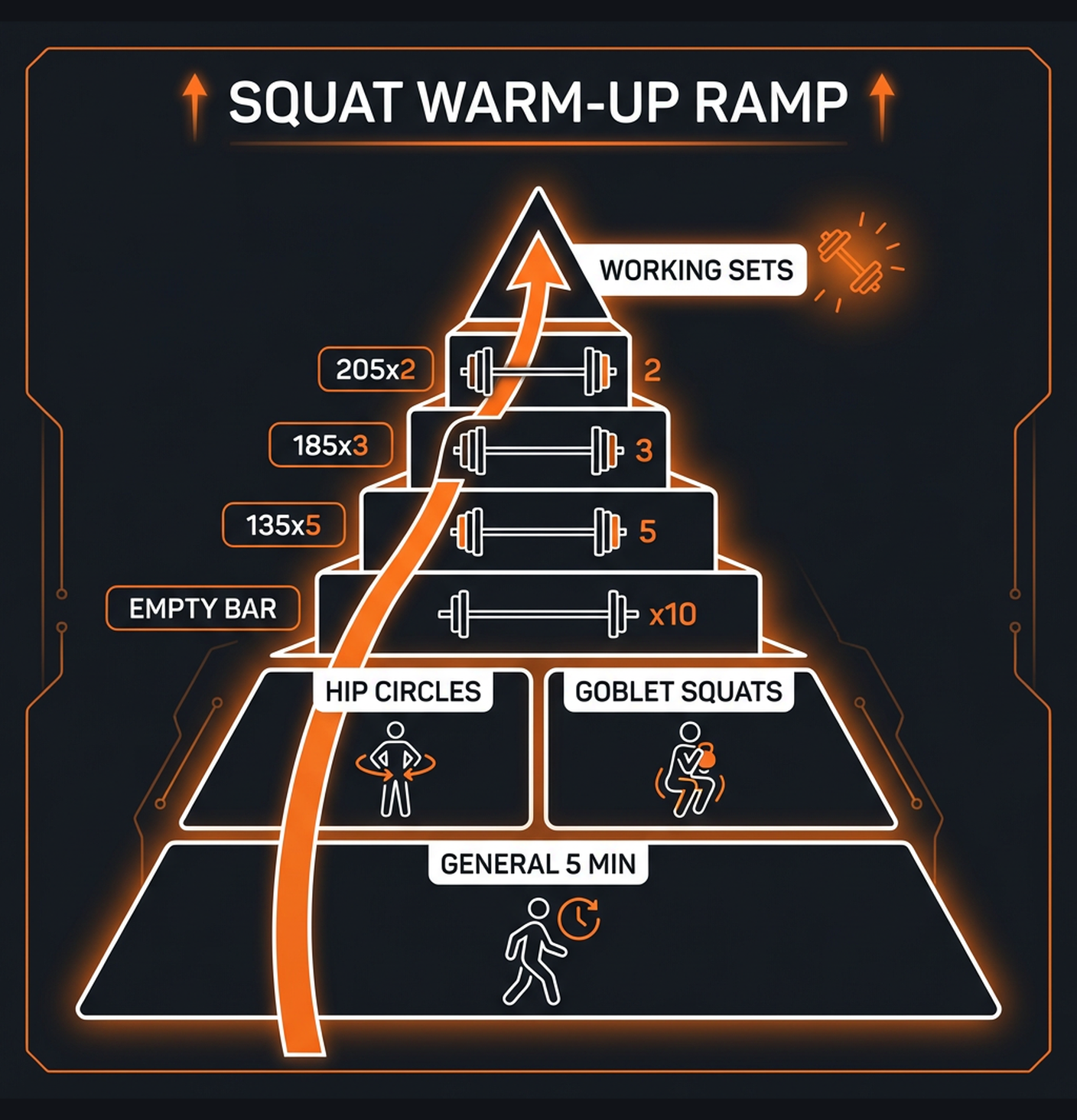
Hip circles (10 each direction): Stand on one leg, lift the other knee, and make slow circles with your hip. This lubricates the hip joint and wakes up the stabilizers.
Bodyweight deep squat hold (60-90 seconds): Hold the bottom of a bodyweight squat. Use a rack or door frame for balance if needed. Let your hips open up, push your knees out gently, and just sit there. This is not about stretching hard -- it is about spending time in the position your body needs to access under load.
Goblet squat (8-10 reps with a light dumbbell or kettlebell): A goblet squat with 20-35 lbs rehearses the squat pattern, opens the hips, and activates the core and quads. Go slow. Pause at the bottom for a count of 2 on each rep.
Ankle dorsiflexion mobilization (optional): If your ankles are stiff, kneel in front of a wall and push your knee over your toes, keeping your heel down. 8-10 reps per side. This improves your ability to get deep without your heels rising.
Ramping Barbell Sets
Now pick up the barbell. Here is how to ramp up to your working weight. The principle: start with the empty bar, take progressively larger jumps, reduce reps as weight increases, and never turn a warm-up set into a work set.
Example: Working weight is 275 lbs for 3x5
| Set | Weight | Reps | Purpose |
|---|---|---|---|
| 1 | Bar (45 lbs) | 10 | Groove the pattern, get loose |
| 2 | 135 lbs | 5 | Start feeling some resistance |
| 3 | 185 lbs | 3 | Moderate weight, building confidence |
| 4 | 225 lbs | 2 | Getting heavy, sharpen technique cues |
| 5 | 255 lbs | 1 | Near-working weight, nervous system primer |
| Work | 275 lbs | 5, 5, 5 | Working sets |
Total warm-up sets: 5. Total warm-up reps: 21. This is not fatiguing -- it is preparing.
Scaling note: If your working weight is lower (say, 135 lbs), you need fewer warm-up sets. Bar x 10, 95 x 5, 115 x 3, then working sets at 135. If your working weight is 405+, you might add another intermediate set.
Bench Press Warm-Up Sequence
Mobility and Activation (3-4 Minutes)
Band pull-aparts (15-20 reps): Hold a light resistance band at arm's length and pull it apart, squeezing your shoulder blades together. This activates the rear delts, rhomboids, and rotator cuff -- all of which stabilize the shoulder during bench pressing.
Push-ups (10-15 reps): Slow, controlled push-ups warm up the pecs, shoulders, and triceps in a pressing pattern. Protract your shoulder blades at the top (push your upper back toward the ceiling) to activate the serratus anterior, which keeps your shoulders healthy during pressing.
Shoulder CARS (Controlled Articular Rotations) (5 each direction): Slowly make the largest circle you can with one arm, keeping it straight. Forward and backward. This moves the shoulder joint through its full range and identifies any sticky or painful spots before you load the joint.
Light dumbbell external rotation (10 reps per side, optional): Hold a light dumbbell (5-10 lbs) with your elbow at your side, bent 90 degrees, and rotate your forearm outward. Warms up the rotator cuff.
Ramping Barbell Sets
Example: Working weight is 205 lbs for 4x6
| Set | Weight | Reps | Purpose |
|---|---|---|---|
| 1 | Bar (45 lbs) | 12 | Groove the press, feel the touch point |
| 2 | 95 lbs | 6 | Light but deliberate |
| 3 | 135 lbs | 4 | Moderate load, check arch and leg drive |
| 4 | 175 lbs | 2 | Getting serious, refine setup |
| 5 | 195 lbs | 1 | Near-working weight, prime the nervous system |
| Work | 205 lbs | 6, 6, 6, 6 | Working sets |
For bench, pay special attention to your setup during warm-up sets. Practice retracting your shoulder blades, setting your arch, planting your feet, and finding your touch point. By the time you hit working weight, your setup should be automatic.
Deadlift Warm-Up Sequence
Mobility and Activation (4-5 Minutes)
Deadlifts require more warm-up attention than squats or bench because they load the entire posterior chain heavily from a dead stop. Your hips, hamstrings, and lower back need to be fully prepared.
Cat-cow (10 reps): On all fours, alternate between arching and rounding your spine. This mobilizes the thoracic and lumbar spine and wakes up the core musculature that you will use for bracing.
Glute bridges (12-15 reps): Lie on your back, feet flat on the floor, and drive your hips up. Squeeze your glutes at the top for a full second. This fires up the glutes before they take on heavy hip extension work.
Light RDLs with an empty bar or light dumbbells (8-10 reps): Hinge at the hips, push your butt back, and feel the stretch in your hamstrings. This rehearses the hinge pattern and warms up the hamstrings.
Hip hinge with band pull-through (10 reps, optional): If available, a band pull-through is a great way to feel the glutes loading in the hinge pattern before you grab a barbell.
Lat activation (band straight-arm pulldown or light lat pulldown, 10-12 reps): Your lats are a primary stabilizer during the deadlift. They keep the bar close and your upper back tight. A quick activation set primes them for the job.
Ramping Barbell Sets
Example: Working weight is 365 lbs for 3x5
| Set | Weight | Reps | Purpose |
|---|---|---|---|
| 1 | 135 lbs | 5 | Groove the hinge, practice brace and setup |
| 2 | 185 lbs | 5 | Still light, focus on bar path and lat engagement |
| 3 | 245 lbs | 3 | Moderate load, feel the floor connection |
| 4 | 315 lbs | 2 | Heavy, refine setup and brace |
| 5 | 345 lbs | 1 | Near-working weight, nervous system ready |
| Work | 365 lbs | 5, 5, 5 | Working sets |
Important: Reset your position between every rep during warm-up sets. Do not touch-and-go your warm-ups. Practice your full setup -- feet position, hip hinge, slack pull, brace, drive. Every warm-up rep is a chance to rehearse perfect technique.
How Many Warm-Up Sets Do You Need?
The answer depends on how heavy your working weight is relative to the empty bar:
| Working Weight | Warm-Up Sets Needed |
|---|---|
| Under 135 lbs | 1-2 (just the bar + one intermediate) |
| 135-225 lbs | 2-3 |
| 225-315 lbs | 3-4 |
| 315-405 lbs | 4-5 |
| 405+ lbs | 5-6 |
The jumps between warm-up sets should get smaller as you approach your working weight. Early sets can jump 40-90 lbs. The last warm-up sets should be within 10-20 lbs of your working weight.
Common Warm-Up Mistakes
Too Much General Cardio
Spending 15-20 minutes on the treadmill before squatting is not preparing you for squats. It is fatiguing your legs before they need to do their hardest work. Keep the general warm-up to 3-5 minutes and spend the rest of your warm-up time on lift-specific preparation.
Static Stretching Before Lifting
Multiple meta-analyses have shown that static stretching (holding a stretch for 30+ seconds) before strength training can reduce force production by 3-8%. Dynamic movement, mobility drills, and activation exercises are better pre-training choices. Save the long static stretches for after your session or rest days.
Jumping to Working Weight
Walking up to the bar, loading your working weight, and pulling cold is a recipe for injury and bad performance. Your first heavy rep should feel familiar because you have already done 15-20 reps at progressively heavier weights. The warm-up sets build both physical readiness and psychological confidence.
Turning Warm-Up Sets Into Work Sets
Warm-up sets should not be hard. If you are grinding through warm-up reps, you jumped too aggressively. Keep warm-up reps submaximal and focus on technique, speed, and preparation -- not on squeezing out every possible rep.
Not Warming Up the Second Lift
If your program has squats followed by bench press, you need to warm up for bench press too. Your chest, shoulders, and triceps are not prepared just because your legs are warm. Do a abbreviated bench warm-up (band pull-aparts, a couple ramping sets) before jumping into bench working sets.
The Time Investment
A proper warm-up adds 10-15 minutes to your workout. That is a small price for better performance, lower injury risk, and more productive working sets. If you are consistently skipping warm-ups to save time, you are optimizing for the wrong thing.
Warm up like your training depends on it. Because it does.
Frequently Asked Questions
- How many warm-up sets should I do before squats?
- Most lifters need 4-5 warm-up sets, starting with the empty bar and ramping up in increments of roughly 20-25% of your working weight. If your work sets are at 225, you might do the bar, 95, 135, 185, and 205 before your first working set.
- Should I stretch before lifting?
- Skip static stretching before heavy lifting because it can temporarily reduce force production. Instead, do dynamic warm-ups like leg swings, hip circles, and bodyweight squats to increase range of motion and blood flow. Save static stretching for after your session.
- Do I need to warm up for bench press?
- Absolutely. Your shoulders, chest, and triceps need blood flow and your rotator cuff needs activation before pressing heavy weight. Start with band pull-aparts or light dumbbell external rotations, then ramp up with the bar and progressively heavier sets.
- How should I ramp up weight during warm-up sets?
- Keep early warm-up sets at higher reps (8-10) to get blood flowing, then reduce reps as the weight increases. By the time you are within 10-15% of your working weight, do only 2-3 reps. The goal is to prepare your body without creating fatigue before the real work starts.
- Can I skip warm-ups if I am short on time?
- Never skip the warm-up for heavy compound lifts. A cold muscle under heavy load is an injury waiting to happen. If you are pressed for time, cut the workout short rather than the warm-up. You can get an effective warm-up done in 5-7 minutes.