Lifting Shoes vs Flat Shoes: What You Actually Need on Your Feet
Heeled lifting shoes, flat Converse, or barefoot? The shoe you wear affects your squat depth, stability, and force transfer. Here is what to pick based on your body and your lifts.
 Jess·Mar 4, 2026·9 min read
Key Takeaways
- Heeled lifting shoes improve squat depth and upright torso position by compensating for limited ankle mobility.
- Flat shoes like Converse or wrestling shoes give you a stable, low-to-ground base that works best for deadlifts and pressing.
- Running shoes are the worst option for lifting because the cushioned sole compresses under load, reducing stability and force transfer.
- If you can only buy one pair, flat-soled shoes are the most versatile option for general strength training.
- Try squatting with small plates under your heels before investing in lifting shoes -- if it feels better, the heeled shoes are worth buying.
Get This on WhatsApp
Get a quick summary and link sent straight to your WhatsApp.
Send Me This ArticleWhy Footwear Matters for Lifting
Your feet are the only thing connecting you to the floor. Every pound of force you generate during a squat, deadlift, or press travels through your feet into the ground. The shoe you wear affects how efficiently that force transfers.
Three things matter in a lifting shoe: a hard sole, minimal cushion, and a stable base. That is it. Everything else -- brand, color, price -- is secondary to those three features.
Why hard and flat? Because cushioned, squishy soles absorb force. When you are squatting 300 lbs and your feet are on top of two soft pillows (running shoes), you are losing force, creating instability, and making it harder to maintain balance. It is like trying to squat on a mattress. You would never do that on purpose, but every gym has people squatting in Nike Air Max shoes, which is essentially the same thing.
Running Shoes: The Worst Choice for Squats
Let us get this out of the way: if you are squatting in running shoes, stop. Today.
Running shoes are designed to absorb impact. They have thick, compressible midsoles (often with air pockets or gel inserts) that cushion each footstrike. This is great for running. It is terrible for lifting.
Under a heavy barbell, that cushioning compresses unevenly. Your feet shift and sink. Your ankles wobble. Your knees track unpredictably because the surface under your feet is not stable. You lose force into the sole instead of driving it into the ground.
Running shoes also have an elevated heel, but it is built into soft foam, so you get the worst of both worlds: an unstable surface and a heel position that shifts under load.
If you only take one thing from this article: do not squat or deadlift in running shoes.
Flat Shoes (Converse, Vans, Wrestling Shoes)
Flat shoes with a thin, incompressible sole are the most popular and versatile lifting shoe for a reason. They work well for almost everything.
What Makes Them Good
- •Hard, flat sole: Minimal cushion means maximum force transfer and stability
- •Low to the ground: Less distance between your foot and the floor means better balance and proprioception (your ability to feel the floor)
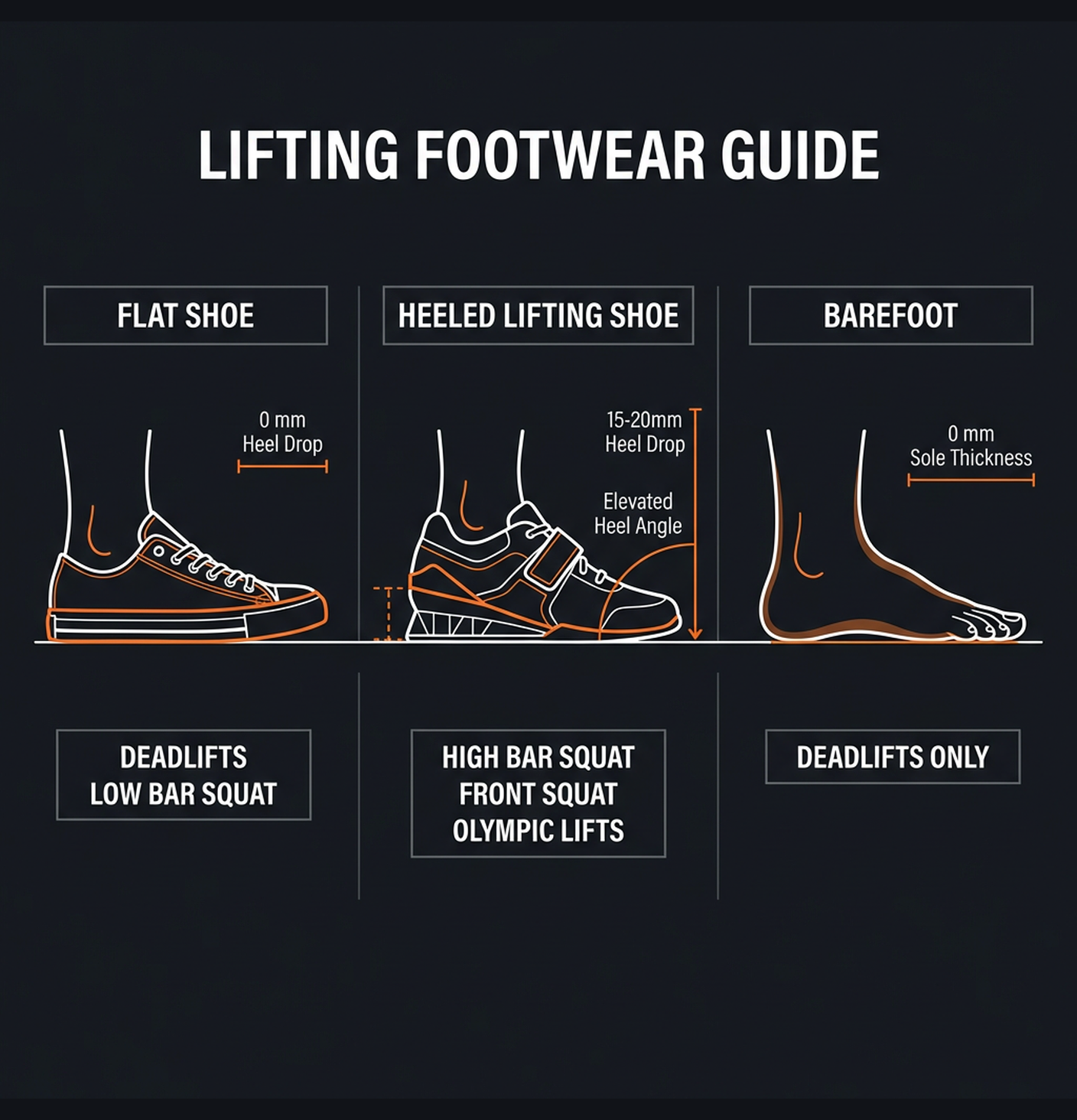
- •Zero or minimal heel drop: The heel and forefoot are at the same height, which encourages a natural foot position
- •Affordable: A pair of Converse Chuck Taylors costs 50 to 60 dollars. Wrestling shoes run 40 to 80 dollars.
Best For
- •Deadlifts: Flat soles keep you as close to the ground as possible, reducing the distance you need to pull the bar. The shorter the pull, the easier the lockout.
- •Low-bar squats: Low-bar squatters typically have a wider stance and more forward lean, which requires less ankle dorsiflexion. Flat shoes work well because you do not need the extra ankle range from a heel.
- •Bench press: You want a flat, grippy surface to plant your feet for leg drive. Flat shoes with rubber soles deliver this.
- •General training: If you only own one pair of gym shoes, flat shoes cover the most ground.
Drawbacks
- •Limited ankle mobility support: If your ankles are stiff and you struggle to hit depth in a squat, flat shoes offer no help. Your heels may rise, your torso may lean too far forward, or you may not reach parallel.
- •Not ideal for high-bar squats or Olympic lifts: These movements demand deep knee flexion and an upright torso, which benefit from an elevated heel.
Heeled Lifting Shoes (Weightlifting Shoes)
Weightlifting shoes have a hard, raised heel (typically 0.5 to 1 inch) made of wood, dense plastic, or stacked leather. They are rigid, heavy, and purpose-built for squatting.
What Makes Them Good
- •Elevated heel compensates for limited ankle mobility. The heel raise allows your knees to travel further forward without your heels lifting off the ground. This lets you squat deeper and stay more upright through the torso.
- •Extremely hard sole. There is zero compression. Every ounce of force goes into the floor.
- •Metatarsal strap. Most weightlifting shoes have a strap across the midfoot that locks your foot in place. Zero heel slip, zero lateral slide.
- •Wide, stable base. The sole is flat and wide, providing a large platform for stability.
Best For
- •High-bar squats: The upright torso position in a high-bar squat demands significant ankle dorsiflexion. The heel does the work your ankle cannot.
- •Front squats: Same reason. Front squats require an even more upright torso than high-bar back squats, and the heel makes this dramatically easier.
- •Olympic lifts (clean and jerk, snatch): These movements involve catching the bar in a deep squat with an upright torso. Weightlifting shoes are standard equipment for Olympic lifters.
- •Lifters with poor ankle mobility: If you have stiff ankles from years of desk sitting, previous injuries, or just anatomy, a heeled shoe may be the difference between hitting depth and not.
Drawbacks
- •Not great for deadlifts. The elevated heel increases the distance between the bar and lockout. Most deadlifters want the opposite. The heel can also shift your weight forward onto your toes, which pulls you out of optimal deadlift position.
- •More expensive. Quality weightlifting shoes run 90 to 200 dollars. Budget options exist but may lack the rigidity and durability of established brands.
- •Overkill for some lifters. If you have good ankle mobility and squat fine in flat shoes, you do not need a heeled shoe. The heel solves a specific problem. If you do not have that problem, it is unnecessary.
Barefoot and Socks
Deadlifting in socks (or barefoot if your gym allows it) is a legitimate option and one that many competitive powerlifters use.
Why It Works
- •Shortest possible distance to lockout. No sole height at all means the bar travels the minimum distance from floor to hips.
- •Maximum ground feel. Your foot can grip the floor naturally, and you get unfiltered proprioceptive feedback.
- •Eliminates any shoe-related instability. No sole to compress, no heel to shift, just your foot and the floor.
The Downsides
- •No foot protection. If you drop a plate on your foot, a sock will not help. Some gyms require shoes for liability reasons.
- •Hygiene concerns. Gym floors are not always the cleanest surfaces. Deadlift slippers (thin-soled minimalist shoes designed for competition) solve this problem for about 20 to 30 dollars.
- •Not practical for an entire session. You probably do not want to squat, bench, and do accessory work barefoot. It is really just a deadlift tool.
How to Choose Based on Your Body and Your Lifts
Here is a simple decision framework:
The Ankle Mobility Test
Stand facing a wall with your toes about 4 inches from the baseboard. Try to touch your knee to the wall without your heel lifting. If you can do it easily, your ankle mobility is fine and flat shoes will work for squats. If your heel lifts or you cannot reach the wall, you have limited ankle mobility and may benefit from a heeled shoe.
The Squat Style Guide
| Squat Style | Recommended Shoe | Why |
|---|---|---|
| High-bar back squat | Heeled lifting shoe | Requires upright torso and deep knee flexion |
| Low-bar back squat | Flat shoe (Converse, wrestling shoe) | Wider stance, more hip-dominant, less ankle demand |
| Front squat | Heeled lifting shoe | Most demanding on ankle mobility and torso position |
| Goblet squat | Either | Less load, either shoe works fine |
The Lift-by-Lift Recommendation
| Lift | Best Shoe | Alternative |
|---|---|---|
| High-bar squat | Heeled lifting shoe | Flat shoe if ankle mobility is good |
| Low-bar squat | Flat shoe | Heeled shoe if you prefer upright torso |
| Front squat | Heeled lifting shoe | Flat shoe only if you have excellent ankle mobility |
| Conventional deadlift | Flat shoe or socks | Deadlift slippers |
| Sumo deadlift | Flat shoe or socks | Deadlift slippers |
| Bench press | Flat shoe | Whatever gives you the best foot grip |
| Overhead press | Either | Heeled shoe can help with slight torso lean |
Budget Recommendations
You do not need to spend 200 dollars on shoes to lift effectively. Here are options at every price point:
Under 60 dollars:
- •Converse Chuck Taylor All Stars (the classic choice, flat sole, widely available)
- •Vans Old Skool or Authentic (similar flat sole, slightly more cushion than Converse)
- •Generic wrestling shoes (great flat sole, lightweight, ankle support)
60 to 100 dollars:
- •ASICS Matflex wrestling shoes (excellent flat sole, very lightweight)
- •Nike Metcon or Reebok Nano (hybrid training shoes with a firm, relatively flat sole -- not as flat as Converse but more versatile)
100 to 200 dollars:
- •Adidas Powerlift (entry-level heeled lifting shoe, solid construction)
- •Nike Romaleos (heeled lifting shoe, very stable, popular choice)
- •Adidas Adipower (heeled lifting shoe, firm heel, reliable)
- •Reebok Legacy Lifter (heeled, wide toe box, comfortable for longer sessions)
The practical approach: If you are a general strength trainee, start with a pair of Converse or wrestling shoes. They cover 80% of lifting situations. If you find that ankle mobility is limiting your squat depth and mobility work is not fixing it fast enough, add a pair of heeled lifting shoes.
Many serious lifters own both: flat shoes for deadlifts and general training, heeled shoes for squatting. Switch them during your workout. It takes 30 seconds and your lifts will thank you.
The Bottom Line
The best lifting shoe is the one that gives you a hard sole, a stable base, and the right heel height for your body and your lifts. Running shoes are out. Flat shoes are the most versatile. Heeled shoes solve ankle mobility limitations. Barefoot or slippers work for deadlifts.
Pick what works for your anatomy, your squat style, and your budget. Your footwear is not going to add 50 lbs to your squat overnight, but the wrong shoes can absolutely hold you back. Get this one right and then focus on what actually matters: training hard and being consistent.
Frequently Asked Questions
- Do I need special shoes for lifting?
- You do not need them, but the right footwear helps. A flat, hard-soled shoe like Converse or Vans is a solid starting point for most lifts. Running shoes with thick cushioned soles are the worst choice because they compress under load and make you unstable.
- When should I use heeled lifting shoes?
- Heeled lifting shoes with a raised heel (usually 0.5-1 inch) are most useful for squats and Olympic lifts. The heel elevation allows deeper knee tracking and a more upright torso, which helps lifters with limited ankle mobility. They are not necessary for deadlifts or upper body work.
- Can I deadlift in squat shoes?
- You can, but most people prefer flat shoes or deadlift slippers. The raised heel in squat shoes shifts your weight forward slightly, which is the opposite of what you want in a conventional deadlift. For sumo deadlifts, some lifters do prefer a small heel.
- Is it okay to lift barefoot?
- If your gym allows it, barefoot lifting gives you the most ground contact and stability for deadlifts. Many powerlifters train barefoot or in socks at home gyms. In commercial gyms, deadlift slippers or minimalist shoes are the closest alternative.
- Are Converse good for lifting?
- Converse Chuck Taylors are one of the most popular budget lifting shoes for good reason. They have a flat, incompressible sole, minimal heel drop, and decent grip. They work well for deadlifts, bench press, and even squats if you have good ankle mobility.