Morning vs Evening Workouts: Does Training Time Actually Matter?
Research shows small performance advantages for evening training, but the best time to work out is the time you will actually show up. Here is what the science says and how to make any schedule work.
 Olivia·Mar 8, 2026·8 min read
Key Takeaways
- Evening training offers a 3-5% strength advantage due to higher body temperature and neural activation, but consistency matters far more.
- Morning exercisers are more consistent over time because fewer schedule conflicts get in the way.
- Your body adapts to your training schedule within 2-4 weeks -- performance at your chosen time improves with consistency.
- If training in the morning, extend your warm-up by 5-10 minutes and accept slightly lower numbers for the first month.
- Finish high-intensity evening workouts at least 90 minutes before bedtime to avoid disrupting sleep.
Get This on WhatsApp
Get a quick summary and link sent straight to your WhatsApp.
Send Me This ArticleWhat the Research Actually Says
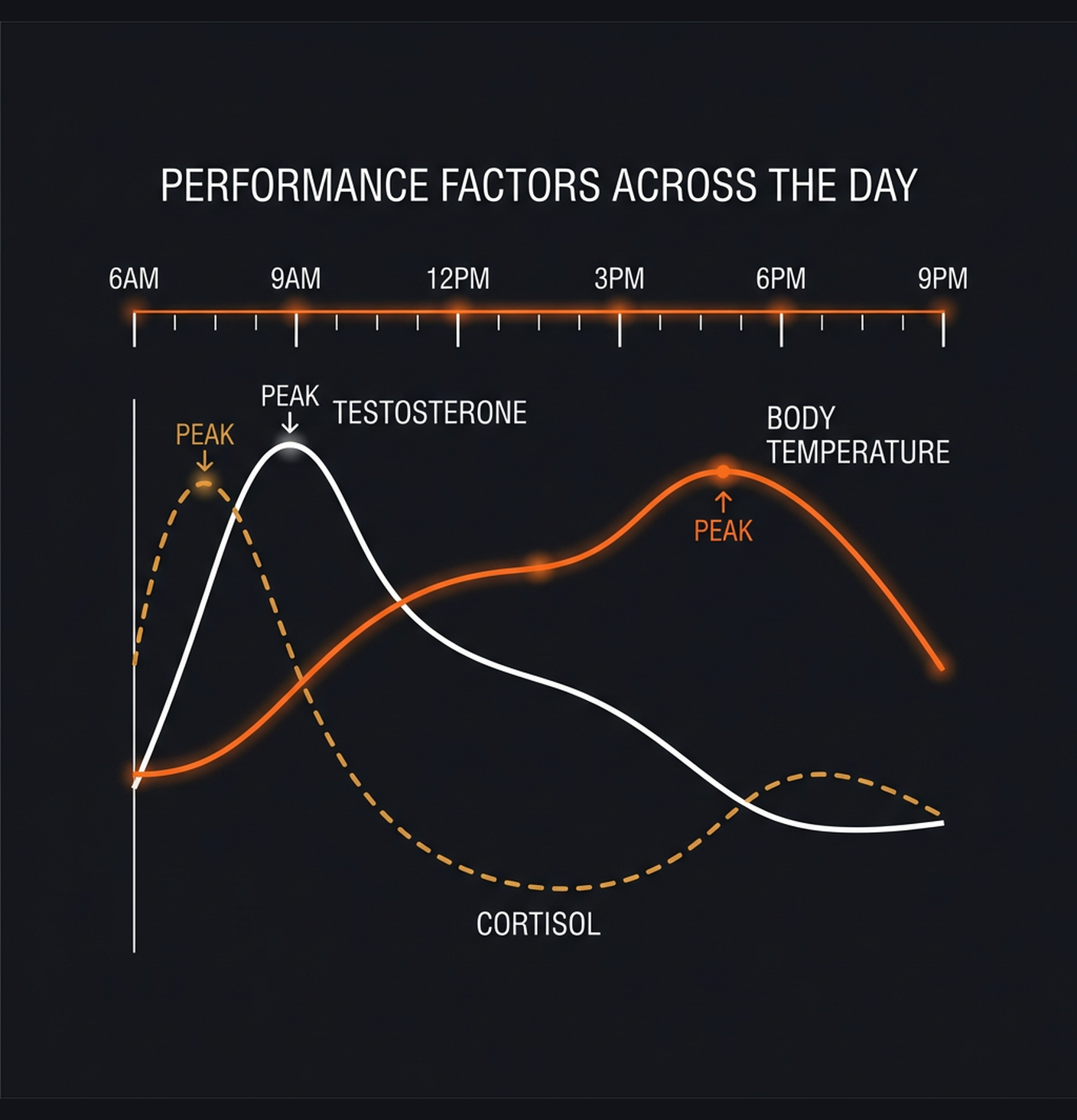
Your body does not perform identically at all hours. Decades of chronobiology research show measurable differences in strength, power, flexibility, and reaction time across the day. Here is the short version:
- •Core body temperature peaks in the late afternoon (4-6 PM). Higher body temperature means faster nerve conduction, better muscle elasticity, and more efficient enzyme activity. Translation: your muscles physically perform better when they are warm.
- •Testosterone peaks in the early morning (7-9 AM) and declines through the day. But the difference between morning and evening levels in healthy adults is small enough that it has no meaningful impact on a single training session.
- •Cortisol is highest in the morning. This stress hormone helps mobilize energy, which sounds good for training but also promotes catabolism. The practical impact on muscle growth is negligible.
- •Reaction time and power output peak in late afternoon. Studies consistently show 3-8% higher peak power and faster reaction times between 4-7 PM compared to early morning.
A 2021 meta-analysis in the *Scandinavian Journal of Medicine and Science in Sports* reviewed 67 studies and found that strength and power performance was slightly better in the afternoon/evening compared to the morning. The average difference: about 3-5%.
That 3-5% matters if you are an Olympic sprinter. For the rest of us trying to get stronger and build muscle, it is statistical noise drowned out by far more important variables like consistency, sleep, nutrition, and effort.
The Case for Morning Training
You Actually Show Up
The number one advantage of morning training is compliance. By noon, a hundred things can derail your workout: meetings run late, kids need pickup, you are tired from a long day, your friend wants to grab dinner. At 6 AM, none of that has happened yet.
Research from the *Health Psychology* journal found that people who exercise in the morning are more consistent over time than evening exercisers. Not because morning is biologically better, but because there are fewer schedule conflicts and decision-fatigue excuses.
Your Day Gets Better
A morning workout floods your brain with endorphins, dopamine, and norepinephrine before you even start your commute. Multiple studies show that morning exercise improves mood, focus, and cognitive performance for 4-6 hours afterward.
You also make better food choices. A 2018 study in the *International Journal of Obesity* found that morning exercisers were more likely to choose healthier meals throughout the day compared to non-exercisers or evening exercisers. The "I already did something healthy today" momentum is real.
Sleep Quality Improves
Vigorous exercise raises core body temperature and stimulates your nervous system. Doing this late at night can delay sleep onset. A 2019 systematic review in *Sports Medicine* found that high-intensity exercise ending less than 2 hours before bed reduced sleep quality in most participants.
Morning training eliminates this concern entirely. Your body temperature rises, falls back to baseline throughout the day, and your circadian rhythm stays intact.
The Case for Evening Training
You Are Physically Stronger
This is just a fact. Most people are 3-8% stronger in the afternoon and evening compared to early morning. Your joints are more mobile, your core temperature is higher, your nervous system is more alert, and your pain tolerance is elevated.
If you are chasing a squat PR, you are statistically more likely to hit it at 5 PM than at 6 AM. Your warm-up takes less time because your body is already primed from a full day of movement.
You Had More Fuel
By late afternoon, you have eaten 2-3 meals. Your muscle glycogen stores are topped off. Your blood sugar is stable. You have more raw energy available for training compared to a fasted or lightly-fed morning session.
Morning lifters who train before breakfast are essentially running on yesterday's fuel. That is not inherently bad (fasted training works fine for most people), but it can mean lower performance on high-volume or high-intensity sessions.
Stress Relief After Work
For many people, the gym after work is a decompression chamber. The mental health benefits of evening training can be significant if your job is stressful. Channeling frustration into a barbell is a lot healthier than channeling it into a bottle of wine or three hours of doomscrolling.
The Real Answer: Consistency Beats Timing
Here is the truth that no clickbait article wants to tell you: the best time to train is the time you will do it consistently, week after week, for years.
A 3-5% performance difference between morning and evening is completely irrelevant if you skip half your evening sessions because life gets in the way. A "suboptimal" morning workout you actually complete beats an "optimal" evening workout you skip.
Training adaptations (strength, muscle growth, endurance) come from accumulated stimulus over months and years. Missing sessions is the single biggest progress killer, and whatever time slot gives you the fewest missed sessions is your optimal training time.
How to Make Morning Training Work
If you decide to train in the morning, here are the adjustments that make the biggest difference:
Extend Your Warm-Up
Your body is cold and stiff at 6 AM. The standard 5-minute warm-up is not enough. Add 5-10 extra minutes of general movement: jumping jacks, bodyweight squats, arm circles, hip circles. Your first working set should not feel creaky or restricted.
Eat Something (or Not, But Know the Trade-Off)
You have three options:
- •Full meal 60-90 minutes before (requires waking up earlier): Best for performance but most disruptive to sleep.
- •Small snack 20-30 minutes before (banana + coffee, toast + peanut butter): Good compromise. Provides quick energy without requiring an early alarm.
- •Fully fasted: Works fine for moderate sessions. May limit performance on very heavy or high-volume days. Make sure your post-workout meal is substantial.
Go to Bed Earlier
This is non-negotiable. Morning training does not work if you still go to bed at midnight. You need 7-9 hours of sleep. If you wake at 5:30, you need to be asleep by 10:30 at the latest. Adjust your evening routine accordingly.
Accept Lower Numbers Initially
If you switch from evening to morning training, your weights will feel heavier for the first 2-4 weeks. This is normal. Your body adapts to your training schedule. After a month of consistent morning sessions, your performance at that time slot will improve significantly.
Research confirms this: a 2019 study in *Cell Metabolism* found that exercise adaptations become time-of-day specific. If you always train in the morning, your body optimizes for morning performance.
How to Make Evening Training Work
Protect Your Time Slot
Put your training session in your calendar as a non-negotiable appointment. When someone asks if you are free at 6 PM on Tuesday, the answer is no. If your workout is optional, it will get cancelled. If it is an appointment, it will get honored.
Eat a Pre-Workout Meal
Have a meal with carbs and protein 2-3 hours before training. This gives you full glycogen stores and stable blood sugar. A 400-600 calorie meal of rice, chicken, and vegetables 2.5 hours before the gym is about as good as it gets.
Watch the Clock for Sleep
Finish your last set at least 90 minutes before you want to fall asleep. If bedtime is 10:30, your workout should end by 9 PM at the latest. A warm shower after training helps lower your core temperature and signals your body to start winding down.
Have a Backup Plan for Busy Days
The biggest risk with evening training is cancellation. Have a 20-minute backup workout you can do at home with minimal equipment for the days when you genuinely cannot make it to the gym. Something is always better than nothing.
What About Lunch Break Training?
Midday training (11 AM - 1 PM) is actually a solid option if your schedule allows it. Your body temperature is rising, you have had breakfast and possibly a snack, and you still have the rest of the afternoon and evening to eat and recover.
The main challenge is time. A lunch break workout needs to be efficient: warm-up, 3-4 exercises, cool down, shower, back to your desk. It works best with a gym close to your office and a program designed for 30-40 minute sessions.
The Bottom Line
| Factor | Morning | Evening |
|---|---|---|
| Peak strength | Slightly lower (-3-5%) | Slightly higher |
| Consistency | Higher (fewer schedule conflicts) | Lower (life gets in the way) |
| Sleep impact | Positive | Can be negative if too late |
| Energy availability | Lower (fasted or light meal) | Higher (multiple meals eaten) |
| Warm-up needed | More (body is cold) | Less (body is warm) |
| Mood/focus benefit | Strong (carry-over all day) | Moderate (stress relief) |
| Adaptation | Body adjusts within 2-4 weeks | Body adjusts within 2-4 weeks |
Pick a time. Commit to it for a month. Your body will adapt. The workout you do consistently at a "suboptimal" time will always produce better results than the workout you skip at the "perfect" time.
Frequently Asked Questions
- Is it better to work out in the morning or evening?
- Research shows a small 3-5% strength advantage for evening training due to higher body temperature and better neural activation. But the best time is whichever time you will show up consistently. Morning exercisers tend to be more consistent because there are fewer schedule conflicts.
- Will I lose muscle if I work out in the morning?
- No. Training in the morning, even fasted, does not cause muscle loss as long as your overall daily nutrition is adequate. Your body adapts to your training schedule within 2-4 weeks, and morning performance improves significantly once you are acclimated.
- Should I eat before a morning workout?
- It depends on the session. For moderate training, fasted or with a small snack (banana, toast with peanut butter) works fine. For heavy or high-volume sessions, a small meal 30-60 minutes before will improve performance. Make sure your post-workout meal is substantial either way.
- How late can I work out without affecting sleep?
- Finish high-intensity exercise at least 90 minutes before you want to fall asleep. Low-intensity activity like walking or stretching is fine closer to bedtime. A warm shower after evening training helps lower your core temperature and signal your body to wind down.
- Does your body adapt to your workout time?
- Yes. A 2019 study in Cell Metabolism found that exercise adaptations become time-of-day specific. If you consistently train in the morning, your body optimizes its performance for that time within 2-4 weeks. The same applies to evening training.