Rest Periods: How Long to Wait Between Sets for Strength and Size
Rest too little and you can not lift heavy enough to grow. Rest too long and you lose the metabolic stimulus. Here is exactly how long to rest for your training goal.
 Jeff·Jan 15, 2026·8 min read
Key Takeaways
- Rest 3-5 minutes between sets of heavy compound lifts to fully recover your nervous system and maintain strength output.
- For muscle growth, 60-90 seconds of rest creates the metabolic stress that drives hypertrophy without sacrificing too much load.
- Endurance and conditioning work calls for short 30-45 second rests to keep your heart rate elevated and build work capacity.
- If your performance drops more than 20% from set to set, you are not resting long enough for your goal.
- Use a timer instead of guessing -- most people either rush rest periods or scroll their phone for five minutes without realizing it.
Get This on WhatsApp
Get a quick summary and link sent straight to your WhatsApp.
Send Me This ArticleRest Periods Are a Training Variable, Not Downtime
Most lifters treat the time between sets as a phone break. Instagram, texts, staring into space. But the rest period is a training variable just like sets, reps, and load. It directly affects how much weight you can move, how many reps you can complete, and what type of adaptation your body prioritizes.
Rest too little before a heavy set and your nervous system has not recovered enough to recruit maximum motor units. You grind through fewer reps, your form degrades, and you get a worse stimulus than if you had waited another minute. Rest too long on hypertrophy work and you lose the metabolic stress that contributes to muscle growth.
The point of resting between sets is not just to "catch your breath." It is to allow your phosphocreatine stores to replenish, your nervous system to reset, and your muscles to clear enough metabolic byproducts to produce quality contractions again. How long that takes depends entirely on what you are trying to accomplish.
Rest by Training Goal
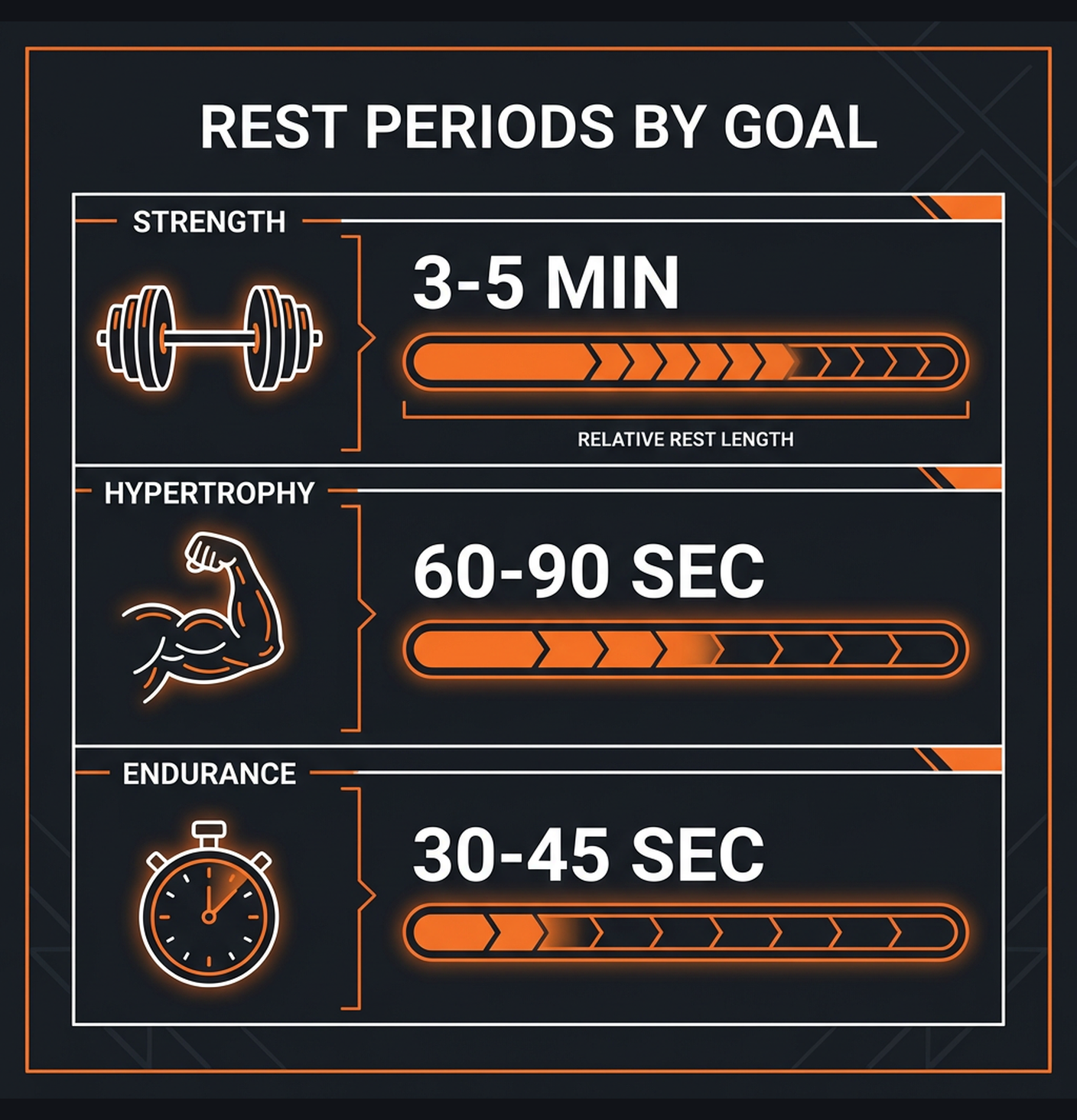
Here is the breakdown based on decades of research and practical application:
| Training Goal | Rest Period | Why |
|---|---|---|
| Maximal strength (1-5 reps) | 3-5 minutes | Full ATP/phosphocreatine recovery, nervous system reset |
| Hypertrophy (6-12 reps) | 60-90 seconds | Partial recovery maintains metabolic stress while allowing adequate performance |
| Muscular endurance (12-20 reps) | 30-45 seconds | Keeps metabolic fatigue high, trains lactate tolerance |
| Power/explosive work | 3-5 minutes | Full recovery needed for max speed and force production |
These are not arbitrary numbers. A 2016 study published in the *Journal of Strength and Conditioning Research* by Schoenfeld et al. compared 1-minute rest to 3-minute rest in trained lifters over 8 weeks. The longer rest group gained significantly more strength and showed a trend toward greater muscle thickness. Why? Because they could maintain higher loads and rep quality across all sets.
Does that mean you should always rest 3-5 minutes? No. If your goal is purely hypertrophy and you are using moderate loads, shorter rests have their place. The metabolic stress from shorter rest periods -- the burn, the pump, the buildup of metabolites -- is one of the mechanisms that drives muscle growth. The key is matching rest periods to your intent for that exercise.
Compound Lifts vs Isolation Movements
Not all exercises deserve the same rest period, even within the same workout.
Compound Lifts Need More Rest
Squats, deadlifts, bench press, barbell rows, and overhead press are systemically demanding. They use large muscle groups, heavy loads, and require high levels of coordination and bracing. Your cardiovascular system, nervous system, and muscles all need time to recover.
For heavy compounds in the 3-6 rep range, take 3-5 minutes. For moderate compounds in the 6-10 rep range, take 2-3 minutes. Going shorter than 2 minutes on a heavy compound set is almost always a mistake. Your next set will suffer, you will use less weight, your technique will break down, and the total training stimulus will be worse.
Isolation Movements Can Use Shorter Rest
Bicep curls, lateral raises, leg curls, tricep pushdowns -- these are less systemically fatiguing. They use smaller muscles and lighter loads. Your heart rate recovers faster, your nervous system is not as taxed, and the individual muscle recovers more quickly.
For isolation exercises, 60-90 seconds is usually the sweet spot. You can push it down to 45 seconds if you are chasing a pump, but anything under 30 seconds usually means your next set will be significantly compromised.
The Readiness Test: Are You Ready for Another Quality Set?
Strict timing works. But there is an even simpler approach that accounts for individual variation, training conditions, and how your body feels on any given day.
Before starting your next set, ask yourself three questions:
- •Is my breathing back to near-normal? Not completely calm, but you should not be gasping.
- •Do I feel like I can match my last set's performance? Same weight, same reps, similar effort level.
- •Am I mentally locked in? Can you focus on the cues that matter for this lift, or is your brain still recovering?
If all three are yes, go. If any one is no, wait another 30-60 seconds and check again.
This readiness test naturally adjusts rest periods based on the demands of the exercise, your fitness level, and daily variables like sleep and nutrition. A set of heavy squats might leave you checking back in at 4 minutes. A set of cable curls might have you ready in 60 seconds.
Timing Rest vs Going by Feel
Should you use a stopwatch or just go by feel?
Use a timer when:
- •You are doing hypertrophy work and tend to rest too long (turning a 90-second rest into 4 minutes because your phone distracted you)
- •You are following a specific program that prescribes rest periods
- •You are trying to increase work capacity and need accountability
- •You are doing conditioning-style training (EMOM, timed circuits)
Go by feel when:
- •You are doing heavy strength work (rushing a max effort set is a recipe for bad reps or injury)
- •You are a more advanced lifter with good self-awareness
- •The readiness test has become second nature
Most lifters benefit from timing their rest on hypertrophy and isolation work, and going by feel on heavy compound strength work. The worst combination is the opposite: rushing through heavy squats because you are impatient, then resting 5 minutes between sets of curls because you got lost in your phone.
Common Rest Period Mistakes
Resting Too Little on Heavy Compounds
This is the most common mistake among intermediate lifters. They feel like resting 4 minutes between squat sets is "lazy" or "wasting time." It is not. If your program calls for 4 sets of 5 at 85%, and you rest 90 seconds between sets, here is what happens:
- •Set 1: 5 reps at 85%. Solid.
- •Set 2: 4 reps at 85%. Lost one.
- •Set 3: 3 reps at 85%. Had to grind.
- •Set 4: 2 reps at 85%. Failed the third rep.
Total productive reps: 14, with declining quality.
Now rest 3-4 minutes instead:
- •Set 1: 5 reps at 85%. Solid.
- •Set 2: 5 reps at 85%. Solid.
- •Set 3: 5 reps at 85%. Hard but clean.
- •Set 4: 4 reps at 85%. Good effort.
Total productive reps: 19, with much better quality. More high-quality volume means a better training stimulus. The extra 8 minutes you spent resting paid for itself.
Resting Too Long on Isolation Work
On the flip side, some lifters take 3-4 minutes between sets of dumbbell curls. Unless you are doing some kind of heavy strength-focused curl (which almost nobody is), this rest period is way too long. The muscle has fully recovered, the pump has dissipated, and you have lost the metabolic environment that isolation work is designed to create.
For isolation work, keep it tight. 60-90 seconds. The moderate burn you feel going into the next set is a feature, not a bug.
Inconsistent Rest Periods
If you rest 90 seconds on set one, 3 minutes on set two, and 45 seconds on set three, you have no idea whether performance changes are due to fatigue, adaptation, or just inconsistent recovery. Pick a rest period for each exercise and stick to it across sets. This makes your training measurable and progressive.
Putting It All Together: A Practical Framework
Here is a simple framework for a typical training session:
| Exercise Type | Example | Rest Period |
|---|---|---|
| Main compound lift (heavy) | Squat 4x5, Bench 5x3 | 3-5 min |
| Secondary compound (moderate) | Romanian deadlift 3x8, Incline press 3x10 | 2-3 min |
| Isolation work | Curls, lateral raises, extensions | 60-90 sec |
| Supersets (paired exercises) | Rows + face pulls | 60-90 sec between pairs |
| Finisher/pump work | Cable flyes, leg extensions | 45-60 sec |
Start your workout with the heavy stuff that needs long rest. Finish with the lighter work that uses short rest. This structure naturally builds your workout from high-intensity, long-rest work at the beginning to moderate-intensity, short-rest work at the end.
The whole session should take 60-75 minutes if you manage your rest properly. If your workouts are consistently running over 90 minutes, your rest periods on non-compound work are probably too long.
The Bottom Line
Rest periods are not about being tough or lazy. They are about giving your body exactly enough recovery to perform the next set at the quality level your goal requires. Heavy strength work needs long rest. Hypertrophy work needs moderate rest. Endurance and pump work needs short rest.
Pick the right rest period for the exercise and the goal. Time it or use the readiness test. Be consistent. And stop scrolling between sets of squats -- those 4 minutes go fast when you are actually paying attention to your recovery.
Frequently Asked Questions
- How long should I rest between sets for strength?
- Rest 3-5 minutes between sets of heavy compound lifts when your goal is maximum strength. Your phosphocreatine system needs at least 3 minutes to fully recharge, and cutting rest short means your next set suffers. If your workout runs long, that is the price of getting stronger.
- How long should I rest between sets for muscle growth?
- Rest 60-90 seconds between sets when hypertrophy is the goal. Shorter rest keeps metabolic stress high, which is one of the main drivers of muscle growth. You will not be able to lift as heavy, but the accumulated fatigue and pump are doing their job.
- Does resting too long between sets hurt my gains?
- Not for strength, but it can for hypertrophy. If you are chasing muscle growth and resting 4-5 minutes between sets of bicep curls, you are losing the metabolic stress that drives growth. Match your rest periods to your goal, not your phone scrolling habits.
- Should I time my rest periods or go by feel?
- Timing is better, especially for hypertrophy work. Most people drastically underestimate or overestimate how long they have been resting. Use your phone timer or a watch. For strength work, going by feel is more acceptable since the goal is full recovery between sets.
- Do rest periods change for isolation vs compound exercises?
- Yes. Compound movements like squats and deadlifts tax your whole body and need longer rest, usually 2-5 minutes depending on your goal. Isolation exercises like curls and lateral raises recover faster and work well with 45-90 seconds of rest.