Single-Leg Training: Why Unilateral Work Makes You Stronger
Your dominant leg is doing more work than you think. Single-leg exercises expose and fix imbalances, build real-world stability, and can even increase your bilateral squat and deadlift numbers.
 Olivia·Mar 8, 2026·8 min read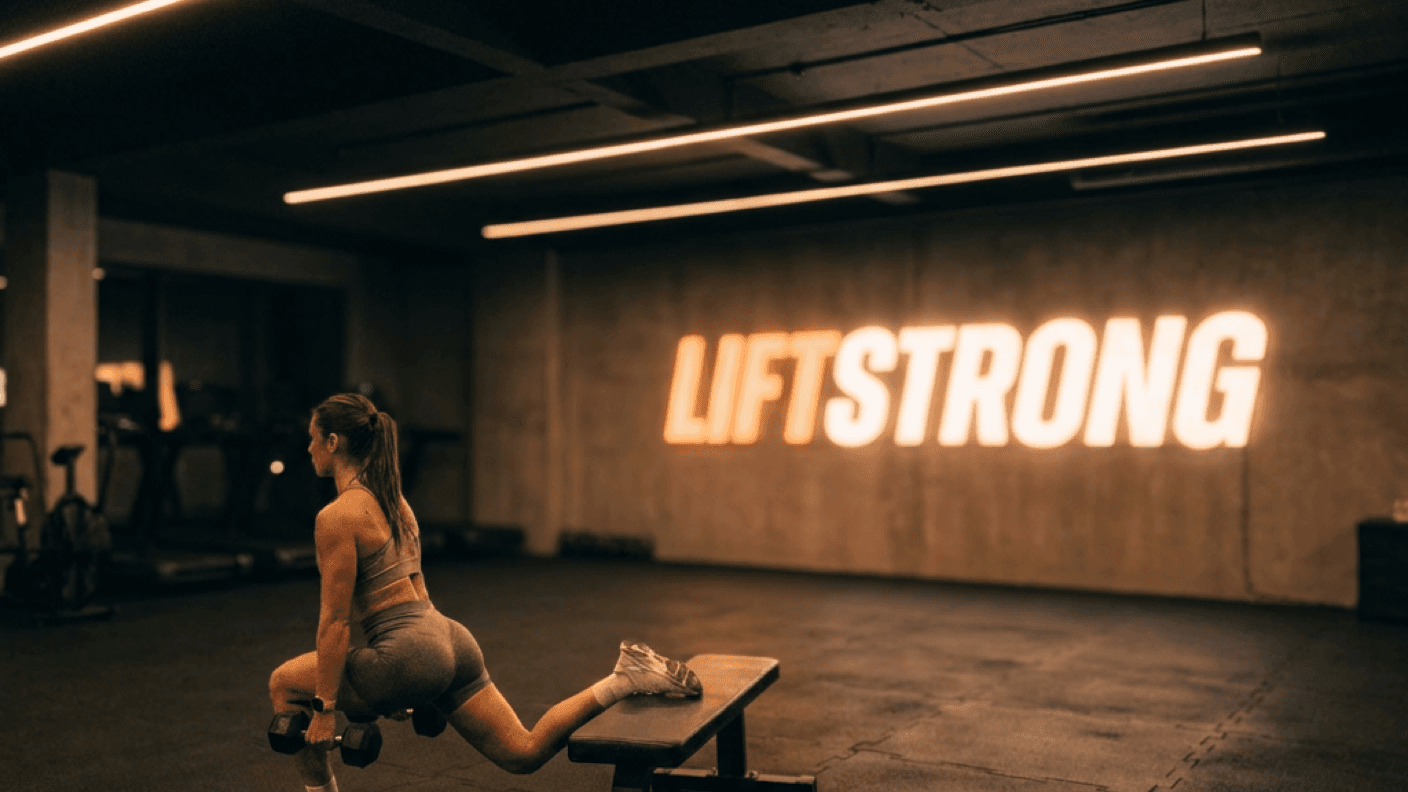
Key Takeaways
- Most people have a 5-15% strength difference between legs that bilateral exercises like squats mask but never fix.
- Single-leg training can actually improve your bilateral squat and deadlift numbers by teaching your nervous system to recruit more motor units per leg.
- Athletes with more than a 15% strength imbalance between legs are 2.5 times more likely to suffer a lower body injury.
- Always start with your weaker leg and match the strong leg to the same reps to prevent the imbalance from getting worse.
- Bulgarian split squats and single-leg RDLs twice per week after your main lifts is enough to see real improvements in 4-6 weeks.
Get This on WhatsApp
Get a quick summary and link sent straight to your WhatsApp.
Send Me This ArticleThe Problem With Only Training Two Legs at a Time
Stand on one leg for ten seconds. Now close your eyes and try it again. If you wobbled, stumbled, or nearly fell over, you just demonstrated why single-leg training matters.
Bilateral exercises like squats and deadlifts are the foundation of any strength program. Nobody's arguing against that. But they have a blind spot: your stronger leg compensates for your weaker one, and you never notice.
Research from the *Journal of Strength and Conditioning Research* has shown that most people have a 5-15% strength difference between legs. In bilateral exercises, your dominant leg picks up the slack. The bar goes up, the weight gets moved, and you assume both sides did equal work. They didn't.
Over months and years, this imbalance compounds. Your dominant leg gets stronger while your weaker leg falls further behind. Eventually, this shows up as an asymmetrical squat pattern, a hip shift under heavy loads, or a knee injury on the weaker side.
Single-leg training forces each leg to do its own work. No hiding, no compensating, no cheating. And the benefits go well beyond fixing imbalances.
The Bilateral Deficit: Why 1+1 Doesn't Equal 2
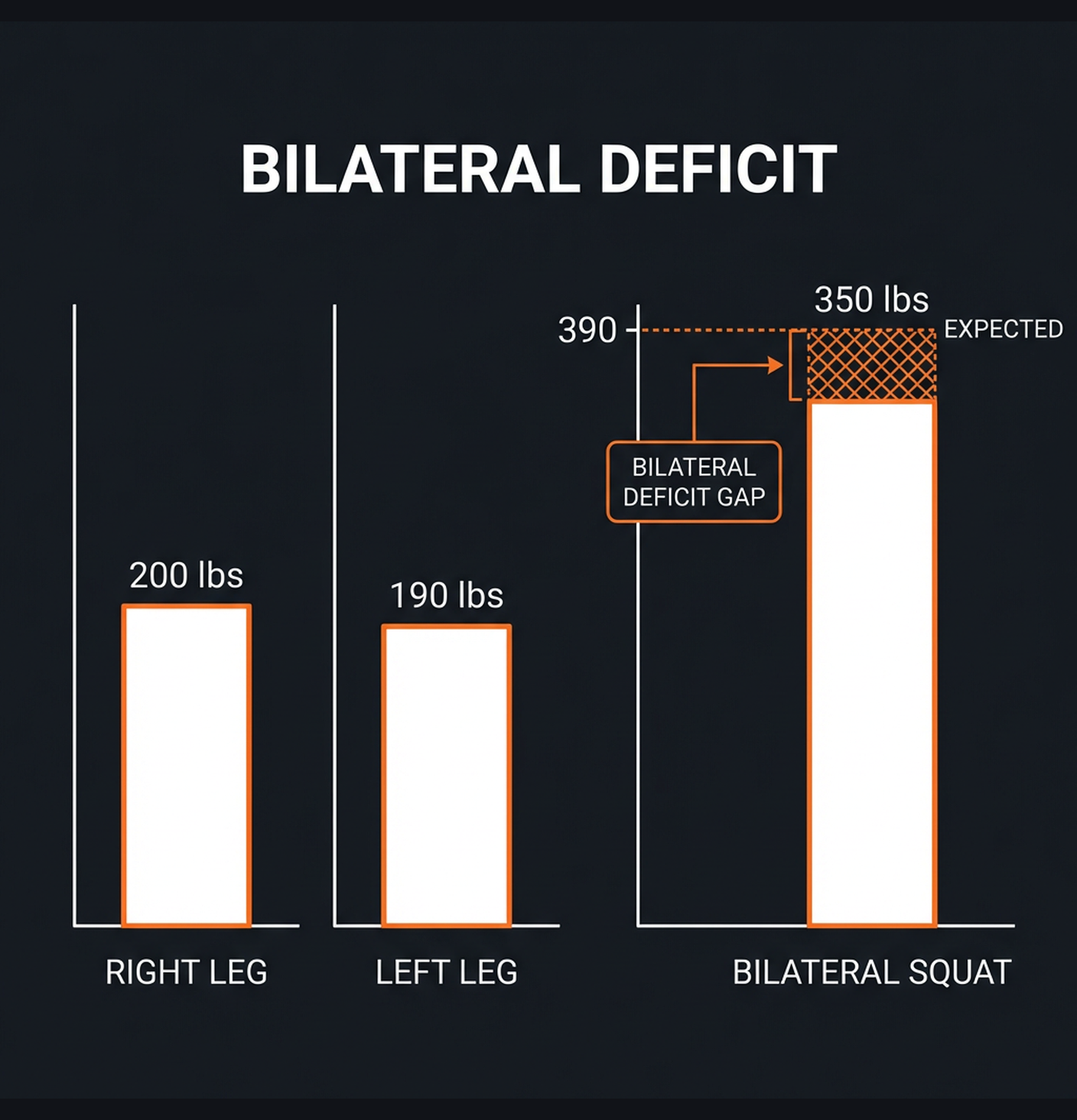
Here's something most lifters don't know: the sum of what each leg can produce individually is actually greater than what both legs produce together. This is called the bilateral deficit.
If your right leg can leg press 200 lbs and your left can do 190 lbs, you'd expect a bilateral leg press of around 390 lbs. But most people can only do 350-370 lbs with both legs. Your nervous system doesn't fire both legs at full capacity simultaneously.
Training unilaterally teaches your nervous system to recruit more motor units per leg. Over time, this increases both your unilateral AND bilateral strength. Multiple studies have shown that lifters who add single-leg work to their programs see improvements in their bilateral squat and deadlift numbers, even without directly training those lifts more.
Benefits Beyond Balance
Injury Prevention
The single biggest risk factor for lower body injuries in athletes is strength asymmetry between limbs. A 2017 study published in the *British Journal of Sports Medicine* found that athletes with more than a 15% strength difference between legs were 2.5 times more likely to suffer a lower extremity injury.
Single-leg exercises address this directly. They also strengthen the small stabilizer muscles around your knees, ankles, and hips that bilateral training barely touches. These stabilizers are what keep your joints healthy when you step off a curb wrong, pivot during a pickup game, or catch yourself on ice.
Core Stability
Try doing a heavy Bulgarian split squat without bracing your core. You'll tip over. Single-leg exercises are self-correcting core exercises because your trunk has to stabilize against rotational and lateral forces that don't exist in bilateral movements.
A barbell back squat loads you symmetrically. A rear-foot-elevated split squat creates an asymmetric load that your core has to fight against. Your obliques, quadratus lumborum, and deep spinal stabilizers work overtime during every rep.
Reduced Spinal Load
This one matters for lifters with back issues. A heavy bilateral squat with 315 lbs means 315 lbs compressing your spine. A Bulgarian split squat with 50 lb dumbbells gives each leg a comparable training stimulus with only 100 lbs of total load.
If you have disc issues, spinal stenosis, or just a beat-up lower back from years of heavy squatting, single-leg work lets you train your legs hard while dramatically reducing spinal compression.
Athletic Transfer
Almost every athletic movement happens on one leg. Sprinting is alternating single-leg bounds. Cutting is a single-leg deceleration and re-acceleration. Jumping often initiates from one leg. Even walking is controlled falling from one leg to the other.
If you only train your legs bilaterally, you're building strength in a pattern you rarely use outside the gym. Single-leg training bridges the gap between gym strength and real-world performance.
The Best Single-Leg Exercises
Tier 1: Primary Movements
Bulgarian Split Squat (Rear Foot Elevated Split Squat)
The king of single-leg exercises. Your rear foot goes on a bench behind you, and you squat down on the front leg until your back knee nearly touches the floor.
Why it works: It allows heavy loading (you can use dumbbells, a barbell, or a goblet hold), it develops both strength and flexibility in your hip flexors, and it absolutely exposes any left-right imbalances.
Start with bodyweight. Once you can do 3x12 per leg without wobbling, add weight. Most intermediate lifters work up to holding 40-60 lb dumbbells for sets of 8-10.
Single-Leg Romanian Deadlift
Stand on one leg, hinge at the hip, and lower a dumbbell or kettlebell toward the floor while your free leg extends behind you. This is a hip hinge pattern that hammers your glutes and hamstrings on one side while demanding balance and coordination.
The balance component makes this harder than it looks. Start with bodyweight or a very light dumbbell. Focus on keeping your hips square (don't let the free-leg hip rotate open) and reaching the weight straight down.
Tier 2: Supporting Exercises
Step-Ups
Simple and effective. Step onto a box or bench with one leg and drive up to standing. The key is using a box high enough that your thigh is at least parallel to the ground at the start. Anything lower and it's mostly a calf exercise.
Hold dumbbells at your sides and focus on driving through the working leg. Don't push off with the trail foot -- that turns it into a two-legged exercise.
Walking Lunges
Take a big step forward, lower your back knee toward the floor, then drive forward into the next step. Walking lunges build strength-endurance and challenge balance in a dynamic movement pattern.
Use dumbbells at your sides or a barbell on your back. Keep your torso upright and your front knee tracking over your second toe.
Single-Leg Leg Press
If balance is the limiting factor and you want to focus on raw single-leg strength, the leg press machine lets you load one leg at a time without worrying about stability. Use it to build single-leg strength that you can later transfer to free-weight movements.
Tier 3: Stability Builders
Single-Leg Glute Bridge
Lie on your back, one foot planted, the other leg raised. Drive your hips up by squeezing the working glute. This is a warm-up and activation exercise that teaches glute firing patterns one side at a time.
Pistol Squat (Advanced)
A full single-leg squat to the floor with the other leg extended in front of you. Requires significant strength, flexibility, and balance. Don't attempt this until you've built a solid base with Bulgarian split squats and step-ups. Most lifters don't need pistol squats unless they're training for calisthenics or specific sport requirements.
Programming Single-Leg Work
For General Strength
Replace one bilateral leg exercise per session with a unilateral alternative. If your current program has back squats and Romanian deadlifts, keep the squats and swap the RDLs for single-leg RDLs. Or add Bulgarian split squats as a third exercise.
| Current Program | Modified Program |
|---|---|
| Barbell Back Squat: 4x6 | Barbell Back Squat: 4x6 |
| Romanian Deadlift: 4x8 | Single-Leg RDL: 3x10 each |
| Leg Extension: 3x12 | Bulgarian Split Squat: 3x10 each |
| Leg Curl: 3x12 | Leg Curl: 3x12 |
For Fixing Imbalances
Start every leg session with 2-3 sets of your weakest single-leg exercise, always leading with the weaker leg. Match the strong leg's reps to whatever the weak leg managed. This prevents the gap from widening.
Example: If your left leg can do 8 Bulgarian split squats with 40 lb dumbbells but your right can do 12, do 8 reps per leg until your left catches up. Never do more reps on the strong side.
For Athletes
Alternate training blocks. Spend 4-6 weeks emphasizing bilateral strength (squats, deadlifts), then 4-6 weeks emphasizing unilateral work (split squats, single-leg RDLs, step-ups). This develops both maximum force production and single-leg stability.
Common Mistakes
Going Too Heavy Too Fast
Single-leg exercises require balance, which limits the load you can handle compared to bilateral movements. If you can squat 315 for reps, you're not going to split squat with 150 lb dumbbells on day one. Check your ego, start light, and build up.
Rushing Through Reps
Balance takes time. Pause for a full second at the bottom of each rep to eliminate momentum and ensure the working leg is doing all the work. Fast, bouncy reps defeat the purpose.
Ignoring the Weak Side
Always start with your weaker leg. If you start with the strong side, you're fresh and energized. By the time you get to the weak side, you're fatigued and do fewer reps. This makes the imbalance worse.
Skipping Single-Leg Work Because It's Hard
Bulgarian split squats are miserable. Single-leg RDLs make you feel uncoordinated. Nobody posts their step-up PRs on social media. But the lifters who do this work consistently are the ones who stay healthy, move well, and keep getting stronger year after year.
Getting Started
If you've never done single-leg training, start with two exercises:
- •Bulgarian Split Squat: 3x8 each leg, bodyweight only. Add dumbbells when you can do all reps without wobbling.
- •Single-Leg RDL: 3x8 each leg, bodyweight only. Add a light dumbbell or kettlebell when your balance is solid.
Do these twice per week after your main bilateral lifts. Within 4-6 weeks, you'll notice better balance, fewer aches in your knees and hips, and a more stable squat pattern. Within 3 months, your bilateral numbers will likely improve too.
Your legs don't work independently in the gym, but they work independently everywhere else. Train them that way.
Frequently Asked Questions
- Will single-leg training improve my squat?
- Yes. Research shows that adding unilateral work can improve bilateral strength because it teaches your nervous system to recruit more motor units per leg. It also fixes the left-right imbalances that cause hip shifts and uneven loading during heavy squats.
- What is the best single-leg exercise?
- The Bulgarian split squat is the gold standard. It allows heavy loading, builds both strength and hip flexor flexibility, and exposes imbalances immediately. Start with bodyweight, then progress to holding dumbbells. Most intermediate lifters work up to 40-60 pound dumbbells for sets of 8-10.
- Should I start with my weak leg or strong leg?
- Always start with your weaker leg. If you start with the strong side, fatigue will limit what your weak side can do, making the imbalance worse. Match your strong leg reps to whatever your weak leg managed, never the other way around.
- How do I know if I have a muscle imbalance between legs?
- Try single-leg exercises and compare sides. If one leg wobbles more, fatigues faster, or can do fewer reps, that is your weaker side. A difference of more than 10-15% in strength between legs is significant enough to address with targeted unilateral work.
- Can single-leg training replace squats?
- Not entirely. Bilateral squats allow heavier absolute loading which drives maximum strength and hormonal responses. But single-leg exercises are an excellent complement, especially for injury prevention, balance, and fixing asymmetries. Ideally your program includes both.