Sticking Points: Why Your Lift Stalls and How to Fix It
Everyone has a point in the squat, bench, or deadlift where the bar just stops. That sticking point tells you exactly what is weak and how to fix it.
 Jeff·Feb 5, 2026·9 min read
Key Takeaways
- A sticking point is the specific range of motion where a lift fails, and it reveals which muscles are the weak link in the chain.
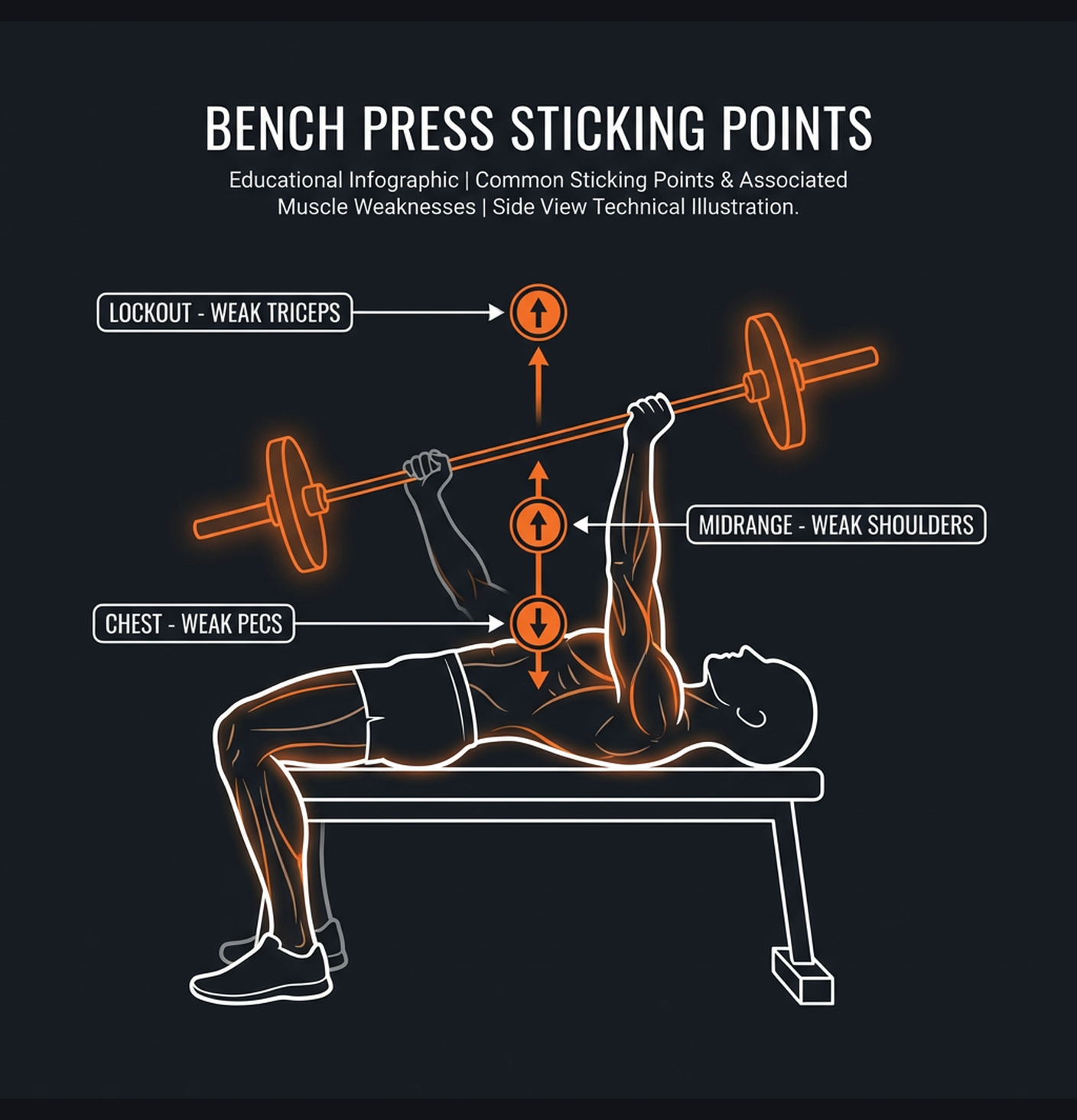
- Bench press sticking points off the chest mean weak pecs, while stalling at lockout usually means weak triceps.
- Pause reps at the sticking point teach your body to produce force from a dead stop where momentum cannot help you.
- Pin squats, board presses, and block pulls let you overload the exact range where you struggle most.
- If you have been stuck at the same weight for more than three weeks, add a targeted accessory exercise for the weak muscle group.
Get This on WhatsApp
Get a quick summary and link sent straight to your WhatsApp.
Send Me This ArticleWhat Causes Sticking Points
Every barbell lift has a moment where the bar feels heaviest. Not at the bottom. Not at the top. Somewhere in between, the weight seems to double and the bar decelerates or stops entirely. This is your sticking point.
Sticking points exist because of mechanical disadvantage. At certain joint angles during a lift, leverage is at its worst. Your muscles are in their least favorable position to produce force, and the effective moment arm (the distance between the load and the joint) is at its longest. The bar has not gotten heavier -- your body is just in its weakest position relative to the weight.
Understanding where your lift stalls tells you something specific and useful: which muscles are underdeveloped, which positions you are weakest in, and exactly what to train to break through. Rather than just adding more of the same training, you can target the weak link directly.
There is also a technique component. Sometimes a sticking point is not a strength issue at all. It is a bar path problem, a bracing failure, or a positioning error that puts you in a mechanically disadvantaged position. We will cover both strength and technique fixes for each lift.
Squat Sticking Points
Stuck Out of the Hole (Bottom Position)
Where it happens: The first 2-4 inches out of the bottom position. You descend fine, hit depth, start to come up, and the bar just parks.
What is weak: Quads (they are doing the most work at deep knee flexion angles) and glutes (hip extension out of the hole). It can also be a core/bracing issue -- if your torso collapses forward at the bottom, your back cannot transmit force efficiently.
How to fix it:
- •Paused squats: Descend to the bottom, pause for 2-3 seconds with zero bounce, then drive up. Use 70-80% of your regular working weight. The pause eliminates the stretch reflex and forces pure strength out of the hole.
- •Front squats: Force you to stay upright, hammer the quads, and build core rigidity. If you cannot front squat well, your back squat will have issues out of the hole.
- •Leg press (deep range of motion): Lets you load the quads heavily through a deep range without worrying about back position.
- •Belt squats: Target the legs directly without spinal loading. Great for extra quad volume.
Technique check: Are you rushing the descent and diving into the hole? A controlled descent allows you to maintain tightness. Are your knees caving inward at the bottom? That is a glute weakness and a technique problem simultaneously.
Stuck Halfway Up
Where it happens: About halfway between the bottom and the top, roughly when your thighs are parallel or just above.
What is weak: Glutes (hip extension), lower back/erectors (keeping the torso upright), and possibly hamstrings (hip extension assistance). This often shows up as a "good morning squat" where your hips shoot up but your shoulders stay low.
How to fix it:
- •Pin squats / Anderson squats: Set safety pins at the sticking point height. Start each rep from a dead stop at that height. This builds strength at the exact position where you fail.
- •Hip thrusts or barbell glute bridges: Heavy hip extension work to build glute strength in mid-range positions.
- •Good mornings: Strengthen the posterior chain (lower back, glutes, hamstrings) in the exact position that causes the "good morning squat" failure.
- •Tempo squats: Use a 3-4 second descent to build strength and control through the entire range.
Bench Press Sticking Points
Stuck Off the Chest
Where it happens: The bar touches your chest, you start to press, and it stalls within the first 2-3 inches.
What is weak: Pecs (they are in their most stretched, weakest position). Can also indicate you are bringing the bar too low on your chest (below the nipple line) or not using enough leg drive.
How to fix it:
- •Spoto press: Lower the bar to about 1-2 inches above your chest, pause, then press. Builds pec strength without the bounce off the chest.
- •Dumbbell bench press: Greater range of motion and stretch on the pecs. Builds the bottom-range strength that barbells cannot match.
- •Wide-grip bench press: Increases pec demand. Use a grip 1-2 inches wider than your competition grip.
- •Paused bench press: Full pause on the chest before pressing. Eliminates momentum.
Technique check: Are you losing your arch? Is the bar touching too low? Are you flaring your elbows too early? These positioning errors magnify the difficulty off the chest.
Stuck at Midrange (About Halfway Up)
Where it happens: The bar clears the chest but stalls around the halfway point, roughly when your upper arms are at 90 degrees to your torso.
What is weak: Front deltoids. The transition from pec-dominant to tricep-dominant happens at midrange, and the anterior delts carry the load through this transition zone.
How to fix it:
- •Overhead press: Builds shoulder pressing strength directly.
- •Board press or pin press at the sticking height: Overload the exact position where you fail.
- •Incline bench press: Increases the demand on the front delts while still being a pressing movement.
- •Pause reps at the sticking point: Lower the bar, press to the sticking point, pause 2 seconds, then complete the rep.
Stuck at Lockout (Last Few Inches)
Where it happens: You get the bar through the midrange but cannot lock it out. Elbows stall at about 15-20 degrees short of full extension.
What is weak: Triceps. The lockout is almost entirely a tricep exercise.
How to fix it:
- •Close-grip bench press: Shifts more work to the triceps throughout the entire lift.
- •Board press or floor press: Limits range of motion to the top portion where triceps dominate.
- •JM press: A hybrid between a close-grip bench and a skull crusher. Hits the triceps hard in the pressing pattern.
- •Heavy tricep extensions (skull crushers, overhead extensions): Build raw tricep strength.
Deadlift Sticking Points
Stuck Off the Floor
Where it happens: The bar does not move or barely breaks the floor. You pull and pull but it feels welded to the ground.
What is weak: Quads (leg drive to break the bar off the floor), upper back (maintaining thoracic position), and it is almost always partially a positioning issue.
How to fix it:
- •Deficit deadlifts: Stand on a 1-2 inch platform and pull from there. This makes the bottom position harder and builds strength off the floor. When you return to the normal height, the bar flies off the ground.
- •Pause deadlifts: Pull the bar 1 inch off the floor, pause 2-3 seconds, then finish the lift. Brutal but effective.
- •Front squats: Build the quad strength needed for strong leg drive at the start of the pull.
- •Focus on setup: Many "off the floor" problems are actually setup problems. If your hips start too high, you are pulling with all back and no legs. Reset your starting position with hips lower, lats engaged, and slack pulled out of the bar before you lift.
Stuck at the Knees
Where it happens: The bar breaks the floor fine but stalls at or just above the knee.
What is weak: Glutes and upper back. At this position, the knees need to push back to let the bar pass, and the glutes and back need to take over from the quads.
How to fix it:
- •Block pulls (bar elevated 2-4 inches): Start at the sticking point and practice driving through it with heavier-than-normal loads.
- •Romanian deadlifts: Build hamstring and glute strength in the hip hinge pattern.
- •Barbell rows: Strengthen the upper back to maintain position when the bar is at knee height.
- •Paused deadlifts at the knee: Pull to the knee, pause 2-3 seconds, finish the rep.
Stuck at Lockout
Where it happens: The bar is past the knees, maybe at mid-thigh, but you cannot stand fully upright and lock the hips.
What is weak: Glutes (terminal hip extension) and sometimes hamstrings. Your upper back may also be rounding, which makes the lockout position feel impossible.
How to fix it:
- •Hip thrusts: Build lockout-specific glute strength. Go heavy.
- •Block pulls from just below the sticking point: Overload the top range of motion.
- •Kettlebell swings: Explosive hip extension that trains the lockout pattern with speed.
- •Rack pulls: Heavy partial range of motion pulls that let you feel supramaximal weights in the lockout position.
The Master Sticking Point Table
| Lift | Sticking Point | Likely Weak Muscles | Primary Fix | Secondary Fix |
|---|---|---|---|---|
| Squat | Out of hole | Quads, glutes | Paused squats | Front squats |
| Squat | Halfway up | Glutes, lower back | Pin squats | Good mornings |
| Bench | Off chest | Pecs | Spoto press | DB bench |
| Bench | Midrange | Front delts | OHP | Incline bench |
| Bench | Lockout | Triceps | Close-grip bench | Floor press |
| Deadlift | Off floor | Quads, positioning | Deficit deadlifts | Pause deadlifts |
| Deadlift | At knees | Glutes, upper back | Block pulls | RDLs |
| Deadlift | Lockout | Glutes, hamstrings | Hip thrusts | Rack pulls |
How to Program Sticking Point Work
Do not just throw a bunch of accessory exercises at the problem randomly. Here is a structured approach:
- •Identify your sticking point. Film your heavy sets from the side. Where does the bar decelerate or stop?
- •Pick one primary variation and one accessory. From the table above, choose the primary fix as a main supplemental movement (3-5 sets of 3-6 reps, moderate to heavy) and the secondary fix as lighter accessory work (3 sets of 8-12 reps).
- •Run it for 4-6 weeks. Sticking points do not fix overnight. Give the targeted work at least a month before reassessing.
- •Retest. After the training block, hit your main lift at the weight where you were previously stalling. Has the sticking point improved?
- •Reassess. Sometimes fixing one sticking point reveals a new one. That is normal progression. The sticking point has moved, which means you got stronger in the previous weak zone. Now address the new one.
The strongest lifters in the world spend significant portions of their training addressing weak points rather than just doing the main lifts over and over. Sticking points are not frustrating roadblocks -- they are diagnostic tools that tell you exactly where to focus your training energy.
Frequently Asked Questions
- Why does my bench press stall a few inches off my chest?
- A sticking point off the chest usually means weak pecs or poor leg drive. The chest muscles are the primary mover at the bottom of the bench press, and they are in their weakest position there. Paused bench press and wide-grip work are the best fixes.
- Why do I get stuck at the bottom of my squat?
- Getting stuck in the hole is usually a quad weakness issue, though poor bracing and loss of upper back tightness also contribute. Pause squats, front squats, and tempo squats that force you to control the bottom position are the most effective fixes.
- Why does my deadlift stall at my knees?
- A stall at the knees usually points to weak quads or the bar drifting forward. If the bar gets away from your shins, it creates a longer moment arm at the knee. Deficit deadlifts and paused deadlifts just below the knee address both the strength and positioning issues.
- Can I just add more weight to push through a sticking point?
- No. Adding weight to a movement you are already stuck on just reinforces bad mechanics. Instead, use variations that specifically target the weak range of motion at lighter weights. Fix the weakness first, then the heavier weights will follow.
- How long does it take to fix a sticking point?
- Most sticking points improve noticeably within 4-6 weeks of targeted accessory work. Dedicate 2-3 exercises per week to the weak point and be patient. Trying to fix everything at once usually means nothing improves.