Training Around Your Menstrual Cycle: A Strength Guide for Women
Your hormones fluctuate across a 28-day cycle, and they affect your strength, recovery, and energy levels. Here is how to work with your biology instead of against it.
 Olivia·Feb 18, 2026·8 min read
Key Takeaways
- The follicular phase (days 1-14) brings higher estrogen levels that support strength and pain tolerance, making it a great time to push heavy loads.
- During the luteal phase (days 15-28), higher progesterone can increase fatigue and body temperature, so autoregulate intensity based on how you feel.
- Many women report peak strength around ovulation (day 12-14) and can use that window to attempt personal records.
- Tracking your cycle alongside your training log helps you spot patterns and stop blaming yourself for predictable performance dips.
- Cramps and bloating are not reasons to skip training entirely -- lighter loads and movement often reduce symptoms better than rest.
Get This on WhatsApp
Get a quick summary and link sent straight to your WhatsApp.
Send Me This ArticleThe Four Phases of Your Cycle
Your menstrual cycle is not just about your period. It is a 28-day (on average) hormonal cycle that affects your energy, strength, mood, recovery, and training tolerance. Understanding the basics gives you an advantage that most training programs -- which are overwhelmingly designed around male physiology -- completely ignore.
Here are the four phases:
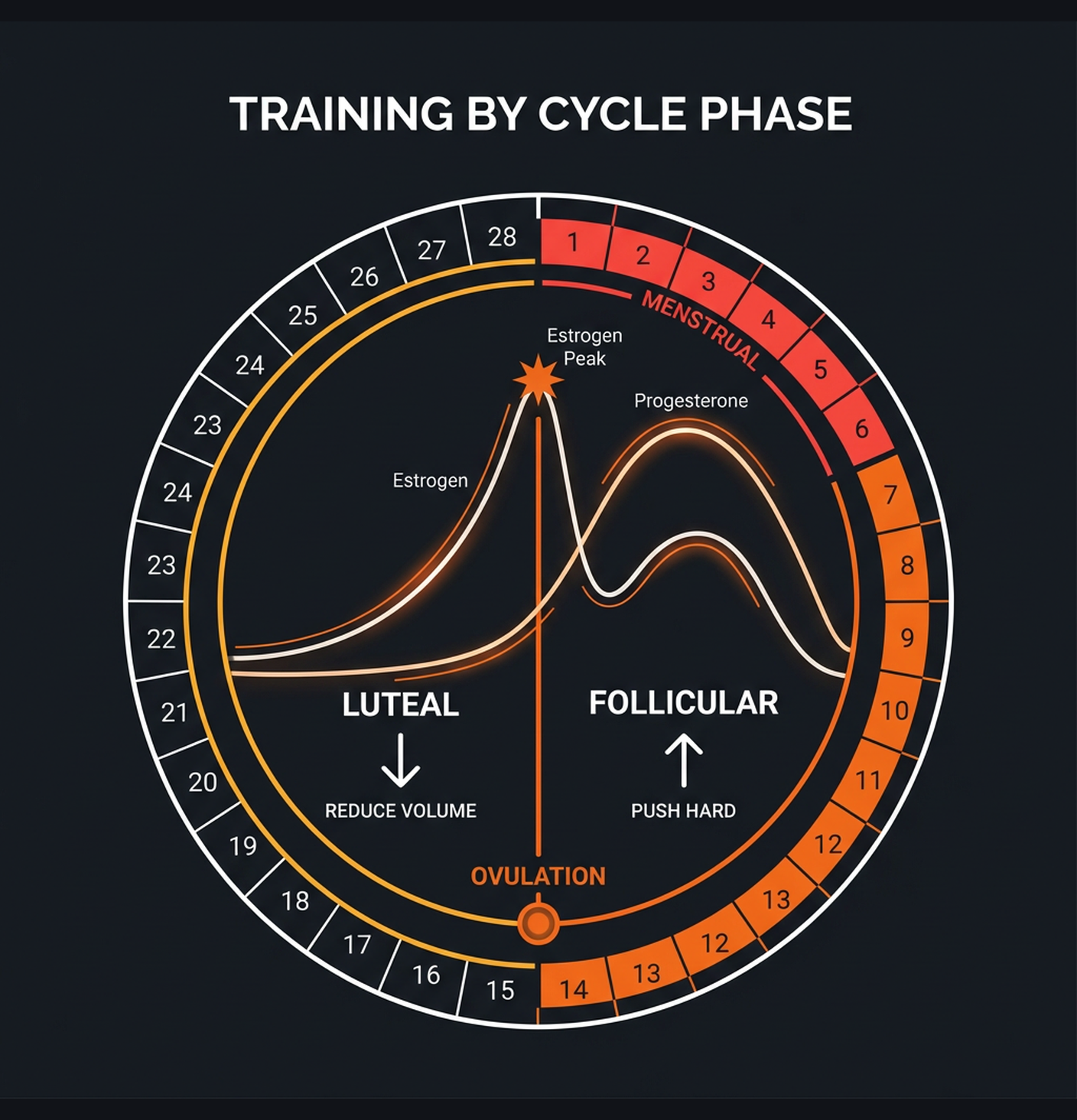
Menstrual Phase (Days 1-5): Day 1 is the first day of your period. Estrogen and progesterone are both at their lowest. Many women experience fatigue, cramping, and lower motivation. But some women feel fine or even relieved.
Follicular Phase (Days 1-13): This overlaps with your period and continues after it ends. Estrogen begins rising steadily. Energy increases, mood improves, and your body becomes more anabolic (primed for muscle building). This is when most women feel their strongest.
Ovulation (Around Day 14): Estrogen peaks. Testosterone also gets a brief spike. Many women feel their most energetic and powerful around ovulation. Strength and power output tend to be highest here.
Luteal Phase (Days 15-28): After ovulation, progesterone rises sharply while estrogen dips and then partially recovers. This is when PMS symptoms can appear: bloating, fatigue, irritability, water retention, increased body temperature. Training may feel harder. Recovery may take longer.
These timelines assume a textbook 28-day cycle. Real cycles vary. Some women run 25 days, others 35. The phases shift accordingly. Hormonal birth control changes the picture significantly (more on that below).
Follicular Phase: When to Push Hard
The follicular phase (after your period ends through ovulation, roughly days 6-14) is when you have the most training potential. Here is why:
Rising estrogen is anabolic. Estrogen promotes protein synthesis, improves muscle recovery, and enhances force production. Research published in the *European Journal of Applied Physiology* shows that women in the follicular phase demonstrate greater strength gains from high-intensity resistance training compared to the luteal phase.
Pain tolerance increases. Estrogen has a mild analgesic effect. You can tolerate more training discomfort, which translates to being able to push closer to failure or handle heavier loads.
Insulin sensitivity is higher. Your body handles carbohydrates more efficiently, which means better energy during training and better glycogen replenishment afterward.
What to do: This is the time to hit your hardest training. Test new PRs. Push volume. Increase intensity. If you are going to schedule a heavy squat day, a high-volume push session, or a deload-ending retest week, this is the phase to do it.
Luteal Phase: When to Pull Back (Slightly)
The luteal phase (days 15-28, roughly the two weeks before your period) brings a different hormonal environment:
Progesterone dominates. Progesterone is catabolic (breaks down tissue) and raises core body temperature by about 0.3-0.5 degrees Celsius. This higher body temperature increases resting heart rate, makes you fatigue faster, and can make the gym feel hotter than usual.
Serotonin drops. This is a big part of why mood dips in the luteal phase. Lower serotonin can mean less motivation, more irritability, and a stronger desire for comfort foods (especially carbs -- your body is actually asking for them because carbs help produce serotonin).
Water retention increases. Bloating and a 2-5 lb scale jump are common and totally normal. This is water, not fat. It goes away when your period starts.
Recovery takes longer. Higher progesterone and the shift away from estrogen-dominant physiology means your body does not recover from training as quickly.
What to do: You do not need to stop training. You do not need to dramatically change your program. But minor adjustments can make a big difference:
- •Reduce total volume by 10-20% (fewer sets, not fewer sessions)
- •Keep intensity (weight on the bar) moderate. RPE 7-8 instead of 9-10
- •Favor steady-state cardio over HIIT (your body handles sustained moderate effort better than spiky high intensity during this phase)
- •Allow an extra rest day if you feel wiped out
- •Increase carb intake slightly to support serotonin production and offset higher metabolic demand
What the Research Actually Shows
A 2020 systematic review in *Sports Medicine* analyzed 78 studies on exercise performance across the menstrual cycle. The conclusion: there are small but real performance differences between phases, but the individual variation is enormous.
Some key findings:
- •Strength and power tend to peak in the late follicular / ovulatory phase
- •Endurance performance shows less variation across the cycle than strength
- •Perceived exertion (how hard exercise feels) tends to be higher in the luteal phase, even at the same absolute intensity
- •Injury risk may be slightly elevated around ovulation (possibly due to estrogen's effect on ligament laxity), though the evidence is mixed
- •The majority of women can train effectively in every phase with minor modifications
The research supports a flexible approach, not a rigid one. You are not a hormone chart. You are a person with daily variation in sleep, stress, nutrition, and motivation that may outweigh the hormonal effects on any given day.
The Phase-by-Phase Training Table
| Phase | Days (approx) | Hormones | Energy | Training Recommendation |
|---|---|---|---|---|
| Menstrual | 1-5 | Estrogen and progesterone low | Variable, often low | Train normally if you feel up to it. Reduce volume if needed. Focus on technique over intensity |
| Early Follicular | 6-10 | Estrogen rising | Increasing | Ramp up. Begin pushing intensity and volume |
| Late Follicular / Ovulation | 11-15 | Estrogen peaks, testosterone spike | Highest | Go hard. PR attempts, max effort days, highest volume |
| Early Luteal | 16-22 | Progesterone rising, estrogen dips | Moderate, beginning to decline | Maintain intensity but consider reducing volume by 10-15% |
| Late Luteal | 23-28 | Both hormones dropping | Often lowest, PMS symptoms | Reduce volume 15-20%. Maintain baseline intensity. Extra rest if needed |
Practical Adjustments (Not a Complete Overhaul)
The biggest mistake people make with cycle-based training is turning it into a complicated system that requires overhauling your entire program every two weeks. That is overkill.
Here is what actually works:
Keep your program structure the same. Do not write a completely different workout for each phase. Your squat/bench/deadlift split stays the same. Your exercise selection stays the same. What changes is the knobs -- volume and intensity.
Adjust volume, not frequency. Instead of skipping sessions in the luteal phase, do the same number of sessions with fewer sets. Going from 5 sets to 4 sets on your main lifts is a 20% volume reduction that most people barely notice in terms of program design but definitely notice in terms of recovery.
Listen to your body more than the calendar. Some women feel great during their period and terrible during ovulation. Some feel no difference at all. The table above is a starting point, not a prescription. If you feel strong on day 22, train hard. If you feel awful on day 12, back off. The hormonal trends are averages, not commands.
Track for patterns, then act on them. Before making any program changes, track your training performance (weights, reps, RPE) alongside your cycle for 2-3 months. Look for patterns. Do you consistently feel weaker in the late luteal phase? Do your best sessions cluster around ovulation? Once you see your personal patterns, make adjustments based on your data, not a generic chart.
Tracking Your Cycle and Correlating With Training
You need two things: a cycle tracking app and a training log.
Cycle tracking: Apps like Clue, Flo, or even a simple calendar note. Track the start of your period, notable symptoms (energy, mood, cramps, bloating), and any cycle irregularities.
Training log: Track your weights, reps, RPE, and a brief note on how the session felt. Most workout apps have a notes field. Even a one-word energy rating (low/medium/high) is useful.
After 2-3 cycles, you will start to see patterns. Maybe your deadlift always feels heavy around day 24. Maybe you hit your best bench numbers around day 12. Maybe you do not notice much variation at all. All of these are valid findings.
A Note on Hormonal Birth Control
Hormonal contraceptives (the pill, IUD, implant, patch) change the hormonal picture significantly. They suppress natural estrogen and progesterone fluctuations and replace them with synthetic hormones at more stable levels.
This means the follicular-phase-push, luteal-phase-back-off model may not apply to you in the same way. Women on hormonal birth control often report more consistent energy and performance across the month but may also notice overall blunted performance compared to their natural cycle (due to lower endogenous estrogen).
If you are on hormonal contraception, cycle-phase-specific training adjustments are less relevant. Instead, track your training performance against how you feel and look for patterns related to your pill pack timing (active pills vs placebo week) or any other rhythm you notice.
When to Push and When to Back Off
Here is the simplified decision framework:
Push hard when:
- •You are in the follicular phase or around ovulation
- •You slept well and feel energized
- •Your training log shows you are in a strong performance window
- •Motivation is high and the weights feel light
Pull back when:
- •You are in the late luteal phase and feeling fatigued
- •You slept poorly or are dealing with significant PMS symptoms
- •The weights feel unusually heavy for no obvious reason
- •Cramping, bloating, or discomfort is affecting your ability to brace and perform
The bottom line: Your menstrual cycle is not a weakness. It is a variable that, once understood, can be used to your advantage. Train with your biology, adjust the knobs when needed, and remember that consistency across the full cycle matters more than any single phase-specific optimization.
Frequently Asked Questions
- Should I train differently during my period?
- You can train during your period, and many women feel fine doing so. However, some experience fatigue, cramping, or lower motivation in the first couple of days. Listen to your body and adjust intensity if needed, but you do not have to skip training entirely.
- When am I strongest during my menstrual cycle?
- Most women feel strongest during the late follicular phase, roughly days 7-14 of a typical 28-day cycle. Estrogen peaks around ovulation and has a positive effect on strength, pain tolerance, and recovery. This is a great window to push for PRs or higher intensity work.
- Should I avoid heavy lifting during the luteal phase?
- You do not have to avoid it, but many women find that the luteal phase (days 15-28) brings more fatigue, water retention, and reduced motivation. Shifting to moderate intensity, higher rep work, or focusing on technique during this window can feel more productive than forcing heavy singles.
- Does birth control affect training performance?
- Hormonal birth control blunts the natural hormonal fluctuations of the menstrual cycle, which means you may not experience the same performance swings. Some women on the pill report more consistent training but slightly lower peak performance. The effects vary widely between individuals.
- Can exercise help with PMS symptoms?
- Yes. Regular strength training and moderate cardio have been shown to reduce cramps, bloating, mood swings, and fatigue associated with PMS. Even a light workout on a rough day can improve symptoms within 20-30 minutes through endorphin release and improved circulation.