Eccentric Overload Strength Program
Control the negative. Eccentric training builds strength your concentric work cannot match.
Send to WhatsApp
Overview
Your muscles are roughly 20-40% stronger during the eccentric (lowering) phase than the concentric (lifting) phase. Eccentric overload training exploits this by using supramaximal loads during the negative portion of the lift. This creates extreme mechanical tension, stimulates strength gains beyond what concentric-only training can produce, and builds bulletproof tendons.
This program requires a training partner for several exercises. The partner helps lift the concentric portion while you control the heavy eccentric alone. For exercises done solo, tempo manipulation and two-up/one-down techniques are used instead.
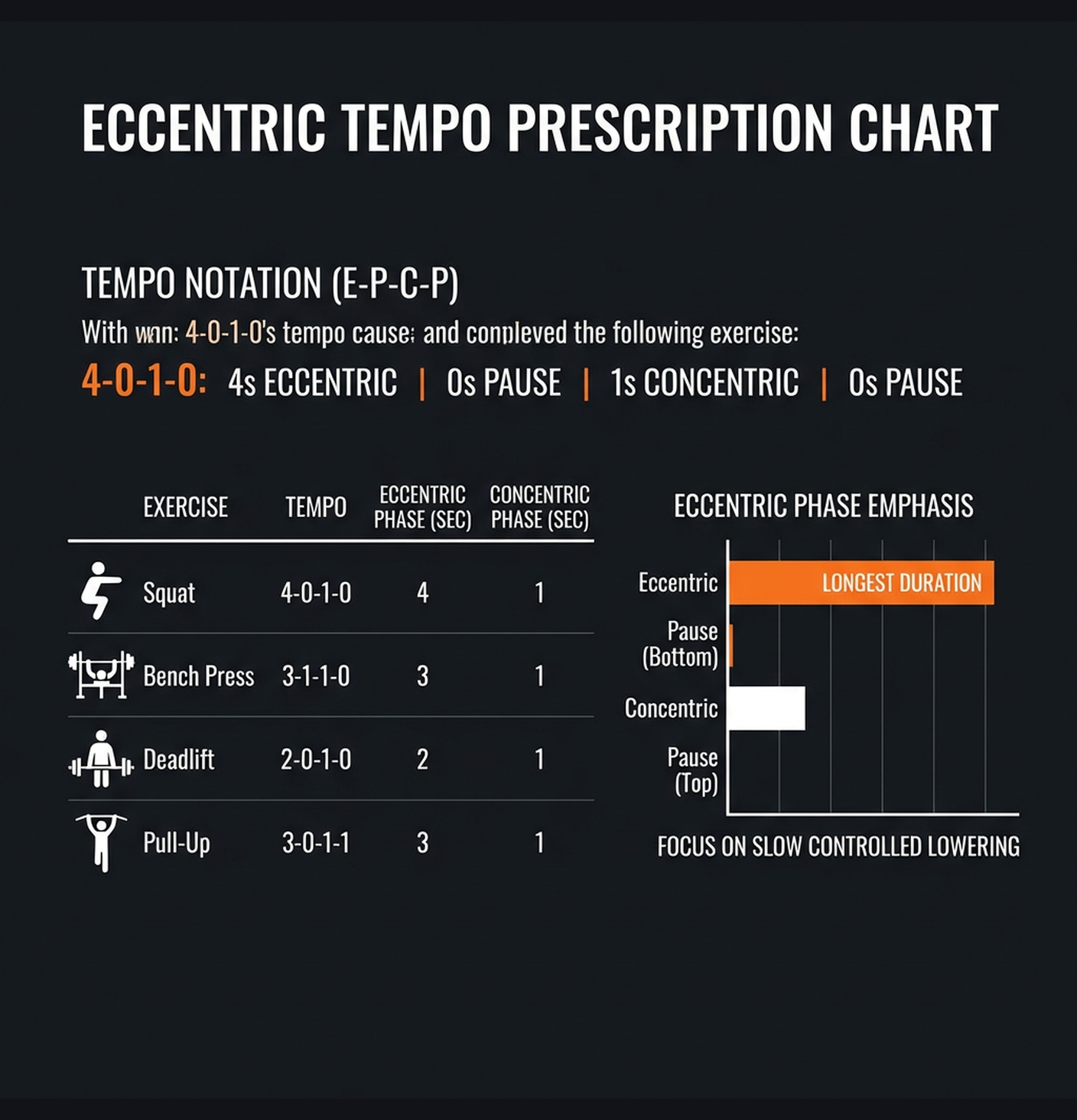
Methods Used
Method 1: Supramaximal Eccentrics (Requires Partner)
Load 105-120% of your 1RM. Your partner helps you through the concentric. You lower the weight alone with a 4-5 second negative. Partner assists the next concentric.
Method 2: Two-Up, One-Down (Solo)
Lift with both limbs, lower with one. Works for leg press, leg curl, dumbbell exercises. Doubles the eccentric load on each limb.
Method 3: Slow Eccentrics (Solo)
Use your normal working weight but lower for 5-6 seconds. Fewer reps per set, dramatically increased time under tension.
Day 1: Lower Body Eccentric Focus
Eccentric Primary Work
- •Barbell Back Squat (Supramaximal Eccentrics): 5x2 at 110% (3min rest, partner assists concentric)
- •Single-Leg Leg Press (Two-Up, One-Down): 3x6 per leg (2min rest)
Standard Accessories
- •Romanian Deadlift (5-second eccentrics): 3x6 (2min rest)
- •Barbell Hip Thrust: 3x8 (90s rest)
- •Leg Curl (Two-Up, One-Down): 3x6 per leg (60s rest)
- •Standing Calf Raise (5-second eccentrics): 3x8 (60s rest)
Day 2: Upper Body Eccentric Focus
Eccentric Primary Work
- •Barbell Bench Press (Supramaximal Eccentrics): 5x2 at 110% (3min rest, partner assists concentric)
- •Weighted Pull-Up (5-second eccentrics): 4x4 (2min rest)
Standard Accessories
- •Dumbbell Row: 3x8 (90s rest)
- •Dumbbell Incline Press (5-second eccentrics): 3x6 (90s rest)
- •Barbell Curl (5-second eccentrics): 3x6 (60s rest)
- •Tricep Dip (5-second eccentrics): 3x6 (60s rest)
Day 3: Lower Body Volume
Eccentric Primary Work
- •Conventional Deadlift (Supramaximal Eccentrics): 4x2 at 110% (3min rest, partner assists concentric)
Standard Accessories
- •Front Squat: 3x6 (2min rest)
- •Bulgarian Split Squat (5-second eccentrics): 3x6 per leg (90s rest)
- •Leg Extension (Two-Up, One-Down): 3x8 per leg (60s rest)
- •Nordic Hamstring Curl: 3x5 (90s rest)
- •Hanging Leg Raise: 3x12 (45s rest)
Day 4: Upper Body Volume
Eccentric Primary Work
- •Standing Overhead Press (Supramaximal Eccentrics): 4x2 at 110% (3min rest, partner assists concentric)
Standard Accessories
- •Close-Grip Bench Press (5-second eccentrics): 3x6 (2min rest)
- •Chest-Supported Row (5-second eccentrics): 3x6 (90s rest)
- •Dumbbell Lateral Raise (5-second eccentrics): 3x8 (60s rest)
- •Face Pull: 3x15 (45s rest)
- •Farmer's Walk: 3x40m (60s rest)
Weekly Schedule
- •Monday: Lower Eccentric Focus
- •Tuesday: Upper Eccentric Focus
- •Thursday: Lower Volume
- •Friday: Upper Volume
Phase 1: Weeks 1-3
Start supramaximal eccentrics at 105% of 1RM. Use 5-second eccentrics on all tempo exercises. Partner-assisted exercises limited to 2-3 reps per set to maintain control. Two-up/one-down exercises use moderate loads until the technique feels natural.
Phase 2: Weeks 4-6
Increase supramaximal loads to 110-115% of 1RM. Extend eccentrics to 6 seconds on tempo exercises. Add a rep to partner-assisted sets if control is maintained.
Recovery Considerations
Eccentric training causes significantly more muscle damage than concentric training. Expect severe delayed-onset muscle soreness (DOMS) during weeks 1-2. This is normal and will diminish as you adapt. Sleep 8+ hours. Eat at maintenance or above. Do not add extra training volume outside this program.
Safety Requirements
A competent training partner is essential for supramaximal eccentrics on squat, bench press, and deadlift. Always use a power rack with safeties set at the appropriate height. If you train alone, stick to the two-up/one-down and slow eccentric methods only. Never attempt supramaximal eccentrics on overhead press without a partner and a rack.
Eccentric overload is contraindicated if you have current tendon injuries. While eccentric training is excellent for tendon rehabilitation at appropriate loads, supramaximal eccentrics on an injured tendon can cause further damage.
Get a Free AI Coach on WhatsApp
Ask questions, get workout plans, and track your progress — all from WhatsApp.
Message Your CoachFrequently Asked Questions
- What should I know about overview?
- Your muscles are roughly 20-40% stronger during the eccentric (lowering) phase than the concentric (lifting) phase. Eccentric overload training exploits this by using supramaximal loads during the negative portion of the lift.
- What should I know about method 1: supramaximal eccentrics (requires partner)?
- Load 105-120% of your 1RM. Your partner helps you through the concentric. You lower the weight alone with a 4-5 second negative. Partner assists the next concentric.
- What should I know about method 2: two-up, one-down (solo)?
- Lift with both limbs, lower with one. Works for leg press, leg curl, dumbbell exercises. Doubles the eccentric load on each limb.
- What should I know about method 3: slow eccentrics (solo)?
- Use your normal working weight but lower for 5-6 seconds. Fewer reps per set, dramatically increased time under tension.
- What should I know about phase 1: weeks 1-3?
- Start supramaximal eccentrics at 105% of 1RM. Use 5-second eccentrics on all tempo exercises. Partner-assisted exercises limited to 2-3 reps per set to maintain control. Two-up/one-down exercises use moderate loads until the technique feels natural.