Blood Flow Restriction Training: Build Muscle With Lighter Weights
BFR training uses elastic wraps or cuffs to partially restrict blood flow during light-weight exercises, triggering muscle growth at loads as low as 20-30% of your max.
 Sam·Mar 8, 2026·8 min read
Key Takeaways
- BFR uses elastic wraps to partially restrict blood flow during light-weight exercises, triggering muscle growth at just 20-30% of your max.
- Research shows BFR produces comparable muscle growth to heavy lifting by creating metabolic stress and recruiting fast-twitch fibers at light loads.
- Use the 30/15/15/15 protocol with 30-45 seconds rest between sets, keeping wraps on for the entire sequence.
- BFR works best on isolation exercises like curls, extensions, and leg curls at the end of your regular training session.
- People with cardiovascular disease, blood clotting disorders, or those on blood thinners should avoid BFR training.
Get This on WhatsApp
Get a quick summary and link sent straight to your WhatsApp.
Send Me This ArticleWhat Is Blood Flow Restriction Training?
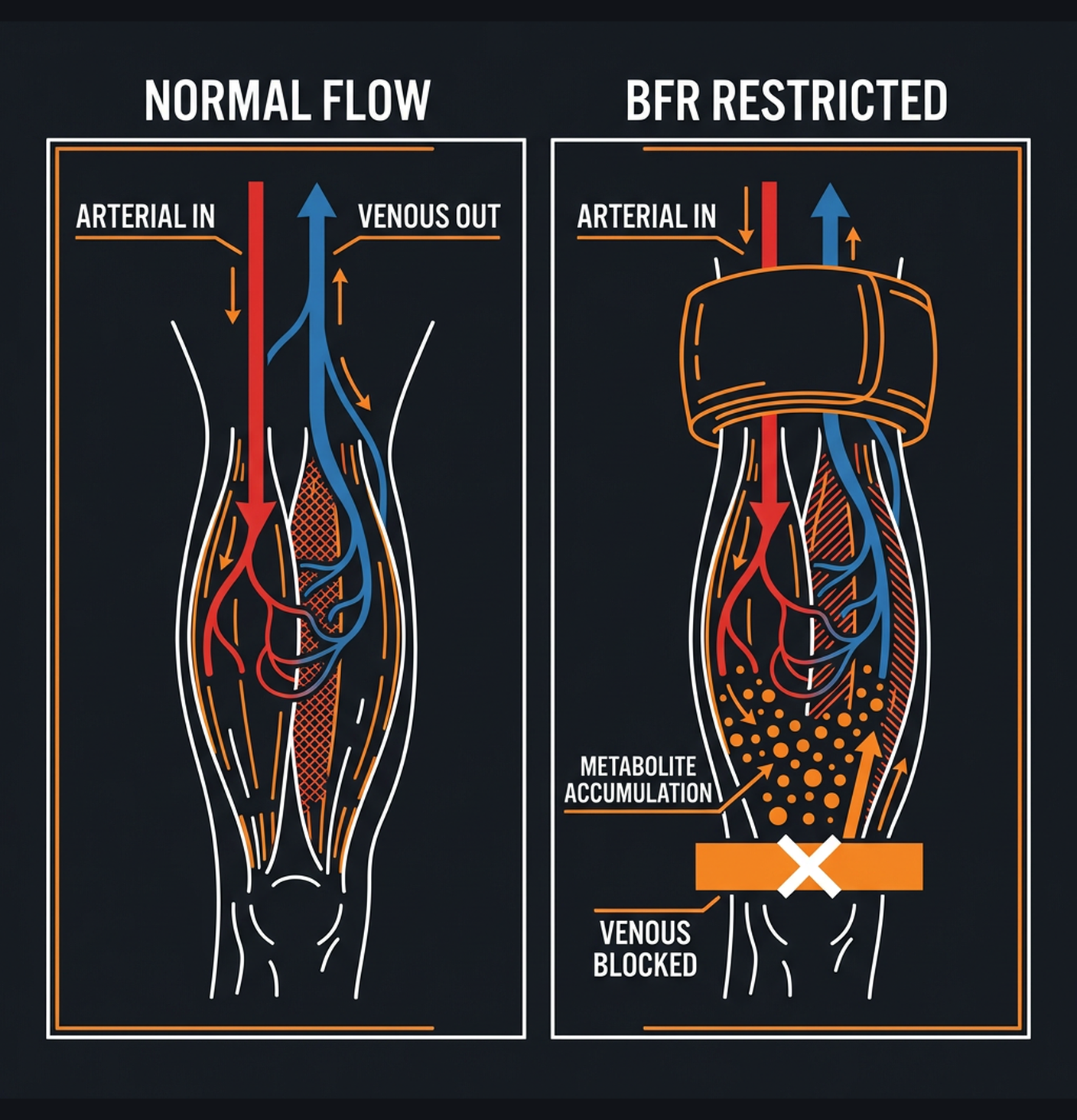
Blood flow restriction (BFR) training means wrapping an elastic band or inflatable cuff around the top of a limb -- usually your upper arm or upper thigh -- and then performing exercises with light weight. The wrap is tight enough to partially restrict venous blood flow (blood returning to the heart) while still allowing arterial blood flow (blood going to the muscle).
The result: blood pools in the working muscle, metabolic byproducts accumulate faster than normal, and your body triggers a growth response that you'd normally only get from much heavier loads.
This isn't some fringe biohacking trend. BFR has been studied extensively since the 1990s, originally developed in Japan as KAATSU training. The research base is large enough that it's now used in clinical rehabilitation, NASA astronaut training, and professional sports.
How BFR Triggers Muscle Growth
Under normal conditions, you need to lift at least 60-70% of your one-rep max to stimulate meaningful hypertrophy. Below that threshold, the mechanical tension on your muscle fibers just isn't high enough to trigger growth.
BFR changes the equation. By restricting blood flow, you create three conditions that don't normally exist at light loads:
Metabolic Stress
When blood can't escape the muscle efficiently, lactate, hydrogen ions, and other metabolites build up rapidly. This metabolic stress is one of the three primary mechanisms of hypertrophy (along with mechanical tension and muscle damage). Normally you'd need to grind through heavy sets to generate this level of metabolite accumulation. With BFR, it happens at 20-30% of your max.
Cell Swelling
The trapped blood causes the muscle cells to swell. This cellular swelling acts as a threat signal -- your cells perceive the pressure as a sign they need to reinforce their structural integrity. The downstream response includes increased protein synthesis and satellite cell activation.
Fast-Twitch Fiber Recruitment
Here's where it gets interesting. Under normal light-load conditions, your body recruits slow-twitch fibers first and barely touches the fast-twitch fibers (the ones with the most growth potential). But when BFR creates an oxygen-depleted environment, your slow-twitch fibers fatigue quickly, forcing your nervous system to recruit fast-twitch fibers much earlier than it normally would.
This is the key mechanism. You're getting fast-twitch fiber activation -- the primary driver of size and strength gains -- at loads that would normally only engage slow-twitch fibers.
What the Research Shows
The evidence for BFR is solid. Here's what the peer-reviewed literature consistently demonstrates:
- •Comparable hypertrophy to heavy lifting: A 2018 meta-analysis in the *Journal of Strength and Conditioning Research* found that BFR at 20-30% 1RM produced similar muscle growth to traditional training at 70% 1RM over 8-16 week periods
- •Strength gains (but smaller): BFR improves strength, though not as much as heavy training. If your primary goal is maximal strength, BFR is a supplement, not a replacement
- •Safe for most populations: A 2019 systematic review found no increased risk of blood clots, nerve damage, or vascular injury in healthy individuals using BFR properly
- •Effective in rehab: Multiple studies show BFR helps maintain or rebuild muscle during periods when heavy lifting isn't possible (post-surgery, joint injuries, older adults)
| Training Method | Load | Hypertrophy | Strength Gains | Joint Stress |
|---|---|---|---|---|
| Traditional | 70-85% 1RM | High | High | High |
| BFR | 20-30% 1RM | Moderate-High | Moderate | Low |
| Light Without BFR | 20-30% 1RM | Low | Low | Low |
How to Do BFR Correctly
Equipment
You have two options:
Elastic knee wraps or BFR bands: Cheap (around $15-25), portable, and effective. The downside is that pressure is inconsistent and hard to standardize. You're guessing at the tightness level.
Pneumatic BFR cuffs: More expensive ($50-200+) but let you set an exact pressure in mmHg. If you plan to use BFR regularly, these are worth the investment because consistency matters.
Where to Wrap
- •Arms: Top of the bicep, as high up into the armpit as possible. The wrap should sit on the proximal (closest to the body) part of the limb.
- •Legs: Top of the thigh, as high up into the groin as possible. Same principle -- as close to the hip joint as you can get.
Never wrap around a joint. Never wrap around your forearm, calf, or anywhere other than the top of the limb.
How Tight
This is where most people mess up. The goal is partial restriction, not a tourniquet. You want to restrict venous flow while preserving arterial flow.
On a scale of 1-10 (where 10 is cutting off all circulation):
- •Arms: wrap to about a 6-7
- •Legs: wrap to about a 7-8 (legs need more pressure because the tissue is thicker)
How to check: After wrapping, your limb should feel tight and you should notice increased vascularity and a "filling" sensation during exercise. Your skin should NOT turn blue or purple. You should still have a pulse below the wrap. If your hand or foot goes numb or turns white, it's way too tight. Loosen immediately.
Rep Scheme
The standard BFR protocol:
- •Set 1: 30 reps
- •Set 2: 15 reps
- •Set 3: 15 reps
- •Set 4: 15 reps
- •Rest between sets: 30-45 seconds (shorter than normal)
- •Load: 20-30% of your 1RM
The first set of 30 reps should be hard but doable. By sets 3 and 4, you'll struggle to hit 15. That's the point. If you're sailing through all four sets, increase the weight slightly (but stay under 40% of your 1RM).
Keep the wraps on for the entire sequence (all four sets). Remove them as soon as you finish the last set. Don't walk around with wraps on between exercises.
Best Exercises for BFR
BFR works best with single-joint (isolation) exercises performed at the end of a session:
Arms:
- •Bicep curls
- •Tricep pushdowns or overhead extensions
- •Hammer curls
Legs:
- •Leg extensions
- •Leg curls
- •Calf raises
- •Bodyweight squats (for rehab)
Avoid using BFR on heavy compound lifts (squats, deadlifts, bench press). The load should be light enough that you can maintain controlled form for high reps.
When BFR Makes the Most Sense
Injury Rehab
This is where BFR really shines. If you've got a knee injury, a shoulder problem, or any condition that prevents heavy loading, BFR lets you maintain or even build muscle at loads that don't stress the joint. Many physical therapists now use BFR as a standard part of post-surgical rehab protocols.
Deload Weeks
Swap your normal isolation work for BFR versions during a deload week. You reduce joint stress while still providing a hypertrophy stimulus. It's a way to keep the growth signal going without the mechanical beating.
Stubborn Body Parts
Got a lagging muscle group that won't grow no matter how hard you train it? Add 1-2 BFR sets at the end of your regular training for that muscle. The additional metabolic stress and cell swelling can break through a plateau.
Travel or Home Gym Limitations
If all you have is a set of light dumbbells or resistance bands, BFR makes them effective for building muscle. This is one of the few evidence-backed ways to get a hypertrophy stimulus from genuinely light loads.
Who Should Avoid BFR
- •People with cardiovascular disease, DVT history, or blood clotting disorders. BFR alters blood flow dynamics and is not appropriate for anyone with vascular health concerns.
- •Pregnant women. Not enough research to establish safety.
- •Anyone with open wounds, skin infections, or rashes on the limb being wrapped.
- •People taking blood thinners. Consult your doctor first.
- •Varicose veins in the area being wrapped. Can worsen the condition.
If you're healthy, BFR is well-established as safe. But if you have any of the conditions above, skip it and stick to traditional training.
Programming BFR Into Your Routine
BFR is not a replacement for heavy training. It's an add-on. Here's how to integrate it:
Sample Week (Upper/Lower Split)
Upper Body Day:
- •Bench Press: 4x8 at 75% (normal)
- •Barbell Row: 4x8 at 75% (normal)
- •Seated DB Shoulder Press: 3x10 (normal)
- •Bicep Curls with BFR: 30/15/15/15 at 25%
- •Tricep Pushdowns with BFR: 30/15/15/15 at 25%
Lower Body Day:
- •Barbell Back Squat: 4x6 at 80% (normal)
- •Romanian Deadlift: 4x8 at 70% (normal)
- •Bulgarian Split Squat: 3x10 each (normal)
- •Leg Extensions with BFR: 30/15/15/15 at 25%
- •Leg Curls with BFR: 30/15/15/15 at 25%
You do your heavy compound work first, then finish with 1-2 BFR exercises for the muscles you want to grow. Total added time: about 8-10 minutes.
The Bottom Line
BFR is one of the few training methods with a strong evidence base that actually lives up to the hype. It's not magic, and it won't replace heavy barbell work for building maximal strength. But for hypertrophy, rehab, and making light weights more effective, it's a legitimate tool.
Get some wraps or cuffs, start conservative with the pressure, follow the 30/15/15/15 protocol, and add it to the end of your regular sessions. After a few weeks, you'll feel the difference -- and eventually see it.
Frequently Asked Questions
- Does BFR training actually build muscle?
- Yes. Multiple meta-analyses show that BFR at 20-30% of your one-rep max produces similar muscle growth to traditional training at 70% of your max. The restricted blood flow creates metabolic stress and recruits fast-twitch muscle fibers that light weights normally would not activate.
- How tight should BFR wraps be?
- On a scale of 1 to 10 where 10 is cutting off all circulation, aim for 6-7 on arms and 7-8 on legs. Your limb should feel tight and veins should be more visible during exercise, but your skin should never turn blue or white and you should not lose feeling in your hand or foot.
- Is blood flow restriction training safe?
- For healthy individuals, yes. A 2019 systematic review found no increased risk of blood clots, nerve damage, or vascular injury when BFR is done properly. However, people with cardiovascular disease, blood clotting disorders, or those on blood thinners should avoid BFR.
- What exercises work best with BFR?
- Single-joint isolation exercises work best: bicep curls, tricep pushdowns, leg extensions, leg curls, and calf raises. Avoid using BFR with heavy compound lifts like squats or deadlifts. The load should be light enough for controlled, high-rep sets.
- How often should I do BFR training?
- Add 1-2 BFR exercises at the end of your regular training sessions, 2-3 times per week. It is a supplement to heavy training, not a replacement. The standard protocol is 1 set of 30 reps followed by 3 sets of 15 reps with 30-45 seconds rest between sets.