What Happens When You Stop Lifting: The Science of Detraining
Missed a week? A month? Three months? Here is exactly what happens to your strength, muscle, and fitness when you stop training, and how fast you can get it all back.
 Sam·Jan 12, 2026·9 min read
Key Takeaways
- Strength drops noticeably after about 3 weeks off, but the first losses are neural -- your muscles forget the movement patterns before they actually shrink.
- Visible muscle loss takes 4-6 weeks to start, and even then you lose size much slower than you built it.
- Cardio fitness declines faster than strength; your VO2 max can drop 5-10% in just 2 weeks of inactivity.
- Maintaining with just 1-2 sessions per week at your normal intensity preserves most of your gains for months when life gets busy.
- The nuclei your muscles gained from training stick around for years, which is why it is much faster to rebuild lost muscle than to build it the first time.
Get This on WhatsApp
Get a quick summary and link sent straight to your WhatsApp.
Send Me This ArticleThe Fear Is Worse Than the Reality
Every lifter has the same nightmare. You get injured, go on vacation, get slammed at work, or life just gets in the way. You miss the gym for a week. Then two. Then a month. And the entire time, you are convinced that your muscles are evaporating, your strength is gone, and you are basically starting from zero.
Relax. The science of detraining is much more forgiving than your anxiety. Yes, you will lose some fitness if you stop training for extended periods. But the timeline is slower than you think, the losses are smaller than you fear, and the comeback is faster than starting from scratch. Much faster.
The First Week: Almost Nothing Happens
If you miss a week of training, your muscles have not noticed. Seriously.
What does happen in the first 5-7 days is a drop in muscle glycogen (the carbohydrate stored in your muscles) and water retention associated with regular training. This makes your muscles look slightly flatter and smaller. You might step on the scale and see a 2-4 lb drop. This is not muscle loss. It is water and glycogen. It comes back within days of returning to the gym.
Your strength is essentially unchanged after one week off. In fact, many lifters come back from a week off slightly stronger because they were carrying accumulated fatigue that masked their true performance. A well-timed week off (a deload) is a legitimate training strategy, not a step backward.
Weeks 2-3: Neural Efficiency Starts to Fade
After two to three weeks without training, the first real changes begin, but they are not structural -- they are neurological.
Your nervous system's ability to recruit muscle fibers efficiently starts to decline. The motor patterns you have practiced (how to fire your muscles in the right sequence for a squat, bench press, or deadlift) begin to get slightly rusty. Your coordination feels a little off. Your first few sets back will feel clumsy and awkward.
At this point, you might test your strength and find it is down 5-10%. But most of that loss is neural, not muscular. Your muscles are still there. Your brain is just not as good at using them as it was three weeks ago. This neural efficiency returns quickly once you resume training -- usually within 1-2 weeks.
Research from McMaster University showed that trained individuals who stopped training for 2 weeks experienced minimal loss in muscle mass but noticeable drops in power output. The muscle was intact; the wiring was slightly degraded.
Weeks 4-8: Muscle Loss Begins (Slowly)
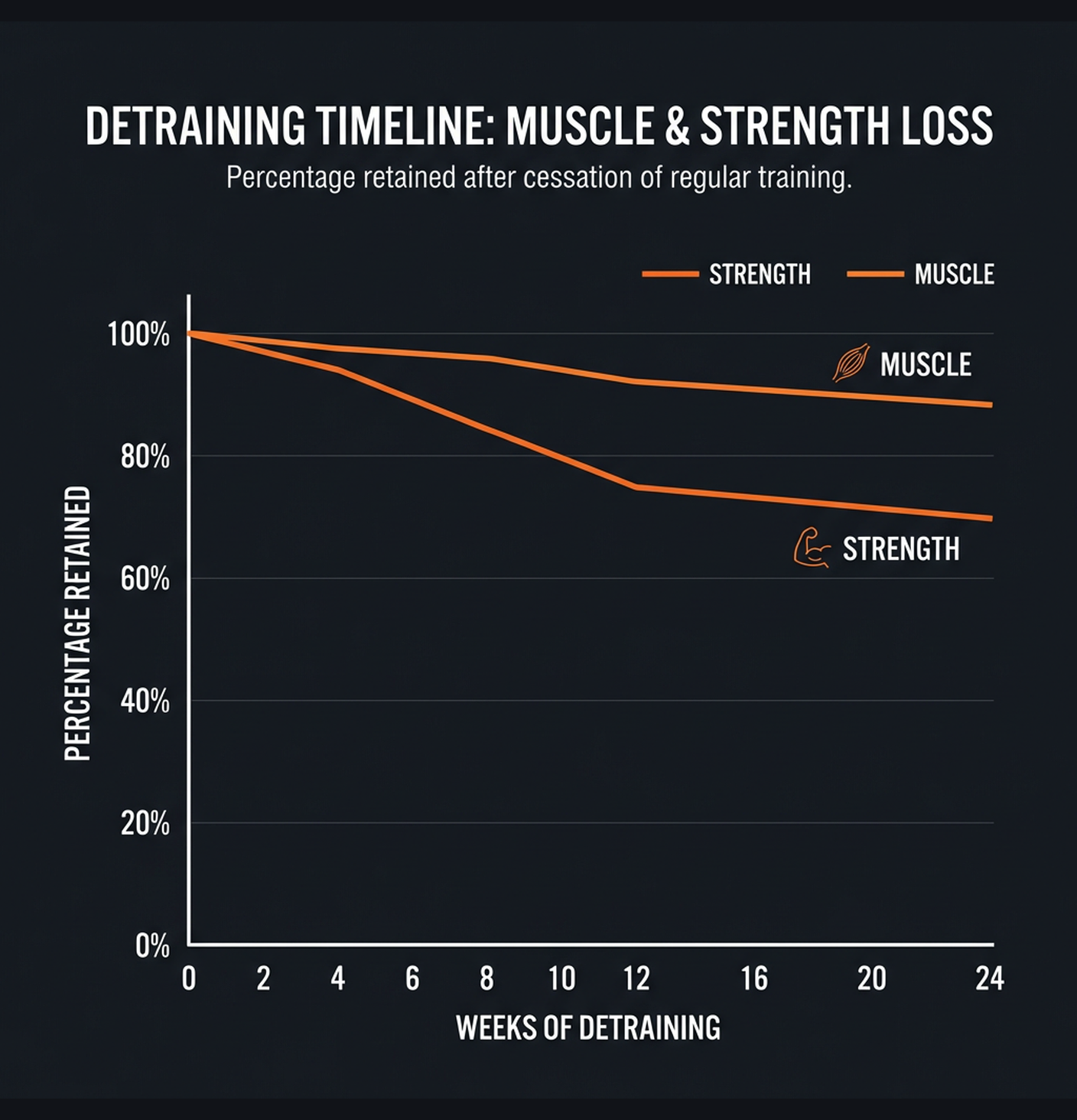
This is where actual structural changes start to occur. After about four weeks without resistance training, your body begins to reduce muscle protein synthesis and the muscle fibers themselves start to shrink. But "start" is the key word. The rate of muscle loss in this window is slow -- roughly 0.5-1% of muscle mass per week for a trained individual.
Here is what the research shows for a trained lifter who stops completely:
| Time Off | Strength Loss | Muscle Mass Loss | Cardiovascular Fitness |
|---|---|---|---|
| 1 week | None | None (glycogen/water only) | Minimal (1-3%) |
| 2 weeks | 5-10% (neural) | Negligible | 4-6% (VO2max starts dropping) |
| 4 weeks | 10-15% | 3-5% | 8-12% |
| 8 weeks | 15-25% | 5-10% | 15-20% |
| 12+ weeks | 20-35% | 10-15% | 25%+ |
Notice the pattern: cardiovascular fitness drops first and fastest, then strength, and muscle mass is the most resilient. This makes sense from an evolutionary perspective. Maintaining muscle is metabolically expensive, so your body holds onto it as long as possible. Cardiovascular fitness, which is largely a function of heart and lung adaptations, starts reverting more quickly because those systems adapt rapidly in both directions.
What Goes First
The order in which you lose fitness components is consistent and well-documented:
1. Cardiovascular Endurance (Goes First)
Your VO2max starts declining within 1-2 weeks of stopping all exercise. After a month off, you might find yourself winded going up stairs or doing an activity that used to feel easy. The heart is a muscle that responds to training stimulus, and without it, stroke volume decreases and your resting heart rate rises.
If you do any form of activity during your break -- walking, hiking, playing sports, even just being active -- the cardiovascular decline slows significantly.
2. Strength and Power (Goes Second)
Strength holds up surprisingly well for 2-3 weeks, then starts a gradual decline. Power and explosive strength tend to drop slightly faster than maximal strength because they depend more heavily on neural factors.
After 8 weeks off, a trained lifter might have lost 15-25% of their maximal strength. A 400 lb squatter might squat 300-340 lbs their first week back. That stings, but it is not starting over.
3. Muscle Mass (Goes Last)
Muscle is the last to go and the easiest to get back. After 8 weeks of complete inactivity, a trained lifter might have lost 5-10% of their muscle mass. That is noticeable but far from catastrophic. And thanks to muscle memory (which we will get to), it comes back much faster than it originally took to build.
Factors That Slow Muscle Loss
Not all detraining situations are equal. Several factors determine how fast you lose muscle:
Training history. The longer you have trained, the slower you lose muscle. A lifter with 5+ years of consistent training has built a much more robust muscular system than someone who has been training for 6 months. Experienced lifters retain muscle better and longer during breaks.
Protein intake. Maintaining a high protein intake (0.7-1g per pound of bodyweight) during time off dramatically slows muscle loss. Your muscles need amino acids for maintenance, even without the training stimulus. Eating enough protein is the single most impactful thing you can do during a forced break.
General activity level. Being sedentary accelerates loss. Staying generally active (walking, recreational sports, manual labor) provides enough stimulus to slow down both strength and muscle loss significantly. You do not need to be in the gym to send a "keep the muscle" signal to your body.
Age. Older adults lose muscle faster during detraining than younger adults, likely due to lower baseline rates of muscle protein synthesis. This makes staying active and maintaining protein intake even more important as you age.
Sleep and stress. Poor sleep and high stress increase cortisol, which accelerates muscle breakdown. If your training break is due to a stressful life event, the muscle loss may be slightly faster than if you are on a relaxing vacation.
How Fast You Regain Everything
Here is the part that should calm your anxiety: regaining lost fitness is dramatically faster than building it the first time.
If it took you 2 years to build your current physique and strength, and you take 2 months completely off, you will not need another 2 years to get back. Most lifters can regain their previous levels within 4-8 weeks of consistent training after a 2-month break. Strength often comes back in 2-4 weeks because the neural component recovers quickly.
The science behind this is the myonuclear domain theory. When your muscles grow, they acquire extra nuclei from satellite cells. These nuclei remain in the muscle fibers even after the fibers shrink from disuse. When you resume training, those extra nuclei allow the muscle to rebuild protein faster than someone building from scratch. It is like your muscles kept the blueprints even after the building shrank.
Research by Bruusgaard et al. demonstrated that myonuclei persist for extended periods, possibly permanently. This is why someone who was muscular in their 20s can regain significant muscle mass in their 40s or 50s much faster than someone who never trained.
Practical Advice for Planned Breaks
Sometimes you know the break is coming. Vacation, surgery, a busy season at work. Here is how to minimize losses:
Before the break:
- •Do not try to "store up" training by crushing yourself the week before. This just leaves you fatigued and potentially injured.
- •Maintain your normal training right up until the break starts.
During the break:
- •Keep protein high. This is non-negotiable if you care about maintaining muscle.
- •Stay active in any way you can. Walk, hike, do bodyweight exercises, swim, play with your kids. Any muscle contraction slows detraining.
- •If you can do even 1-2 abbreviated training sessions per week (20-30 minutes of compound movements), you can maintain almost all of your strength and muscle for months. Research shows that maintenance requires far less volume than building -- as little as one-third of your normal training volume can preserve gains.
- •Sleep well. Your body maintains muscle better when it is well-rested.
Coming back:
- •Start at 50-60% of your previous working weights, regardless of how strong you feel.
- •Spend 1-2 weeks at reduced volume and intensity to let your connective tissue readapt. Your muscles bounce back faster than your tendons and ligaments. Rushing back at full intensity is how you get injured.
- •Add 5-10% per week until you are back to your previous weights. Most lifters are back to normal within 4-6 weeks.
- •Expect soreness. Your muscles have lost some of their conditioning for eccentric damage. The first two weeks will probably leave you more sore than you have been in a while. This passes quickly.
The Detraining Timeline at a Glance
| Component | When It Starts Dropping | Rate of Loss | Time to Regain |
|---|---|---|---|
| Glycogen/water | Day 3-5 | Fast, but not real loss | 2-3 days |
| Neural efficiency | Week 2-3 | Moderate | 1-2 weeks |
| Cardiovascular fitness | Week 1-2 | Fast (3-5% per week) | 4-6 weeks |
| Maximal strength | Week 3-4 | Moderate (2-3% per week) | 2-4 weeks |
| Muscle mass | Week 4-6 | Slow (0.5-1% per week) | 4-8 weeks |
The Bottom Line
Missing time in the gym is not the disaster your brain tells you it is. One week off changes nothing. Two weeks off costs you some neural sharpness that comes back in days. Even a month or two off only sets you back to a point you can return to in a fraction of the time it originally took.
The worst thing you can do during a training break is stress about losing your gains, because the stress itself is worse for your muscles than the missed workouts. Eat your protein, stay active, sleep well, and when you get back to the gym, trust the process. Your body remembers what it built. It will build it again.
Frequently Asked Questions
- How quickly do you lose muscle when you stop training?
- Visible muscle size starts declining around 3-4 weeks of complete inactivity. However, much of the early shrinkage is from lost glycogen and water stored in muscle, not actual tissue loss. True muscle protein breakdown becomes significant after about 4-6 weeks off.
- How fast does strength decline when you stop lifting?
- Strength holds up longer than you might expect. Most people retain the majority of their strength for 2-3 weeks of no training. After that, neural adaptations fade and you start losing about 5-10 percent of your strength per week. The more training experience you have, the slower the decline.
- Does cardio fitness decline faster than strength?
- Yes, significantly. VO2 max can drop 5-10 percent within 2 weeks of no cardio. Strength and muscle hang around much longer because the structural adaptations in muscle tissue are more durable than the cardiovascular ones. This is why returning to cardio after a break feels brutal.
- How much training do I need to maintain my gains?
- Research shows you can maintain most of your muscle and strength with as little as one-third of your normal training volume, as long as intensity stays high. Two hard sessions per week with compound lifts at near-normal weights can preserve months of progress during a busy period.
- Do you lose gains faster if you are a beginner?
- Beginners actually retain gains relatively well during short breaks because much of their early progress is neurological. However, they also have less total muscle to buffer losses over longer periods. Experienced lifters lose absolute strength slower but have more to lose overall.