Muscle Memory Is Real: Why Your Gains Come Back Faster the Second Time
Took time off and worried about losing everything? The science of myonuclear domain theory explains why previously trained muscle regains size and strength far faster than building it from scratch.
 Sam·Feb 10, 2026·9 min read
Key Takeaways
- When you build muscle, your muscle fibers gain new nuclei through satellite cell fusion -- and those nuclei persist for years even after the muscle shrinks.
- These extra nuclei are like a biological blueprint that lets your muscles ramp up protein synthesis much faster when you start training again.
- Most people who return to lifting after a long break regain their previous muscle size in roughly half the time it originally took to build.
- Strength comes back even faster than size because the neural pathways for familiar movement patterns reactivate within the first few sessions.
- This is why taking a break from lifting is not the end of the world -- your body remembers, and the comeback is always faster than the initial build.
Get This on WhatsApp
Get a quick summary and link sent straight to your WhatsApp.
Send Me This ArticleYour Muscles Remember More Than You Think
You spent two years building a solid physique. Then life happened. An injury, a new job, a move across the country, a newborn -- whatever it was, you stopped training for months. Maybe longer. And now you are looking in the mirror at a smaller, softer version of yourself, convinced you are starting from zero.
You are not. Not even close.
Your muscles remember everything you built. Not in some vague motivational-poster sense, but in a literal, biological, cellular sense. The muscle fibers you built left behind a permanent record that makes rebuilding dramatically faster than the original construction.
This is muscle memory. And the science behind it is one of the most encouraging findings in exercise physiology.
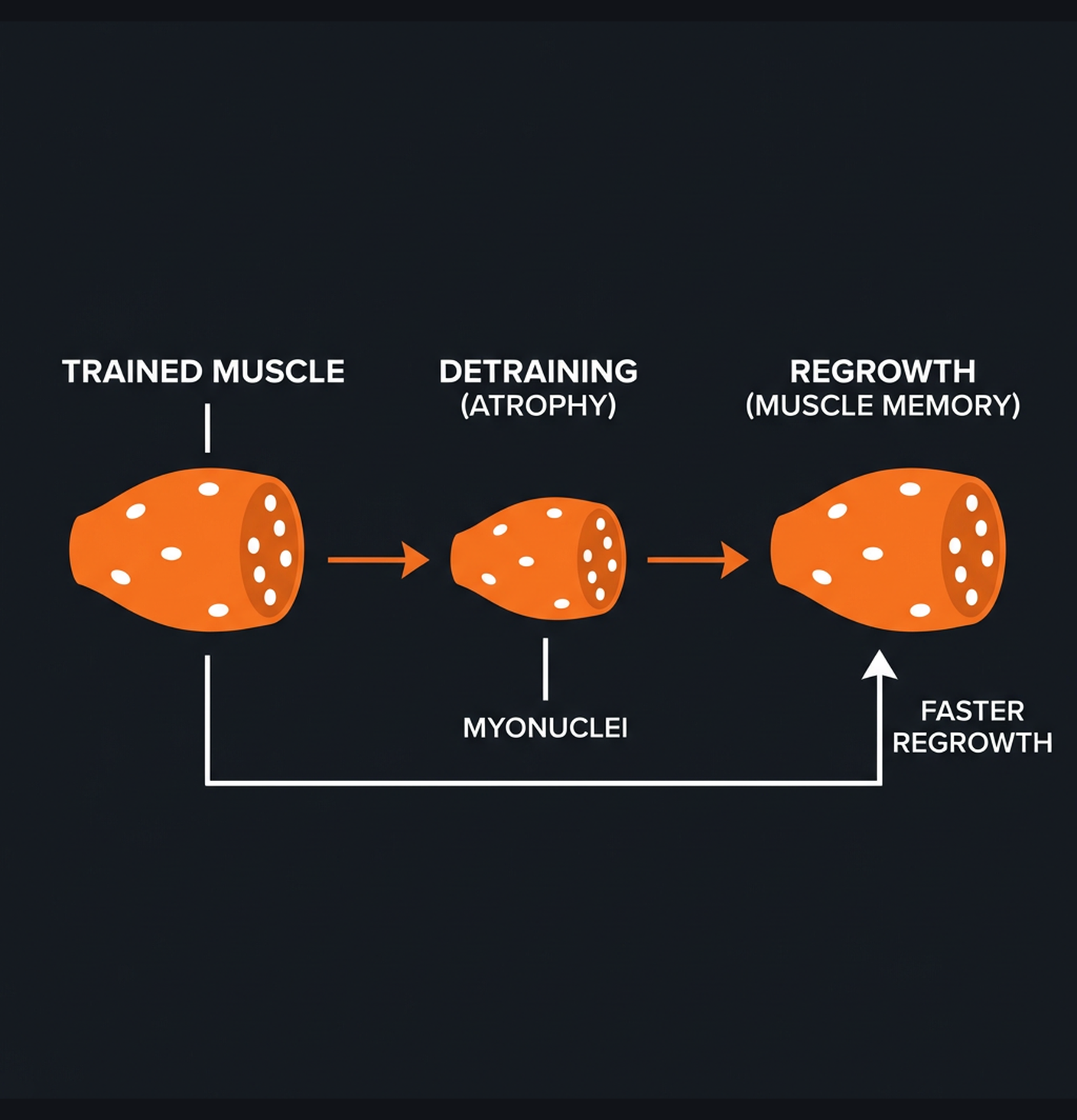
The Myonuclei Theory
To understand muscle memory, you need to understand one thing about muscle cells: they are weird.
Most cells in your body have one nucleus -- the control center that contains your DNA and directs all cellular activity. Muscle fibers are different. They are massive cells (comparatively speaking), and one nucleus cannot manage all the protein synthesis and cellular activity required across such a large cell. So muscle fibers are multinucleated -- they have many nuclei spread along their length.
When you train and your muscles grow, the fibers need more nuclei to manage the increased cell volume. They get these extra nuclei from satellite cells -- stem cells that sit on the outside of muscle fibers, waiting to be activated. Resistance training activates satellite cells, which donate their nuclei to the growing muscle fiber.
Here is the critical part: when you stop training and your muscles shrink, the nuclei stay.
The fibers get smaller. The protein content decreases. The muscle looks and measures smaller. But the extra nuclei that were added during training remain embedded in the muscle fiber. They do not leave. They do not die off (at least not for a very long time). They just sit there, waiting.
What the Research Shows
The landmark research on this topic comes from Kristian Gundersen's lab at the University of Oslo. In 2010, Bruusgaard, Johansen, and Gundersen published a study that fundamentally changed how we think about muscle loss and regain.
Using animal models, they showed that myonuclei acquired during a period of muscle overload persisted even after the muscle had completely atrophied back to its original size. When those atrophied muscles were stimulated again, they regrew faster than muscles that had never been enlarged in the first place.
The timeline was striking. Muscles that had been previously trained regrew in about one-third the time it took to build them originally. The extra nuclei served as a "head start" for protein synthesis -- more nuclei meant more sites for producing the proteins needed for muscle growth.
Follow-up studies in humans have largely confirmed these findings:
- •A 2018 study by Seaborne et al. found epigenetic markers in human muscle tissue that persisted after detraining, suggesting a form of molecular "memory" that primes the muscle for faster regrowth.
- •Multiple studies have demonstrated that previously trained individuals regain both muscle mass and strength faster than untrained individuals gain them initially, even when the detraining period is many months long.
- •Research from Staron et al. showed that muscle fiber type shifts from training (increased Type IIa fibers) partially reversed during detraining but quickly re-shifted when training resumed, faster than in novice trainees.
How This Works in Practice
Let us say it takes you 18 months of consistent training to add 15 pounds of lean muscle mass. During those 18 months, your muscles acquired a significant number of new myonuclei. You got stronger, bigger, and your muscles adapted.
Then you take 4 months completely off. No training at all. You lose maybe 5-8 pounds of that muscle (remember, muscle mass is the slowest component to decline during detraining). Your strength drops 15-25%.
When you return to training, here is what happens:
Weeks 1-2: Your neural efficiency returns rapidly. Strength jumps 10-15% in the first couple weeks just from your nervous system remembering how to recruit muscle fibers effectively. The movements feel "right" again.
Weeks 2-4: Muscle protein synthesis ramps up faster than it did when you were a beginner. Those extra myonuclei that stuck around are already in place, ready to drive protein production. Your muscles start refilling with protein and glycogen. You might notice size returning visibly by week 3-4.
Weeks 4-8: Most of your lost muscle mass is regained. You are approaching your previous working weights in the gym. Your clothes fit the way they used to.
Weeks 8-12: You are back to where you were, or very close to it. What originally took 18 months to build was rebuilt in 2-3 months.
This is not hype. This is the documented experience of thousands of lifters and the prediction of the myonuclear domain theory.
Does It Work After Very Long Breaks?
This is the question everyone wants answered: what if you have not trained in years, not months?
The honest answer is that we do not have long-term human studies that track myonuclei over decades. The animal research suggests that myonuclei persist for very long periods, possibly permanently. Gundersen's work showed no significant loss of myonuclei even after extended periods of detraining in animal models.
Anecdotal evidence from the lifting community strongly supports long-term muscle memory. Lifters who were muscular in their 20s and return to training in their 40s or 50s consistently report regaining muscle and strength much faster than their peers who are training for the first time. Former athletes who return to strength training after years away often surprise themselves (and their training partners) with how quickly they progress.
The likely reality is that muscle memory fades gradually over very long periods. A 5-year break probably preserves a significant advantage. A 20-year break might preserve a smaller but still meaningful one. There may be some loss of myonuclei over decades, or the remaining nuclei may become less responsive with age. But the advantage does not disappear entirely.
What About Steroids and Muscle Memory?
This is worth addressing because it has real implications for competitive sport. Research by Egner et al. (2013) showed that testosterone administration increased myonuclei in mice, and those extra nuclei persisted long after the testosterone was withdrawn. When those muscles were stimulated again (without testosterone), they grew faster than muscles that had never been exposed to testosterone.
The implication is clear: athletes who used anabolic steroids at any point in their careers may retain a permanent advantage in their muscle's ability to regrow, even after they stop using steroids and even after their muscles return to a "natural" size. This has sparked debate in anti-doping circles about whether a time-based suspension is truly adequate for athletes caught using performance-enhancing drugs.
For the natural lifter, the takeaway is simpler: every year of training you do, even if you eventually take time off, deposits a permanent investment in your muscle cells.
Why This Matters for Your Training Life
The muscle memory research has several practical implications that should change how you think about training:
Consistency Over a Lifetime Matters More Than Any Single Block
Ten years of on-and-off training beats 3 years of perfect training followed by quitting forever. Every training period adds myonuclei. Every return from a break builds on the foundation laid before. The lifter who trains for a year, takes 6 months off, trains for another year, takes 3 months off, and keeps repeating this pattern is still building a larger and larger foundation with each cycle.
Training Breaks Are Not Catastrophic
Stop feeling guilty about time off. If you need a break for mental health, injury recovery, family obligations, or any other reason, take it. Your muscles will remember what they built. The anxiety about "losing everything" is far worse than the actual physiological consequence of a training break.
Starting (or Restarting) Is Always Worth It
If you trained seriously 5, 10, or even 15 years ago, your body still has a head start. Walking into the gym at age 45 after last lifting at age 25 is not the same as a complete beginner at 45. Your muscles retained nuclei from those younger years. You will progress faster than you expect.
Youth Training Pays Dividends
For younger lifters, the implication is exciting. The muscle you build in your teens and 20s creates a foundation that serves you for life. Even if you cannot maintain that level of training forever, the myonuclei you accumulate now are a gift to your future self.
The Practical Comeback Plan
If you are returning to training after an extended break and want to take advantage of muscle memory:
- •Start conservatively. Use 50-60% of your previous working weights for the first 2 weeks. Your muscles can handle more than your tendons and ligaments, which do not have the same "memory" effect. Connective tissue needs time to readapt.
- •Prioritize the basics. Compound movements (squat, bench, deadlift, rows, press) will stimulate the most muscle mass and take advantage of the most myonuclei. Do not get cute with exercise selection. Hit the big movements and let muscle memory do its thing.
- •Eat enough protein. Your muscles are primed to regrow, but they need the raw materials. Aim for 0.8-1g of protein per pound of bodyweight. This is even more important during the regaining phase because protein synthesis rates are elevated.
- •Progress weekly. Unlike a true beginner who might need to be patient with progression, a returning lifter can often add weight to the bar every week for the first 6-8 weeks. Your muscles have the infrastructure for rapid growth -- you just need to provide the stimulus and the fuel.
- •Do not compare yourself to your peak. You will get back there. But comparing your week-2 numbers to your previous best will just frustrate you. Track your progress from your restart point and watch how fast the line goes up.
The Bottom Line
Muscle memory is not a myth or a feel-good story. It is a documented biological phenomenon backed by rigorous research. Your muscles keep the extra nuclei they gained from training, even after significant atrophy. Those nuclei allow faster regrowth when you resume training.
Every training session you do is an investment that pays dividends for years, possibly for life. If you have taken time off, stop worrying about what you lost. Start thinking about how fast you are going to get it back. Because with muscle memory on your side, the answer is: faster than you think.
Frequently Asked Questions
- What is muscle memory and is it actually real?
- Muscle memory is real and backed by research. When you build muscle, your body adds new nuclei to muscle fibers, and these nuclei stick around even after the muscle shrinks from detraining. When you start training again, those extra nuclei let you rebuild muscle faster than the first time.
- How long does muscle memory last?
- Current research suggests the extra myonuclei can persist for at least 15 years, and possibly much longer. This means that even after years away from the gym, your body remembers its previous muscular state at a cellular level and can rebuild faster than someone starting from scratch.
- How fast can you regain lost muscle?
- Most people can regain previously held muscle in roughly half the time it originally took to build. If it took you a year to build a certain amount of muscle, expect to get it back in about 4-6 months with consistent training. The more muscle you had before, the more dramatic the comeback.
- Does muscle memory work for strength too?
- Yes, but through a different mechanism. Strength returns quickly because the neural pathways for motor patterns are well-established from prior training. Your nervous system remembers how to recruit muscle fibers efficiently, so your coordination and force production come back fast even before the muscle fully rebuilds.
- Should I train differently when trying to regain lost muscle?
- Not drastically. Go back to your normal training program but start with lighter weights for the first 2-3 weeks to let your connective tissues readapt. Your muscles will be ready before your tendons and ligaments are. Ramp up intensity over a month and you will be back to normal without getting hurt.