Minimum Effective Dose: How Little Can You Train and Still Progress?
Life gets busy. The question is not whether you can train less, but how little you can train and still make progress. The answer is less than you think.
 Jeff·Feb 25, 2026·8 min read
Key Takeaways
- Research shows you can maintain muscle with as few as 2 sessions per week if intensity stays high enough.
- For beginners, just 4-6 hard sets per muscle group per week is enough to drive meaningful growth.
- Training frequency matters less than total weekly volume -- 2 full-body sessions can match 4 split sessions if the sets are equivalent.
- During busy seasons of life, a maintenance program of 2 days per week preserves 90% of your strength for months.
- The minimum effective dose for strength is about 1-2 heavy sets per movement pattern per week, but more is better when you have the time.
Get This on WhatsApp
Get a quick summary and link sent straight to your WhatsApp.
Send Me This ArticleThe Concept of Minimum Effective Dose
The minimum effective dose (MED) is the smallest amount of stimulus needed to produce a desired outcome. In medicine, it is the lowest drug dose that works. In training, it is the least amount of work you can do and still get stronger, build muscle, or at minimum, keep what you have.
This is not about being lazy. It is about being realistic. Life has seasons. Work deadlines, new babies, travel schedules, injuries, illness, and just general life chaos will all, at some point, make your normal training volume impossible. When that happens, you have two options: try to maintain your full program and fail (leading to inconsistency and frustration), or intentionally reduce to the minimum effective dose and keep progressing.
The research on this is surprisingly encouraging. You need far less training than you think to maintain muscle and strength, and the minimum dose for actual progress is lower than most programs suggest.
Muscle Maintenance: Shockingly Little Is Needed
Here is the most liberating finding in exercise science: maintaining existing muscle mass requires a fraction of the volume it took to build it.
A 2011 study by Bickel et al. published in *Medicine and Science in Sports and Exercise* found that trained individuals could maintain strength and muscle size for up to 32 weeks with just one-third of their original training volume -- as long as intensity (weight on the bar) stayed the same.
Let that sink in. If you built your muscle doing 15 sets per muscle group per week, you can maintain it with as few as 5 sets per muscle group per week. For months.
The key insight: volume can drop dramatically, but intensity must stay high. If you were squatting 275 for sets of 5, you need to keep squatting around 275. You just do not need to do as many sets. Dropping to 135 "to stay active" is not enough stimulus to maintain the adaptations you built with heavier loads.
Other research confirms the pattern:
- •Trainees maintained leg muscle thickness for 8 weeks with just 2 sets of leg work per session, twice per week (Tavares et al., 2017)
- •Strength was preserved for 12 weeks with reduced training volume in competitive athletes (Ronnested et al., 2011)
- •Even elderly populations maintained strength gains for 8 months with a single weekly session (Bickel et al., 2011)
Muscle Growth: The Minimum Volume Threshold
Maintaining muscle is one thing. Actually building new muscle with minimal volume is a different question. The research points to a rough minimum:
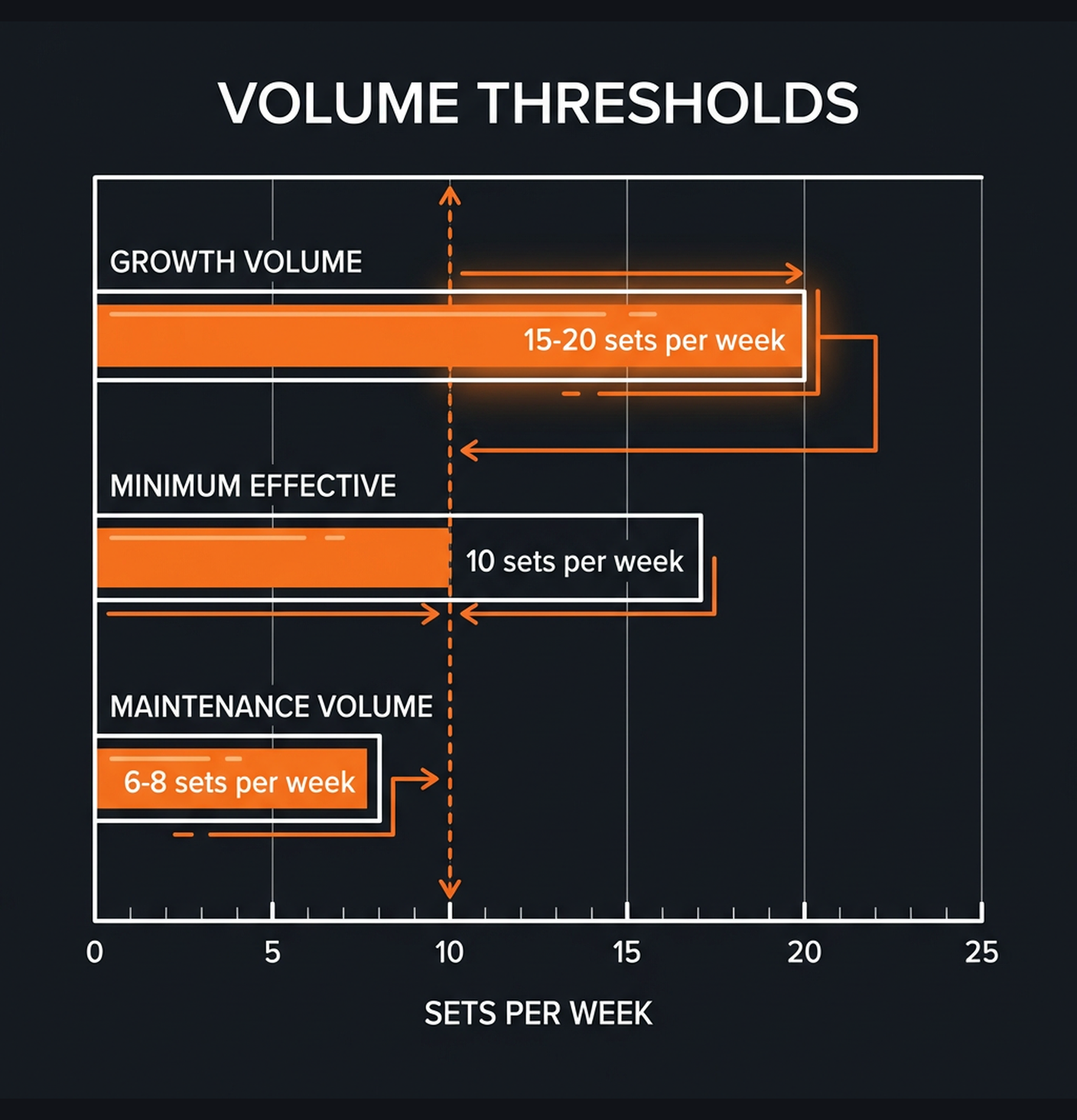
Around 10 hard sets per muscle group per week is the lower threshold for growth in most trained lifters.
A 2017 meta-analysis by Schoenfeld et al. found a dose-response relationship between weekly sets and hypertrophy, with 10+ sets per muscle group per week producing significantly more growth than 5 or fewer sets. But the key word is "hard" sets -- sets taken close to failure (within 1-3 reps).
If you are doing 10 truly challenging sets per muscle group per week, you are probably growing. Not as fast as someone doing 15-20 sets, but you are not spinning your wheels.
For a time-crunched lifter, this means:
| Muscle Group | Minimum Sets for Growth | Minimum Sets for Maintenance |
|---|---|---|
| Quads | 8-10/week | 3-4/week |
| Hamstrings | 6-8/week | 2-3/week |
| Chest | 8-10/week | 3-4/week |
| Back | 8-10/week | 3-4/week |
| Shoulders | 6-8/week | 2-3/week |
| Biceps | 4-6/week | 2/week |
| Triceps | 4-6/week | 2/week |
Note: compound lifts count for multiple muscle groups. A set of squats counts for quads, glutes, and to some extent hamstrings and core. A set of bench press counts for chest, shoulders, and triceps. This is how minimal programs can cover a lot of ground with few exercises.
Frequency: How Often Do You Need to Train?
The research consistently shows that training each muscle group at least twice per week is better for hypertrophy than once per week, assuming the same total volume. But what about the minimum?
Twice per week per muscle group is the sweet spot. This allows you to split your weekly volume across two sessions, which means better performance per session and a more frequent growth signal.
Once per week still works. It is not optimal, but if once per week is all you can manage, you will maintain and can even grow -- especially if you are relatively untrained or coming back from a layoff. A single hard session per muscle group per week is infinitely better than zero sessions.
The total weekly volume matters more than how you split it. 10 sets of chest per week spread across 2 sessions (5 sets each) or 3 sessions (3-4 sets each) produces similar results. Pick whatever frequency fits your schedule.
The Two-Session Full-Body Template
If you can only train twice per week, here is a template that covers all major muscle groups at or near the minimum effective dose for growth:
Session A
| Exercise | Sets x Reps | Muscles Worked |
|---|---|---|
| Barbell Squat | 3x6-8 | Quads, glutes, core |
| Bench Press | 3x6-8 | Chest, shoulders, triceps |
| Barbell Row | 3x8-10 | Back, biceps, rear delts |
| Romanian Deadlift | 2x8-10 | Hamstrings, glutes, lower back |
| Lateral Raise | 2x12-15 | Side delts |
Session B
| Exercise | Sets x Reps | Muscles Worked |
|---|---|---|
| Deadlift | 3x5 | Hamstrings, glutes, back, core |
| Overhead Press | 3x6-8 | Shoulders, triceps |
| Chin-ups or Lat Pulldown | 3x8-10 | Back, biceps |
| Leg Press or Bulgarian Split Squat | 2x10-12 | Quads, glutes |
| Dumbbell Curl | 2x10-12 | Biceps |
Total sets per session: 13. Total time per session: about 45-55 minutes including warm-up. Total sessions per week: 2.
This gives you roughly 5-6 sets per week for each major muscle group, which is enough to grow (especially for less advanced lifters) and more than enough to maintain for anyone.
Maintenance Mode During Busy Periods
Sometimes even two sessions per week is not feasible. New baby. Work crisis. Traveling for three weeks. When life goes sideways, here is how to enter maintenance mode without losing your hard-earned progress:
The rules of maintenance mode:
- •Keep intensity high. Whatever you can do, keep the weight heavy (relative to your capacity). One set of 5 at 80% is worth more for maintenance than three sets of 15 at 40%.
- •Drop volume aggressively. Cut your normal volume to one-third. If you normally do 15 sets per muscle group per week, do 5.
- •Prioritize compound lifts. When time is scarce, every exercise needs to hit multiple muscle groups. Squat, hinge, push, pull. Skip the isolation work.
- •Accept that maintenance is the goal. You are not going to set PRs during a maintenance phase, and that is fine. The goal is to preserve muscle and strength so you can pick up where you left off when life normalizes.
A true minimum maintenance session could look like this:
- •Squat: 2x5
- •Bench Press: 2x5
- •Barbell Row: 2x5
- •Romanian Deadlift: 2x8
Eight total sets. About 25 minutes. Done once or twice per week. This is enough to maintain nearly all of your strength and muscle mass for 2-3 months.
Research on Reduced Volume Maintaining Strength
The evidence is clear that reduced training preserves gains far better than most lifters expect:
- •Bickel et al. (2011): Trained subjects maintained strength for 32 weeks on one-third of their original volume.
- •Tavares et al. (2017): Two sessions per week with minimal volume maintained muscle thickness for 8 weeks.
- •Trappe et al. (2002): Runners maintained VO2max for 15 weeks on reduced training, and the principle applies across modalities.
- •Ogasawara et al. (2013): Periodic training (6 weeks on, 3 weeks off) produced similar long-term muscle gains to continuous training over 24 weeks.
That last study is especially interesting. Taking 3 weeks completely off did not permanently hurt muscle growth. The subjects caught back up within a few weeks of resuming training. Your body does not forget.
When to Do the Minimum vs When to Do More
The minimum effective dose is a tool, not a lifestyle. Here is when to use it and when to do more:
Use the minimum when:
- •Life is genuinely chaotic and normal training is impossible
- •You are recovering from illness or injury and need to rebuild gradually
- •You are in a planned deload or recovery block
- •Mental burnout is making training feel like a chore
- •You are on vacation or traveling
Do more when:
- •You have the time, energy, and recovery capacity for higher volume
- •You are in a dedicated hypertrophy or strength block with specific goals
- •You are healthy, sleeping well, eating well, and motivated
- •You want to bring up a weak point that requires extra volume
The minimum effective dose gives you a floor. It tells you: "You cannot go below this and still make progress." But it does not tell you to stay at the floor. When conditions allow, train more. When they do not, know that the minimum is enough to keep you in the game.
The lifters who stay strong for decades are not the ones who train at maximum volume every week of every year. They are the ones who know how to dial it back without quitting, and dial it up when the time is right.
Frequently Asked Questions
- What is the minimum amount of training to maintain muscle?
- Research shows you can maintain existing muscle with as few as 6 sets per muscle group per week, as long as intensity stays high. That could mean two short full-body sessions. You will not grow much, but you will not lose what you have either.
- Can I build muscle training only twice a week?
- Yes, especially if you are a beginner or early intermediate. Two well-designed full-body sessions per week with sufficient intensity can produce meaningful muscle growth. It is not optimal compared to 3-4 sessions, but it absolutely works.
- How many sets per muscle group do I need to grow?
- Most research points to 10-20 sets per muscle group per week as the growth range, with diminishing returns above 20. Beginners respond well to the lower end. If you only have time for 6-8 sets per muscle group, you are still getting about 80% of the benefit.
- Will I lose muscle if I take a week off?
- No. Muscle protein turnover is slow, and detectable muscle loss does not begin until about 2-3 weeks of complete inactivity. One week off will not cost you anything measurable, and you may come back feeling stronger due to accumulated fatigue clearing out.