Pause Reps: Why Removing Momentum Builds More Muscle
A one-second pause at the bottom of each rep eliminates the stretch reflex, forces your muscles to generate force from a dead stop, and exposes every weak point you have been hiding behind momentum.
 Jeff·Jan 18, 2026·8 min read
Key Takeaways
- Pausing for 1-3 seconds at the hardest part of a lift eliminates the stretch reflex, forcing your muscles to generate force from a dead stop.
- Pause reps build more strength at your sticking point because you cannot rely on momentum to carry the bar through the weak range of motion.
- You will need to drop the weight 10-20% when adding pauses, but the increased time under tension and muscle recruitment more than make up for the lighter load.
- Pause bench press, pause squats, and tempo deadlifts are the most effective variations -- start with 2-3 second pauses and keep reps in the 3-6 range.
- Use pause reps for your first 1-2 working sets to build strength and control, then finish with touch-and-go sets to accumulate more volume.
Get This on WhatsApp
Get a quick summary and link sent straight to your WhatsApp.
Send Me This ArticleWhat Are Pause Reps
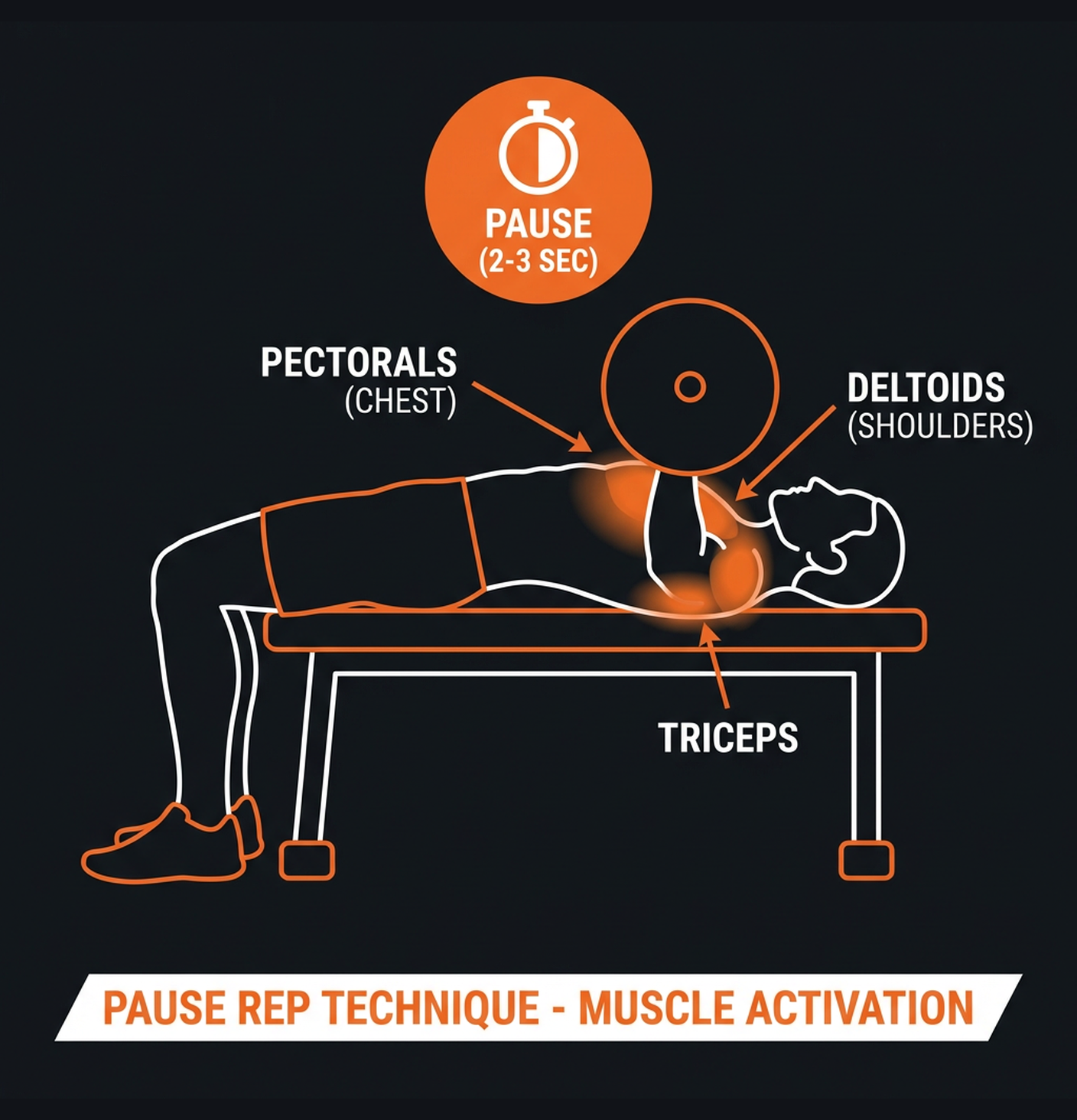
A pause rep is exactly what it sounds like: you add a deliberate pause at the most challenging point of a lift -- usually the bottom position -- before completing the rep. On a bench press, you lower the bar to your chest and hold it there for 1-3 seconds before pressing it back up. On a squat, you sit in the hole for a beat before standing.
That is it. No fancy equipment, no complicated protocols. Just a pause.
But that simple pause changes the nature of the exercise in ways that build more muscle, develop more usable strength, and expose technique flaws you did not know you had.
The Stretch Reflex: Your Secret Cheat Code
When you lower a weight and immediately reverse direction, you benefit from something called the stretch reflex (also known as the stretch-shortening cycle). As your muscles lengthen under load, your tendons store elastic energy like a rubber band being pulled. When you reverse the movement, that stored energy helps propel the weight back up.
This is free force. It is not generated by muscle contraction. It is mechanical energy stored in your connective tissue.
On a touch-and-go bench press, the stretch reflex at the bottom can contribute 10-15% of the force needed to get the bar moving. On a bounced squat where you dive into the hole and immediately rebound, it can be even more.
When you pause at the bottom, you eliminate the stretch reflex. The elastic energy dissipates within about 1-2 seconds. Now, when you press or stand, 100% of the force must come from muscular contraction. There is no assistance from stored elastic energy. Just you and the weight.
This is harder. That is the point.
Why Pause Reps Build More Muscle
Greater Muscle Activation
Without the stretch reflex to help, your muscles must recruit more motor units to move the same weight. More motor unit recruitment means more muscle fibers are stimulated, which means a stronger growth signal.
EMG studies have shown increased muscle activation during the concentric (lifting) phase of paused reps compared to touch-and-go reps at the same weight. You are doing more work with your muscles and less with your tendons.
Longer Time Under Tension
The pause adds time to each rep. A set of 8 reps with a 2-second pause adds 16 seconds of loaded time to the set compared to touch-and-go. That might not sound like much, but over the course of a workout (15-20 working sets), you are accumulating significantly more total time under tension without adding any extra sets.
Time under tension is not the only factor in muscle growth, but it contributes, especially for metabolic stress -- one of the three primary mechanisms of hypertrophy.
Honesty Check on Your Technique
Bouncing and using momentum let you hide technical flaws. That slight lean forward out of the hole on squats? The stretch reflex bails you out. That chest bounce on bench press? It launches the bar past the sticking point before you notice you are weak there.
Pause reps strip away all of that. Every technical weakness is exposed at the pause point. If your squat shifts to one side at the bottom, you will feel it during the pause. If your bench press bar path is inconsistent, the dead-stop start reveals it immediately. This forces you to develop better positions and more consistent technique.
Strength Out of the Hole
The hardest part of most lifts is the transition from lowering to lifting -- the "hole" on a squat, the chest on a bench press, the floor on a deadlift. This is where most lifters fail heavy attempts.
Pause reps train exactly this transition. By eliminating the bounce and forcing a dead-stop start, you develop specific strength in the position where you need it most. This carries over directly to max-effort lifts and competition performance.
How to Pause on Each Lift
Pause Bench Press
Lower the bar under control to your chest. Let it settle on your chest (touching, but not sinking or bouncing). Hold for 1-3 seconds. Press explosively. Keep your shoulder blades squeezed, your arch set, and your feet driving into the floor throughout the pause. Do not let your body go slack.
The temptation during the pause is to relax your upper back or lose your leg drive. Fight it. Stay tight. The pause is a moment of stillness, not relaxation.
Pause Squat
Descend to your bottom position at your normal tempo. Hold the bottom position for 1-3 seconds with your chest up, core braced, and knees tracking over your toes. Stand up explosively.
Pause squats are humbling. Weight that feels moderate for touch-and-go sets becomes genuinely challenging with a 2-second pause. Reduce your working weight by 15-20% when you first introduce them.
Pause Deadlift
Pause deadlifts can be done two ways. Paused off the floor: pull the bar 1-2 inches off the ground and hold for 1-3 seconds before completing the pull. This builds starting strength. Paused at the knee: pull to knee height, hold for 1-3 seconds, then finish the lockout. This builds positional strength and upper back endurance.
Paused deadlifts off the floor are brutally difficult. Start with 60-65% of your max and work up gradually.
Pause Rows
Lower the dumbbell or barbell to full arm extension. Pause for 1-2 seconds. Row the weight up without momentum. This eliminates the swinging and body English that most people use on rows and forces the lats and mid-back to do all the work.
If you have never paused your rows, prepare to use significantly less weight than your current "working" weight. But also prepare for your back to grow faster.
Programming Pause Reps
Pause reps are not a replacement for your normal training. They are a tool to use strategically within your programming. Here are practical approaches:
Option 1: Replace One Working Day Per Month
If you bench press twice a week, make one of those sessions a pause bench session every other week. Same sets and reps as your normal session, just reduce weight by 10-15% and add a 2-second pause.
Option 2: Use Them as a Supplemental Lift
After your main heavy sets (touch-and-go), do 2-3 sets of pause reps at a lighter weight. For example: 4 sets of 5 on barbell bench press, followed by 3 sets of 6 on pause bench press at 75% of your working weight.
Option 3: Training Block Approach
Spend 3-4 weeks doing all your main lifts with a pause. Use lighter weight and focus on position, control, and building strength out of the bottom. Then return to normal touch-and-go work. You will almost always find that your touch-and-go strength has improved because the pause work built capacity in your weakest positions.
Weight Adjustments
When adding pauses, reduce weight from your normal working loads:
| Pause Duration | Weight Reduction |
|---|---|
| 1 second | 10% lighter |
| 2 seconds | 12-15% lighter |
| 3 seconds | 15-20% lighter |
These are starting points. Adjust based on how the weight moves.
Touch-and-Go vs Paused: The Comparison
| Factor | Touch-and-Go | Paused |
|---|---|---|
| Weight used | Heavier | 10-20% lighter |
| Stretch reflex | Active (helps you) | Eliminated |
| Muscle activation | High | Higher (no elastic assistance) |
| Technique feedback | Some | Extensive (flaws exposed) |
| Sticking point strength | Moderate training effect | Direct training effect |
| Time per set | Shorter | Longer |
| Best for strength peaks | Yes (competition-specific) | Best for building strength base |
| Best for hypertrophy | Good | Often better (more activation, more time under tension) |
When NOT to Use Pause Reps
Pause reps are not appropriate for every situation:
- •When peaking for competition. In the weeks before a meet or max-out day, practice the competition movement at full speed. You need to be sharp with the stretch reflex, not train without it.
- •On high-rep pump work. Sets of 15-20 on leg extensions do not need a pause. The goal there is metabolic stress and time under tension, which constant-tension reps already provide.
- •If you cannot maintain position during the pause. If your lower back rounds during a pause squat, you are going too heavy or your positional strength is not ready for paused work. Drop the weight until you can hold a clean position.
- •Every single session. Pause reps are a tool, not a religion. Using them exclusively means you never practice with the stretch reflex, which is part of real-world and competition lifting. Mix both into your training.
The Bottom Line
Pause reps work because they remove the crutch of momentum and elastic energy. They force your muscles to do all the work, reveal your technical flaws, build strength in your weakest positions, and increase the time your muscles spend under load.
You do not need to completely overhaul your training. Just add a 1-2 second pause to a few sets per week. Use 10-15% less weight, focus on holding a perfect position during the pause, and drive out explosively. Within a few training blocks, you will notice stronger sticking points, cleaner technique, and better muscle development. The pause is a small addition with outsized returns.
Frequently Asked Questions
- What is a pause rep and how long should the pause be?
- A pause rep means holding the weight motionless at the hardest point of the lift for a set duration, usually 1-3 seconds. On bench press, you pause on your chest. On squats, you pause in the hole. The key is a dead stop with no bouncing, so you eliminate the stretch reflex that helps you reverse direction.
- How much weight should I take off for pause reps?
- Start by reducing your working weight by 10-20 percent. A 2-second pause on a squat makes 315 feel like 365, so check your ego and go lighter. As you get used to the technique, you can gradually bring the weight back up while keeping the pause honest.
- Do pause reps build more muscle than regular reps?
- Pause reps increase time under tension at the most challenging part of the range of motion, which is a strong stimulus for muscle growth. They also improve your strength out of the bottom position. You will not handle as much weight, but the quality of each rep is higher.
- Where should I add pause reps in my program?
- Use them as your main variation for 3-6 week blocks, or as a secondary movement after your regular compound lift. For example, do normal squats first, then follow up with pause squats at a lighter weight. Two to three sets of 3-5 reps with a 2-second pause is a solid starting point.
- Are pause reps good for fixing sticking points?
- They are one of the best tools for it. If you always get stuck at a specific point in the lift, pausing right at or just below that point forces your muscles to produce force without any help from momentum. A few weeks of consistent pause work at the sticking point usually makes a noticeable difference.