Dumbbell vs Barbell: When to Use Each for Maximum Growth
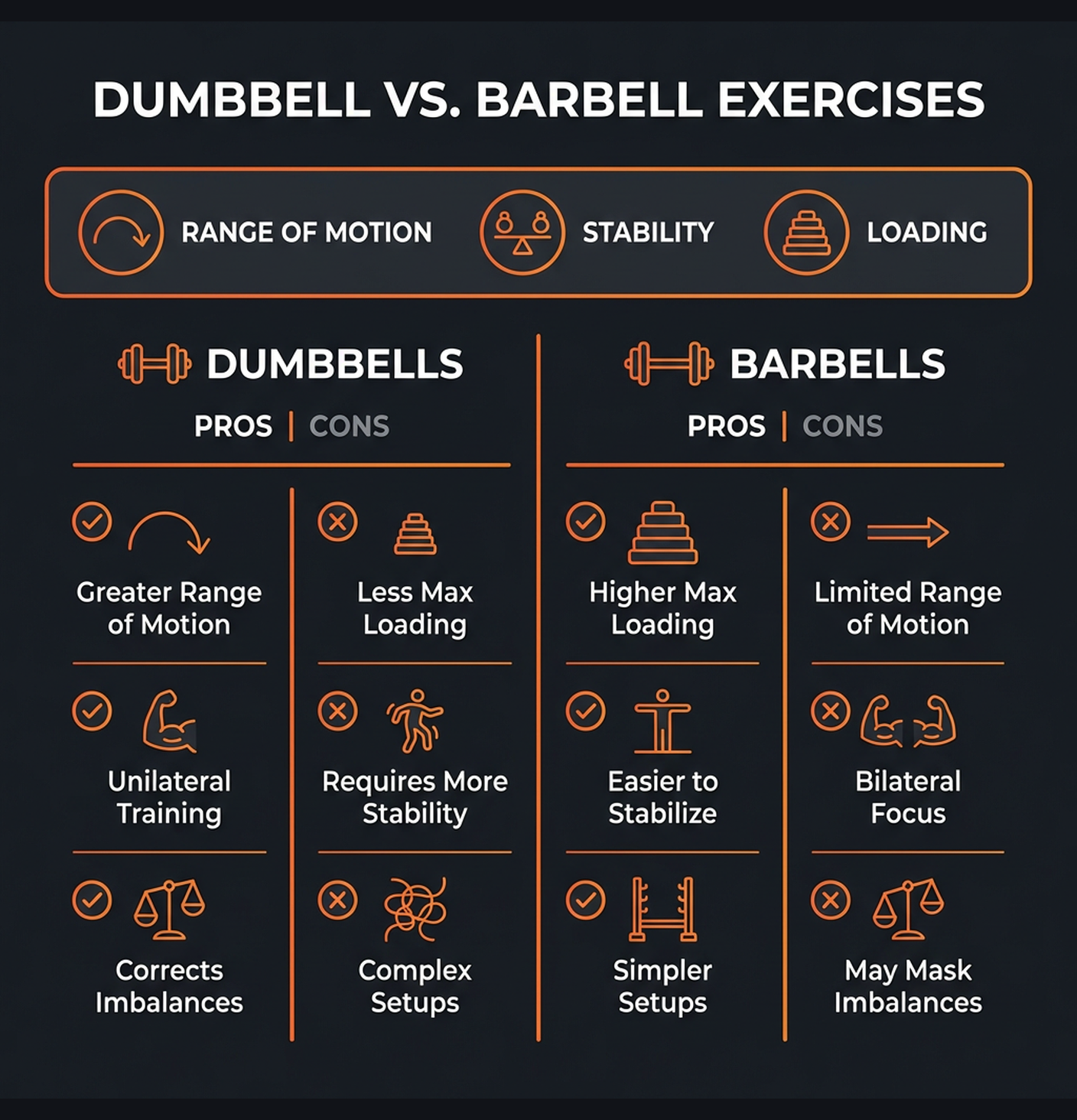
Barbells let you go heavier. Dumbbells give you more range of motion. Both build muscle, but knowing when to use each makes your training significantly more effective.
 Olivia·Dec 28, 2025·8 min read
Key Takeaways
- Barbells let you load heavier because both arms share the load, making them ideal for compound strength movements like squats, deadlifts, and presses.
- Dumbbells force each side to work independently, which exposes and corrects strength imbalances that barbells can mask.
- For chest and shoulder hypertrophy, dumbbells allow a greater range of motion at the bottom of presses, stretching the muscle under load for more growth stimulus.
- Use barbells for your main heavy lifts early in the session, then switch to dumbbells for accessory work where isolation and muscle connection matter more.
- If you only have access to dumbbells, you can still build a strong physique -- you just need to push closer to failure since the absolute load is lower.
Get This on WhatsApp
Get a quick summary and link sent straight to your WhatsApp.
Send Me This ArticleTwo Great Tools, Different Jobs
Walk into any gym and you will see people doing the same exercises two different ways. Bench press with a barbell. Bench press with dumbbells. Rows with a barbell. Rows with dumbbells. Curls, presses, lunges -- almost every exercise has both a barbell and dumbbell version.
So which one is better? Neither. But each has specific strengths that make it the better choice in specific situations. Understanding when to reach for the bar vs when to grab the dumbbells is the difference between a good program and a great one.
The Barbell Advantage
Barbells do a few things that dumbbells simply cannot match:
You can load more weight. A barbell bench press will always be heavier than a dumbbell bench press. Both hands work together on a fixed bar, and your stabilizer muscles have less work to do. The result is more total load on the target muscles. For pure strength development, this matters a lot.
Progression is more precise. Most gyms have fractional plates or at minimum 2.5 lb plates. That means you can add 5 lbs to a barbell lift. Dumbbells typically jump in 5 lb increments (per hand), so your smallest progression is 10 lbs total. That is a massive jump on pressing movements, especially for smaller or intermediate lifters.
Bilateral stability. Both arms work together on a fixed path. This allows you to push harder because you do not have to independently stabilize two separate weights. On compound movements where the goal is maximum force production, this is an advantage.
They are easier to spot. A training partner can help you through a sticking point on a barbell bench press much more easily than with dumbbells. Safety pins in a squat rack make solo heavy squatting safe. These safety features let you push closer to failure with less risk.
The Dumbbell Advantage
Dumbbells bring things to the table that barbells cannot:
Greater range of motion. On a barbell bench press, the bar stops when it touches your chest. On a dumbbell bench press, you can lower the weights past your chest line, getting a deeper stretch on the pecs. This extra range of motion at the stretched position is one of the most powerful drivers of muscle growth.
Unilateral loading. Each arm works independently. If your left side is weaker than your right (and it probably is), the barbell lets your strong side compensate. Dumbbells force each side to carry its own weight, which over time corrects strength imbalances.
More natural movement paths. A barbell locks your hands in a fixed position. Your joints have to accommodate the bar. Dumbbells let each arm move through its natural arc, which is often gentler on the shoulders, elbows, and wrists. If barbell pressing hurts your shoulders but dumbbell pressing feels fine, this is why.
Greater stabilizer activation. Controlling two independent weights through space requires more work from your stabilizer muscles. This builds coordination and joint stability that carries over to real-world strength and injury prevention.
More exercise variety. Some movements only work with dumbbells. Flyes, lateral raises, concentration curls, single-arm rows -- these exercises are either impossible or impractical with a barbell.
Exercise-by-Exercise Breakdown
Here is when to use each for the most common exercises:
Bench Press
| Factor | Barbell | Dumbbell |
|---|---|---|
| Max load | Higher | Lower (15-25% less) |
| Range of motion | Limited by bar touching chest | Deeper stretch possible |
| Joint friendliness | Can stress shoulders | Generally easier on shoulders |
| Best for | Strength, powerlifting | Hypertrophy, pec development |
Use barbell when you are training for strength, following a powerlifting program, or working in the 1-5 rep range. The barbell lets you load heavy and progress precisely.
Use dumbbells when you are training for chest growth, have shoulder issues with barbell pressing, or want to address left-right imbalances. The deeper stretch and independent arm work make dumbbell bench a superior hypertrophy tool for most people.
Rows
| Factor | Barbell | Dumbbell |
|---|---|---|
| Max load | Higher | Lower per arm, but unilateral |
| Back activation | Both sides simultaneously | Each side independently |
| Lower back demand | Higher (bent over position) | Lower (can brace with free hand) |
| Best for | Overall back thickness | Lat isolation, addressing imbalances |
Use barbell rows when you want to move heavy weight and build overall back mass. Pendlay rows, bent-over rows, and Yates rows all have their place.
Use dumbbell rows when you want to isolate each side of your back, reduce lower back fatigue (bracing on a bench with one hand), or get a longer range of motion by pulling past your torso.
Overhead Press
Use barbell for heavy overhead strength and if you want to compete in any strength sport. The barbell strict press and push press are foundational movements.
Use dumbbells if barbell pressing bothers your shoulders (very common), if you want a longer range of motion, or if you are training for shoulder hypertrophy. Many lifters find that dumbbell pressing lets them rotate their wrists to a more comfortable angle at the top.
Curls
This one is straightforward. Use both, but for different reasons. Barbell curls let you go heavier and train both arms together. EZ-bar curls are easier on the wrists. Dumbbell curls allow supination (rotating your wrist as you curl), which fully activates the bicep, and let you do concentration curls, hammer curls, and incline curls that are not possible with a barbell.
For bicep growth specifically, dumbbells generally win because of the variety of angles and the full supination.
Squats
This is the one exercise where barbells dominate and it is not close. You cannot hold dumbbells heavy enough to meaningfully challenge your legs the way a barbell on your back can. Goblet squats are great for beginners, but once you can goblet squat a 100 lb dumbbell for reps, you need to get under a bar.
Use barbell for back squats, front squats, and any serious lower body strength work.
Use dumbbells for goblet squats (beginners, warm-ups, mobility), Bulgarian split squats (excellent unilateral leg work), and lunges.
When to Prioritize Each
Prioritize barbells when:
- •You are training for strength and need to lift the heaviest loads possible
- •You are following a program built around the main lifts (5/3/1, Starting Strength, etc.)
- •You need precise loading increments for linear progression
- •You are in the early stages of training and learning basic movement patterns under load
- •You are peaking for a competition
Prioritize dumbbells when:
- •You are training for muscle growth and want maximum range of motion
- •You have joint pain that barbells aggravate
- •You have noticeable strength imbalances between sides
- •You are training at home with limited equipment (dumbbells are more versatile pound for pound)
- •You are recovering from injury and need more movement freedom
- •You want variety in your accessory work
Programming Both in a Single Session
The best approach for most lifters is not either/or -- it is both, in the right order.
A proven structure:
- •Start with a barbell compound lift (heavy, 3-5 sets, 3-8 reps). This is your main strength work. Squat, bench, deadlift, overhead press.
- •Follow with a dumbbell variation of a similar pattern (moderate, 3 sets, 8-12 reps). Dumbbell incline press after barbell flat bench. Dumbbell rows after barbell deadlifts. This adds hypertrophy volume with a different stimulus.
- •Finish with dumbbell isolation work (lighter, 2-3 sets, 10-15 reps). Lateral raises, flyes, curls, extensions. These are the finishing touches that target specific muscles.
This structure gives you the strength benefits of barbells and the hypertrophy benefits of dumbbells in a single session. It is how most well-designed bodybuilding and powerbuilding programs are structured, and it works at every experience level.
The Comparison Table
| Factor | Barbell | Dumbbell |
|---|---|---|
| Maximum load | Higher | Lower |
| Range of motion | Fixed | Greater |
| Progression increments | 5 lbs total | 10 lbs total (5 per hand) |
| Joint stress | Can be higher | Generally lower |
| Stabilizer demand | Lower | Higher |
| Imbalance correction | Poor | Excellent |
| Exercise variety | Limited | Extensive |
| Ease of spotting | Easy | Difficult |
| Best for strength | Yes | Supportive role |
| Best for hypertrophy | Good | Often superior |
The Bottom Line
Stop thinking about barbells vs dumbbells as a competition. Think about them as two different tools with different strengths. Barbells build maximum strength, allow precise progression, and are essential for compound lifts. Dumbbells build muscle through greater range of motion, fix imbalances, and are gentler on your joints.
Use both. Lead with barbells when strength is the goal. Lead with dumbbells when growth and joint health are the priority. And if you have to pick just one due to equipment limitations, dumbbells are the more versatile option -- you can build an impressive physique with nothing but a good set of adjustable dumbbells and a bench.
Frequently Asked Questions
- Are dumbbells or barbells better for building muscle?
- Neither is universally better. Barbells let you load heavier, which is important for progressive overload on big compound lifts. Dumbbells offer a larger range of motion and force each side to work independently, which is great for targeting weak points and getting a deeper stretch.
- Should I do dumbbell bench press instead of barbell?
- Ideally, do both. Barbell bench lets you push heavier weight and track progress easily. Dumbbell bench gives you a deeper stretch at the bottom, works your stabilizers harder, and helps fix left-right imbalances. Programming one as your main press and the other as an accessory works well.
- Why do I lift so much less with dumbbells?
- Each arm has to stabilize the weight independently, and you lose the mechanical advantage of having both hands locked to one bar. If you barbell bench 225, expect to use 80-85 pound dumbbells at most. This is completely normal and does not mean the exercise is less effective.
- When should I prioritize dumbbells over barbells?
- Use dumbbells when you have a noticeable size or strength imbalance between sides, when you want a deeper range of motion, or when a barbell variation causes joint pain. Dumbbell pressing is often easier on the shoulders because your wrists can rotate to a neutral position.
- Do I need both dumbbells and barbells in my program?
- You do not strictly need both, but using a mix gives you the best results. A practical approach is barbell for your heavy compound sets early in the workout, then dumbbells for your higher-rep accessory work later. This gets you the benefits of heavy loading and full range of motion.