Strategic Deload Week: Recovery Program
Train smarter, not just harder. A structured deload week to supercharge your next training block.
Send to WhatsApp
Overview
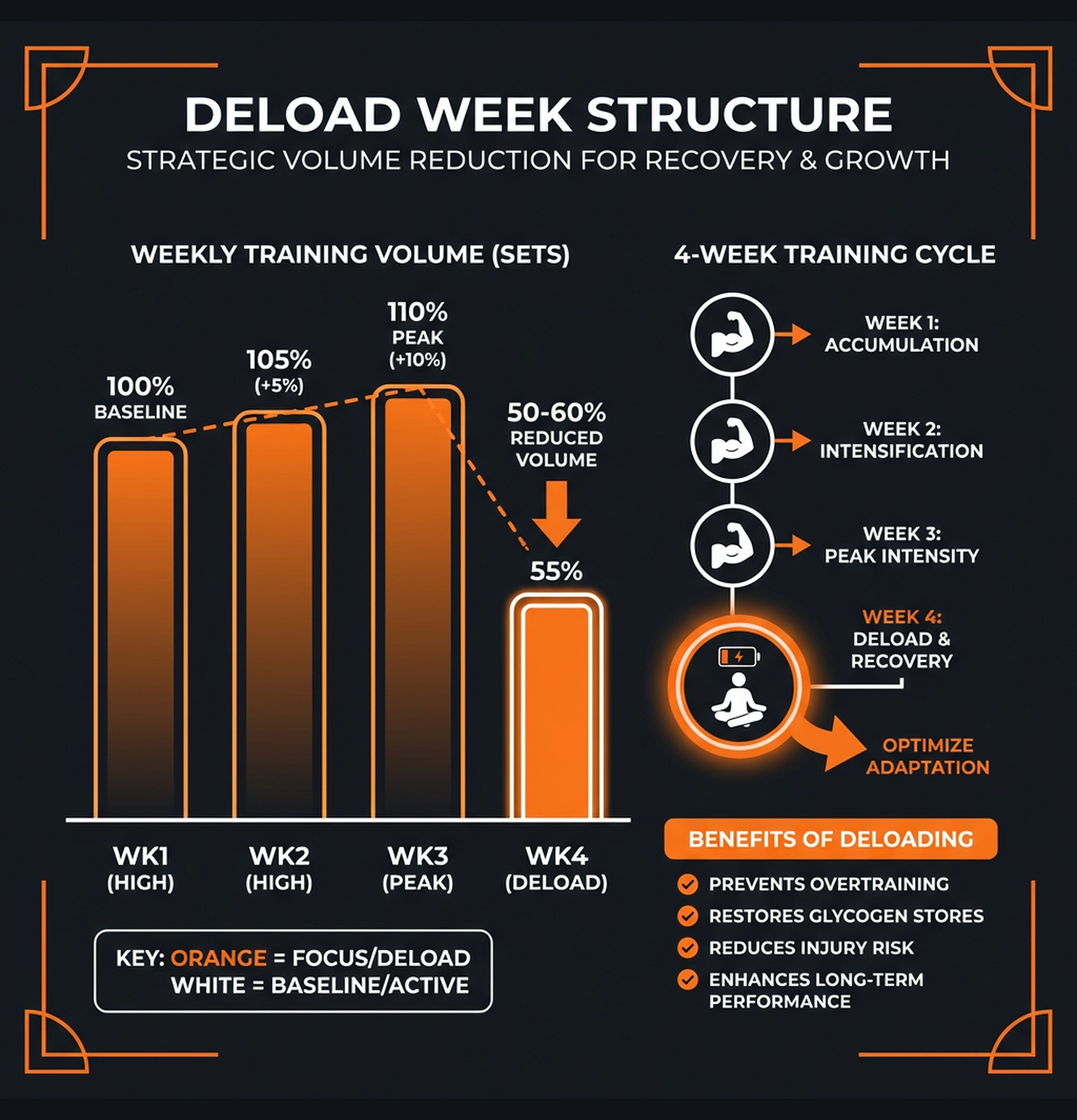
A deload is not a week off. It is a strategic reduction in training stress that allows your body to recover, adapt, and come back stronger. Most lifters either skip deloads entirely or turn them into rest weeks. Both approaches leave gains on the table.
This program gives you a structured 7-day deload that maintains movement quality while cutting volume and intensity enough to drive recovery. Use it after every 4-6 weeks of hard training, or whenever you notice accumulated fatigue — poor sleep, nagging joint pain, stalled lifts, or lack of motivation.
When to Deload
- •After 4-6 weeks of progressive overload
- •When your working weights feel 10-15% heavier than they should
- •When sleep quality drops despite good habits
- •When minor aches become persistent
- •Before peaking for a max attempt or competition
Day 1 — Light Full Body
Cut all working weights to 50% of your normal loads. Focus on perfect form and controlled movement.
- •Back Squat: 3x5 at 50% (60s rest)
- •Bench Press: 3x5 at 50% (60s rest)
- •Barbell Row: 3x5 at 50% (60s rest)
- •Overhead Press: 2x5 at 50% (60s rest)
- •Face Pulls: 2x15 (30s rest)
- •Band Pull-Apart: 2x20 (30s rest)
Total session time: 25-30 minutes.
Day 2 — Mobility and Active Recovery
No barbell work today. Move your body through full ranges of motion.
- •Foam Roll: Full body, 10 minutes
- •Hip 90/90 Stretch: 2x30s per side
- •World's Greatest Stretch: 2x5 per side
- •Cat-Cow: 2x10
- •Deep Squat Hold (bodyweight): 3x30s
- •Shoulder Dislocations (band or PVC): 2x15
- •Light Walk: 20-30 minutes
Day 3 — Technique Practice
Use 60% of normal loads. Perform every rep like it is being judged. Slow eccentrics, controlled pauses, perfect bar path.
- •Pause Back Squat (2s pause): 3x3 at 60% (90s rest)
- •Pause Bench Press (2s pause): 3x3 at 60% (90s rest)
- •Romanian Deadlift: 3x5 at 50% (60s rest)
- •Dumbbell Shoulder Press: 2x8 light (45s rest)
- •Pull-Ups (bodyweight): 2x5 (60s rest)
- •Plank: 2x30s (30s rest)
Total session time: 25-30 minutes.
Day 4 — Complete Rest
Do nothing gym-related. Walk, stretch if you feel like it, but do not touch a barbell. Sleep as much as possible.
Day 5 — Light Full Body
Same structure as Day 1 with slightly different exercises. Keep weights at 50%.
- •Front Squat: 3x5 at 50% (60s rest)
- •Dumbbell Bench Press: 3x8 light (60s rest)
- •Lat Pulldown: 3x8 light (60s rest)
- •Lateral Raises: 2x12 light (45s rest)
- •Leg Curl: 2x10 light (45s rest)
- •Ab Wheel Rollout: 2x8 (45s rest)
Total session time: 25-30 minutes.
Day 6 — Active Recovery
- •Light Cardio: 20-30 minutes (bike, walk, swim — keep heart rate under 130)
- •Foam Roll: Full body, 10 minutes
- •Static Stretching: Hamstrings, hip flexors, chest, lats — 30s each
Day 7 — Rest or Light Movement
Rest completely, or take a 30-minute walk. Prepare mentally for the next training block.
Deload Recovery Checklist
- •Sleep 8+ hours per night all week
- •Eat at maintenance calories (do not cut during a deload)
- •Keep protein at 1g per pound bodyweight
- •Hydrate aggressively — aim for clear urine
- •Avoid adding extra cardio to "make up" for lighter training. That defeats the purpose.
- •Reduce caffeine intake to let your natural energy return
- •Stretch or foam roll daily for 10-15 minutes
What to Expect After the Deload
The first session back should feel noticeably better. Weights that were grinding should move smoothly. Your joints should feel quieter. If you do not feel refreshed after a deload, you may need a full rest week or a training program adjustment.
Get a Free AI Coach on WhatsApp
Ask questions, get workout plans, and track your progress — all from WhatsApp.
Message Your CoachFrequently Asked Questions
- What should I know about overview?
- A deload is not a week off. It is a strategic reduction in training stress that allows your body to recover, adapt, and come back stronger. Most lifters either skip deloads entirely or turn them into rest weeks. Both approaches leave gains on the table.
- What should I know about day 1 — light full body?
- Cut all working weights to 50% of your normal loads. Focus on perfect form and controlled movement.
- What should I know about day 2 — mobility and active recovery?
- No barbell work today. Move your body through full ranges of motion.
- What should I know about day 3 — technique practice?
- Use 60% of normal loads. Perform every rep like it is being judged. Slow eccentrics, controlled pauses, perfect bar path.
- What should I know about day 4 — complete rest?
- Do nothing gym-related. Walk, stretch if you feel like it, but do not touch a barbell. Sleep as much as possible.