Active Recovery: What to Actually Do on Rest Days
Rest days do not mean lying on the couch for 24 hours. Light movement, mobility work, and smart nutrition on off days speed up recovery and keep you feeling good between sessions.
 Jess·Feb 14, 2026·8 min read
Key Takeaways
- Active recovery means light movement that increases blood flow without creating new fatigue -- think walking, swimming, or easy cycling.
- A 20-30 minute walk on rest days reduces muscle soreness more effectively than sitting on the couch all day.
- Foam rolling and light stretching on off days can reduce perceived soreness, but they do not speed up actual tissue repair.
- Rest days are when your muscles grow -- skipping them because you feel guilty is counterproductive and leads to overtraining.
- Sleep is the single most powerful recovery tool you have, and consistently getting 7-9 hours will do more than any supplement or gadget.
Get This on WhatsApp
Get a quick summary and link sent straight to your WhatsApp.
Send Me This ArticleWhat Active Recovery Actually Is
Active recovery is light, low-intensity movement performed on rest days to promote blood flow, reduce stiffness, and accelerate the recovery process without adding meaningful training stress.
The key word is light. Active recovery is not a bonus workout. It is not "just a quick session" that turns into 45 minutes of moderate lifting because the weights were calling your name. It is intentional low-level movement that helps your body recover faster than sitting still all day.
Why does light movement help recovery? Increased blood flow delivers nutrients (amino acids, glucose) to damaged muscle tissue and removes metabolic waste products. Gentle movement through full ranges of motion prevents the stiffness that accumulates when you go from intense training to total inactivity. And psychologically, doing something keeps you in the habit of daily physical activity without the stress of a real training session.
What active recovery is not: another lifting session, a "light" CrossFit WOD, a pickup basketball game, or anything that makes you sore. If you wake up the next day feeling like you trained, you went too hard on your "rest" day.
Walking: The Most Underrated Recovery Tool
If you do nothing else on your rest days, walk.
Walking for 20-40 minutes promotes blood flow throughout your entire body without adding any meaningful stress to your muscles or nervous system. It aids digestion, reduces cortisol, improves mood, and supports cardiovascular health. It is recovery for your body and your brain.
You do not need a destination. You do not need to track your steps obsessively (though 7,000-10,000 daily steps is a solid target). Just get outside, walk at a comfortable pace, and let your body move gently.
Walking after meals is especially effective. A 15-20 minute post-meal walk improves blood sugar regulation and digestion. On rest days when you are eating to recover, this is a free benefit.
Some lifters dismiss walking as "not real exercise." Good. That is exactly the point. Rest days are not for real exercise.
Light Mobility and Stretching
A 10-15 minute mobility routine on rest days keeps your joints healthy, improves your positions for the main lifts, and reduces the stiffness that makes you feel like a rusty hinge on Monday morning.
Here is a simple rest day mobility flow that covers the major areas:
Lower Body (5-7 Minutes)
- •90/90 hip stretch: Sit on the floor with one leg in front (knee bent 90 degrees) and one behind (knee bent 90 degrees). Lean your torso forward over the front leg. Hold 30-60 seconds per side.
- •Couch stretch or half-kneeling hip flexor stretch: Open up the hip flexors that get tight from sitting. Hold 45-60 seconds per side.
- •Deep squat hold: Sit in a deep bodyweight squat with feet shoulder width, holding onto a door frame or squat rack for balance. Just hang out for 60-90 seconds. Let gravity open your hips and ankles.
- •Standing hamstring stretch or RDL stretch: Hinge at the hips with a slight knee bend and reach toward the floor. Hold 30-45 seconds.
Upper Body (5-7 Minutes)
- •Doorway chest stretch: Stand in a doorway with your forearm on the frame at shoulder height. Step through gently until you feel a stretch in the chest and front of the shoulder. Hold 30-45 seconds per side.
- •Thread the needle (thoracic rotation): On all fours, reach one arm under your body and rotate your torso. Great for upper back mobility. 8-10 reps per side.
- •Band pull-aparts or light face pulls: 2 sets of 15-20 reps with a light band. Not for strength -- for blood flow and shoulder health.
- •Neck circles and shrugs: Gentle circles and light shrug-and-hold for the upper traps, which take a beating from heavy barbell work.
This entire routine takes about 12 minutes. Do it while watching TV, listening to a podcast, or right after your rest day walk.
Foam Rolling: What the Research Actually Says
Foam rolling is one of the most popular recovery tools in the gym. People roll everything -- quads, IT band, back, glutes, calves. But what does the research actually show?
What foam rolling does:
- •Temporarily increases range of motion (10-15 minutes of improvement after rolling)
- •Reduces perceived muscle soreness (DOMS) in some studies
- •Feels good and promotes relaxation
What foam rolling does not do:
- •Break up scar tissue or adhesions (your body weight on a foam tube is not generating enough force to remodel connective tissue)
- •Permanently increase flexibility (the range of motion gains are temporary)
- •Speed up actual muscle repair at the tissue level
The mechanism is likely neurological rather than mechanical. Foam rolling stimulates sensory receptors in the fascia and muscle, which reduces pain perception and muscle tone temporarily. Think of it like a self-massage -- it feels good and reduces tightness, but it is not physically restructuring your tissue.
Should you foam roll on rest days? If it feels good and reduces your stiffness, yes. Spend 5-10 minutes on the areas that feel tight. Do not spend 30 minutes grinding into your IT band until you are in tears. Moderate pressure, slow rolling, 30-60 seconds per area.
Nutrition on Rest Days
One of the biggest mistakes lifters make is eating significantly less on rest days. The logic seems sound: "I am not training, so I do not need as many calories."
But muscle repair happens on rest days. Protein synthesis, glycogen replenishment, and tissue remodeling are all active processes that require energy and nutrients. Cutting your food intake in half on rest days slows down the recovery your body is trying to do.
Protein: Keep it the same as training days. Your muscles are rebuilding, and they need amino acids to do it. Aim for the same 0.7-1.0 g per pound of body weight.
Carbohydrates: You can reduce these slightly since you are not burning through glycogen in a training session. But do not cut them drastically. Your body is replenishing muscle glycogen stores, and carbs support this process. Reduce by 20-30% at most.
Calories overall: Eat at or very near your normal intake. If you are in a caloric surplus for muscle gain, stay in it. If you are at maintenance, stay at maintenance. The only scenario where you might drop calories slightly on rest days is during a dedicated fat loss phase, and even then the reduction should be modest.
Hydration: Stay on top of it. Water intake should not change just because you are not sweating in the gym. Your body is still running repair processes that require adequate hydration.
Sleep: Where Recovery Actually Happens
If there is one thing you should prioritize on rest days more than anything else, it is sleep.
Growth hormone release, protein synthesis, nervous system recovery, and mental restoration all peak during deep sleep. A rest day with 5 hours of sleep is less effective for recovery than a training day with 8 hours of sleep.
Rest day sleep tips:
- •Aim for 7-9 hours. Use rest days to catch up if you have been short on sleep during the training week.
- •Naps are fine. A 20-30 minute nap on a rest day can boost recovery without interfering with nighttime sleep. Keep it under 30 minutes to avoid grogginess.
- •Keep your sleep schedule consistent. Do not stay up until 2 AM because you do not have to train tomorrow. Consistent bed and wake times lead to better sleep quality.
- •Avoid screens for 30-60 minutes before bed. Yes, you have heard this before. Do it anyway.
What NOT to Do on Rest Days
Adding "Bonus" Workouts
"I feel fine, so I will just do a quick chest session." This is how rest days become training days and how overtraining sneaks up on you. If your program says rest, rest. The adaptation happens during recovery, not during the workout itself. Adding extra sessions disrupts the training-recovery balance your program is designed around.
HIIT or Hard Conditioning
A 20-minute HIIT session on the assault bike is not active recovery. It is a workout. It demands recovery of its own. Save hard conditioning for training days or designated conditioning days that are part of your program.
Ignoring Pain or Tightness
Rest days are a good time to assess how your body feels without the adrenaline and focus of training masking issues. If your shoulder aches at rest, if your knee feels stiff after sitting, if your lower back is tight -- these are signals. Do not just push through and hope it goes away. Use your rest day to address these with targeted mobility, ice if something is inflamed, or a note to modify your training when you return.
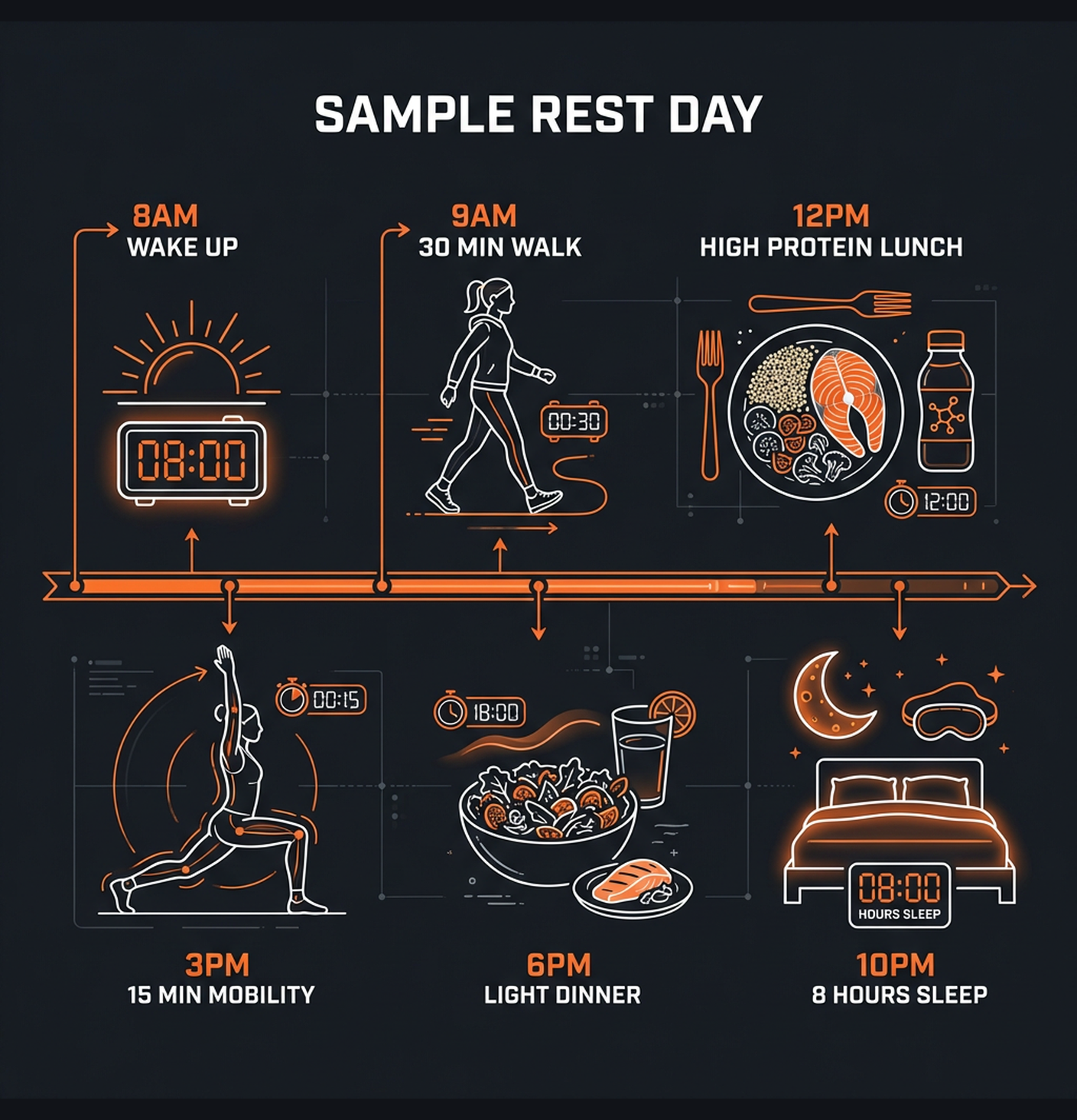
A Sample Rest Day Routine
Here is what a well-structured rest day looks like:
Morning:
- •Wake up at your normal time
- •Eat a normal breakfast with adequate protein
- •20-30 minute walk (outside if possible)
Midday:
- •Normal lunch with usual protein intake
- •10-15 minute mobility routine (the one outlined above)
Afternoon:
- •5-10 minutes of foam rolling on tight areas
- •Optional: 20-minute nap
Evening:
- •Normal dinner
- •15-20 minute walk after dinner (optional but beneficial)
- •Screens off 30-60 minutes before bed
- •7-9 hours of sleep
Total active time: about 45-60 minutes of very light movement. No equipment needed. No gym visit. No soreness the next day. Just smart, intentional recovery that has you feeling better when you walk into the gym tomorrow.
Rest days are not wasted days. They are where the results actually happen.
Frequently Asked Questions
- What should I do on rest days?
- Light walking for 20-30 minutes, some basic stretching or mobility work, and maybe foam rolling are the sweet spot. The goal is to move enough to promote blood flow without creating any meaningful fatigue. Save the intense yoga classes for another day.
- Should I eat less on rest days?
- If you are trying to build muscle, no. Your body is repairing and growing on rest days, and it needs fuel to do that. Keep protein at the same level as training days. You can drop carbs slightly if you want, but do not slash your calories dramatically.
- Is doing nothing on rest days actually okay?
- Yes, but light movement usually makes you feel better than being a couch potato all day. A short walk, some gentle stretching, or playing with your kids is enough. You do not need a structured active recovery protocol to benefit.
- How many rest days per week do I need?
- Most people do well with 2-3 rest days per week. Beginners often need more recovery and can train 3-4 days. Advanced lifters sometimes train 5-6 days but manage fatigue through smart programming. If your performance is declining week over week, you need more rest.
- Does sleep matter more than active recovery?
- Sleep matters far more than any active recovery technique. Seven to nine hours of quality sleep is the single most effective recovery tool you have. No amount of foam rolling or ice baths will compensate for consistently sleeping five hours a night.