Muscle Soreness vs Injury: How to Tell the Difference
That ache after leg day is probably DOMS. That sharp pain during a rep is probably not. Here is how to tell when you should push through and when you need to stop.
 Sam·Mar 8, 2026·8 min read
Key Takeaways
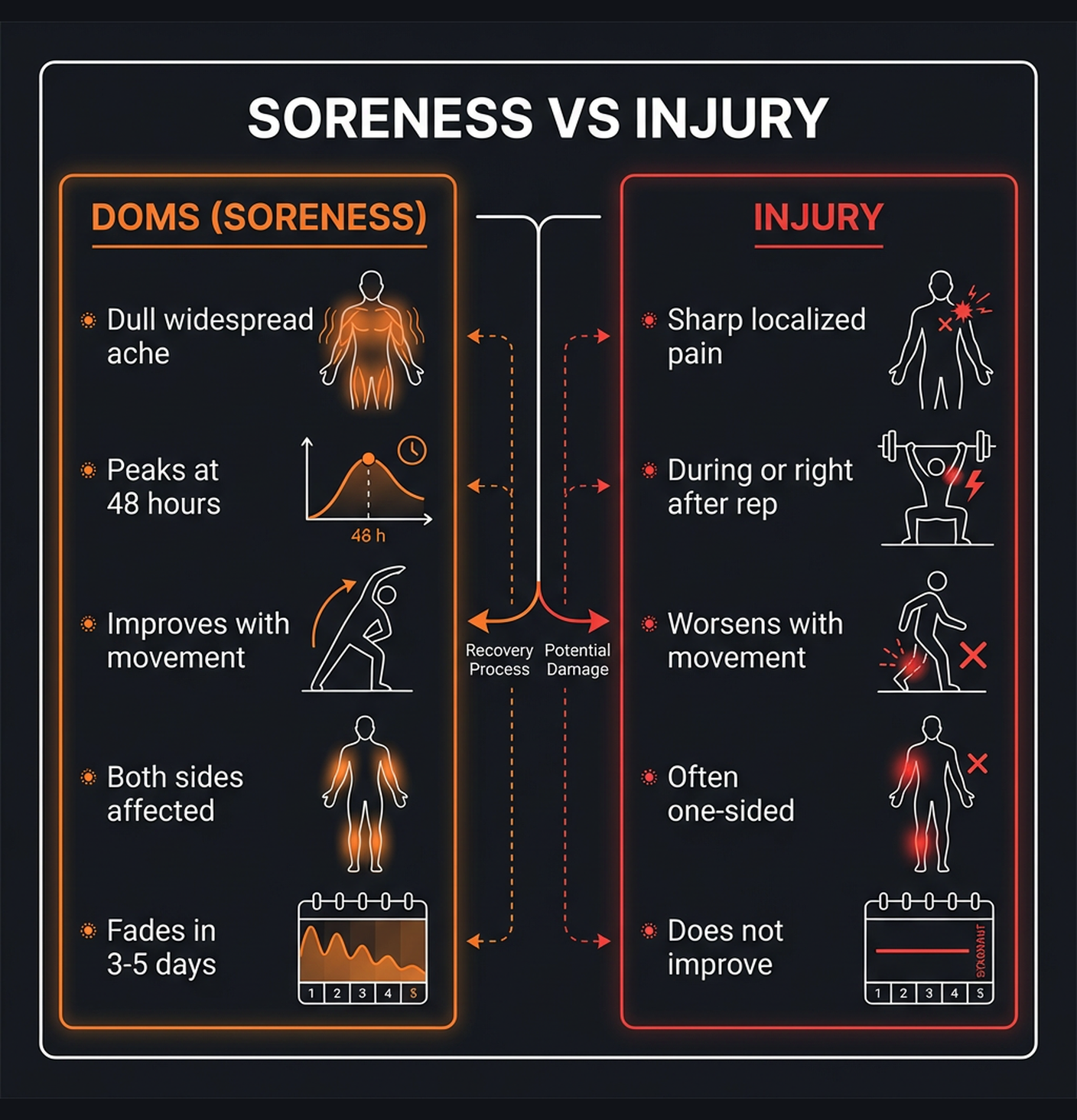
- DOMS is a dull, widespread ache that peaks at 48 hours and fades within 3-5 days. Injury is sharp, localized, and does not follow that timeline.
- Pain during a loaded rep that gets worse with each rep is a red flag -- stop the exercise immediately.
- Asymmetric pain (one knee hurts but not the other after squats) is not normal DOMS and needs attention.
- Tendinopathy (chronic tendon irritation) often improves during training but aches after -- do not completely rest it, modify the load instead.
- When in doubt, warm up and try the exercise at 50% weight. If pain disappears, it is likely stiffness. If it stays or worsens, stop.
Get This on WhatsApp
Get a quick summary and link sent straight to your WhatsApp.
Send Me This ArticleThe Difference in One Sentence
Soreness is a dull, diffuse ache that shows up 24-72 hours after training and fades on its own. Injury is a sharp, localized pain that happens during or immediately after a movement and does not improve within a week.
That is the simplified version. The reality is a spectrum, and the gray zone between "just sore" and "actually injured" is where most lifters make bad decisions -- either training through something they should rest, or sitting out for weeks over normal DOMS.
Understanding DOMS (Delayed Onset Muscle Soreness)
DOMS is the stiffness and tenderness you feel 24-72 hours after training a muscle, especially one that has not been trained recently or was trained with a new stimulus. It peaks around 48 hours post-workout and usually resolves within 3-5 days.
What Causes DOMS
The mechanism is microdamage to muscle fibers, particularly from eccentric (lowering) contractions. When you lower the bar during a squat, your quads are lengthening under load. This creates tiny tears in the muscle fibers that trigger an inflammatory response.
This is not the same as a muscle tear or strain. The damage is at the cellular level, it is a normal part of the adaptation process, and your body repairs it stronger than before. That is literally how muscles grow.
What DOMS Feels Like
- •Dull, widespread ache across the entire muscle belly (not a specific point)
- •Stiffness and reduced range of motion (your quads feel tight walking downstairs)
- •Tenderness when the muscle is pressed or stretched
- •Pain that is worst at 48 hours and then gradually improves
- •Movement makes it feel temporarily better (warm-up reduces symptoms)
- •Both sides affected roughly equally (if you trained both legs, both legs are sore)
When DOMS Is Worst
- •First 2-3 weeks of a new program (your body has not adapted yet)
- •After training a muscle you have not hit in weeks
- •After exercises with a large eccentric component (Romanian deadlifts, Nordic curls, slow negatives)
- •After significantly increasing volume or intensity
- •After trying a new exercise or movement pattern
DOMS is not a sign of a good workout. It is a sign of novelty. Experienced lifters who train consistently rarely get debilitating DOMS because their muscles have adapted to the stimulus. If you are constantly destroyed after every session, you are probably changing your routine too often or jumping too fast in volume.
Red Flags: Signs of Actual Injury
Sharp, Localized Pain
Injuries tend to produce a sharp, specific pain you can point to with one finger. "It hurts right here" is very different from "my whole quad is sore." If the pain is pinpoint and reproducible (it hurts every time you do that specific movement), that is a warning sign.
Pain During the Movement
DOMS hurts after training, not during. If you feel a sharp pain, pop, or sudden weakness during a rep, stop immediately. Pain that occurs during a loaded movement pattern -- especially if it gets worse with each rep -- is your body telling you something is wrong.
The exception: the first few reps of a session sometimes feel achy when you are still sore from a previous workout. If the discomfort fades as you warm up, that is residual DOMS. If it stays the same or gets worse as you continue, it is not.
Asymmetric Pain
You squatted heavy three days ago and both legs are sore. Normal. You squatted heavy three days ago and only your right knee hurts. Not normal. DOMS affects the muscles you trained, roughly symmetrically. Unilateral pain in a joint, tendon, or one side of a muscle group deserves attention.
Pain That Does Not Improve
DOMS has a predictable timeline: onset at 24 hours, peak at 48, improvement by 72, mostly gone by 96-120 hours. If you are still in significant pain after 5-7 days, it is probably not DOMS.
Swelling, Bruising, or Deformity
DOMS does not cause visible swelling, bruising, or any change in the appearance of the muscle or joint. If you see puffiness around a joint, a bruise that appeared without direct impact, or anything that looks different than the other side, get it checked.
Numbness, Tingling, or Radiating Pain
Soreness stays in the muscle. If pain radiates (shoots down your leg, travels up your arm), or you experience numbness or tingling, that suggests nerve involvement. This is especially relevant for lower back pain that radiates into your leg (potential disc issue) or shoulder pain that radiates down your arm.
The Gray Zone: Tendinopathy and Overuse
Not everything is a clear case of DOMS vs acute injury. The most common gray zone issue for lifters is tendinopathy -- chronic irritation of a tendon from repeated loading.
Common Sites
- •Patellar tendon (front of the knee, below the kneecap): from squats, lunges, and leg extensions
- •Elbow tendons (inside or outside of the elbow): from curls, pull-ups, and pressing
- •Rotator cuff (deep in the shoulder): from pressing, overhead work, and lateral raises
- •Achilles tendon (back of the ankle): from calf raises and running
What Tendinopathy Feels Like
- •Dull ache around a tendon (not the muscle belly) that shows up gradually over weeks
- •Worse at the start of a session, improves during training, then aches again after
- •Stiffness first thing in the morning that loosens up with movement
- •Does not respond to rest the way DOMS does -- it lingers for weeks
What to Do About It
Tendinopathy usually does not require complete rest. In fact, complete rest often makes it worse because tendons need loading stimulus to heal. The standard approach is:
- •Reduce the load that aggravates it (drop weight, modify the exercise)
- •Introduce slow, controlled eccentric work for the affected tendon
- •Maintain training volume for other body parts
- •Give it 4-8 weeks of modified training before expecting resolution
- •See a physiotherapist if it has not improved after 6-8 weeks
Decision Framework: Train, Modify, or Rest?
Here is a practical flowchart for when something hurts:
Train Normally
- •Dull, widespread muscle soreness 24-72 hours after training
- •Both sides affected equally
- •Pain improves with warm-up and movement
- •No joint involvement
- •Follows the normal DOMS timeline
Modify Your Training
- •Dull ache around a joint or tendon that has persisted more than a week
- •Pain during a specific exercise but not others
- •Discomfort that warms up but comes back after training
- •Mild asymmetric soreness without sharp pain
Modifications: reduce weight by 20-30%, avoid the specific movement that aggravates it, substitute a similar exercise that does not hurt, reduce range of motion if the painful part is at the end range.
Stop and Get It Checked
- •Sharp pain during a rep that does not go away
- •A pop, snap, or sudden loss of strength
- •Visible swelling or bruising without impact
- •Pain that has worsened progressively over 2+ weeks
- •Numbness, tingling, or radiating pain
- •Inability to bear weight or move through normal range of motion
How to Prevent the Common Stuff
Warm Up Properly
Five minutes of light cardio and dynamic stretching before lifting is not optional. Cold muscles, tendons, and joints are more susceptible to strain. A proper warm-up increases blood flow, raises tissue temperature, and primes your nervous system.
Progress Gradually
Most training injuries are overuse injuries from adding too much weight or volume too fast. The body adapts to training stress, but muscles adapt faster than tendons and ligaments. Give your connective tissue time to catch up.
General rule: increase total weekly volume by no more than 10% per week. If you squatted 3 sets of 8 at 225 this week, next week do 3 sets of 8 at 230-235, not 275.
Sleep and Eat
Under-recovered lifters get hurt more. Sleep deprivation reduces coordination, slows reaction time, and impairs tissue repair. Chronic caloric restriction weakens connective tissue. Protein deficiency slows recovery.
You cannot out-train bad recovery habits. If you are sleeping 5 hours a night and eating 1500 calories, your body does not have the raw materials to repair the damage you are inflicting.
Deload Regularly
A planned deload week every 4-6 weeks gives your tendons, ligaments, and joints a chance to catch up with your muscles. This is especially important for lifters over 30, whose connective tissue recovers more slowly.
The Bottom Line
Soreness is part of training. Injury is not. Learning to distinguish between the two is one of the most important skills you will develop as a lifter.
When in doubt, apply this test: warm up thoroughly and attempt the exercise with 50% of your normal working weight. If the pain disappears or significantly reduces, you are probably dealing with stiffness or residual DOMS. Train with reduced weight and build back up over the session.
If the pain stays the same or gets worse with any load, stop that exercise. Substitute something that does not hurt, and if the issue persists beyond a week, see a professional. Physical therapists who work with lifters are worth their weight in gold.
Your ego will heal faster than your rotator cuff. When something feels wrong, listen.
Frequently Asked Questions
- Is it normal to be sore after every workout?
- Soreness after new exercises or increased intensity is normal, especially in the first few weeks of a program. But if you are severely sore after every single session for months, you are probably doing too much volume or changing your routine too often. Consistent training with the same exercises reduces DOMS significantly.
- Should I train if I am still sore from the last workout?
- Usually yes. Light to moderate DOMS is not a reason to skip training. Warm up thoroughly and start with lighter weights. Movement and blood flow actually help reduce soreness. However, if the soreness is so severe you cannot perform the movements with proper form, take an extra rest day.
- When should I see a doctor for workout pain?
- See a professional if you experience sharp pain during a movement that does not go away, a pop or snap followed by sudden weakness, visible swelling or bruising, pain that has worsened over 2 or more weeks, or any numbness, tingling, or radiating pain. A sports-focused physical therapist is usually the best first step.
- How long does DOMS usually last?
- DOMS typically starts 24 hours after training, peaks at 48 hours, and resolves within 3-5 days. If significant pain persists beyond 5-7 days, it is likely not standard DOMS and may indicate an overuse issue or minor strain that needs attention.
- Does soreness mean the workout was effective?
- No. Soreness indicates novelty, not effectiveness. A muscle can grow without ever getting sore if the training stimulus is consistent and progressive. Chasing soreness by constantly changing exercises is actually counterproductive because it prevents you from tracking progressive overload.