How to Fix Rounded Shoulders With Strength Training
Rounded shoulders come from too much sitting and too much pressing without enough pulling. The fix is not a posture brace. It is targeted strength work that pulls your shoulders back where they belong.
 Jess·Jan 5, 2026·9 min read
Key Takeaways
- Rounded shoulders come from tight pecs and front delts combined with weak mid-back muscles -- you need to strengthen the back side, not just stretch the front.
- Face pulls, band pull-aparts, and reverse flyes done for 15-20 reps at the start of every session build the rear delts and rhomboids that pull your shoulders back.
- Rowing movements with a pause at full contraction teach your mid-back muscles to actually fire instead of letting your biceps do all the work.
- Stretch your pecs in a doorway for 30-60 seconds per side daily -- this is one case where stretching genuinely helps because the tissue is adaptively shortened.
- Fixing posture takes consistent effort over 8-12 weeks; there is no quick hack, but the shoulder pain and neck tension that disappear make it worth the patience.
Get This on WhatsApp
Get a quick summary and link sent straight to your WhatsApp.
Send Me This ArticleYour Shoulders Did Not Round Overnight
Nobody wakes up one morning with their shoulders suddenly caved forward. It happens gradually over months and years. Hours at a desk. Hours on your phone. Hours driving. Your body adapts to the position you spend the most time in, and for most people, that position involves hunching forward with your arms in front of you.
Add a gym routine that is heavy on bench press and light on rowing, and you accelerate the problem. Tight, overdeveloped pecs pull your shoulders forward. Weak, understretched upper back muscles cannot pull them back. The result is that classic rounded-shoulder posture that makes you look like you are permanently bracing for a punch.
The good news is that this is entirely fixable. Not with a posture brace (those things are crutches that weaken the muscles you need to strengthen). Not with a reminder to "stand up straight" (that lasts about 45 seconds). The fix is building the muscles that hold your shoulders in the right position so they stay there without you thinking about it.
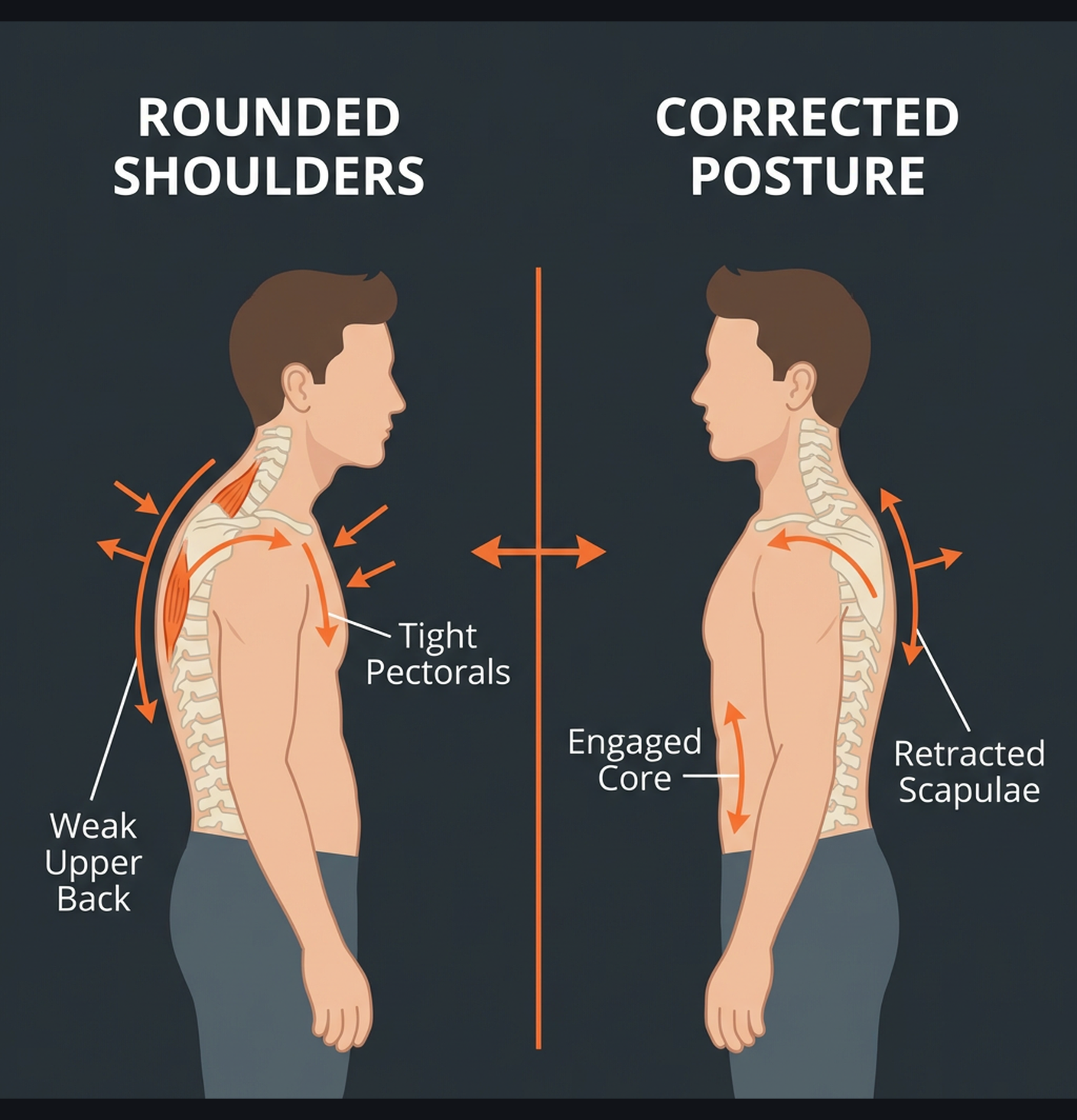
What Is Actually Happening: Upper Cross Syndrome
Physical therapists call this pattern "upper cross syndrome." Here is what it looks like in simple terms:
Tight and overactive:
- •Pectoralis major and minor (chest muscles)
- •Upper trapezius (top of your shoulders)
- •Levator scapulae (side of your neck)
- •Suboccipitals (base of your skull)
Weak and underactive:
- •Lower and middle trapezius (mid-back)
- •Rhomboids (between your shoulder blades)
- •Rear deltoids (back of your shoulders)
- •Deep neck flexors (front of your neck)
- •Serratus anterior (side of your ribs)
The tight muscles pull everything forward and up. The weak muscles cannot counteract that pull. Your head drifts forward, your shoulders roll in, your upper back rounds, and your chest caves. It looks bad, it feels worse, and over time it can lead to shoulder impingement, neck pain, headaches, and limited overhead mobility.
The fix has two parts: stretch what is tight, strengthen what is weak. Most people only do one of these. You need both.
Stretches That Actually Help
You do not need to spend 30 minutes stretching. Three targeted stretches, done consistently, make a significant difference.
Doorway Pec Stretch
Stand in a doorway with your forearm flat against the door frame, elbow at shoulder height. Step forward through the door until you feel a stretch across your chest and the front of your shoulder. Hold 30-45 seconds per side. Do this 2-3 times per day if you sit at a desk.
The key is to keep your ribs down and avoid arching your lower back to compensate. You want the stretch in your pec and front shoulder, not your lumbar spine.
Thoracic Extension Over a Foam Roller
Lie on a foam roller placed horizontally across your mid-back (around the bottom of your shoulder blades). Support your head with your hands. Let your upper back extend over the roller, opening your chest toward the ceiling. Hold for 5 seconds, roll up an inch, repeat. Work from mid-back to upper back, spending about 2 minutes total.
This mobilizes the thoracic spine, which stiffens from sitting. You cannot have good shoulder position if your thoracic spine is locked in flexion.
Chin Tucks
Sit or stand tall. Without tilting your head, pull your chin straight back as if you are trying to make a double chin. Hold for 5 seconds. Repeat 10 times. This activates the deep neck flexors and counteracts forward head posture.
It looks ridiculous. It works.
The Strength Exercises That Fix Rounded Shoulders
Stretching addresses the tight side. Now you need to build the weak side. These six exercises, done consistently, will pull your shoulders back into alignment.
1. Face Pulls
This is the single best exercise for fixing rounded shoulders. Period.
Set a cable machine to face height with a rope attachment. Grab the rope with an overhand grip and pull it toward your face, separating your hands as you pull so they finish beside your ears. Squeeze your shoulder blades together and externally rotate your shoulders at the end position. Slowly return to the start.
3 sets of 15-20 reps. Light weight, high reps, perfect form. Do these every training day as a warm-up or finisher.
2. Band Pull-Aparts
Hold a resistance band in front of you at shoulder height with straight arms. Pull the band apart by squeezing your shoulder blades together until the band touches your chest. Slowly return.
3 sets of 15-20 reps. These can be done anywhere -- at home, at the office, before training. They are one of the best daily-use exercises for shoulder health. Keep tension in the band throughout the movement.
3. Reverse Flyes
Use light dumbbells. Hinge forward at the hips until your torso is roughly parallel to the floor. Let the dumbbells hang straight down. Raise them out to the sides by squeezing your rear delts and mid-back, keeping a slight bend in your elbows. Lower slowly.
3 sets of 12-15 reps. Go light. If you are using more than 15-20 lbs, you are probably swinging and using momentum instead of isolating the rear delts.
4. Seated Cable Rows (With a Pause)
Use a cable row machine with a neutral grip (palms facing each other). Row the handle to your lower chest, then pause for 2 seconds at the fully contracted position while squeezing your shoulder blades together. Slowly release.
3 sets of 10-12 reps. The pause is what makes this a corrective exercise instead of just a back exercise. That 2-second squeeze trains the mid-back to hold the retracted position.
5. Prone Y Raises
Lie face-down on an incline bench set to about 30-45 degrees. Hold light dumbbells (5-10 lbs) or no weight at all. Raise your arms up and out to form a Y shape, thumbs pointing toward the ceiling. Squeeze at the top, lower slowly.
3 sets of 12-15 reps. This targets the lower traps, which are often extremely weak in people with rounded shoulders. You will be humbled by how hard this is with almost no weight.
6. Wall Slides
Stand with your back flat against a wall, feet about 6 inches out. Press your head, upper back, and arms against the wall. Place your arms in a "goalpost" position (elbows at 90 degrees, upper arms at shoulder height). Slide your arms up the wall overhead while keeping contact between your arms and the wall, then slide back down.
2 sets of 10 reps. If you cannot keep your arms against the wall throughout the full range, your shoulders are tighter than you think. Work within the range you can maintain wall contact.
Fix Your Push/Pull Ratio
This is the programming fix that addresses the root cause. Most lifters press more than they pull. Three bench press variations and one row is a recipe for shoulder problems.
The fix: pull at least twice as much as you push.
| Category | Weekly Volume Goal |
|---|---|
| Horizontal push (bench, push-ups) | X sets |
| Horizontal pull (rows, face pulls) | 2X sets |
| Vertical push (overhead press) | Y sets |
| Vertical pull (pull-ups, lat pulldowns) | 2Y sets |
If you bench press 4 sets twice per week (8 total pressing sets), you need at least 16 sets of rowing and pulling movements per week. That sounds like a lot, but it includes face pulls, band pull-aparts, rows, pull-ups, and lat pulldowns. Spread across 3-4 training days, it is very manageable.
This 2:1 ratio is not forever. Once your shoulders are back where they belong and the imbalance is corrected (usually 3-6 months), you can move closer to a 1.5:1 ratio for maintenance.
Daily Habits That Speed the Fix
Training is 3-5 hours per week. You spend the other 160+ hours either reinforcing the problem or supporting the fix.
- •Monitor setup. Your screen should be at eye level so you are not looking down. If you use a laptop, get a separate keyboard and a laptop stand.
- •Phone posture. Hold your phone up instead of looking down at your lap. This one change reduces enormous strain on your neck and upper back.
- •Driving position. Adjust your mirrors so you have to sit tall to see them. If you start slouching, you will notice because your mirrors are "off."
- •Desk breaks. Every 45-60 minutes, stand up, do 10 band pull-aparts or doorway pec stretches, and sit back down. This takes 30 seconds and prevents your muscles from locking into a hunched position.
- •Sleep position. If you sleep on your side, your top shoulder rolls forward all night. Place a pillow between your arms or try sleeping on your back occasionally.
How Long Does It Take to Fix?
Honest answer: 4-8 weeks to notice a difference, 3-6 months to fully correct, ongoing maintenance forever.
You did not develop rounded shoulders in a week, and you will not fix them in a week. But here is the typical timeline:
- •Week 1-2: The exercises feel awkward. Your mid-back gets sore in muscles you did not know you had. No visible change yet.
- •Week 3-4: You start to feel your shoulder blades "sitting" differently. Standing tall feels more natural and less forced. Other people might not notice yet, but you feel it.
- •Week 5-8: Visible improvement. Your shoulders sit further back. Your chest looks more open. Shirts fit differently. You catch yourself standing taller without thinking about it.
- •Month 3-6: The new position becomes your default. You only round forward when you are very tired or have been sitting for hours. Your back muscles are strong enough to hold the position automatically.
Sample Corrective Routine
Do this 3 times per week, either as a warm-up before your main training or as a standalone 15-minute session:
- •Doorway pec stretch: 2 x 30 seconds per side
- •Thoracic foam roller extension: 2 minutes
- •Band pull-aparts: 3 x 15
- •Face pulls: 3 x 15
- •Prone Y raises: 3 x 12
- •Wall slides: 2 x 10
Total time: 12-15 minutes. Pair this with the 2:1 pull-to-push ratio in your main training, and your shoulders will start pulling back within a month.
The Bottom Line
Rounded shoulders are not permanent. They are a muscle imbalance -- tight in the front, weak in the back -- made worse by modern life. The fix is not complicated: stretch your pecs, mobilize your thoracic spine, strengthen your mid-back and rear delts, and pull more than you push.
It takes consistency, not heroic effort. Fifteen minutes of corrective work three times a week, plus smarter programming, and your posture will improve faster than you expect. Your shoulders will thank you, your neck will thank you, and your bench press will probably get better too -- a stable, retracted shoulder position is actually a stronger pressing position.
Frequently Asked Questions
- What causes rounded shoulders in the first place?
- Sitting at a desk all day tightens your chest and front delts while your upper back muscles get weak and stretched out. Over time, this pulls your shoulders forward and down. The fix is strengthening the back side of your body and stretching the front.
- What exercises fix rounded shoulders the fastest?
- Face pulls, band pull-aparts, and rows with a focus on squeezing your shoulder blades together are the most effective. Do them frequently, ideally 3-4 times per week, with moderate weight and higher reps. It is about building endurance in your postural muscles, not maxing out.
- How should I adjust my push-pull ratio for better posture?
- Aim for a 2:1 pull-to-push ratio until your posture improves. If you bench press 3 times per week, you should be rowing or doing pull variations 6 times. This sounds like a lot, but many of those pulling sets can be light band work between pressing sets.
- How long does it take to fix rounded shoulders?
- Most people see noticeable improvement in 6-8 weeks with consistent effort. Your muscles adapt faster than your habits, though. If you fix your training but still sit hunched over a laptop for 10 hours a day, progress will be slow. Address both the gym work and your daily posture.
- Can stretching alone fix rounded shoulders?
- Stretching helps but is not enough on its own. Loosening your chest and front delts creates the mobility to get into a better position, but without strengthening your mid and upper back, you will just slouch right back. You need both flexibility and strength to make the change stick.