Romanian Deadlift vs Conventional: When to Use Each
The RDL and conventional deadlift look similar but train completely different things. Here is when to use each and how to program both.
 Jeff·Feb 10, 2026·11 min read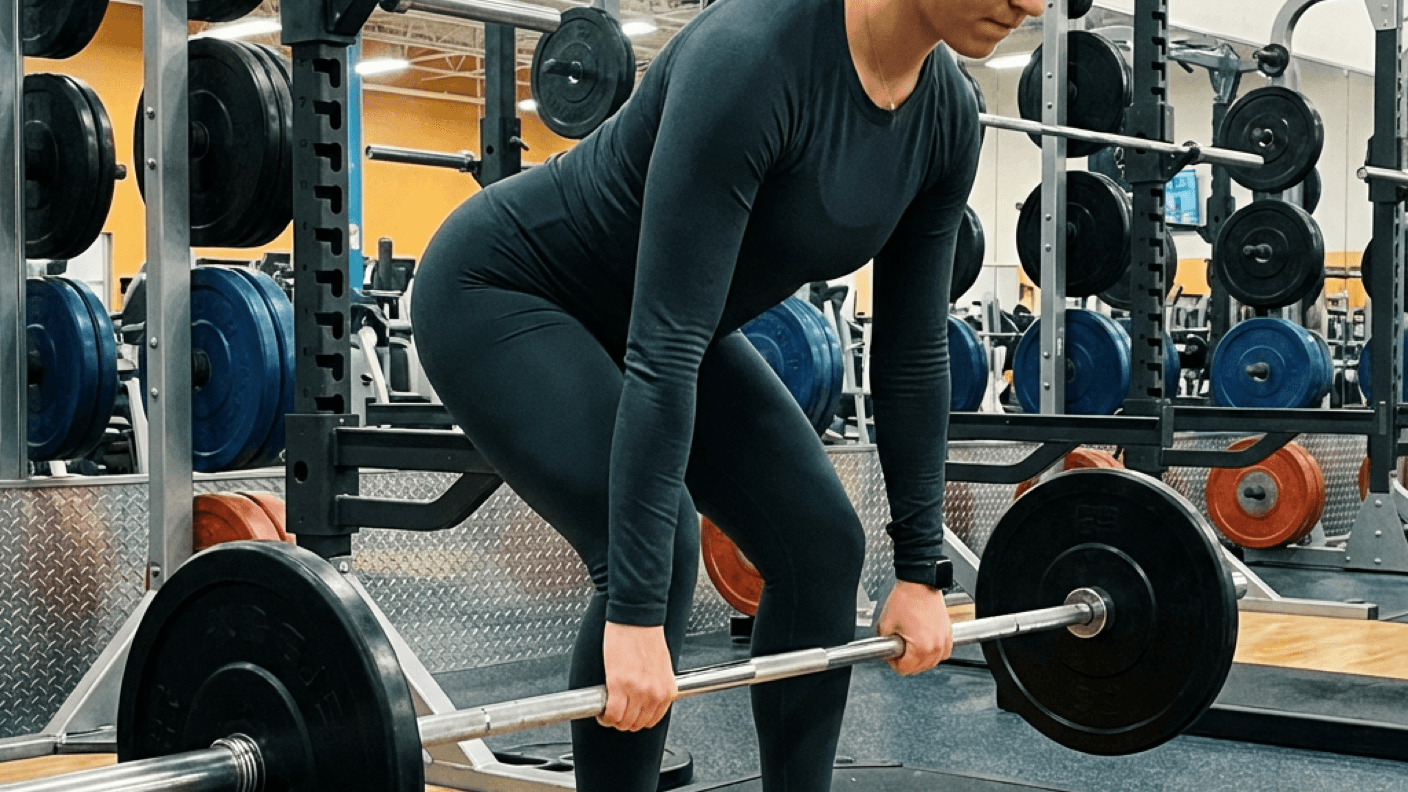
Key Takeaways
- Conventional deadlifts start from the floor and work your entire body while RDLs start from the top and mainly crush your hamstrings and glutes.
- The conventional deadlift is way more taxing on your nervous system because you're pulling from a dead stop and using everything from quads to grip strength.
- RDLs keep constant tension on your hamstrings and build muscle better because of that deep stretch at the bottom.
- Use conventional deadlifts when you want to get stronger overall and RDLs when you want to build your hamstrings and posterior chain.
- You can do both in the same week but put the conventional deadlift on your heavy day and RDLs as accessory work.
Get This on WhatsApp
Get a quick summary and link sent straight to your WhatsApp.
Send Me This ArticleThey are not the same exercise
I cannot tell you how many times someone has asked me, "should I do RDLs or deadlifts?" as if they are interchangeable. They are not. They look vaguely similar because both involve a barbell and a hip hinge, but the mechanics, the muscles targeted, and the purpose of each exercise are completely different.
The conventional deadlift is a pull from the floor. You start with a dead stop, break the weight off the ground, and stand up. It trains everything: quads, glutes, hamstrings, erectors, traps, grip, lats. It is the most systemically demanding exercise you can do in a gym.
The Romanian deadlift starts from the top. You hinge at the hips, lower the bar along your legs, feel a stretch in your hamstrings, and reverse the movement. It is a hamstring and glute exercise first, with everything else playing a supporting role.
Different start positions. Different prime movers. Different rep ranges. Different goals. Let me break down each one.
The conventional deadlift explained
The conventional deadlift is arguably the most primal exercise in the gym. You walk up to a barbell on the floor and pick it up. That is it. Humans have been picking heavy things off the ground since before we were technically humans.
What makes the conventional deadlift unique is that it starts from a dead stop (hence the name). There is no eccentric phase to build elastic energy before the concentric. You have to generate 100% of the force from a standstill. This makes it one of the truest tests of raw strength.
The movement involves significant knee extension in the bottom half (quad involvement) and hip extension throughout (glutes and hamstrings). The lower back works isometrically to keep your spine neutral. Your lats keep the bar close to your body. Your traps hold your shoulders in position. Your grip keeps the bar in your hands.
It is a full-body exercise in every sense of the word. And because of that, it is incredibly fatiguing. A heavy set of 5 on deadlifts will tax your nervous system in a way that almost no other exercise can match.
The Romanian deadlift explained
The RDL was popularized by Romanian Olympic weightlifter Nicu Vlad, who used it as an accessory to strengthen his clean and snatch pull. It was never meant to be a max-effort exercise. It was designed as a tool to build the hamstrings and glutes through a full stretch under load.
The key difference: the RDL starts from the top (standing with the bar in your hands) and you lower the bar by hinging at the hips while keeping your legs relatively straight. The bar stays close to your body, slides down your thighs and shins, and you reverse when you feel a deep stretch in your hamstrings (usually somewhere around mid-shin to just below the knee).
Because you start from the top and never touch the floor, there is constant tension on the hamstrings throughout the set. No dead stop, no reset, no rest at the bottom. This makes the RDL an absolutely brutal hamstring exercise. The stretch at the bottom creates what researchers call "stretch-mediated hypertrophy," and Maeo et al. (2022) showed that exercises loading a muscle in its lengthened position produce significantly more growth than those loading it in its shortened position.
Translation: the RDL is one of the best hamstring builders that exists precisely because of that deep stretch at the bottom.
Muscle activation differences
Here is where the two exercises really diverge:
| Muscle | Conventional deadlift | Romanian deadlift |
|---|---|---|
| Quads | High (especially off the floor) | Minimal |
| Hamstrings | Moderate | Very high |
| Glutes | High | High |
| Lower back (erectors) | Very high | Moderate to high |
| Upper back / traps | High | Moderate |
| Lats | High (keeping bar close) | Moderate |
| Grip | Very high | Moderate |
McAllister et al. (2014) compared muscle activation between the two lifts and found that the RDL produced significantly higher hamstring activation, while the conventional deadlift produced higher activation in the vastus lateralis (outer quad) and erector spinae. The glute activation was roughly similar between the two.
This makes intuitive sense when you look at the mechanics. In the conventional deadlift, you have to extend your knees and hips from a deep starting position. In the RDL, your knees barely bend, so the quads do almost nothing, and the entire movement is driven by hip extension with the hamstrings under stretch.
Form breakdown: conventional deadlift
Setup
- •Walk up to the bar. It should be over your mid-foot (about an inch from your shins).
- •Take your stance: feet hip-width apart, toes pointed slightly out.
- •Bend down and grab the bar just outside your legs. Double overhand grip to start, switch to mixed grip or hook grip when it gets heavy.
- •Drop your hips until your shins touch the bar. Do not move the bar. Bring your shins to the bar.
- •Squeeze your chest up to set your back. Think "proud chest." Your back should be flat or very slightly extended. Never rounded.
- •Take a big breath and brace hard.
The pull
- •Push the floor away with your legs. The initial break from the floor is primarily leg drive.
- •Once the bar passes your knees, drive your hips forward. Squeeze your glutes.
- •Stand up tall. Shoulders back, hips locked out.
- •Reverse the movement by pushing your hips back first, then bending your knees once the bar passes them.
- •Touch the floor, reset, repeat.
Key cue: "Push the floor away" is better than "pull the bar up." It keeps your chest up and prevents your hips from shooting up too fast.
Common conventional deadlift mistakes
- •Rounding the lower back. The most dangerous mistake. If you cannot keep a neutral spine, the weight is too heavy.
- •Hips shooting up. Your hips rise faster than your chest, turning it into a stiff-leg deadlift. This usually means your quads are weak or you did not set your hips low enough.
- •Bar drifting away from the body. The bar should drag up your shins and thighs. If it drifts forward even an inch, the lift gets exponentially harder. This is why deadlift shins get torn up. Wear long socks or shin guards.
- •Hitching. Resting the bar on your thighs and jerking it up in stages. This is a competition red light and a sign that you are grinding past your actual strength.
Form breakdown: Romanian deadlift
Setup
- •Take the bar out of a rack at hip height (do not deadlift it off the floor and then start your RDL set, that is wasted energy unless you want the practice).
- •Stand with feet hip-width apart, slight bend in the knees.
- •Grip the bar just outside your hips, double overhand. Use straps if your grip limits you. The RDL is a hamstring exercise, not a grip exercise.
The movement
- •Push your hips BACK. Not down. Back. Like you are trying to close a car door with your butt.
- •The bar slides down your thighs, staying in contact with your legs the entire time.
- •Keep the slight knee bend constant. Do not bend your knees more as you go down, and do not lock them straight.
- •Descend until you feel a strong stretch in your hamstrings. For most people this is somewhere around knee level to mid-shin. You do NOT need to touch the floor.
- •Reverse by driving your hips forward. Squeeze your glutes at the top.
Key cue: "Show your butt to the wall behind you" is the cue I use most often and it works almost every time. If you think about pushing your hips back rather than bending forward, the movement clicks.
Common mistakes on the RDL
Squatting the RDL. This is the most common mistake by far. People bend their knees too much, lowering their hips toward the floor instead of pushing them back. The RDL is a hip hinge, not a squat. Your knees should have a slight, fixed bend. That is it.
Going too deep. If you are touching the plates to the floor on an RDL, you are either incredibly flexible or your form has broken down. Go until you feel the hamstring stretch, then reverse. Chasing depth at the expense of hamstring tension defeats the purpose.
Rounding the back. Your back should be flat and neutral throughout. The moment your lower back rounds, the stress shifts from your hamstrings to your spinal structures. If your back rounds before you feel a hamstring stretch, you have tight hamstrings (most people do) and you need to respect your current range of motion while working to improve it.
Using too much weight. The RDL is not a max-effort exercise. It is a hypertrophy tool. If you are using so much weight that you cannot control the eccentric and feel the stretch, you are missing the point. Drop the weight 20-30% and focus on the muscle.
Not keeping the bar close. The bar should be in contact with your legs (or within an inch of them) throughout the entire movement. If the bar drifts forward, the lever arm increases, your lower back takes over, and your hamstrings get less stimulus. Lats engaged, bar on the legs.
When to use each one
Use the conventional deadlift when:
- •You want to build overall posterior chain strength
- •You are training for powerlifting or strength sports
- •You want a movement that hits everything from your grip to your traps to your glutes
- •You are working on maximal strength (1-5 rep range)
- •You want to test raw pulling power
Use the Romanian deadlift when:
- •You want to specifically target the hamstrings
- •You are training for muscle growth (hypertrophy)
- •You want to improve your hip hinge pattern
- •You have a hamstring-dominant weakness in your conventional deadlift
- •Your lower back is beat up and you need a less systemically fatiguing option
- •You are an athlete who needs strong hamstrings for sprinting, jumping, or sport performance
Here is the thing: you should probably be doing both. They complement each other perfectly. The conventional deadlift builds total-body pulling strength. The RDL builds the hamstrings and glute-ham tie-in that make you stronger off the floor on your conventional pull.
Programming both in the same week
Here is how I typically program these for someone on a 4-day upper/lower split:
Lower Day 1 (strength focus)
- •Conventional deadlift: 4x3-5 @ RPE 8-9
- •Squat variation (front squat or goblet): 3x6-8
- •Leg curl: 3x10-12
- •Calf raises: 3x12-15
Lower Day 2 (hypertrophy focus)
- •Squat: 3x6-10 @ RPE 8
- •Romanian deadlift: 3x8-12 @ RPE 8
- •Walking lunges: 3x10 per leg
- •Leg curl: 3x10-12
This way you get your heavy pulling on Day 1 and your hamstring hypertrophy work on Day 2. The RDL acts as an accessory to the deadlift, building the muscles that the deadlift demands.
A few more programming notes:
Rep ranges: Conventional deadlifts work best at lower reps (1-6) for most people. The form breakdown risk increases with fatigue, and sets of 10+ on conventional deadlifts are a special kind of hell that I do not think most people need. RDLs work best at moderate reps (6-12) where you can maintain tension and control.
Frequency: One heavy conventional deadlift session per week is enough for most people. It is incredibly taxing on the nervous system and lower back. You can do RDLs 1-2 times per week without issues because they are less systemically fatiguing.
Progression: Add weight to your conventional deadlift when you can hit all your sets at the prescribed RPE. Add weight to your RDLs when you can hit 12 reps with good form and a full stretch. If your RDL form breaks down, the weight is too heavy. Simple as that.
One last thing: if you are doing both in the same week, put at least 48-72 hours between them. Your lower back needs recovery time, and doing heavy deadlifts on Tuesday followed by RDLs on Wednesday is a recipe for a cranky lower back.
Frequently Asked Questions
- What is the difference between RDL and deadlift?
- The conventional deadlift starts from the floor and is a full-body pull. The Romanian deadlift starts from the top, does not touch the floor, and specifically targets the hamstrings and glutes through a hip hinge. Think of the RDL as a hamstring exercise and the conventional as a total body strength movement.
- Should I do both RDLs and conventional deadlifts?
- Ideally, yes. Conventional deadlifts build raw pulling strength and total body power. RDLs hammer the hamstrings with more time under tension. A common setup is heavy conventional deadlifts early in the week and lighter RDLs on a separate leg or posterior chain day.
- How low should I go on Romanian deadlifts?
- Go until you feel a strong stretch in your hamstrings, which is usually around mid-shin for most people. Do not try to touch the floor. The whole point of the RDL is maintaining tension on the hamstrings, and going too low rounds your back and kills that tension.
- Can RDLs replace conventional deadlifts?
- For hamstring and glute development, yes. For overall strength and posterior chain power, no. If you can only pick one, your goals matter. Want to be strong and powerful? Conventional. Want bigger hamstrings and glutes? RDLs will actually serve you better.